
Translated material
Kings and loans
On November 23, a great economist, one of the creators of the new institutional theory, the Nobel Prize laureate Douglas North, died in his house in the state of Michigan (USA).
Perhaps the study of economic institutions - rules that determine the interaction of subjects of the economy - contributes to longevity. Ronald Cowz, the 1991 Nobel laureate, lived 102 years. Douglas North, a 1993 laureate, died at the age of 95.
North was one of several great economists, for whom history was the main source of material for building “big theories” of economic development. All that North asserted about long -term development was based on his own analysis of microdata - for example, about the production of cotton in the United States.
One of the most famous works of North is the analysis of factors that determine the growth of ocean transportation in 1600-1850. It is clear that over two and a half centuries, the efficiency of transportation has grown many times due to technological progress, but what is “technological progress” in a particular case? North collected and analyzed the data, and the answer was partly unexpected: a decrease in piracy played a noticeably more important role than increasing the technical characteristics of the courts.
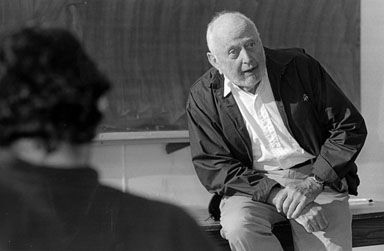
Douglas North (1920-2015) at a lecture at the University of Washington, St. Louis, Missouri, USA, 1993
Disassembleing individual episodes of American and European history - for example, comparing the speed of the development of individual industries - North deduced a “big theory”: property rights play the key role in economic development. The better they are protected, the more incentives for production have the subjects of the economy and the faster this economy is growing.
In the introductory course of the economy, which I read to students of the undergraduate, I usually talk about the famous article by Douglas North, written together with Barry Weingast "Constitution and connecting promises: the development of public administration institutions in England of the XVII century." Which king could get a loan, strong or weak? It turns out that before the glorious revolution of 1688, which deprived the English kings of many powers - to parliament, in particular, controlled control of the army - it was more difficult to get money. The weak king was ready to borrow the money at a lower percentage!
Douglas North showed: Property rights play a key role in economic development
Another important concept of North is “multiple equilibrium”, an explanation of “development traps”, when countries that are no different in fundamental characteristics (natural resources, climate, people) grow and develop differently. His “large theories”, which is thirty years ago (“institutes are created by those who have the opportunity to influence them” from “institutes ...”) that new ones (about “Society with Limited Access” and “Open Access Society”) became the basis of the modern political economy.
In 1990, we were widespread by the really outstanding book of North “Institutes, institutional changes and the functioning of the economy”, and it has become popular not only in itself, but also thanks to numerous transformations. Unfortunately, this has laid a strange tradition - an “institutional approach” is often associated with multi -layer abstract theories, and not with a painstaking study of huge empirical material. That is, something completely opposite to what North, Vogel, his “partner” in the 1993 Nobel Prize, and other “new institutionalists” did.
Photo: YouTube.com, Wustl/Joe Angeles