
Translated material
Paris instead of Kyoto
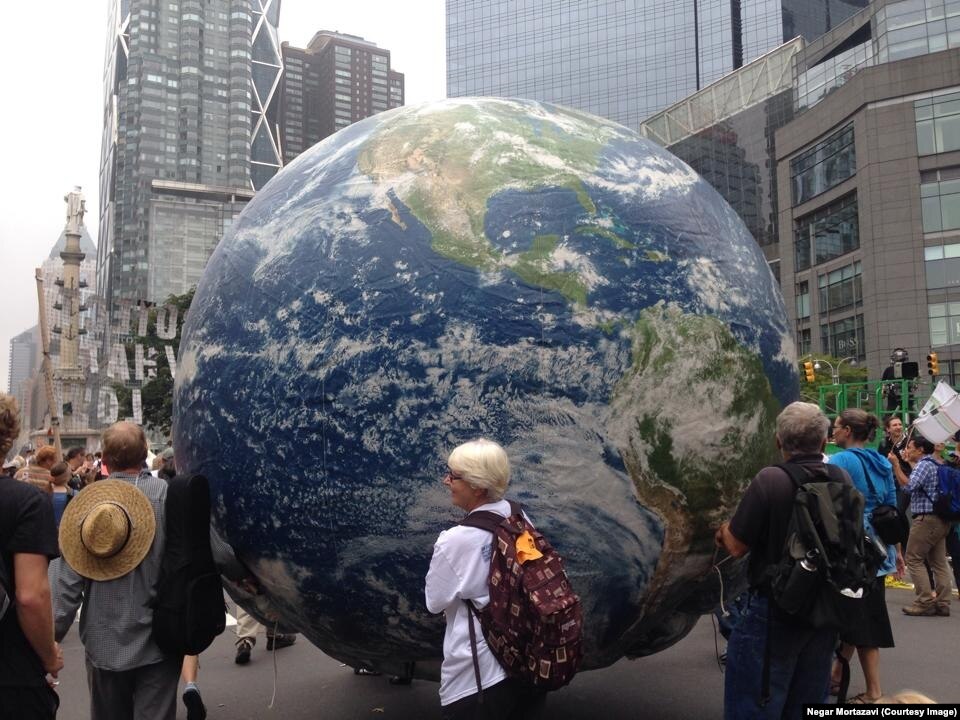
In Paris, a forum opens, at which the countries of the world will try to agree on how not to destroy humanity
On Sunday, the UN climate conference opens in Paris. The leaders of many countries will take part in her work, important international meetings will be held as part of the summit, which will discuss issues that have little to do with global warming. In particular, the meeting of Vladimir Putin with Benjamin Netanyahu has already been confirmed, Putin’s negotiations with Angel Merkel and Barack Obama are discussed, and the meeting of the Russian president with Turkish President Recep Tayyip Erdogan is not even excluded. Nevertheless, the topic of the Paris Forum is not a situation in Syria, but a much more global problem, which is all the more impossible without combining efforts.
Alexei Kokorin, the head of the Climate and Energy program of the International Wildlife Fund (WWF) in Russia, one of the authors of the Kyoto Protocol , which has been replaced by a new agreement, explained Radio Liberty, why the work of this summit means no less for human security than the fight against terrorism.
- Why is the climatic conference that opens in Paris on Monday is so important?
-Firstly, it is dedicated to the global question. It is impossible to solve the problem of climate change by any one country. Secondly, we will talk about long-term actions that are always difficult to plan. Thirdly, at this summit, the provision of very massive financial assistance will be discussed about a hundred weakest, vulnerable countries, first of all, assistance in adaptation to climate change, but also in reducing greenhouse gas emissions. There are very large amounts to stake: it is about the fact that climatic financing should be drawn up from 2020 from 2020, $ 100 billion annually. This is a lot.
- The Paris summit is the largest such forum since the adoption of the Kyoto Protocol?
- Yes. Something similar was conceived in Copenhagen in 2009, but that meeting was unsuccessful, it was not possible to accept the agreement, since it was not possible to agree on a version of a document that would be the same in legal status for all countries. And the division according to some signs, for example, into developing and developed countries, as they tried to do in Copenhagen, managed to become obsolete, it did not answer economic realities, and it is pointless to discuss financial issues in such a situation. Now Copenhagen lessons are taken into account, so I hope everything will be in order.
- When the Kyoto protocol was accepted, the world looked different, in particular, no one expected that countries like China and India would lead to the emission of greenhouse gases - they belonged to developing countries, which, as part of the agreement, had no particular obligations to reduce harmful emissions. Now the situation is completely different.
- Yes, completely different. When the Kyoto Protocol was written 20 years ago (it was adopted in 1997, but wrote it in 1995-1996), it was assumed that the main task was to reduce the developed countries, which accounted for 2/3 of the issue. In addition, there was a naive idea that it would be possible to reduce emissions so much that there would be a fairly natural adaptation, adaptation of agriculture, water systems, and healthcare systems. It was believed that a smooth natural adaptation will occur to climatic changes. Now it is clear that neither one nor the other nor the third is wrong.
- What were the main provisions of the Kyotsky Protocol? Which of this worked, but what - no?
We can expect that we will go, in any case, along the so -called path
3 degrees Celsius - this means that an increase in temperature by the end of the 21st century will be 3 degrees from the pre -industrial level
- As one of the authors of its writing at the draft level, I can say that we set three tasks. The first is just to promote the problem. The developers of the Kyoto Protocol wanted the very problem of anthropogenic impact on the climate and the corresponding economic consequences to be widely discussed at the global level, so that everyone realized its importance. It succeeded. I must say that even the United States’s non -participation in the Kyotsky protocol, the exit from Canada did not interfere with this, or maybe even attracted even more attention, and the climate science in the United States eventually received additional funding. The second task was to reduce emissions of developed countries so that they were on average in 2008-2012 by an average of 5% less than in 1990. This also succeeded, although not because the protocol was so successful, but because for other reasons, emissions in Russia, Ukraine, a number of Eastern European countries fell significantly and at the same time did not grow so much in the USA, Japan and the European Union. So for this task you can put a “plus”, although it was resolved not thanks to the protocol, but naturally. The third and last task is to test economic, market mechanisms that would reduce the emission of greenhouse gases with an economically profitable business.
Three such mechanisms were proposed, the first - interstate trade in quotas, that is, the rights to emissions in certain volumes, the second and third are design mechanisms operating at a more local level, for example, for individual enterprises. Kwot trade in the end failed, it was conducted in symbolic volumes. The fact is that those states that were supposed to become buyers of the quota were not very motivated for this, from their point of view they turned out to be buyers only because they did not agree well in Kyoto. In addition, in Eastern Europe there were unpleasant corruption stories associated with the sale of quotas, and this, in general, has even spoiled their image. Russia did not participate in this mechanism at all. But the project mechanism is a completely different matter. It works at the level of completely real projects, such as chemical enterprises, and is able to bring the real result, both economic and environmental. I would say that the experience was successful. There were about 100 such projects in Russia, in total around the world about 6-7 thousand, most of all in China, India and Brazil. However, there was also an unpleasant moment. Like any market tool, the mechanism of trading in design emission quotas was used primarily to make a profit. As a result, the largest projects in Russia were that a certain chemical substance was produced, in the process the emission of greenhouse gases was obtained, these emissions were captured. The more you produce the starting substance, the more emissions it turns out, the more you catch them and the more you can earn on quotas. But the trick is that no one needed this substance, it was essentially garbage. But this lesson is learned, and those design mechanisms that will be described in the new agreement will not be 100% market, such a scheme will no longer pass with them. In general, I repeat, the result of Kyoto can be considered successful, first of all, because the problem really managed to promote.
- What is the fundamental difference from the Kyoto protocol of the agreements that can be adopted as part of the Paris summit?
The agreement immediately provides massive financial assistance to weak countries in adaptation to already ongoing climatic changes, and this is vital to do it right now
- Differences are fundamental. Firstly, this time we will talk about the control of emissions in almost all countries. Of course, 100% will not work, but 80% of the countries for sure, while the Kyotsky protocol concerned only the emissions of conditional developed countries. But even more importantly, massive adaptation measures will include the agreement on which weak countries will receive financial support. The rest of the countries will adapt to their money, but quite coordinated. And the third component is finances. More than a hundred countries will receive a lot of money, and, of course, you need a system of very clear monitoring, verification of targeted use, and efficiency of using funds. Such a system is the basis of a new agreement, because finances without transparent reporting simply will not work.
- Who will become a donor of those 100 billion dollars that will spend annually on a climatic program?
- Three macodonors are the USA, or rather North America, the USA and Canada together, this is the European Union, and this is Japan. But it must be understood that $ 100 billion is not only state, but also private funds. So far, the proportion has not been determined, but most likely, about 2/3 of the budgets will be financed from the funds of private companies, and 1/3 - from the state budgets of the largest countries. Relatively small donors will also be China, Russia and some other countries. Small, of course, regarding their economies: China allocates 3 billion, we are 1 billion. And we have been talking about the budget since 2020, since 2025 it should be increased, probably to 120-150 billion annually.
- Agreements, obviously, have long been discussed at the level of working groups. Is there now an understanding, will they eventually be accepted? Are there any points for which it is not possible to agree?
- The discussion is at two levels. The upper level is political. What budget will be for 2025? How long will the main donors give? These things are solved at the level of senior management. That is why the presidents come not at the end, as usual, but at the beginning of the summit - and precisely for the sake of discussing these issues. As soon as, I hope, decisions of the macrofinance and ideological plan are made, then technical work on the text will go further. There are also a lot of details there, it will be very hard work, because in the document you need to register the actions of all countries in the document. The actions of the United States, China, Burkina-Faso, India should be spelled out simultaneously, but people in these countries live completely differently. We will have to find formulations that would take into account these differences, but at the same time would be equal in legal status. An agreement is 26 articles on 28 pages of a very clean text, there are a lot of contradictions, many problematic points.

- The compromise will be found, do you think?
- The compromise is quite possible. I do not want to predict whether it will be found, but the fact that it is possible is unconditionally.
- Now everyone, and politicians and voters, is much more concerned about security issues, terrorism. Will the abstract problems of climate change against this background seem less significant, is the motivation to work on their solution not reduced?
- Climate change is a long -term problem, and the agreement is fundamentally accepted for the long -term period. Perhaps the brains of politicians are now busy with completely different things, but they still cannot neglect the issue that is so important for the whole world, especially since we are talking about very big money. Well, the highest political link is going on the summit for only one day.
- What does a new agreement mean for humanity? What forecasts for warming is it connected with?
- If it is accepted, then we can expect that we will go, in any case, along the so -called path of 3 degrees Celsius, this means that an increase in temperature by the end of the 21st century will be 3 degrees from the pre -industrial level. In principle, we are already quite stable along this path, to warming at 3, and not by 4 or 4.5 degrees, which we could fear. The agreement will give us a mechanism to get closer to an even smaller figure - ideally to 2 degrees. I think that in the agreement it is precisely 2 degrees or slightly less as a goal. This is already very good, because the fears that we would go 4 degrees were serious. To make it clear what these degrees really mean: if we follow the path of 2 degrees, then by the middle of the century, about 300 million people will suffer from the lack of fresh water. If 3 degrees are already 3 billion people, that is, the difference of one degree is very, very significant. But if there are 4 degrees, then many areas of the globe can be almost unsuitable for living. There may be not very much relative to the total area of the globe, but these are densely populated areas in Asia, in Africa, a serious issue of migration and so on will arise. The fact that we rebuilt from the path of 4 degrees is already an achievement, and now we need to gradually approach 2, as far as possible. We must not forget that in the short term, the agreement immediately provides massive financial assistance to weak countries in adaptation to already occurring climatic changes, and this is vital to do now, ”said Radio Liberty, Moscow Ecologist Andrei Kokorin.