
Translated material
Who is in boots?
Today, December 3, another festival of German cinema begins in the St. Petersburg Aurora. Among other achievements of German cinema (for example, a very good directorial debut of Timm Kreger “Kingdom of Birds”) at the festival will show Rainer Werner Fassbinder and Doc Fassborder. RVF is an indispensable attribute of any cultural German program in the year of the 70th anniversary of the director. Ivan Chuvilyaev - about why Fassborder is not the past, but the real one.
The anniversaries, in principle, is nonsense - “an occasion to recall creativity”, which is used by those who remembers it and so. But not in the case of Fassbinder. Each of his retrospective, each exhibition of his archive literally allows “to open the author again”. Every ten years a new Fassbord is entering the arena. At first, in antediluvian times, there was a scandalist, gay, an author who died at the age of Pushkin, Byron and Rimbo. Then, to the last anniversary, they revised everything, and it turned out that Fassborder is not just a rock star in the cinema, but a damned poet. Now they open the new RVF. Relevant, today.
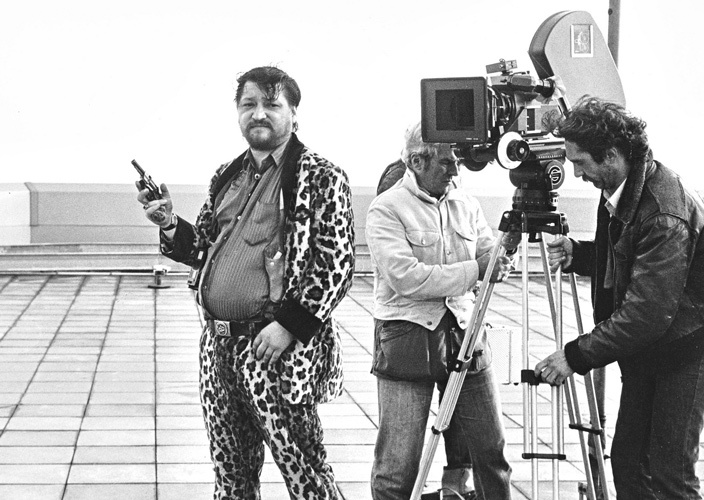
Talking about Fassbert often spin around cute and meaningless definitions. Punk. Damned poet. Brawler. Occasionally - well, this is the highest degree of acquaintance with the material - a workaholic. But beard, kosukha, boots obscure the work of the RVF. And every new “appeal to the creative heritage” this set of stamps will switch. Under the husk, the most important and relevant is exposed - still! - Director of Europe. Unfinished, strange, talking about hidden. Yes, even unusual - still! - language. Each retrospective makes Fassborder a contemporary of the viewer. Literally.
The culmination of celebrations on the occasion of the anniversary was the exhibition in Berlin Martin-Gropius-Bau, on which the director archive was put up. Opening the same kosukha, a slot machine bought for a fee for a “Berlin, Alexanderplatz” fee, and a bicycle named Siegfried. All this works for the image of an eccentric and original - nevertheless, this exhibition showed the world a new Fassbinder. In accordance with the name - Fassbinder Jetzt is today.
He did not write scripts, but slandered them on the recorder. Strange and wild experience: you put on headphones - and you listen to thirteen hours of the Berlin script. With shortness of breath, cough, household sounds, the murmur of beer from the bottle. Nothing actualizes as household sounds. Thus, the distant barking of the dog in the videos of the “conversations of Russian culture” Lotman or the gurgling of Vodara and the giggling of the students as the background to the author’s performance “Moscow -Petushkov” Erofeev bring closer to reality.
Stamps, although they remain, are something great. Gain a meaning. At the exhibition is a convincing evidence that the RVF was a workaholic: huge, in the entire wall, glued together by Vatman's sheets, on which is the schedule of the filming “Berlin, Alexanderplas”. 10:00 - one shooting, 11:40 - the other, 13:00 - nothing (there is just time to say on the voice recorder “Toski Fossi”), 13:40 - again “Berlin”, 14:20 - there are two hours of free, so you can remove the episode “Lily Marlene”. “The cinema was his life” - a battered, meaningless stamp (applicable at least to Anatoly Eiramjan, at least to anyone). But here he must be understood literally: it is completely incomprehensible when Fassbord managed to burn himself, sniff cocaine, show off in a jacket, give interviews, put performances. “It existed at the limit of human capabilities” is also a stamp, and in this case it must be understood literally.
But Fassborder is relevant - which means that now it is more important than not his oddity and punctuality. The historical prospect of his films only gives significance - the further, the more understandable it becomes how much he was ahead of his time, how the first he was.
First of all, the RVF was the first to speak with the images of the cinema about what they had been silent about before, which they did not know how to talk about today. About migrants and new Europe - in "fear eats the soul." About the "problems of the LGBT community"-in "In the year of thirteen Moon" and "Culaim's right of freedom." These are the most uncomfortable topics and plots, there is no tradition and conventions in them - and cannot exist. This is too sick to talk about him - but Fassbord only shot about what should not be removed. About Nazism, collaboration, occupation, gays, transgender, migrants, pigs-burgers.
The Fassbinder camera does not look into the world, does not cries reality, does not relieve death at work.
In “Fear eats the soul,” such Frau Burgher, performed by Brigitte, the worlds falling in love with a giant-migrant from Morocco, and her life flies to Tartarara. And not because of a conservative society-it is a colorful (literally black and white) couple in the end accepts. But it is easier to get from this, the common language between the pensioner and the migrant worker does not appear. Fassborder here as an actor left the most tidbit-the role of the main character’s son-in-law, a portrait of modern Europe, written by fat strokes: forever on sick leave, sucks beer (“Mom, where is the beer?” The character from Elena Zvyagintseva, the brother of the hero of the RVF), watches a foot-up, “entered here”.
Fassbord is really afraid of anything, his fearlessness scares. The heroine of “fear” every now and then remembers the Fuhrer in vain. "It was during the time of Hitler, do you know Hitler?" "Hitler loved to dinner in this restaurant, do you know Hitler?" And the Moroccan only murms in response: “Gi-and-and-hetler ... yes-ah ...” And continues, like the giant black slave of the white mistress, stomping behind her on the heels, repeating like an echo, every last word in her phrases.
Well, also about the courage of the director. Translating the language of “fear” into a verbal language today, to decipher the film - to go under the article for inciting the hatred of everyone to everyone. The cinema is still looking for what Fassbinder had the right of birth: the courage with which he went to new territories made it possible to talk about the newest, incomprehensible, strange, hidden. It’s scary to imagine what will happen if at some rally of the LGBT community to show “in the year of thirteen Moon”, what noise and din rise. This is not the Renoir beauties of "Adele's Life". The local Elvira-Erwin is not a sad handsome, taking hormones and looking for “his soul mate”, but an abundant Haria with tits, a drunken monster. The RVF sensed a tragedy in the topic - which he did more, it seems, no one after him. The hero is no longer Erwin and not Elvira yet, he has no name and identity. He is stuck between names, floors. He does not know the answer to the question of who he is. And this life does not turn his life into Romkom about the search for love, but into a catastrophe and horror.
An even greater innovator, an even more modern Fassborder - in the very language by which he speaks his uncomfortable stories. In the same “in the year of thirteen Moon”, at the very beginning, the RVF is coming to her older brothers, the new -wavelengths with the Italians. After the scene of the hysterical quarrel of Erwin Elvira, with its roommate, the camera breaks out of a cluttered apartment to a warm spring street, and here Fassborder does not restrain himself from thin trolling: gives an affectionate panorama, and even the background triggers Nino, so that no one has doubts about whom we are fighting. Against complacency, faith in human warmth, against field beauties and type of expressiveness. Against everything that is associated with the sweet copyright cinema of Europe.
Fassborder is a fundamentally anti -kinematographic, “evil twin” of masters of cinema. The director with theatrical experience, he always builds a frame as if the action takes place on the stage, and not in reality. The French wise men indulged with the words “realism”, “neorealism” - neither one nor the other exists for Fassbinder. The camera does not look into the world, does not grieval reality, does not relieve death at work. She flirts, indulges in, leads to her nose.
Fassborder clutches the space, builds the boundaries of the frame with objects: boxes, cabinets, ladders, banners with a swastika or American flags. The fact that others work against the film, against the formation of the image, gives the image false, in the RVF brings dramaturgy and nerve. The theatricality of space works to create an image of bright and expressive. It turns heroes into a kind of birds in a cage, from where they can’t escape, puppets locked in a box. In these cells and boxes, hysterical creatures are sitting - they are in convulsions, beat the dishes, sob, fuck, scream.
All this seems excessive, unnatural. The actor at Fassborder is always on the platoon, he always carries him. In the “Marriage of Maria Brown”, the disappeared husband of the heroine Hannanah Shigullah suddenly returns from the front, finds his wife with a black lover and rushes - just not to beat the face or drag an incorrect wife by the hair, but behind cigarettes. I really want to smoke. Actor Fassbinder balances somewhere on the verge of hyperbola, grotesque-and incredible accuracy of the gesture; Between Camp and expressionism. The irritating "anti -kinematographic" of Fassbinder over time turns into the urgent language out of bad taste and exaggeration. The image of figures locked in a cage on the screen is now being triggered as one of the most relevant, as if another video artist was moving forward Visual Culture .
It is impossible to get used to the RVF. He has no and cannot have students or successors of the case. Its topics, language and manner cannot be reproduced again. Its style cannot be copyed (and if you try, you will get the films of Mark Zakharov, television testercruses with sadomaso elements). He is always alone, without students and epigones. He set the upper bar for the most difficult: theatricality, work with hard and complex topics. An incomprehensible, incomprehensible, strange, hysterical Fassborder eventually becomes clearer and more understandable. The historical perspective gives his films not only understanding, but meaning, and therefore will be returned to him all the time. And more often than on the occasion of the next anniversary.