
Translated material
Flags for the elite
"Carnegies" on "Medusa". Andrey Kolesnikov - about why the presidential message is still needed
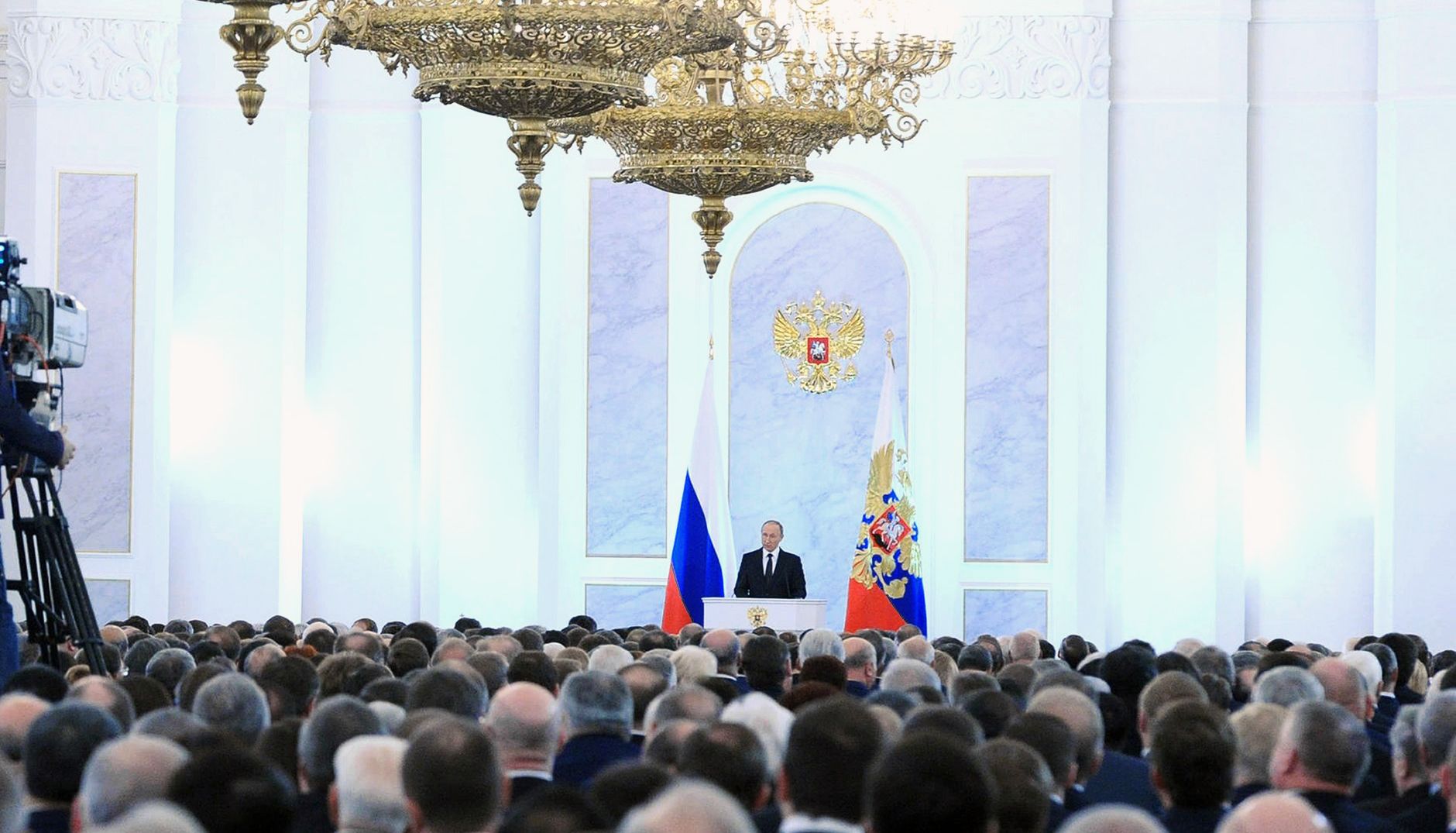
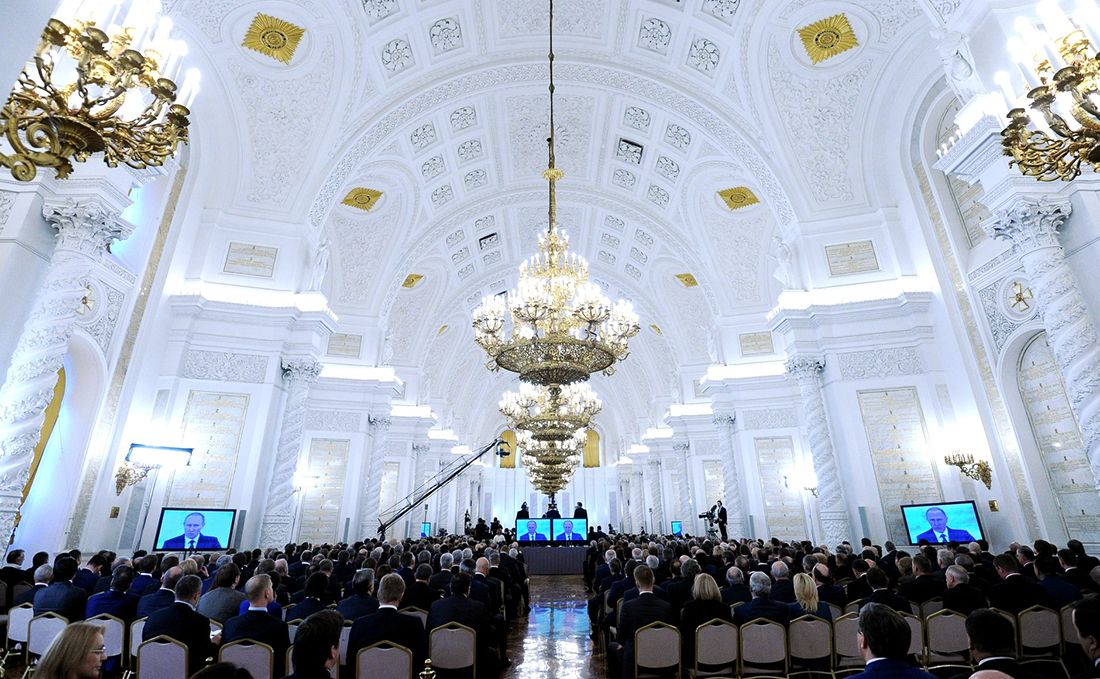
Medusa continues a joint project with the Moscow Center of Carnegie . In the next text, the journalist, head of the Russian Internal Policy and Political Institute of the Center, Andrei Kolesnikov, analyzes the message of the President of the Russian Federation Vladimir Putin, with whom he addressed the Federal Assembly on December 3. According to the number of new ideas, the presidential messages are approaching the speeches of the late Soviet Secretary Generals, but the genre still did not exhaust itself. There are no ideas, but it still plays its role in the demonstration of flags and signals for elites, and not without success.
Once, when the speaker of the Secretary General of the Central Committee of the CPSU, Alexander Bovin, in the presence of Brezhnev, read out a rhyme that described the hardships and deprivation of the life of the speaker. It was in the Brezhnev residence in Zavidov, where the speakers sat for weeks. These were the times when Leonid Ilyich himself worked with his advisers and personally invaded the content of the texts that he had to pronounce. The poem was this: “Behind the speech - a speech, / for the cottage - cottage, / behind the drink - drink. / And every day, / laughing and crying, / we meet, / as a terrible dream. " The Secretary did not like the poem.
Even in that comparatively dynamic era, with healthy Brezhnev, the speaker labor was distinguished by monotony and isolation from reality. Gennady Gerasimov, who then will become the head of the press center of the USSR Foreign Ministry, sediment from summer gatherings of party liberals, proposed to make texts as a designer-from ready-made blocks, changing them in places. The main thing that the speakers themselves complained about, especially during the years of more and deeper stagnation, is a shortage of ideas. Moreover, such ideas that could still undergo censorship and approval of the secretaries of the Central Committee and members of the Politburo.
For several years, the authors of the President’s Epistle have been experiencing the same shortage of ideas and especially ideas of “passable”.
Letter to the Turkish Sultan
There is nothing to surprise the people, and so every morning the TV and the computer work surprises for him: then citizens wake up in another country - literally - after the accession of new territories; then the power fights with food and exacerbates inflation, introducing counter -sanctions against Western countries and sanctions against Turkey; then the authorities are fighting imported medicines, resolutely refusing to maintain the health of the Russians entrusted to him. In the existing political frame, the main meaning of the existence of which is the preservation of the current leader and today's elites in power - no reforms are impossible, respectively, no one has been waiting for any breakthrough ideas and news from the President’s message.
All that remains is to talk about the banal (and briefly - the message is becoming shorter every year; in comparison with the previous one, for example, 12 minutes), confirming the well -known theses of the head of the Russian state for a long time. For example, that it is necessary to develop import substitution, and by 2020 to fully provide itself with domestic food (from which it can be concluded that the “besieged fortress” by that time will be outside world trade and global chains of creating added value). And to hit the imagination of the audience with populist statements, fixing Putin's image as a “cool guy” and oriented to laughter and applause or exclamations of indignation. For example, about the fact that "Allah decided to punish the ruling clique of Turkey, depriving her of reason and reason."
The message is 2015 and turned out to be a sort of epistolary of the Russian leader to all enemies of the Russian people, and even Allah was called to help. The announcement of the message was inscribed in the political technological structure of Putin-rescuer. It was beautiful: in the evening of the previous day, the Russian President launched the first place of the Energomost in the Crimea, and in the morning he had already made fun of the high Moscow rostrum over his foreign opponents.
Thanks to engineers and villagers
The announcement of the President’s message to the elites, connected by one chain of voluntary-compulsory patriotism, took place against the backdrop of the “permanent war”, which compensates the Russians welfare: Crimea, Donbass, Syria, terrorists, Turkey-this line of events replaces both the economic miracle and thoughts on the nature of the Russian political regime. Direct analogies between the anti -Hitler coalition and antijihadist, equating patriotic feelings to moral, promoting the idea of a preventive and fair (almost in accordance with the theses of Lenin about fair wars) war - all this standard mythology of mandatory victories over the enemies was present in the text of the president’s speech.
The message became a triumph of symbolic and mythological over material. And not only in the sense that Putin appealed to Allah and military-political victories. Or pathos thanked the engineers and workers of the defense-industrial complex, which ensured the technical basis of the operation in Syria (in the terms of the Great Patriotic War, these are “rear workers”). He also thanked the “villagers” who achieved that Russia had become an exporter of food (as if the Russian village had not died out, and farming had not degenerated).
He also distorted material reality, turning it into mythologically victorious: to attribute to maternal capital the role of the engine of increased birth rate in a situation where it is necessary to say that the birth rate increased, and soon it will decrease simply due to the features of the Russian age pyramid, the configuration of which was set up by the events of the 20th century-war and gulag-somehow strange. It is strange even from a propaganda point of view, because life will very soon begin to refute the president’s victorious relations: the beginning of the cancellation of the able -bodied population has already been laid out, and no one removed the problem of a collapsing pension system, inside which by 2030 one pensioner will have one employee.
The same with the labor market: Putin spoke of some high quality workplaces against the backdrop of a contracting work week and salaries of those workers who are formally occupied, and de facto have already become semi-craft. In addition, talking about high -tech work in the economy, focused on the abandonment of all Western, including components and technologies, is simply absurd.
Social-useful pocket
“We know, for example, who in Turkey stuffs his pocket and gives the terrorists to sell oil looted in Syria,” the president says. But we do not know, more precisely, we do not want to know who “stuffs the pocket” at the very top of the administrative-political pyramid of the Russian authorities. The day before the presidential appeal to the Federal Assembly to the question of what the presidential administration thinks about information about the alleged mafia businesses and the connections of the Prosecutor General of the Russian Federation Yuri Chaika and his relatives, the press secretary of the head of state Dmitry Peskov replied that now it was not up to that-everyone was occupied by the message. As if corruption in almost the nearby circle of the president did not matter to the nation and its legislators.
Translation of shooters is a banal and repeatedly used rhetorical technique. And against the background of the widely advertised adventures of the Turkish elite, the fun of the Russian elite flesh. And the General Prosecutor's Office itself was mentioned only once, except for the call for the prosecutor’s system as a whole to ensure the quality control of the investigation. And no matter how ridiculous, it is in the context of the fight against corruption: “Just the other day, the participants in the project of the All -Russian Popular Front“ For Honest Purchases ”told me about the facts of abuse, about frank violations. I ask the Prosecutor General’s Office, law enforcement agencies immediately respond to such information. ”
And, in Putin’s logic, it’s not the time to do this now: in the face of a common threat, the nation should unite and bear its share of responsibility for what is happening. And everything else, everything that is knocked out of the consolidation mainstream, will be declared extremism. The same - and with non -profit organizations. Who is not with us, he is against us. Who is not with us is a foreign agent. And whoever proves his loyalty-will receive a sign of distinction, the status of "non-profit organization-the contractor of socially useful services." The state should take care of political competition: “In this case, it is necessary to ensure unconditional public trust in the election results, their firm legitimacy.” What did Putin mean? The fact that any elections held on its territory are obviously honest?
Salary arguments that, “without changing anything, we simply eat our reserves, and the growth rate of the economy will fluctuate somewhere at the zero mark”, were immediately undermined by some kind of exhaust logic. Change - what? Your political distance from the world, turning around with economic isolationism? No, again, a half -nosed rhetoric, imposed on the economy: "Russia has no right to be vulnerable."
That is, in conditions of confrontation with the outside world, it should do everything or almost everything itself. Where will the technological update, new enterprises of small and medium -sized businesses come from? And how to achieve the required balance of the budget with large -scale defense and safety expenses, the so -called unproductive expenses, in contrast to spending on human capital, healthcare and education?
More questions than answers
“We have repeatedly faced a fundamental, fateful choice of a path of further development. And we passed the next such line in 2014, when the reunification of Crimea and Sevastopol with Russia took place. Russia in full voice declared itself as a strong independent state with a thousand -year history and great traditions, as a nation, which is consolidated by common values and common goals. ”
This statement is perhaps the most alarming conclusion to the message. Still, for part of the nation, even if it is 10-15% of the population, the selected vector of the country's movement is not a path of development, but the road to degradation, mental, political, economic, social. Are representatives of the “postcrymist minority” deprived of this phrase Putin of his right not to consolidate with the “Crimean majority”, while remaining citizens of Russia and being free (in the criminal law sense of the word)?
And what then, from a strategic point of view, from the standpoint of images of the desired future, this “fateful choice” consists of? The fact that, as in the logic of the pre -industrial and industrial era of the XIX -XX centuries, Russia thinks itself as a great power in terms of the protection of sovereignty, isolation, territorial expansion and restoration of 1991 fragments scattered?
The theme of “common values and common goals” remained stated, but unsolved, as if finally, the audience was once again talked about the weather in the bombing zone in Syria. Probably, these bombing, along with the accession of Crimea and the response of the Turkish Sultan - is not articulated, but poured in the air and intuitively felt by everyone a national consolidation idea.
The genre of the presidential message did not exhaust itself. Yes, there are no ideas, but it still plays its role in the demonstration of flags and signals for elites, and not without success. Moreover, due to a permanently mobilization state, Putin manages to revive this genre, turn it into a populist one. The background war with almost the entire Western world and part of the Eastern one is not a situation of the first and last period of Dmitry Medvedev, when it was, according to the idea, the truth, the then main political manipulator Vladislav Surkov, about the possibility of preparing a monotematic message about the support of motherhood and childhood. In today's situation, a much wider conversation is possible and the most peppy and arrogant statements.
But this is not the genre that was conceived by Article 84 of the Constitution of the Russian Federation, and not the way of talking to a leader with the people, who, as they say, was the first to come up with the then assistant to President Boris Yuri Baturin in 1993.
Because in the current form this is not a conversation with the people and its representatives in parliament. This is a publicly announced system of prohibitions and ideological boundaries within the regime of hybrid authoritarianism in Russian. Instructions for consolidation around the leader and inside his fortress, which now can only be besieged and no other.
Other texts of the Carnegie Moscow Center on the topic:
Why Putin for a while became Medvedev
Andrey Kolesnikov
Moscow Center of Carnegie