
Translated material
1965. Gading rally in Moscow
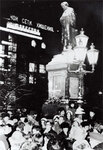
50 years ago, on December 5, 1965, on the Day of the Constitution of the USSR, a glace rally was held on Pushkinskaya Square in Moscow - the first public action of Soviet dissidents. It was organized by the mathematician Alexander Yesenin-Wolpin, physicist Valery Nikolsky, artist Yuri Titov and his wife Elena Stroyeva. It was also attended by Yuri Galanskov, Vladimir Bukovsky and about 200 students and writers.
The main slogan of the rally was "respect the Soviet Constitution." The audience demanded a vowel court over the writers arrested shortly before, Andrei Sinyavsky and Julius Daniel. The rally was dispersed by the KGB officers. 20 people were detained for two hours, but then released. Several participants were excluded from the institutions, but with respect to the majority they limited themselves to study at party and Komsomol meetings.
A few weeks before the rally, dozens of typewritten copies of leaflets with a "civil circulation" spread in humanitarian universities of the capital:
*"Several months ago, the KGB bodies arrested two citizens: writers A. Sinyavsky and Yu. Daniel. In this case, there is reason to fear a violation of the law on the publicity of legal proceedings. It is well known that any lawlessness is possible with closed doors, and that the violation of the law on publicity (Article 3 of the Code of Criminal Procedure and Article 18 of the Code of Criminal Procedure of the RSFSR) is already inaudicated. So that the work of writers can draw up a state crime.
In the past, the lawlessness of the authorities cost the lives and freedom to the millions of Soviet citizens. The bloody past calls us to vigilance in the present. It is easier to sacrifice peace in one day than for years to endure the consequences in time of an unstoppable arbitrariness.
Citizens have means of combating judicial arbitrariness, these are “publicity rallies”, during which the audience chants one single slogan: “Tre-bo-b-do-it is over ...” (follow the names of the accused), or show the appropriate poster. Any cries or slogans that go beyond the requirements of strict compliance with the rule of law are certainly harmful, and, possibly, provocative and must be suppressed by the rally participants themselves.
During the rally, it is necessary to strictly observe order. At the first request of the authorities, to disperse - you should disperse by telling the authorities about the purpose of the rally.
You are invited to a “publicity rally”, which is December 5. At 6 o’clock in the evening in the square on Pushkin Square at the monument to the poet.
Invite two more citizens through the text of this appeal. "*
From the memoirs of Alexander Yesenin-Volpin:
"Valery (V.D. Nikolsky, mathematician. - Ed.) Says:" Here the holiday will be December 5. " -" The Day of the Constitution? So God himself ordered this day to use! " They began to sort out the building of the prosecutor's office, the building of the Supreme Court - all in the mind, but, as it is on purpose, all these buildings are located so that they did not organize the large demonstration. He wrote posters from my words, and added from himself: "Respect the Soviet Constitution - the Basic Law of the USSR!" I would say, but there was no time to change it ... since Bukovsky was taken away, and on the eve of the rally, Julia Vishnevskaya was thrust into a psychiatric hospital, in the last minute the slogans were added about the liberation of Bukovsky and Vishnevskaya. Daniel! " - each of these slogans was at least, and maybe in triplicate, but no more ... "
From the book of Lyudmila Alekseeva " History of dissent in the USSR ":
"According to Bukovsky’s assessment (with the words of his friend who visited the demonstration), about 200 people came to the monument to Pushkin at the appointed time. But I was in the square and I think that there were much less demonstrators, but it was difficult to understand who was who was who. Behind her from the side.
Volpin and several people next to him launched small posters, but they quickly grabbed their trained hands, and even those standing nearby did not have time to read what was on the posters. Then it became known that the inscriptions read: “We demand the publicity of the trial of Sinyavsky and Daniel!” And "Respect the Soviet Constitution!"
The person was detained 20. They were pushed into cars. The scene was clearly visible due to outbreaks of cameras of Western correspondents, they learned about the demonstration and came to look at the sight so unusual in the Soviet capital.
The detainees were released after a few hours. Most of these were students. All of them and noticed in the square that evening were excluded from the institutes - about 40 people.
The trial of Sinyavsky and Daniel was declared open - perhaps because of publicizing abroad and this demonstration had to be done by this. True, the openness of the court was peculiar: the entrance to the court building was guarded by police officers, only people selected by the Kagabists were passed inside, according to special passes. Since then, “open” courts for political reasons with rare exceptions are the same. Of the people close to the defendants, only wives gained access to the hall. "