
Translated material
"If these rallies are included in the tradition ... The number of arrests will decrease"
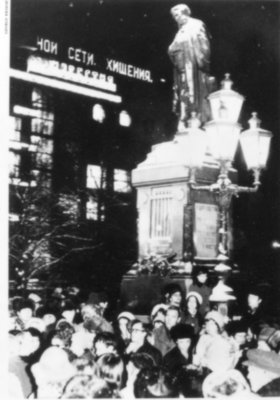
On the 50th anniversary of the first human rights rally in the USSR-the “rally of publicity”-the OVD-info publishes an article by Alexander Yesenin-Volpin, dedicated to the problem of freedom of assembly in the USSR. The text was written in late October - early November 1965 and was later reduced to one page, which was distributed before December 5, 1965, when a rally dedicated to the case of Andrei Sinyavsky and Julia Daniel was held on Pushkinskaya Square. The text is stored in the Yesenin-Volpin Foundation in the archive of the International Memorial.
Civil appeal
In September, the KGB bodies were arrested in Moscow and Kyiv. Among the arrested are the Moscow writer A. D. Sinyavsky [1] , the Kiev critic Svetlichny [2] and others. The arrested is threatened by a conviction issued in a closed court. In the best case, it will be proclaimed, as required by the law, publicly - but since it will not be published, and the public will not be present at meetings, citizens will be deprived of the opportunity to judge its legality. There is no reason to believe that any of the accused is connected with the state secret-what could be the legal justification of the meetings during closed doors. Therefore, there is reason to fear violations of the rule of law, especially since in the past such cases have been frequent.
There is no need to dwell in detail on the well -known tragedy of the past, which consisted in mass lawlessness. We note the other: these lawlessness, which can be made “with convenience” only with closed doors, because only through publicity can cases of an improper interpretation of the law or the doubtfulness of the evidence adopted by the court.
The publicity of the proceedings is the most important guarantee of legality. Nevertheless, it does not apply to the law of the rights of the accused himself. This means that all citizens have the same right to her as observing the Soviet Constitution.
Citizens have a legal means to achieve publicity, which, unfortunately, has not yet been used. This tool consists in organizing rallies for each case of a trial or threatening violation of the vowel of the trial. This tool should be used steadily, and especially persistently in those cases when someone threatens repression for participating in such a rally or its preparation. If this tool were widely used by citizens during the times of passing repressions - mass repressions, in all likelihood, would have been prevented.
Gathering for a rally organized in defense of publicity, should, in order to effective and in order to avoid provocations, strictly limit their requirements with the requirement of publicity. “Tre-Bo-to-Ho-Sobe Su-da” (with the possible addition of the names of the accused) is the only slogan that they should chant or portray on posters. (In the event that the rally is organized on the occasion of the already held violation of publicity, the word “demand” should, of course, be replaced by “protest against violations.”) Even a tacit -assembly crowd, which makes the impression of a joint public, will achieve a lot if the violators of the legality will know the reason for the meeting. Whether to be silent to the audience, or to discuss the problems of publicity and legality in general is a matter of a form of a rally, the solution of which should be provided to the organizers in each case. But in any case, one should strictly avoid playful or too emotional shouts that can distort the goal of the rally and turn it into an erratic collection. All anti -Soviet speeches, as well as speeches directed against individual ruling persons, can only interfere with the goals of the rally, even if they do not entail repressions against speakers. Such speeches would interfere with the following such a rally (and they should be organized, as already mentioned, in each case threatening or committed violation of publicity) and people prone to such speeches should be carefully avoided when organizing a rally, since they can ruin the whole thing. If such speeches or shouts nevertheless occur, they must be stupid together, treating them as provocateurs and removing them from the place of meeting - if possible, avoiding gross violence, as it can serve as a pretext for the intervention of the police. It is necessary to strictly observe the order in other relationships - do not occupy any room or roadway without permission, gathering on the boulevards - to leave a narrow passage for outsiders, and do not stand on the lawns, etc. The requirements of the proper authorities to disperse calmly: ask only for the purpose of the rally to be fixed and dispersed, considering the purpose of this rally already achieved by the fact that the authorities of the authorities are already achieved that the authorities They paid attention to him.
It is impossible to evaluate the results of the rally by such obvious signs as satisfying the requirements of publicity, etc. Most likely, in the publicity of violators of the legality you can’t reach with only rallies, and this tool should be combined with other legal means - through numerous articles, massive petitions, etc. You can discuss these funds at the rally (if it is not announced that it will be strictly silent), or immediately after it), or immediately after it), or immediately after it), or immediately after it), or immediately after it). And in these discussions, in the very activation and expansion of the part of the population that is able to advocate for publicity, one of the most important tasks of each rally is. If these rallies enter the tradition, then, at least it was not possible to immediately achieve publicity in strict accordance with the law, the number of arrests will decrease - and this will be the main positive role of such rallies. True, violators of the legality can bring down their repressions just against the organizers and participants of these rallies-and if the audience gives himself in this way, it is better not to get together (all the more so since any failure of a single rally can worsen the fate of that accused, whose work was caused by this rally). But if, in response to repression against the participants or organizers of these “rallies of publicity” (as I propose to call them - although some of them may be silent) will follow new rallies, and even deployed with greater force - then the success is ensured.
It is better to lose a few days of peace than for years to endure the consequences of an unstoppable arbitrariness on time. It is better to take some risk at the first signs of threatening repression, or even hints of such signs than to subsequently allow the death of many people. Moreover, usually for the rally participants, it is only a little risk-because the purpose of the rally is completely legal, and the right to rallies is provided for by the 125th article of the Constitution of the USSR [3] . That is why it is important that during rallies and preparation for them the public behaves strictly disciplined, not giving reasons for arrest or other types of repression. V and a violation of this rule, at least without malicious intent, creates unnecessary difficulties to the rest and undermines the very idea of a rally. In addition, persons who, for other reasons, are threatened with arrest, must refrain from participating in publicity rallies, since by their participation they, in the event of arrest for another reason, would cause an unreasonable organization of an expanded promotion rally.
 Only serious people who know how to behave calmly should participate in the rallies of publicity. The rally may not last long - about 15-30 minutes, but still long enough to notice it. It can also take the form of the procession through the streets-but the most calm form is, apparently, the form of a meeting in central squares or boulevards, etc., in compliance with all the above rules. It is natural to choose such an area, or a boulevard, near which the building of the institution is located on which the resolution of publicity depends - for example, the area of Nogin or the boulevard adjacent to it in Moscow, etc. [4] is natural to gather in the court building, or near it, say, in the yard. In the squares, it is better to gather near the monuments or a taxi parking, or under a clock or at a well -known kiosk, etc. It is good if several cities are one in one case (that is, glasninity rallies will be organized in each of them).
The large number of the meeting has much less value than the evidence of the fact that, if necessary, the promising rallies will be collected again and again. During the appearance of the rallies, a clearly insufficient number of people should be postponed for one to two weeks, invited to everyone who came to call several people in the same way as he himself was called. A sign of the sufficiency of the number of public in a larger city can serve as that almost everyone will see many unfamiliar faces.
The rally should be convened by the spread of sheets, which are best called “civil appeals” (filing them out of those who are not able to take the rally idea), but in no case with “leaflets”, etc., each such sheet should be short-if possible, no more than the 1st page of the engineering and contain a brief indication of the cause of the collection and form of the rally, its date and place and place and place and place the proposal to propagate this appeal at least in 3 copies, destroying the resulting copy; Propagated (by hand or on a typewriter) copies must be handed alone well -known serious people who can appear at the rally, dividing its goal. In the civil circulation, in addition, it should be indicated that everyone who received it must keep secret the name of the present and the names of those to whom he will hand him or try to hand him (except when the contrary is required to identify the traitor [5] ), as well as the case of the distribution or compilation of such an appeal. The receipt of an unfamiliar, or unfamiliar person may refuse to take him without bringing suspicions of indifference to the idea of a rally. A person who has already received such an appeal and spread it should refuse to accept a new invitation to a rally from a person who deserves confidence - so that the invitation extends to new persons. Do not draw general conclusions about the reasons for the refusal of a person to accept the invitation. Not having two well -known persons suitable for further transfer of circulation, it should be recommended to declare this to the one from whom he received this invitation and come to the rally. If anyone finds it difficult to disseminate an invitation due to the fact that his acquaintances are already invited, one should not try to make risky attempts to involve little-known persons in the matter, since in his circle the purpose of the invitation has already been achieved. Every invited can call his loved ones with him, not counting those to whom he handed over the invitation by spreading the sheet. He has the right to replace this distribution to any of his closest relatives or inseparable friends. The invited is the one who promised to come to the rally himself and invite at least two others, if possible.
One of the serious difficulties is that the distributed civil appeals should be brief (so that they can be easily rewritten) and at the same time substantial, convincing people to appear. It should be borne in mind that the style of the text can give the author in the absence of other evidence. Each organizer must choose any one text, offering its further distribution to future participants in the rally. His own appearance, of course, is very desirable - but the reasons why it should refrain from him may meet. The most important ones are that in the case of mass illegal pressure on the rally participants by the authorities, at least part of the active organizers remain at all and continued the work.
Therefore, one should strive for the majority of the rally participants to know either the names of the organizers or their number. The organizers should also occur in order of agitation, and everyone should attract several new ones-at least three or four, and this is two times so that the total number of organizers reaches 15–20. All of them receive an organizing idea-indicating the date, place and form of the rally-from the first first organizers; The names of the latter are reported to them only as necessary. Each of the organizers then makes up the text of civil circulation independently (unless it is decided to distribute the same very short text). This text should be very loyal, without touching the feelings of either the Communists or non -partisan. If the rally is organized in connection with the arrest of at least one participant in the previous rally, civil appeals apply to each at least three, and with repetitions for the same reason - at least four, etc., due to which the force of those gathered also increases [6] . This should be indicated from the very beginning in the texts of civil circulation. In addition, they should indicate that new rallies will be organized in case of extrajudicial repressions over one of the participants in the publicity rally - namely, in the case of its administrative expulsion (deprivation of registration) or a worst measure [7] . (Of course, the slogans should be in this case the nature of the protest against the incident.) For softer measures (such as dismissal from work or short -term arrest or premises in a psychiatric hospital), organizers and rally participants can answer at the beginning not by a new rally, but in a shorter form - the distribution of letters and petitions to the appropriate addresses [8] .
In all cases, the power of rallies and petitions should be ensured by the widespread dissemination of information about what is happening, including the texts of civil appeals, at the end of the rally. It is desirable to invite at least one correspondent of Western newspapers to each rally.
Everyone is recommended, going to the rally, to think through their behavior in case of subsequent interrogations. It must be demanded that the answers are minimized - a link to the legality of the rally itself or its goals, to the fact that unacceptable statements (if it were not possible to prevent) were suppressed by the rally participants themselves and that by the very nature of the rally organization, no one can know his organizers and who invited him to hide the names of those who called him and whom he called him and whom he called him and whom he called him and whom he called him myself.

In no way should be invited to rallies of little -known persons or non -circuit faces to observe these rules. But, despite all the precautions, one should not be seduced by the hope that the instructions will be carefully observed in all cases! Each organizer must remember that out of several dozen people invited to him directly or indirectly, people will almost certainly meet such people who, out of petty vanity or cowardice, will blame about what they know, while others are simply flooded to keep their promise - to invite the next or come to a rally. It is for this reason that the number of those gathered will probably be much less than can be expected according to the laws of geometric progression. That is why (not to mention other reasons already mentioned) the organizers should be many, and you should not be too upset if the first experience is unsuccessful. In this case, despite anyone’s ridicule, you should try to repeat it - and it will be all the easier that, according to the first unsuccessful attempt, you do not have to fear significant repression.
Repression against the rally participants should be considered, first of all, as a sign that the rally was not a blow to the eyebrow, but in the eye of violators of the rule of law. This is a sign that it is necessary to continue the work, and that after several successful large rallies of publicity, opponents will be forced to change tactics.
Unfortunately, all this will not be able to express in the civil appeals of the organizers of the rally due to the forced brevity of these appeals. But after several such rallies, brief appeals will already reach the goal, and over time, the moment will come when, according to the oral proposal of one person, hundreds of people will gather.
The brevity of appeals may at first be a very serious obstacle. On a simple call “Come on the 31st October S.G. in 6 hours. on pl. Nogina to participate in a rally rally ” [9] (with a short explanation of this term) now, perhaps, almost no one will respond. In this case, you should try to refuse brevity and admit that only persons who are able to spend 2-3 hours on rewriting the text deserve invitations. If there are too few such persons, then it is necessary to engage in the promotion of publicity in various forms for some time. But the most important argument of this propaganda should serve as a danger of a wide wave of repression - together with the existing, so far few cases. Losing time is both unreasonable and dangerous.
Glass rallies are only one of the forms of struggle for the publicity of legal proceedings. Они должны дополняться борьбой за улучшение действующего законодательства. В Конституцию следует внести статью о праве каждого гражданина на соблюдение норм Конституции. Это позволило бы каждому добиваться судебным путем восстановления гласности, как и других конституционных норм, в каждом случае их нарушения против кого бы то ни было. Такие процессы по закону могли бы происходить только открыто.
В некоторых случаях — по действующему УПК только в связи с охраной государственной тайны и по делам о половых преступлениях — действующий закон допускает нарушение гласности, и с этим надо считаться. Это значит, что если нарушение гласности состоялось, митинги протеста можно организовывать только в том случае, если у публики есть основания считать, что не было законных оснований для слушания дела при закрытых дверях. Об этом можно судить по содержанию приговора, который по [3]10-й ст. УПК РСФСР должен быть провозглашен публично во всяком случае. Организаторы должны быть среди присутствующих при оглашении приговора, чтобы судить о возможности митинга протеста; при этом следует проявлять крайнюю осмотрительность, чтобы не организовать митинга зря, по незаконному поводу. Каждый такой случай явился бы причиной тяжелейшей неудачи. Но если кто-либо не будет допущен присутствовать при оглашении приговора (не считая лиц, моложе 16 лет), или не будет возможности узнать, когда состоится эта процедура — всякий имеет законное право и разумное основание организовать митинг протеста против нарушения гласности.
Правда, по действующему законодательству в случае направления арестованного на принудительное лечение его судьба решается не приговором, а определением, и в этих случаях закон не предусматривает никакой гласности. С этим также следует бороться, особенно имея в виду широкий размах, который получила эта мера за последние годы [10] . Митинги гласности и в этом случае могут быть разумной формой борьбы — но они должны носить характер требований изменения закона, а не протеста против беззакония, поскольку уличить кого-либо в беззаконии в таких случаях бывает почти невозможно. (Иногда возможно и это — путем сопоставления изъятых при обыске вещей с требованиями закона, или опираясь на признания свидетелей.)
Изменения закона, которых следует добиваться, должны состоять в следующем:
В тех случаях, когда дело слушается при закрытых дверях, хотя бы одно заседание судебного следствия (или судоговорения по гражданскому делу) должно производиться публично. Это должно быть заключительное заседание судебного следствия (судоговорение по гражданскому делу), и на нем должны быть оглашены протоколы предыдущих заседаний, отредактированные применительно к этой цели. Стороны должны при этом опрашиваться о своем согласии с этими протоколами — а в случае несогласия обвиняемого и невозможности решить этот вопрос при открытых дверях, хотя бы один раз должно быть возобновлено предыдущее разбирательство с последующим публичным заключительным заседанием.
Гласность должна включать в себя право обвиняемого на опубликование приговора и, в случае его несогласия с обвинением — его возражений по существу. Публикация неосновательных возражений может повлечь возмещение обвиняемым связанных с ним издержек.
Требования гласности оглашения должно распространяться и на определения о направлении на принудительное лечение. Недопущение обвиняемого к участию в таких делах должно допускаться только в исключительных случаях буйного помешательства и публике должна быть представлена возможность видеть этого обвиняемого.
Приговор или решение суда, а также только что упомянутое определение, не может вступить в законную силу, если не были соблюдены требования гласности. В этом случае приговор, решение или определение подлежит обязательной отмене кассационной инстанцией.
Эти или аналогичные предложения по усовершенствованию института гласности должны стать темой мирного обсуждения. Следует, чтобы каждый, имеющий склонность обдумывать подобные предложения, направил свой вариант таких предложений в Комиссию законодательных предположений Верховного Совета РСФСР или Конституционную комиссию [11] . Такие предложения следует направлять и в газету «Известия» и широко обсуждать ее ответы — или факты неполучения ответа. Чем больше таких предложений — хотя бы и совершенно одинаковых — будет поступать в компетентные государственные органы, тем больше шансов на то, что они когда-нибудь будут обсуждены и приняты. Этой теме также следует посвящать некоторые митинги гласности — с тем, чтобы о предложениях этого рода и о фактах их направления в соответствующие органы знало как можно больше людей.
Митинги гласности и только что упомянутая юридическая инициатива многих граждан — это основные формы борьбы за гласность. Этой теме следует также посвящать много статей и бесед.
О состоявшихся митингах гласности следует сообщать в газеты и журналы, выдерживая эти статьи в строгом духе лояльности. В случае их непомещения в печати разумно добиваться их опубликования путем организации митингов, которые тоже следует считать митингами гласности.
На все упреки типа «много митингуете» следует отвечать, что они направлены не по адресу: не было бы и митингов, если бы государственные учреждения всегда соблюдали законы о гласности, а газеты своевременно печатали материал на эту тему.
В настоящее время закон об авторском праве, содержащийся в гражданском кодексе [12] , дает право каждому добиваться — в случае надобности, через суд — заключения с соответствующей организацией авторского договора об опубликовании любого своего произведения; произведение может быть одобрено, либо отклонено или возвращено для переработки — но только по основаниям, указанным в договоре (подразумевай: или в законе). Автор имеет право на неприкосновенность текста (включая его заглавие), на выбор подписи (или отсутствия таковой) и на опубликование одобренного произведения в срок не свыше 2-ух лет по одобрении. Ясно, однако, что для газетных сообщений двухлетний срок практически бесполезен — и тут нужна особая процедура, гарантирующая быстрое появление в печати каждого сообщения о нарушении законности. Следует добиваться улучшения действующего законодательства и в этом направлении путем обращений в соответствующие организации.
Так как именно гласность является гарантией законности, надо добиваться того, чтобы все сообщения о нарушениях гласности и связанных с этим митингах и других публичных выступлениях появлялись в печати в максимально короткие сроки. Средством борьбы и в этом случае могут служить митинги, и при частых повторениях митингов гласности (кроме молчаливых) на них следует говорить во всеуслышание о произведенных попытках публикации материалов о предыдущих митингах.
Нет сомнения в том, что иностранные корреспонденты обратят внимание на эти митинги. Вопрос о целесообразности их приглашения с самого начала следует обсуждать и решать конкретно, в зависимости от обстановки и возможного влияния на судьбу уже арестованных; следует учитывать и характер представляемых ими газет и т. п. Но так как сообщения неизбежно будут появляться, следует позаботиться о том, чтобы во всем мире создавалось правильное представление о происходящих событиях и чтобы выступающим не приписывались вымышленные цели. Этим доводом можно с самого начала оправдать в глазах сомневающихся присутствие корреспондентов на самых первых митингах гласности. Приглашать корреспондентов следует на общих основаниях, не распространяя, однако, на них просьбы об уничтожении экземпляра полученного ими приглашения, но требуя, чтобы оно, в случае публикации, было помещено дословно.
— Примерный кратчайший текст гражданского обращения:
31-го октября с.г. в 6 час. веч. на площади Ногина состоится молчаливый митинг, посвященный требованию гласности судебного разбирательства по делу арестованного А. Д. Синявского. Вы приглашаетесь прийти на митинг, передав это приглашение не менее, чем двоим лицам, не считая членов Вашей семьи. Для передачи этого приглашения, перепишите этот текст в нужном числе экземпляров, а полученный Вами экземпляр приглашения уничтожьте. Во время митинга надлежит стоять молча, или скандировать лозунг «Тре-бу-ем глас-нос-ти су-да над Си-нявс-ким», или показывать соответствующий плакат. Собираться — возле стоянки такси, продвигаясь, по мере накопления народу, в сторону бульвара, к тому месту, которое расположено напротив здания ЦК. Требуется строго соблюдать порядок, не становиться на газоны и проезжую часть площади, оставлять место для прохода идущих мимо и избегать излишнего нарушения тишины, т. к. всякие нарушения порядка, и особенно озорные или антисоветские выкрики, должны пресекаться участниками митинга путем спокойного удаления нарушителей. На требование властей разойтись отвечать требованием фиксации происходящего и цели митинга и, по удовлетворении этого требования, расходиться, так как цель достигнута. Приглашать можно только тех, кто способен соблюдать эти требования, и если Вы не знаете таких людей из числа неприглашенных, воздержитесь от приглашения, но приходите сами. Никому не сообщайте имен тех, кто пригласил Вас и кого захотите пригласить Вы. Никому не называйте также известных Вам имен распространителей гражданских обращений, аналогичных настоящему, кроме случаев, когда это требуется для выявления осведомителей.
Если Вы однажды уже получили приглашение на этот митинг, сообщите об этом лицу, приглашающему Вас вновь (соблюдая только что указанное правило!) с тем, чтобы он постарался пригласить другого; но если это лицо не заслуживает вашего доверия, поступайте по своему усмотрению.
В случае, если на митинг явиться слишком мало народа, он будет перенесен на другой день и Вы подумайте, кого сможете пригласить. Заранее обдумывайте свои ответы на вопросы, связанные с митингом.
Если Вам угрожает арест — воздержитесь от участия в митинге. Если кто-либо из участников митинга будет серьезно репрессирован, будет организован новый, более широкий митинг в защиту его прав, а в случае его ареста — в защиту гласности суда по его делу.
[1] Синявский Андрей Донатович (1925–1997), писатель (Москва); с 1956 публиковал под псевдонимом произведения за рубежом; политзаключенный (1965–1971, Дубравлаг). Эмигрировал во Францию (1973).
[2] Светличный Иван Алексеевич (1929–1992), литературовед (Киев); политзаключенный (1965–1966, 1972–1978, пермские политические лагеря, в ссылке — 1978–1983, Горно-Алтайская автономная область).
[3] В соответствии с интересами трудящихся и в целях укрепления социалистического строя гражданам СССР гарантируется законом:
а) свобода слова, б) свобода печати, в) свобода собраний и митингов, г) свобода уличных шествий и демонстраций. Эти права граждан обеспечиваются предоставлением трудящимся и их организациям типографий, запасов бумаги, общественных зданий, улиц, средств связи и других материальных условий, необходимых для их осуществления.
[4] Подобные митинги проводили отказники — у здания МИДа, напротив приемной Президиума Верховного Совета РСФСР. Диссиденты проводили митинги в символических местах — Пушкинская площадь, площадь Маяковского, Красная площадь.
[5] Интересна игра в конспирацию.
[6] Александр Есенин-Вольпин использует в общественных целях математическую прогрессию.
[7] Вероятно, имеется в виду заключение в психиатрической больнице.
[8] После помещения Есенина-Вольпина в психбольницу ответом гражданского общества была именно петиция. И одна из самых массовых и солидных — письмо 95 (99) математиков, которую подписали многие член-корреспонденты Академии наук.
[9] У здания ЦК КПСС.
[10] Есенин-Вольпин был знаком с Владимиром Буковским, который был признан невменяемым и направлен на принудительное лечение.
[11] На протяжении всех 1960-х годов работала Комиссия по выработке новой Конституции. Существовали альтернативные, диссидентские, проекты Конституции.
[12] 4-я глава Гражданского кодекса РСФСР 1964 года.