
Translated material
Tour play for refugees
On Japanese screens, the premiere of an unusual film took place-about how 75 years ago, starting from the fall of 1940, German and Polish Jews, fleeing the Nazis, through Moscow and the entire Soviet Union got to Japan
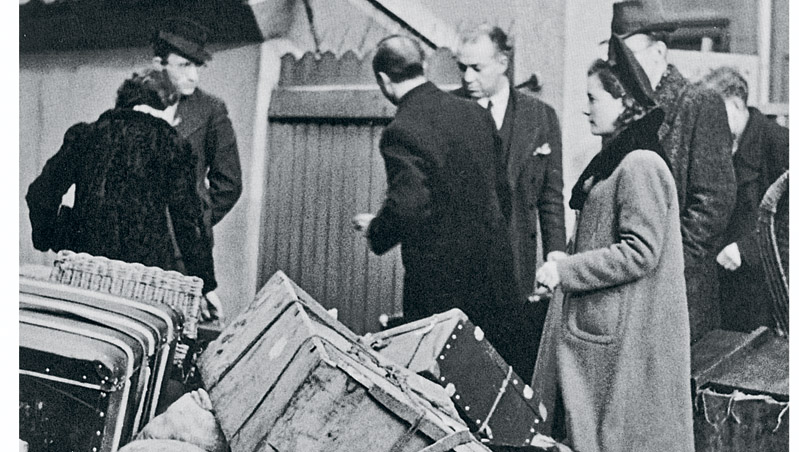
Jewish refugees from Poland, Kobe, Japan, April 1941
In early December 1940, German Jew Leo Adler came from Kaunas to Moscow. He got to Lithuania after several years of wandering - at first he was forced to leave Hamburg, fleeing the Nazis, then the war began and had to run already from Poland occupied by the Germans, where he had settled by that time. A successful young man who, until recently, in the German football team, was supposed to go to Palestine for World Jewish Games - McCabiada, by 1939 he became twice a refugee. But he was lucky: he managed to get a transit visa in the Japanese consulate and leave through the USSR to Japan, and from there to the United States. His wife Bella was less fortunate: she worked at school and was able to leave Kaunas only after the end of the school year. She arrived in Moscow in the last month of pregnancy: on May 21, 1941, her son Samuel was born. And on June 25, she was arrested as the “wife of a German citizen”, and she and her son got into the Gulag, from where her husband, with the help of the International Red Cross, managed to rescue her only in 1946.
Leo Adler was one of several thousand Jewish refugees saved by the Japanese vice-consul Tiune Sugihara (1900–1986). Humanly shocked by the fate of the persecuted, this person with a risk for a diplomatic career and his own well-being in a short time before closing the consulate issued more than 2100 visas to refugee families*. With these visas in their hands, they were able to obtain permission to travel through the territory of the Soviet Union.
The price of salvation. In dollars
If we are more or less known about the feat of the Japanese diplomat, then we know very little about how transit passed. In particular, about the role of the Soviet “Intourist” in this story. With the outbreak of World War II, Intourist lost almost all his customers. The fate of about 20 thousand Jewish refugees, who, after the Soviet-German section of Poland in Lithuania and strove to travel to Palestine or the American continent, opened up new opportunities for making currency. That is why Intourist opened an additional office in Kaunas, the capital of then independent Lithuania, and lobbied for the passage of Jewish refugees through the USSR. But the People's Commissar of Foreign Affairs Vyacheslav Molotov did not give permission to transit. The USSR allowed the passage throughout the territory only after Lithuania’s “voluntary accession” to the USSR in the summer of 1940 and only thanks to the entrance visas to Japan issued by Sugihara. From Japan, refugees were supposed to sail to the island of Curasao - the Netherlands colony was the only place for them to get without entry visas.
Refugees published in the USA, Australia, Israel and other countries have been preserved, as well as a video interview with Spielberg Foundation, which make it possible to look at transit through the USSR through the eyes of their direct participants.
In the Intourist’s office in Kaunas (it was necessary to come there after an interview with an employee of the NKVD and with a Japanese visa in his hands) refugees received colorful cards who invited to catch fish in Lake Baikal and admire evening Moscow. Sometimes the visa procedure took place quickly, sometimes the conversation lasted an hour or two. The 18-year-old Henry Pollak, who later turned out to be in Australia, said that an interview was led by a man “with an intelligent but tired face”, along with an assistant whom Pollak considered a student student. Standard questions followed: “Why are you leaving? Where? Is there money? " The obligation to indicate the place where it can always be found after leaving the USSR. In parting, the "interns" significantly said: "We must be able to always be in contact with you ..."
The problem for many was the payment of travel to Japan.
Intourist demanded payment of the entire package of services at once and only in American dollars, moreover, in cash, although officially foreign exchange operations in the USSR were banned
The fare cost from $ 180 to $ 200 in a reserved seat car. Traveling in a compartment car is twice as expensive. Money went through Joint **. But he had the opportunity to pay far from everything and not everyone. Refugees sold jewelry, jewelry, more or less valuable of things.
The price of the ticket in the Intourist, even under the conditions of wartime, seemed to many "exorbitant". In addition, they did not always understand that they were offered a more comfortable trip option for them. Henry Pollak recalls that the desired $ 180 had to come from aunt from Canada, but an Intourist official demanded $ 360. After refusing to pay, threats followed: “Well, we have a room for you. In Kazakhstan. " Only when did he call the official from the NKVD (bowing him to cooperation), the very next day he received a ticket for $ 180, paying in cash. At the same time, several people were arrested before or immediately after leaving the “Intourist” - under the pretext of having a currency.
Two tickets to the Bolshoi Theater
The epic of refugees did not end there. They had a long crossing through Soviet territory full of new adventures. The entire Kaunas - Moscow - Vladivostok - Kobe route took about four weeks. The first impressions began immediately after the crossing of the “old” border with Poland, which existed until September 17, 1939. Samuel Hebrew, the future professor in the United States and the famous researcher of the Dead Sea sweatshirts, left in March 1941. The first stop was in Minsk. He had a gloomy impression of the Soviet people what he saw on the platform: no one smiles, unfortunate faces. At the same time, the young man saw a lot of military equipment and soldiers, explaining this for himself by preparing for the war.
But the pre -war Moscow was most remembered for refugees. The cost of the Intourist package of services included a hotel for three days and a cultural program, including two tickets to the Bolshoi Theater. At the Belarusian station, a bus was delivered, which drove along the embankment along the Kremlin to the Novomoskovskaya hotel (now Balchug) or to Metropol. The impressions of the Soviet hotels among the refugees remained very contradictory. The hotel "In the pre-revolutionary building" seemed critical of the entire Soviet Samuel Hebrew "more or less tolerable", with good nutrition. Zori Vargaftik (Varhaftig), one of the organizers of the transit, an enthusiast of the Jews move to Palestine and subsequently the Israeli Minister for Religious Affairs, responds positively about the hotel near the Kremlin. On the contrary, according to the memoirs of Henry Pollak, a mess reigned in the hotel, but the staff turned to them strange for the Soviet servant by the word “Lord”. Refugees, according to him, felt like participants in the propaganda film.
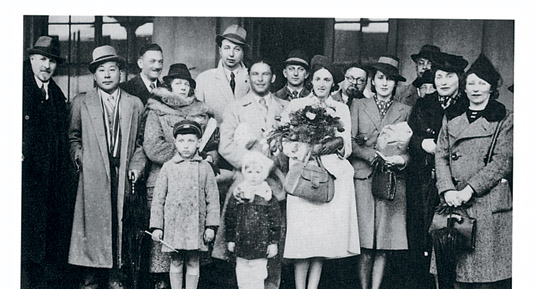
Tiune Sugihar (second on the left) with a group of Polish refugees at the station in Kaunas, 1940
Many tried in Moscow to meet with relatives or friends. Almost everyone notes the fear of Muscovites: only older people usually responded to the proposal to see themselves, young people were afraid to meet
Samuel Hebrew could not immediately meet with a relative-doctor (“I live in an apartment where there are many people”-so he delicately called his communal apartment). He refused to come to the hotel - "there are spies." Still, the relative appeared at the meeting, appointing it, in the best traditions of the detective genre, at the entrance to the central telegraph with a newspaper in his hand. “You look a little like a foreigner,” Moskvich told a relative cautiously. But Putting the guest on the subway and making sure that it made an impression, he still brought him to his communal apartment. Clothing, isolation and concern of Muscovites allowed Samuel Ivry to draw a conclusion: “We were refugees, but looked ten times better!”
Under the "roof" of the NKVD
But most of all, refugees themselves (especially members of Zionist organizations) were afraid in Moscow and on the way to Vladivostok “spies and provocations”. So, the couple of the VargaFtiki practically did not leave the room. Samuel Hebrew tried not to speak Russian in a hotel.
The next stage of the trip was a long trip to Vladivostok. Most of the "tourists" rode in reserved seats. Here's how Samuel Hebrew describes his trip: the car is quite old, in the compartment 8 people, 11 days on the way, cold food, you can’t go out at stops. Henry Pollak also rode in a reserved seat car. He especially noted that "without a bath." But the VargaFtik was quite pleased with the service on the train (he was driving in a compartment car).
Some of the Clients of Intorist were shown by Birobidzhan. During the stop in the capital of the Jewish Autonomous Region (EAO) Samuel Ivri, having learned that he was a teacher, they asked to speak with "methodological recommendations." He considered that the local official who proposed this was an agent of the NKVD, and prudently refused the proposal. Other passengers proceeded through the capital of the EAO without stopping, only paying attention to the inscription at the station building - it was Yiddish. Henry Pollak was remembered by an hourly stop in Irkutsk.
Each group of refugees should have been accompanied by employees of the NKVD. They acted very secretly. Thus, an experienced Vargaft separately noted that in his car "there were no local passengers." But Pollak recalled the unusual accompanyers: a tall, impressive and willingly helped other passengers “Olga Dmitrievna from Yaroslavl” rode in his carriage. Particular confidence was caused by the fact that she allegedly headed for her mother in exile. What was the surprise of the refugees when they met with Olga Dmitrievna at customs, where she led the process of a more thorough inspection of individual passengers: several by her order they gave castor - searched for values hidden in the stomach.
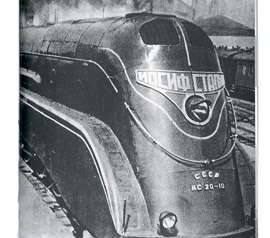
Diesel locomotive "Joseph Stalin". It was this that was used on the Trans -Siberian Railway from mid -1930 to 1940
In Vladivostok, refugees who spent three days to several weeks here, or even months, were remembered by soldiers on the platform who met them after arriving from Moscow, and a hurry on buses, as well as night loading on the steamer.
Further, on the old and crowded Japanese ship "Amasuki-Mara" refugees were heading in Kobe. Many of them noted the courtesy of the crew, possibly in contrast with Soviet personnel. But they had nowhere to go further, with the exception of few who had real entry visas in the USA, Canada or the countries of South America. Not a single one reached Curasao ... In 1943, almost everyone was enclosed in a ghetto in Shanghai, and after the end of World War II left for Palestine, the United States and other countries.
The same Jewish refugees who were not sent to Siberia and remained in Soviet Lithuania were, with rare exceptions, executed by German invaders and their accomplices.
* According to approximate estimates, this helped to escape more than 6 thousand Polish and Lithuanian Jews (the visa was given throughout the family). In 1985, the state of Israel awarded Sugihara the title of the righteous of the world.
** The largest Jewish charity organization created in 1914. The headquarters is located in New York.
Photo: United States Holocaust Memorial Museum, Washington