
Translated material
Intifada of social networks
Why in Israel the attacks on Jews continue. Reporting Daniil Turovsky
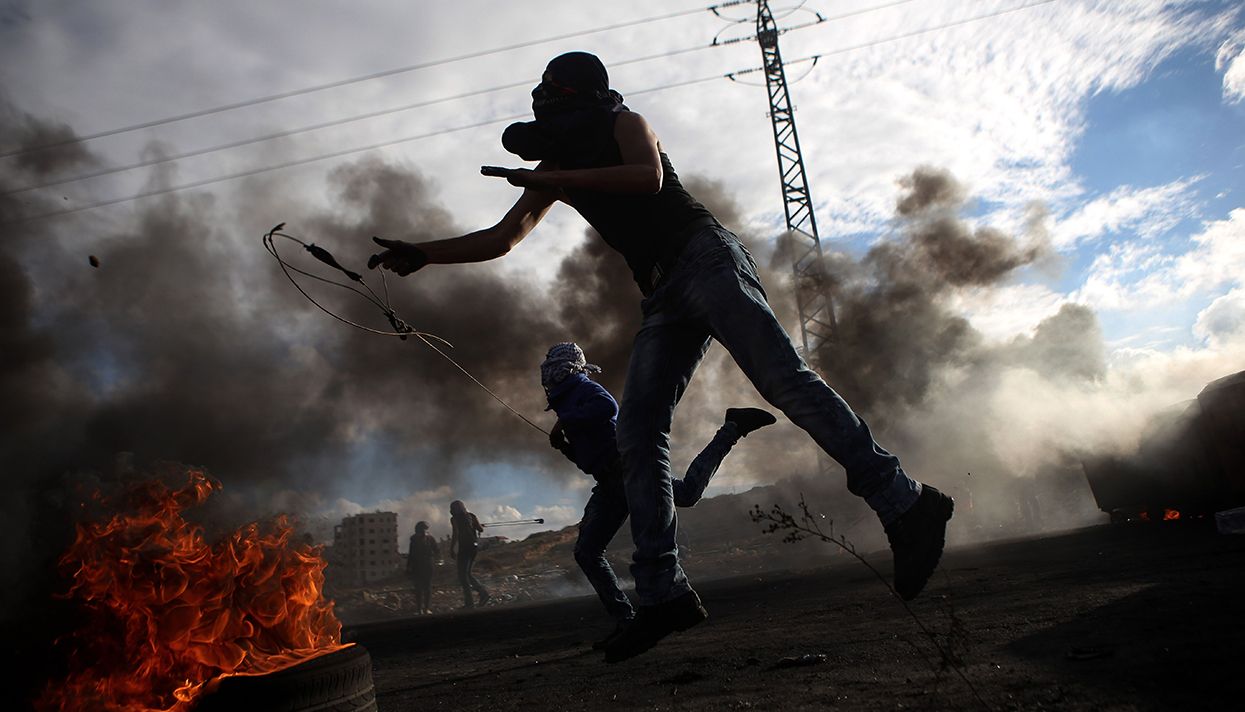
In Israel, street attacks have been continuing for more than two months. The Israelis call them terrorist acts, the Palestinians - "intiphadas of knives." Unlike previous intifada (intifada - a movement aimed at “the liberation of the occupied territories of Palestine”), the current one, according to the Palestinian leadership, is not coordinated by anyone. Most of the attacks are performed in Jerusalem, where the al-axa mosque is located, one of the most important shrines of Islam. Palestinians believe that the Israelis are trying to take control of the mosque. Israel has already complicated a visit to the temple mountain for Muslims, where al-axa is located-they are allowed only at certain hours, checkpoints were exhibited on the road to the temple mountain. All this causes indignation among the Palestinians. The special correspondent of Medusa Daniil Turovsky visited the Jewish and Palestinian part of Jerusalem to understand how long the “intifada knives” will last.
Storming cafe
Three police jeeps drive up to the nondescript cafe. Soldiers with machine guns and in full combat uniform jump out of them. On each - two body armor: black protects the neck and arms from blows with a knife, green - from bullets. Two soldiers rush to men standing at the door, after a second they put them on the ground face down. The rest of the special forces run into the building. Screams come, but without shooting.
The soldiers remaining on the street notice a woman nearby in a scarf who put her hand in a women's bag; Weapons are instructed and asked to move as far as possible; She obeys. Soon, two men of about thirty years and a teenager are taken out of the cafe. They are planted in cars - at the same time, those who were detained on the street. Jeeps are moving rapidly.
All this happens in early December 2015 in Silvan, the area of East Jerusalem.
Near the cafe are gathered by local residents. One of them tells me that people were taken away due to the fact that on the eve they were thrown by the stones of the police.
The 16-year-old guy Imran is watching what is happening, he lives in Silvan. It has a tracksuit, he is briefly tonsured, his hands are clenched into fists. “In recent days, it is a little more restless than usual,” he tells me. Imran says: on November 29, 2015, the Israeli military shot in the neighboring area of the local 17-year-old teenager Aiman Abbasi. According to the small Silvan, the news of this scattered instantly: Abbasi walked along the street, the military patrol stopped him, the documents were checked, searched, released, and then shot in the back. According to the Israeli side, Abbasi was shot dead during clashes with the military on a checkpoint in Silvan, when he tried to set fire to the Molotov cocktail.
Abbasi spent ten months under house arrest and a year and a half in prison on suspicion of preparing an attack on a resident of Israel in November 2012 (street clashes between Palestinians and Jews last for decades, but when the situation is heating up almost daily).
Each funeral of the Palestinian, shot down by the police or soldiers after (or when trying) to attack the Israelis, usually turn into a spontaneous manifestation. Immediately after the death of Abbasi, the youth wing Fath (Palestinian militarized political party) called for "fighting the invaders, murderers of Shahid Abbasi" and began to gather people for "day of anger." The 16-year-old Imran from Silvan also learned about this-along with hundreds of other local residents and relatives of the deceased, he went out on November 30 to the streets of East Jerusalem.
They walked with the body of Abbasi in their arms, lifting it over their heads, a march of protest to the place of burial.
Many were masked and Palestinian flags. All the way they chanted "Allah Akbar!" After some time, the Israeli military arrived in the district. Palestinians met them with barricades from set on fire tires. The teenagers climbed onto the hill by the road and threw stones into the soldiers from there. The clashes this time did not last long, and there were no new victims.
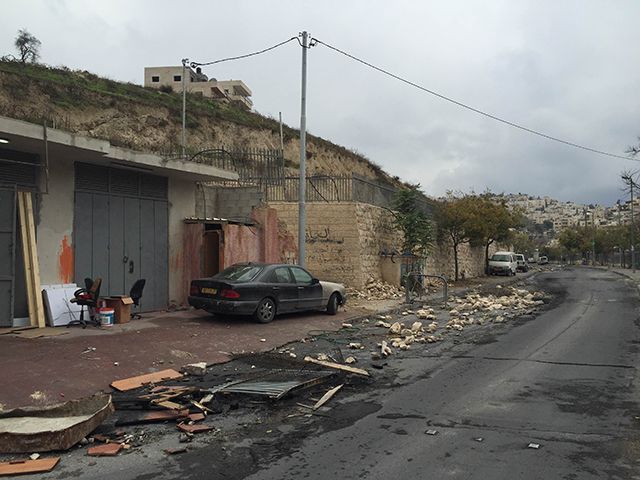
Imran talks about this as something completely ordinary. Looking at how the Israeli special forces storms the cafe, chatting with his friends, he takes me to the place of collision with the police. The whole road there is littered with stones, broken glass and tires.
“This will continue, the intifada will not end this time until [the mosque] al-axa will not be safe until we free our land,” he says goodbye, and he goes to the store to buy soda.
Al-Aksa Mosque
Israeli military periodically overlap the Muslims a passage to the Al-Aksa mosque, which is located on the temple mountain in Jerusalem. The Al-Aksa Mosque is one of the main Muslim shrines, the third most importantly after the mosques of al-Haram in Mecca and the prophet mosque in Medina. Muslims believe that the temple mountain is connected with Mirage - the ascension of the Prophet Muhammad to heaven, where he met with Allah; Every year they celebrate this meeting. The temple mountain is also a sacred place for the Jews: here were the first and second Jerusalem temples (the surviving part of the wall of the second temple is known as a wall of crying; there is a separate passage to it).
In early September 2015, a rumor appeared among the Palestinians that not only Muslims, but also the Jews will be allowed to pray on the temple mountain. Palestinians believe that there should not be Jews on the temple mountain. In recent years, Jews were allowed to visit the temple mountain, but only as tourists, without any religious paraphernalia - and they were forbidden to pray there. Against the visits by the Jews of the Temple Mount, people from the VAKF, the Islamic Council, which controls the holy places on the temple mountain, periodically protruded. Religious Jews, trying to read the texts of prayers and performing prayer actions on grief, were sent by the territory of the Islamic organizations Al-Murabitun and Al-Murabitat.
In early September 2015, the Minister of Internal Security of Israel Gilah Erdan announced the ban on these organizations. Group members have repeatedly attacked religious Jews who visited the temple mountain. “Groups consisting of young men and adolescents use the al-axa mosque as their base and weapon warehouse, hiding at night in this holy place,” the ministry explained.
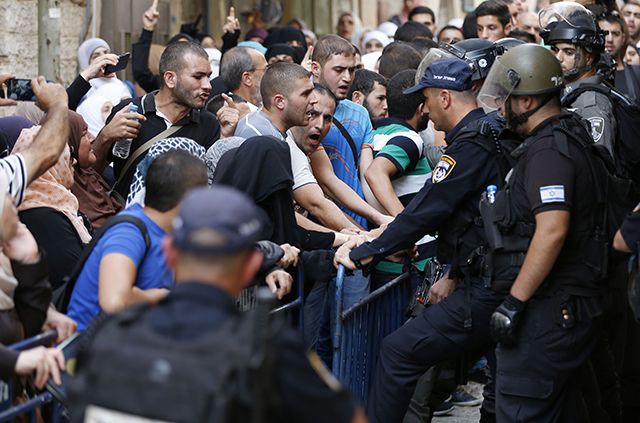
On the morning of September 13 (on the eve of the Jewish New Year, when many Jews traditionally visit the temple mountain), police detachments entered the territory of the Temple Mountain to expel the participants of these prohibited groups from there. The police used light -school grenades, tear gas and rubber bullets; Islamists in response threw the police with stones and firecrackers. The clashes continued inside the Al-Aksa mosque. Dozens of activists were detained.
The situation was even more intense by the manager of the Al-Aksa mosque, Sheikh Omar al-Kiswani, who stated that Israel "intensely established his control over the temple complex." For several days after that, mass skirmishes between the Palestinians and Israeli military continued near the temple mountain. And at the end of September, anti -Israeli statuses began to appear on the social networks of the Palestinians; It seems like such - “The Third Intifada is here”, “People must wake up. What happens in al-Ax? "
From that moment on, street attacks on Jews were already constantly taking place. Palestinians call them "intifada knives." Waves of street violence occurred before. During the first “intifada stones” (Palestinians used stones against the Israelis), from 1987 to 1993, about a hundred Israelis and two thousand Palestinians died. During the “al-axa intifada” (which began after visiting the mosque Prime Minister of Israel Ariel Sharon), from 2000 to 2005, about a thousand Israelis and three thousand Palestinians were killed.
Attacks
For two months - from the end of September to November 30, 2015 - 22 Jews were killed in the clashes, 215 people were injured. More than 100 attackers (5% of them, according to the Israeli Security Service - Israeli Arabs) were killed . Incidents occur almost daily.
Many attacks were made in the central part of Jerusalem, where it is easy to get from the Palestinian territories located “outside the wall” (we mean the border structures separating Israel from the western bank of the Jordan River and the Gaza sector), or from the Arab regions of the East Jerusalem. Arabs attacked Jews in public places - on the streets, bus stops, markets, supermarkets, checkpoints, synagogues, in transport. In addition to Jerusalem, attacks take place in Tel Aviv, at border points in the area of the Gaza Sector, on the western bank of the Jordan River.
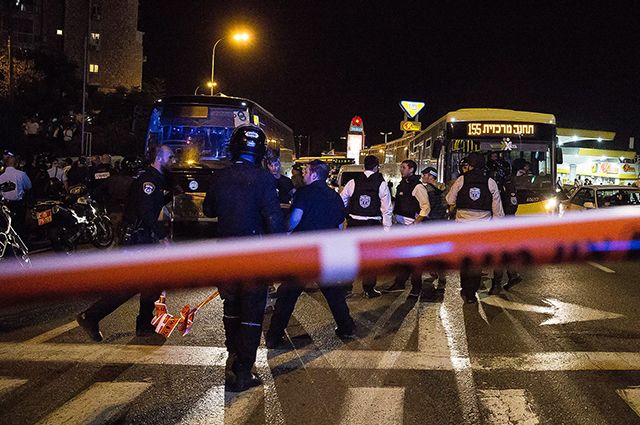
On October 12, 2015, a terrorist took out a knife in a bus near the Jerusalem string bridge. He managed to injure two passengers and tried to take away the weapons from the soldier, and then he was shot dead.
One of the military personnel who were traveling on that bus told me that “he was scared, but less than other people”; In confirmation of his words, he pointed to his machine gun. Like any person living in Jerusalem, this soldier at the beginning of the conversation takes a step back and looks not in the eyes, but in his hands.
“All people in the city are scared,” he says. - It is impossible to live calmly. They can attack anywhere and anywhere. Why is it all? Do they think that after this will someone negotiate with them? Although to some extent I understand them. They are also people, they just don’t want to live peacefully. ” “And we want, so we’ll be on duty here,” adds his colleague. “And with us - our friends in all parts of the city.”
"How to stop the attack?" I ask. “We need to ask them. I do not understand why they are attacking, ”the soldier replies. “Yes, and you won’t take the knives from the sale.”
Near the synagogue in the central part of Jerusalem there is a tray; The plate on it calls to support a soldier - buy a t -shirt or baseball cap with the symbols of the Israeli Defense Army. “I reduced my stay on the street as much as possible,” the synagogue parishioner tells me, “and I try to walk next to the police. But life cannot be stopped. ”
Two orthodox Jews are waiting for the bus towards the old city. “You cannot sit or walk as usual,” one of them thinks. - You always look around: see who is behind you. You always suspect that something bad can happen. ”
Mark - the owner of a bookstore in the central part of Jerusalem - on November 23 went to buy products for the Mahane Ehuda market. Having made purchases, he went outside and heard from somewhere behind him the scream "Allah Akbar!" He turned and saw how girls - for 14 years - attacked a man with scissors. They ran around him, hit the head and stomach. The police officers in a nearby civilian ran up and shot teenagers. For some time, Mark looked at what was happening, and then went back: he couldn’t, he says that the store was idle for a long time.
“All, of course, were worried in the first weeks, but for two months this has been going on, everyone is used to it,” explains Mark. - It is terrible that children participate in all these attacks. There is rarely someone over 17 years old. Many call it “intifada of social networks”. Neither the “Hamas” ( the Palestinian Islamic movement and the party ruling in the gas sector - approx. “Medusa” ), nor the Fath, which at the previous time [attacks by the Arabs on Jews] organized this seemingly organized. Although, I think, terrorists get some money from them. ”
The market in the old part of Jerusalem is a popular tourist place. It is located next to the three main religious attractions. Most of the outlets here are held by the Palestinians, and now it is impossible to meet Jews or tourists in the Arab part of the market. From here, the road leads to the Damassian (Shkham) gate-a place in which attacks happen more often than somewhere else. This is due to the fact that near the gate there is a stop, with which buses go to Palestinian territories.
Some people working near the Damassian Gate observe attacks every other day.
The seller of juices named Latif, the Palestinian, claims that he has seen four such cases in recent years. “A boy of about fifteen, they shot him, and then put a knife to him as if he had attacked him,” he says. - That's how they do. And recently, the girl attacked a soldier with a cry: “What are you doing here? This is our land.” Several times it hit him. He shot her. I support the intifada. They dance in our mosque, mock her. How to solve the problem? Close the entrance there. "
Politicians
The Prime Minister of Israel Benjamin Netanyahu called the series of attacks "Wave Terror." According to him, there is no quick solution to the problem. A month after the start of attacks on Jews, Netanyahu said that there were no changes on the temple mountain: “Muslims can pray on the temple mountain, and non -Muslims will be able to visit it freely.” The Prime Minister of Israel drew attention to the fact that many call the current wave of attacks on Jews "intifada of social networks." “Osama bin Laden met Mark Zuckerberg,” the prime minister described a new reality.
At the end of November, Israeli President Reuven Ruwen called the world community to perceive attacks on Israeli citizens in the same way as terrorist attacks in Paris or a terrorist attack, as a result of which the Russian A321 was blown up in the sky over the Sinai Peninsula. “Our hearts are broken and bleeding. The sorrow in Tel Aviv is the same as in Paris, the gush-ecio ( settlements south of Jerusalem, in which there were also attacks- approx. Medusa ) and in Sinai, ”he said. “Islamic fundamentalism threatens all free nations, and we must conduct an unconditional struggle against him.”
On September 16, two weeks before the start of daily attacks, the head of the Palestinian administration and leader Fath Mahmud Abbas said on Palestinian television: “We welcome every drop of blood that spilled in Jerusalem. This is pure blood, blood on the way to Allah. ” A week later, in a conversation with French President Francois Holland, he warned of the consequences of pressure from Israel: “What is happening is extremely dangerous. There will be chaos, an intifada that we do not want. ”
If the first two intifada were coordinated by the Palestinian leadership, today we are talking about “decentralized terror”: the Palestinian leadership emphasizes that it does not control adolescents who watch propaganda rollers in social networks, urging Jews.
On November 20, UN Secretary General Pan Hi Moon called attacks in Israel terrorist attacks. Thus, he supported the Israelis who achieved the attacks of the Arabs on Jews on the basis of religious and national hatred, including by journalists - not like household crime, but terrorism.
Arab quarters
Most of the attackers live in the immediate vicinity of their victims. At a 20 -minute walk from the temple mountain, the quarters of East Jerusalem begin - areas where Jews try not to walk. They are inhabited by about 300 thousand Palestinians.
Israel occupied this part of the city during the six -day war of 1967. Palestinians want to declare East Jerusalem the capital of their future state.
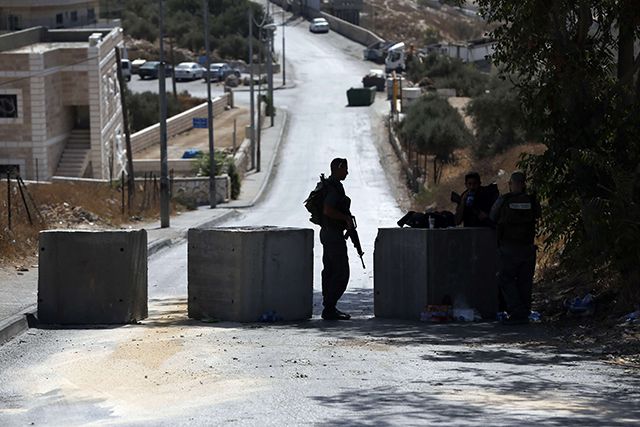
In recent months, these areas were periodically blocked by Israeli military, which further strengthened the discontent of the Palestinians. Representatives of the FATH party called the exposition of checkpoints "an act of collective punishment contrary to international norms"; Representatives of Hamas said that such measures would not be able to stop Intifada.
In the Arab areas, police raids are periodically held, in October and November 2015, suspects in the preparations of attacks were detained there. The Israeli military continues the total searches of the Palestinians. In addition, the Israeli authorities began to punish relatives of terrorists - exploding the houses in which they lived.
It is difficult not to notice the border with Eastern Jerusalem. Immediately behind it - after a checkpoint, on which three soldiers are on duty - abandoned territories begin. Utilities do not work here; Lying mountains of garbage bags; The roads are broken, the houses are destroyed, the fences are dismantled into stones.
The closest to the temple mountain Arabic district Sylvana meets graffiti - a red knife is depicted on the wall of the house. On the next wall, Palestinian flags and mosque are painted with the same paint.
Children are watching a video on a smartphone: under fun music, the author of the video calls to kill Jews. The teenager has several such propaganda videos at once on the phone. In one of them, a man in a camouflage suit and balaclava takes a knife and begins to sharpen it; A Palestinian flag hangs behind him. Having imprisoned the weapon, the man demonstrates four ways to striking with a knife: in the stomach, in the head, in the neck and again in the neck, but from behind. This “video tutorial” became very popular in Palestinian social networks starting in October, when the Palestinians almost daily attacks on Jews began.
* * *
Рядом с домом застреленного израильскими военными 17-летнего подростка Аймана Аббаси проходит собрание его родственников и жителей Сильвана.
Я спрашиваю у них, может ли что-то остановить нынешнюю волну насилия.
— Интифада будет продолжаться, — категорично отвечает на это мужчина.
— Зачем они ходят в нашу мечеть? Она только для мусульман, — возмущается другой.
— Ты сам видишь, как здесь все. Здесь нечего делать. Нет работы, нет будущего, дети на улице.
— Они убивают наших детей! Ребенок кинет один камень — его застрелят. Никто не хочет войны, но эти люди на табуретках, политики, только треплются. Я ненавижу все эти убийства, но что нам делать?
Мужчина, жалующийся на политиков, отводит меня в сторону и рассказывает, что ему надоело так жить — когда на каждом шагу блокпосты, постоянно обыскивают, на работу не устроишься, а ребенка могут застрелить в любой день. По данным правозащитной «Ассоциации за права человека в Израиле», 75% населения Восточного Иерусалима живут за чертой бедности.
За Сильваном начинается район Джебель Мукабер. На его улицах встречаются дома, украшенные символикой «Хамаса».
Житель Джебеля Мукабера Махмуд знаком с палестинцами, устроившими серию атак на евреев 13 октября 2015 года (трое погибли, 20 человек получили ранения). Он управляет небольшим магазином — нападавшие часто заходили сюда выпить арабского кофе. Махмуд знал, что они готовят атаку.
— Тут все готовы. Но это не атака, как говорят — это оборона. We protect our land. Хотим, чтобы они ушли, — говорит он.
— Вы же понимаете, что из этого ничего не выйдет?
— Они уйдут. Мы добьемся этого. They hate us. Мы ненавидим их.
Daniil Turovsky
Jerusalem