
Translated material
About the simulators of pleasure
Doctors strictly define love as a dopamineergic healing motivation for the formation of stable pair ties. About the same (only simply and entertaining) will tell you Renata Litvinov as a lecturer in neurophysiology of love, the heroine of the through novels of the new film by Anna Melikyan “About Love”, which has been released today.
The film took only twenty -five shooting days, the year of production and the tradition of student short films: minimal preparation, improvisation, meager fees and sincere hobby of participants with the topic. Melikyan has been accumulating all the time to his author’s projects: preparations for her best in the rhythm of the film “Zvezda” took about seven years-therefore, she conceived a new film-almanes as an exclusively commercial, purely audience project to raise dough for the implementation of the following ideas.
Suddenly, the “craft” won the Kinotavr and seems to be preparing to collect the rental. “About love” designated the crisis border of Russian cinema, separating the young educated audience from the so -called “mass cinema” (about some representatives of which, despite the cash desk, cannot be remembered without blushing). The romantic comedy - the most commercial genre - is saturated with Melikyan characteristic of her handwriting to the smallest details of the inner life of the characters: from emotional habits to make desires with a paper aircraft to the environment of the TTK. This almost entomological interest, which is fully fits into the genre of the genre, makes Romk intellectually attractive for a young and romantically -minded educated audience. The first timid attempts to integrate instagram, tags and chats into the screen space are not just a marketing course, but also a way to convey a new style of thinking and interaction with the world. All this so far seems quite raw, but Anna Melikyan, despite her youth, seems to be very promising and already possessing her vision author. The main thing here is that this campaign for a cash desk from pop arthaus to simply the pop does not distort the recognition of its creative vector.
“About love” is a microscopic Moscow Decameron, which grew out of the shortcom for the auction “Action”. In one of them, in the situation, the deed lovers quarrel and put up with a difficult reliable reliability.
In another, two lovers in bed play “in truth”, either stimulating, or killing their feeling.
The full -length film is much more accurate to form a problem and is much easier to get by. Having decided to abandon the audience to kill his heroes (otherwise, “about love” would be littered with corpses), Melikyan completely loses the finals of all lines, leaving them hanging in the dramatic space, pleasantly gleaming and delighting the eye.
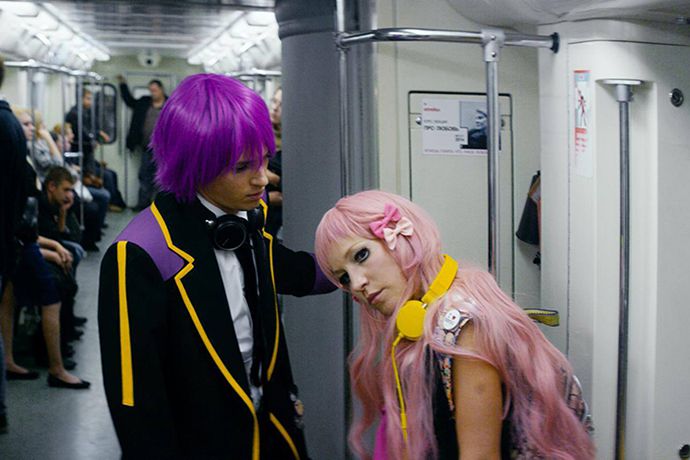
Two cosplayers have been found for six months - but only in the images, not even knowing the real names of each other, having sex with their eyes closed and shut -up headphones. When a sexy animashka turns into a waitress from Polezhaevskaya, and her bright guy turns out to be one of a thousand backcapish students, they are not able to cope with reality and refuse this venture. Who are they actually: having revealed their true personality - or running away from themselves?
The secretary from City is given for a lot of money to his boss to buy an apartment for himself and his young man, an infantile unemployed fan of playing the clocks in tanks. How does she feel that she will be with her love, will she be silent about it? The strithairtist is obsessed with his imaginary ideal woman and does not really like anyone-but women are in love with him because he draws them throughout the wall in the center of the city. He is ill between a desire to meet his perfect projection - and an acute reluctance to plunge into the details of the meager inner life of each of the women. Inspiration and hopelessness.

An elderly rich businessman is inexorably pulling to a nineteen -year -old, frozen student, but he is so worried about his capital that he calls a specialist to “check” it. The Japanese woman comes to Russia to find mental Russian love and revel in a rich culture-but does not find among Russian men not one who read Dostoevsky or listened to Rachmaninov (it, in addition, sings the song “Gop-Stop” in a broken Russian as if it were a romantic ballad). Despite the unpleasant honesty in the image of his heroes, Melikyan knows how to approach any characters at such a close distance that it is no longer possible to take objectively - you have to accept as they are, knowing the charms of disinterested love.
The author’s desire not to draw conclusions and not screw to the plot lines of conflict resolution are intuitive, because there are only two sane options. The rampant, finding out the origins, causes and consequences of conflicts, then you will turn out to be hopelessness and decay; Or amuse the tragedy-in order to at least somehow elevate the characters over their own pettiness. All this is very costly and unpleasant, of course. The film has one replica of a connoisseur of love, Litvinova, who unites all the stories (and all the audience) with one verdict and which I tend to attribute to the author's voice.

Talking at a lecture on testosterone attraction, dopamine love and oxytocin affection, she says that there is still great love, which will not end at the end of thirty months of excess of the corresponding hormones. There is the love of poets and artists, there is great, there is eternal love. But most of you, she says, did not meet her - and many will never meet her in their path.
Well, dear readers, it would be nice to find out what Renata Litvinova promises to never see us as his ears, and why for many and many people these “unattainable” things were the only goal, law or meaning of life.
The Indian text of the Bhagavat-guita tells about the ways of the practice of Yogin: he can go to improve the service, by cognition, but the highest of the ways calls the Way of Love, Bhakti-Yoga. Bhakti-yog is freed from the captivity of the lust of the result, because for him, like for any loveman, love for the deity (and for the world as its manifestation) is a process that destroys the very need for the result. For the Western reader, Swami Vivekananda tried to chew this topic in the book of the same name .
Empedocles from Acrangant, a Greek philosopher philosopher, believed that love is one of two forces and that it was responsible for all the attraction in the universe (in contrast to the pushing power of hostility). He would have known that after two and a half thousand years of Christopher Nolan, “lovers of science” booze for this approach - he would leave more poems on this topic.
Plato (the guy who was covered by the name of his teacher) in the " Feast " dialog is arranged by a whole freestyle session at which everyone discusses the essence of love in philosophical monologues. Interesting theses sound. The lover is inspired by the deity and therefore stands above the lover, despite subjective sensations. There is vulgar erotic love capable of baseness, and there is exalted erotic love, possible only to the young man already endowed with a teenage fluff in which the mind arose. It is here that the legend of Androgyn, chopped by the gods with fear of a “double” person, who now desperately wants to restore his integrity, is for the first time - but has the opportunity to only copulate. The idea of finding the “second half” is also from there. Under the final, Socrates puts an end to the debate, telling the opinion of one of his wise girlfriend that love is the desire for good, good and, accordingly, immortality. A beautiful move of thought - from the idea to blow a pretty efebub to an eternal good, isn't it?

The Greeks, unlike us-departments, found more words for love than one thing, so as not to get confused. The most windy love was called "Lyudus" - a playful desire to satisfy sexual attraction. The passionate jealous power of obsession was called "mania" and equated to madness. The devoted and calm love of friends was called "Filiya" - what to say about the modern use of this root in the names of paraffilies is not clear. Tenderness, a sense of mature union (oxytocin, that is), bore the name "stack". And the highest love, “agapa”, was precisely described as an unconditional manifestation of the desire for universal good, not without self -sacrifice.
It is easy to see that Yeshua was not an innovator (hence the legends about his internships by the yogis), because Christian love is the same bhakti or agape. The first two commandments, according to Christ, are to love God with a heart, mind and soul and love his neighbor as himself. “The whole law is affirmed on the two commandments,” he said, and then everyone was overdoed, as usual. And although he practically quoted these commandments from the Old Testament, he explained the essence of love and formulated extremely practically and simply: he canceled the law of blood feud that contradicts the commandments, clearly answered the question “ who is the neighbor? "And he urged not to justify his evil by the fact that" he began. " From the Jesus commandments, an ardent anticleric and the Pononavitnik Leo Tolstoy in his work “ Four Gospels ” tried to shake off the dust (the bearded man was anathematized, so he was his own). The count carefully analyzed the words of Christ and brought everything to even simpler expressions: work for everyone for good, help everyone and everyone, do not love one to the detriment of another, do not kill under any pretext, rejoice - and if not glad, then this is because you are an asshole, return to paragraph one.

The Bible also presented us with the most quoted cart about love about love from the first message to Paul Corinthians as a status in social networks: “If I say human and angelic languages, but I have no love, then I am ringing or kimval sounding. If I have a gift of prophecy, and I know all the secrets, and I have all knowledge and all faith, so I can rearrange the mountains, and I do not have love, then I am nothing. And if I distribute my whole estate and give my body to burn, but I have no love, I have no benefit to me. Love will be longing, merciful, love does not envy, love is not exalted, not proud, not at least ate, does not seek its own, does not be annoyed, does not think evil, does not rejoice in untrue, but is charged with the truth; It covers everything, believes everything, everything hopes, tolerates everything. Love never ceases, although the prophecies will stop, and the languages will silent, and knowledge will be abolished. ”
In the twentieth century, Erich Fromm, drowned (in addition to pop singers) for love. The German philosopher often turned to this topic in his works , trying to restore the humanistic picture of the world of Christian commandments in modern form on quite rational foundations. He contrasted love as possession , turning people into goods that deprive the partner of freedom and not interested in him inner world - love as co -creation, disinterested interest and help, enhancing the experience of the fullness of life. A desperate humanist echoes here to previous speakers: if a person loves only one person and does not love everyone else - most likely, he is completely incapable of love, and his feeling is only a selfish parasitic semblance of love.

In general, this is what all I am. Of course, Anna Melikyan made a good film: a flying camera, a summer center of Moscow, an arrow event, a romantic Fleur of everyday life and comic batteries. But that is why he turned out to be close to life: if you suddenly decide to think about the deep content of the relationship of the heroes of the film, you will be stuffy and scary in this small, adhering dust of the melting asphalt of Moscow of the Universe. Then know that there are other worlds and other love. Well, or at least look at Anna's other short film “Such a mood, Adagio Bach and a small fragment from the life of the girl Lena” with the Armenian Vanessa Paradis in the main role and amazing migrant workers.