
Translated material
Chernikhov-Annamonism | Colta.ru
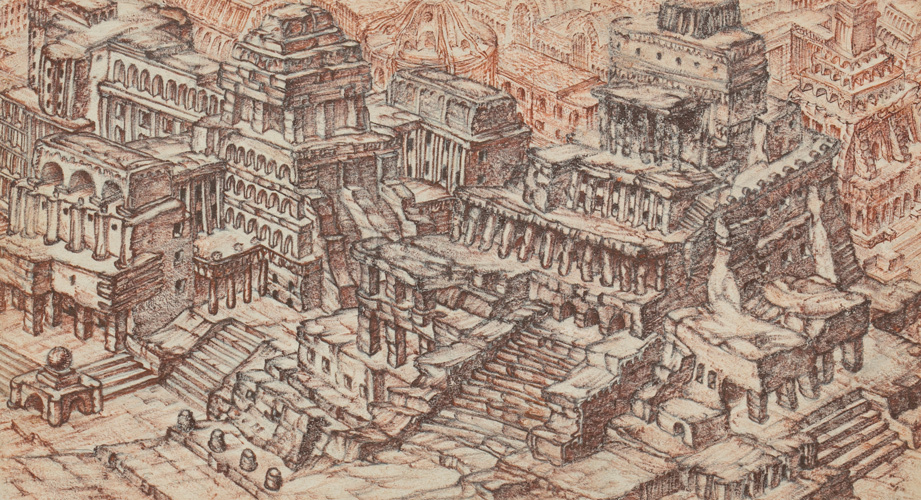
This week, a large -scale retrospective of the architect and graphics of Yakov Chernikhov “Codes of Geometry” in the St. Petersburg Erarte ends. Olga Ryabukhina found out how the Soviet press wrote about Chernikhov, why he painted a lot, whether he built a little and where to look for unknown buildings.
Yakov Chernikhov owned many professions: from a wood cutter and a transparencers to the engineer and the architect of the largest design institutions of the country. For the modern viewer of Chernikhov - primarily a high -class schedule. But his main discovery lies, probably, in the field of utopia-a three-dimensional ornament. Infinitely repeated structures unfold in space into certain structures that will never be erected. The phenomenon of Chernikhov is that today these compositional constructions still look like fantasies about the city of the future.
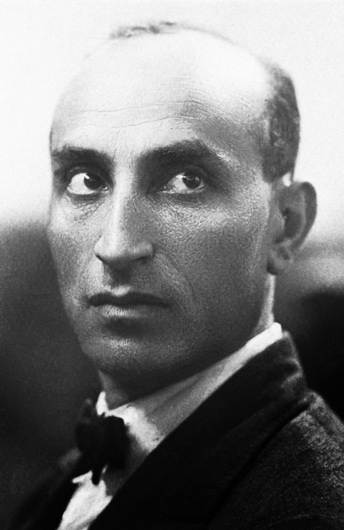 Yakov Chernikhov
However, among contemporaries of Chernichs, it looks like an anachronism. First of all, because the main corps of his books saw the light late, at the turn of the 1920-1930s. Then the main architectural manifestos of constructivism - the “style and era” of Moses Ginzburg, the articles of Alexei Gan - have already been published, but most importantly - the state system sharply changed its priorities. Already in 1928, the once independent journal Modern Architecture entered into an imposed discussion about whether the constructivism of Marxist-Leninist ideology corresponds. So, Gan's program article “What is constructivism?” Published in No. 3 “SA” for 1928, begins with the duty portion of the ideological “norm”: “constructivism ... arose ... under the banner of dialectical materialism. The methodology of constructivism is inextricably linked with the proletarian revolution and the socialist construction of the Soviet system. ” In 1931, SA was suddenly closed, and at the beginning of 1932 the results of the competition were announced for the draft Palace of Soviets, in which the first awards receive grandiose projects of Zholtovsky, Iofan and Hamilton. All independent creative organizations cease to exist. The era of the Stalinist Empire begins.
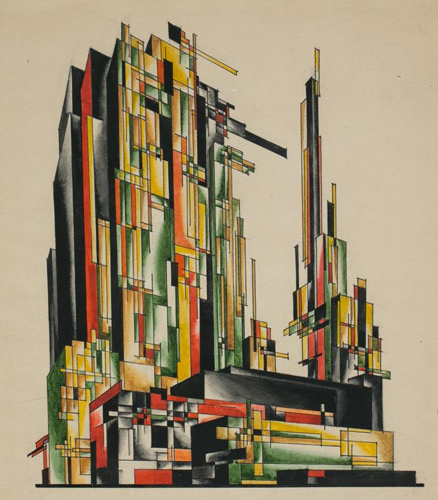 © Museum of Contemporary Art of Erarta series of the foundations of modern architecture, Giant House in New York. 1930
At this time, Chernikhov, as if not noticing an impending catastrophe, first releases the textbook “Art of Drawing” (1927), in which he sets out his teaching method based on the construction of indescribable compositions. Then - “Fundamentals of modern architecture” (1930), where it claims that fantasy is a way of professional thinking, followed by “design of architectural and machine forms” (1931), which includes its own manifesto of constructivism. And finally, “Architectural fantasies. 101 composition ”(1933). The publications look like real artist ' s book : expensive paper, superblastes, drawn furious and shmustitulas. All these myris -articular delights contradicted both constructivist ethics and the aesthetics of the Stalin era.
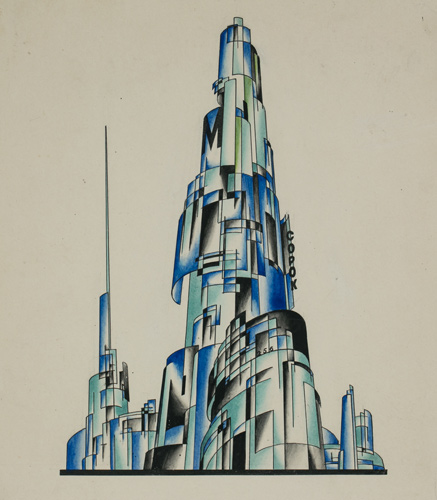 © Museum of Modern Art of Erart
The book “Fundamentals of Modern Architecture” received the greatest coverage in the contemporary artist. In it, Chernikhov then calls for a decisive abandonment of classic techniques of art, as expected to the left artist, then suddenly becomes a symbolist poet: "The horizontal direction forward expresses a feeling, the horizontal direction in width expresses the will, the vertical direction upwards expresses thought, the vertical direction expresses confidence in depth." Reviews of the “Fundamentals ...” were published in several magazines, and in each Chernikhov they reproach in a formalistic approach, poorly exposing theory, secondaryness, but graphics are praised. The most tough review was published by Soviet Architecture. In the article with the warlike heading “On the Khlestakovschina and the bourgeois wrecking on the architectural front”, the book is called an example of “machine fetishism” and “preaching pure formalism”, and Chernikhov - a compiler and, most dangerous, class enemy. In 1931, “Fundamentals ...” were discussed in the Leningrad society of architects. The main report was read by Professor Andrei Ol, who simply proposed to burn this harmful book. Wanting to keep the answer, Chernikhov climbed the stage, said loudly: “Here Andrei Andreyevich Ol believes that everything is bad for me! And I think - good! " - And he retired. A sort of carelessness could cost the artist very expensive, but everything worked out. Moreover, since the beginning of the 1930s, Chernikhov begins to actively build.
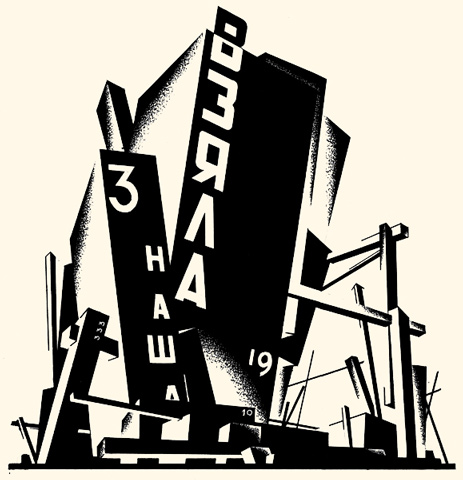 © Museum of Contemporary Art of Erarta The design of architectural and machine forms, a volume-constructive theater composition (Renaissance theme). 1931
It is customary to talk about Chernikhov-Architector with sad reverence as the author of almost one single building. We are talking about the cable workshop and the water tower of the Red Clobber plant on Vasilyevsky Island in St. Petersburg. The dynamic composition of these buildings reminds of the author’s architectural fantasies: the vertical of the tower is opposed to the horizontal of the case, the laconicism of the planes is combined with the rigidity of the angles. One glance is enough to understand that we have a constructivist building. The other embodied projects of Chernikhov is not known about other embodied projects. However, as it means in his autobiographical records, partially published in 2011 in the book “Yakov Chernikhov. My creative path ”, during the service in various design institutes from 1927 to 1936, he completed“ over 60 objects - residential, educational, transport, metalworking, chemical, public and other structures. Most of them are carried out in kind. ” From the same records it follows that the authorship of Chernikhov belongs, among others, the Nevsky Chemical Plant (1929-1931), in the late Soviet era renamed the Pigment plant, and now standing in ruins . According to his projects, several workshops of the Kuibyshev Leningrad Carburetor Plant were erected, and at least one of them, instrumental, is very well preserved: a squat four-story building with wide windows complements the narrow with one vertical strip window.
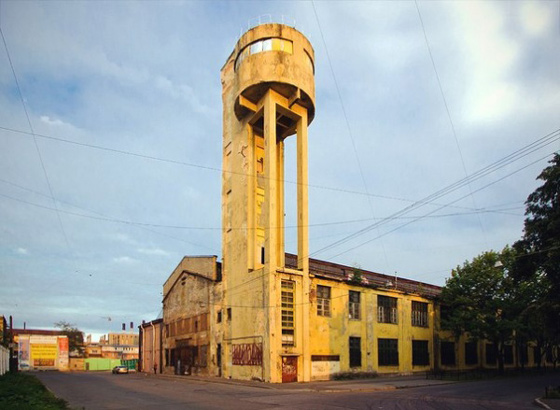 The cable workshop and the water tower of the Red Cloveshore plant, St. Petersburg
The status of other buildings listed in the book has yet to be found out, but it is safe to assume that the career of the architect Chernikhov was much more successful than it seems to us. Numerous design institutions, where he served, built throughout the Union, and factories built according to his projects are in the Crimea, Belarus, in the Urals and even in Turkmenistan. Why do we know so little about them?
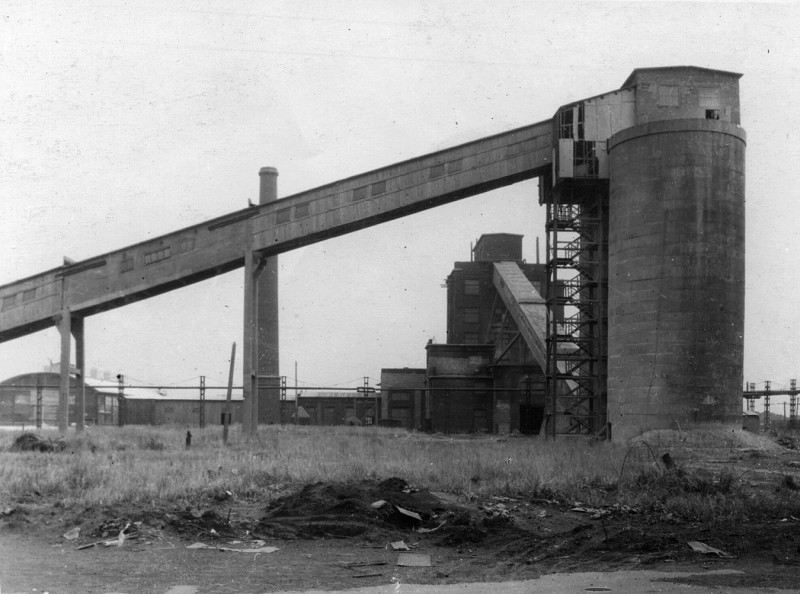 The building of the nephelin coagulant of the abandoned plant "Pigment"
The complexity of the study and popularization of industrial architecture, which Chernikhov clearly preferred civilian, is that she all the time hides behind her fences and barriers, in the area, inaccessible experience of a simple city dweller. The contemplation of architecture is always the joy of the first discovery. But it is one thing to observe the lights in the windows of the cylinder house Konstantin Melnikov (by the way, Chernikhov took Chernikhov in Markhi in 1936) from the bushes of Krivoarbatsky Lane or pilgrim to the House of the Central Union Le Corbusier. And quite another - with great difficulty to find an old factory corps, drowning in a slush industry, and finding that there have long been warehouses, garages or nothing left. In the second case, the opening remains personal, and collective experiences, often heated by the press, as you know, is always stronger. In a word, if you can’t bow to the construction, then we can assume that it does not exist for collective experience.
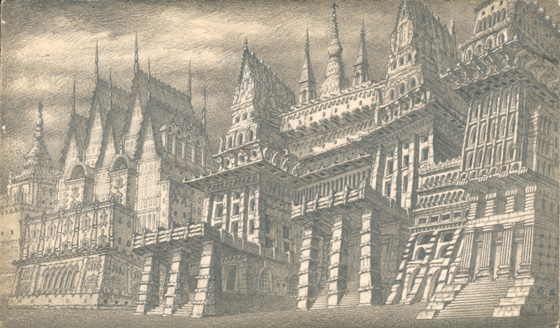 © Museum of Modern Art of Erarta Architectural Romance, 1931-1944. Series of antiquity.
Another weak point of industrial buildings is that they always represent a complex of buildings. Chernikhov called this "architectural industrial landscape." Both constructivists and late -Soviet modernists thought “industrial ensembles” and took care of their organic inclusion on the environment. The new building around, the change of industrial filling to the Office-Square after perestroika led to the fact that the “architectural industrial landscape” was turned into a mockery of the original intention before our eyes.
Maybe the point is that the buildings of Chernikhov want to be forgotten, in contrast to his pedagogical heritage. He created all architectural fantasies as educational illustrations, which he wrote about in his every book. From about 1917, he led classes in real schools, city schools, women's educational institutions, in unified labor schools and at the rabfaks. Almost nothing is known about the results of his teaching work, but Chernikhov taught the art of drawing simple hard workers that had not previously dealt with drawing and drawing. Chernikhov’s architectural fantasies have not yet lost their nutritional capacity: for the modern architect, these drawings are a powerful source of inspiration.