
Translated material
Vitaly Mansky: "Everything is there - fake"
“In the rays of the Sun” - this is the name of a documentary about the life of an eight -year -old schoolgirl Zin Mi in Pyongyang, the capital of the DPRK, shot by the Russian scenario written by North Korean comrades.
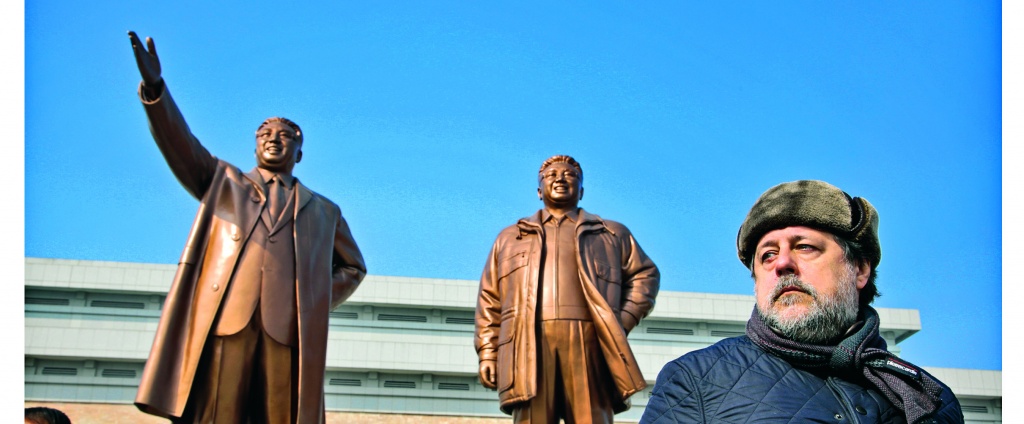
Vitaliy Mansky (Foreman on the right) on the set of the film, Pyongyang, February 2014
The film has already gathered a bunch of prizes and presses, and also awarded the notes of the Ministry of Culture of the DPRK of the Russian Foreign Ministry and the requirements of the North Korean side to ban it for further show.
What did Mansky see in Pyongyang? How did he manage to remove it and what failed? And how he left the observation of the North Korean Chekists-about this in an exclusive interview with The New Times after watching the film.
Have you been offered to make a film about the DPRK or was it your decision?
Well, of course, mine ... I was always interested in North Korea, because I was always worried about how, how can I suppress a person, how to destroy the fundamental principles in him, why a person is ready to obey. And it is clear that this film is not only about North Korea and not so much about North Korea. I read the journal Korea Today, eagerly grabbed the people who were there, always watched some video from there. And then one day I managed to get acquainted with North Korean officials - so everything spun.
Stalin VDNH
When did you first get into the country of Chuchha?
In 2013, I had the first introductory trip: they showed me what a wonderful country it was, and ultimately I managed to choose the heroine: I was taken to an exemplary school, five girls were brought to the director’s office, they said: “You have five minutes, you can meet and choose who you like.” The script of a documentary about a girl who joins the pioneers, in the Union of Children, is entrusted with a very important thing for her - to be a participant in the world's largest holiday, for which she and her comrades are preparing for a long time, and ultimately turns into one of the thousands of people who create this world's most living picture, depicting absolute happiness - by this moment it has already been written. Although the heroine was still to choose. I chose Zin Mi, because the girl said that her dad works as a journalist: I thought that I could get somewhere through his work. The girl said about her mother that she was working in the factory dining room. I thought: wonderful, dining room, people eat, also some kind of texture. And Zin Mi lives near the station, in a one -room apartment with mom, dad, grandfathers and grandmothers ...
But the film is not so: dad is not a journalist, and there is no dining room, and grandparents with grandfather too ...
Naturally. When we already arrived to shoot, dad miraculously turned into an engineer into an exemplary sewing factory, mom-into an employee of an exemplary factory for the manufacture of soy milk, and they live, as it turned out, in the most chic house of the capital with a fantastic look from the window. True, linoleum there, depicting the parquet, is simply cut off with scissors and lies over the cement floor - it was not even beaten under the baseboard, the furniture was just brought, the pictures just hung, I took an opportunity and looked into the cabinet - it was empty, the bathroom never used it, and there was no water, the light was turned on for the time of the filming, that the house was launched and the elevator was not resident Just for the sake of the film. But in this house at least three entrances were opened. And the house is opposite - I went around it when I managed to escape from the accompanying people - there was no entrance at all. At the same time, windows were burning in it, but having looked closely, I saw that they were all burning with the same lamps. Apparently, a system is set that in the evenings a common chip is turned on, and a certain sensation of a residential building is created, although the house is not populated and there are no entrances in it. Everything is there - fake.
How is it? Is it just worth the box?
Yes.
And mom and dad Zin Mi - are they real?
Real - I saw a family album. But the photos in this album were shot on some fake background, mounted in photographs from the magazine or against the backdrop of a furniture salon-I specially take these photos to the beginning of the picture ... Having lived there for some time, I realized that Pyongyang is the absolute Stalin, Brezhnevskaya VDNH, and all the inhabitants of Pyongyang are absolute exhibits. For example, there are lawns everywhere, and on the lawns early in the morning, at six in the morning, or in the evening, after work, bending down in three deaths, people are sitting and some kind of specks are taken out with tweezers.
By the way, when we filmed the exemplary sewing factory, where the dad of our heroine, as it were, works as an engineer (see photo on page 46), I went to the toilet and made a mistake of the door. I open the door, and there is a man of 150 naked women who wash in the soul. I managed to look out the window, and I realized that there are residential barracks in the factory, and this scene, when the workers go to the factory, are an absolute fake, because they live at the factory.
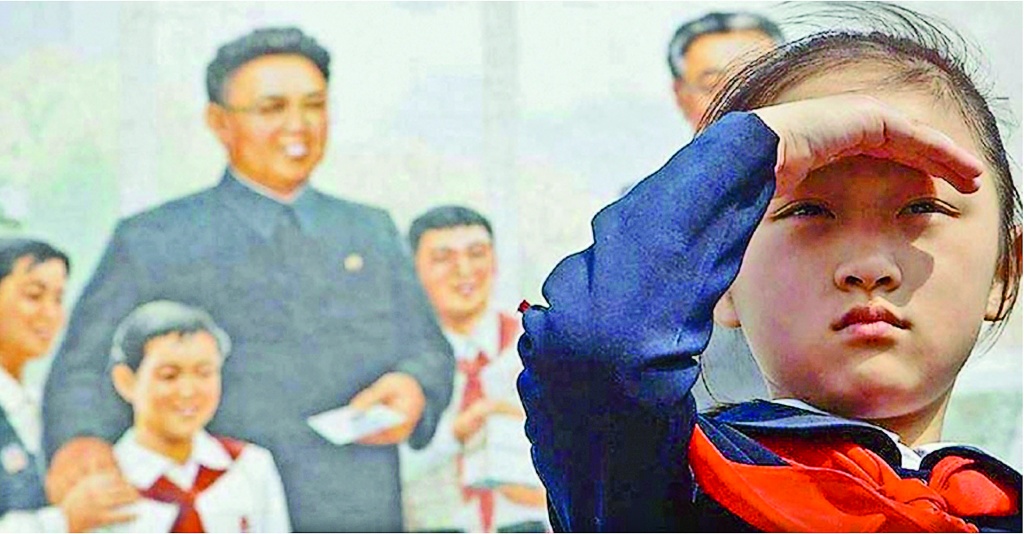
The main character of the film is 8-year-old Zin Mi against the background of the North Korean version "Favorite Leader and Children"
And what's the point in all this fake? There are almost no foreigners in Pyongyang, and if there are, then, as they say, do they go along a strictly defined route?
Don't know. From the end of October to the beginning of April, the country generally closes for visiting by foreigners: houses are heated either by carbon or firewood - the type of bourgeois protruding from the windows is unlikely to be attractive. North Korea now has the two most important world partners: China and, recently, Russia has become again, which receives about 500 visas in North Korea a year. My three trips, a group - four people - this is twelve visas; The annual arrival of the choir Alexandrov or the Choir of the Ministry of Internal Affairs is to take out a hundred visas, so consider how many people come from Russia. From China, apparently, more. Well, some very, very limited number of other foreigners.
A peeping life
Why then did they go to this venture with the film - not only is the Russian director, but also with your reputation as a rebel?
And how could they know that, if there is no Internet in the country? They probably believed that since Russia is their friend, so the rules in Russia are the same, and live there just as in North Korea. In addition, the film was officially supported by the Russian Ministry of Culture, and director Mansky made films about Putin - they had enough knowledge.
How many expeditions did you have in North Korea?
Two. Although there should have been three, they closed the entrance to us.
Why? They noticed that you secretly shoot a film about the film - the way all this theater about the happiness of life in North Korea is played, how duplicates are rewritten, how these very accompanying people say to people, what and how should they say?
They did not understand and did not see this. But they did not like that, for example, I was shooting because of the curtain in the hotel ... Once I wake up from the noise, go to the window and see a completely fantastic picture: six in the morning, the whole square, all the sidewalks are clogged with people who squatted, someone just chews, someone is sleeping, someone is lying on the rehearsal of the next rally. Naturally, I grab the camera and start shooting out the window. Three or four minutes pass-a knock on the door: my accompanying people, who, lived on the right and left of my room, say: move away from the window, do you want us to let you let in again? All that was shot in the film is unofficially-people pushing the bus, children at the garbage tanks, the queue for the utilization of coupons-all this was taken into the slot because of the curtain.
Could you walk through the streets?
No, our passports were immediately selected, and without passports it was impossible to go out into the street. But nevertheless, we ran out of the hotel a couple of times with fraudulent ways, we managed to run somewhere until we included the “interception” plan and we were not caught in the city.
Did you manage to enter the shops?
I was a couple of times in the department store, where I got into funny situations. The first time I was directly taken to this department store accompanying people. I walked around, looked, surprised how cheap everything was. This was my first visit, and I did not realize what was the matter - besides, a foreigner has no right to have North Korean money, and therefore I could not buy anything. But then I managed to get a little money, and with the accompanying I went to buy some souvenirs. I come to the department store, there are mountains of funny notebooks, I ask: I have three notebooks. Answer: "You cannot buy them." Then I realized: sellers, visitors, goods are not a real store, this is an exhibition hall. Another time, we - naturally, with the accompanying - went to the grocery store. There are 15–20 people there, all the shelves from top to bottom are laid down by packs of tomato juice. I ask how much tomato juice costs. The accompanying person answers the traditional: "Then we will tell." Me: "No, translate now." The saleswoman says for a long time, accompanying-to me: “They have not yet brought the price tag,” or something like that. I say: “Good. How much did tomato juice cost last week? " He translates: "Tomato juice is not for sale."
“I come to the department store, there are mountains of funny notebooks, I ask: I have three notebooks. Answer: "You cannot buy them." Then I realized: sellers, visitors, goods are not a real store, this is an exhibition hall "
And where and what did your film crew ate?
We had breakfast and dined at the hotel, in the evening they ate most often in the room-they purchased products several times, some canned sausages in the store at our embassy. Sometimes we were taken to foreign exchange restaurants: ten euros for lunch - inexpensive. For us - inexpensive. Do you know what is the salary of the main scriptwriter of the documentary cinema studio in Pyongyang, on which 800 people work? Its salary is 75 cents per month.
There are shots in your film when the family - mother, dad, girl - is going at a low table, which is all lined with plates with food. If in the country all products are distributed by coupons, and shops are exhibitions, then where is it from?
This is the food that was brought with us with a packed cellophane, unpacked, laid out on this table, put it, and people were really afraid to touch it. The accompanying them said: you eat, eat. They looked at them: can you really?
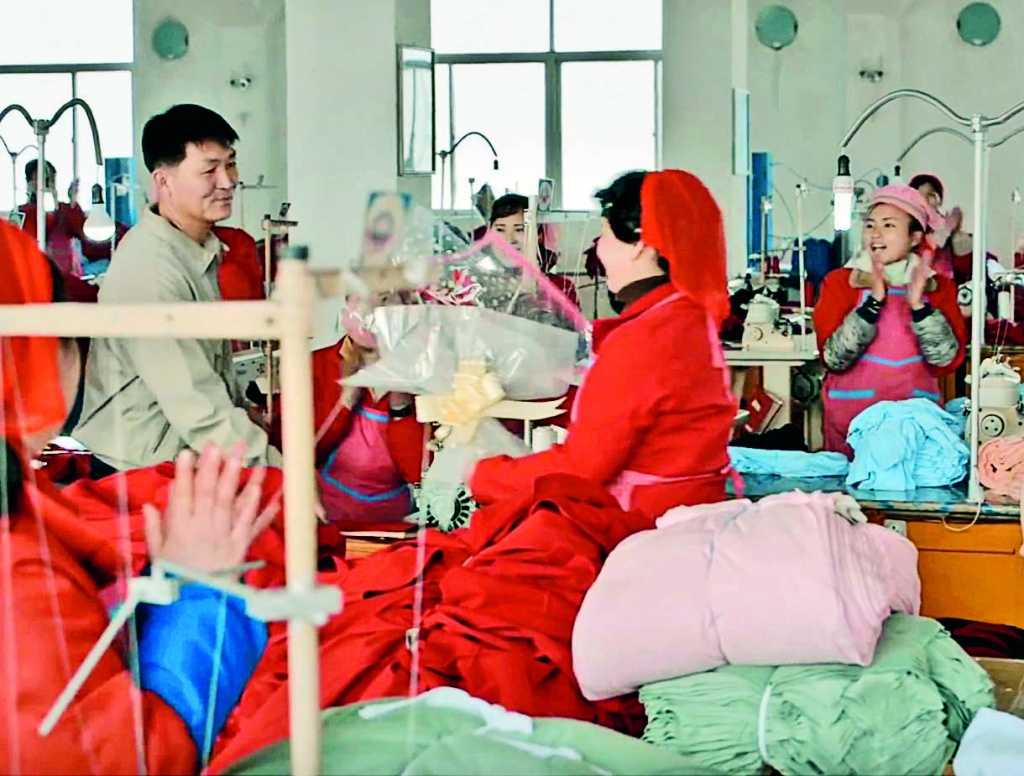
Shooting on an exemplary sewing factory. A man in the frame is Zin Mi's father, like an engineer. The film has two dumches of this scene: in the first, the employee reports that the plan is overfulfilled by 150%, the accompanying one stops it
After fear
But what's the point in stores, where the only product is tomato juice, and it is not sold?
I don't understand. I have more questions after my life in North Korea than before. I went there with some completely intelligible performance. Well, first of all, I thought that this was a system of fear, suppression, that people inside themselves understand everything. But, having plunged, I saw that people, in principle, not only do not understand, but do not even think ...
I once talked with the trainer of the tigers: he explained to me that when the tiger is born-the one that has to be performed in the circus-he is brought up from the first day in such a way that he does not know that he is a tiger. That is, he grows up, his claws, teeth, mustache grow in him, he growls, he jumps, but he simply does not know that he is a tiger ...
Here is an example for you: we shot in the subway. In Pyongyang in the subway, a foreigner cannot go without accompanying and can only pass two stops. That is, he can see three stations. There is a special route for foreigners: to enter a certain station and go out at a certain station. We did not have time to finish the shooting for two stops and ask you to give us a few more stations. In response - there is no categorical. They offer to go back and finish there. I explain: other people will already be on the way back in the wagons. The accompanying people answer: this is not a problem. And they command people in the car: "They got up and crossed the station." And the whole car gets up, goes and sits down in the car, which goes in the opposite direction. Silently, without discussion.
And these real people were in the car?
How do I know?
Do you want to say that there is no doubles in North Korea, as it was even in the Stalinist USSR?
No, absolutely. There are people-they were born in a given that their parents and their grandfathers lived, and they have no information that life can be some other-they do not go anywhere, they have no Internet. It seems to me that they no longer have fear-the horror is that this is something next, something after fear. You know, the most powerful explanation and exposure, if you want, is its television ... Naturally, it is forbidden to record television programs in North Korea, but we brought with us the following installation: we wrote a television signal for 24 hours a day on a hard drive - just in case. So, there are only two channels, of course, there are no advertisements - instead of advertising pauses, clips about the great leaders, content - either programs glorifying leaders, or reading a chuchha. There is not even news in our understanding of this word.
“They are completely sure: somewhere there is a war, North Korean troops go there, there is a front line, the soldiers die, and the leader takes care of their children ...”
And there are no films about love?
In no film in the history of North Korean cinema, no one has ever kissed.
Your heroes, mom and dad-did they somehow demonstrate their relationship?
No, nothing. They performed an important state business: they starred in the film.
Well, well, but people can’t ask the question why in the film they have food on the table, which they did not eat and did not see?
They know that they live poorly only because the United States against them ... When we shot the scene of children to pioneers, accompanying us at the children-about seven-eights, in military uniforms, and they say: "Their parents died in the war, these are children of the war." What is the war? The last war in which North Korea participated was sixty years ago! But they are completely sure: somewhere there is a war, North Korean troops go there, there is a front line, the soldiers die, and the leader takes care of their children ... They are fighting, they are really fighting.
What do newspapers look like there?
There are three newspapers in North Korea. By the way, newspapers are prohibited from exporting from the country and it is forbidden to use as paper. So, all newspapers are published on one pattern. The first page is the leader of the leader in the whole strip with a small text. The second page is the four faces of the leader in some kind of set with something and small texts to this. The third page is eight faces of the leader, as a rule, some common photos. And the fourth page is photographs of accomplishments, and in the very corner, events in the world: small texts with even smaller black and white photos, which reports on strikes, disasters, and the falls of aircraft. Every day behind these newspapers there is a queue in kiosks.
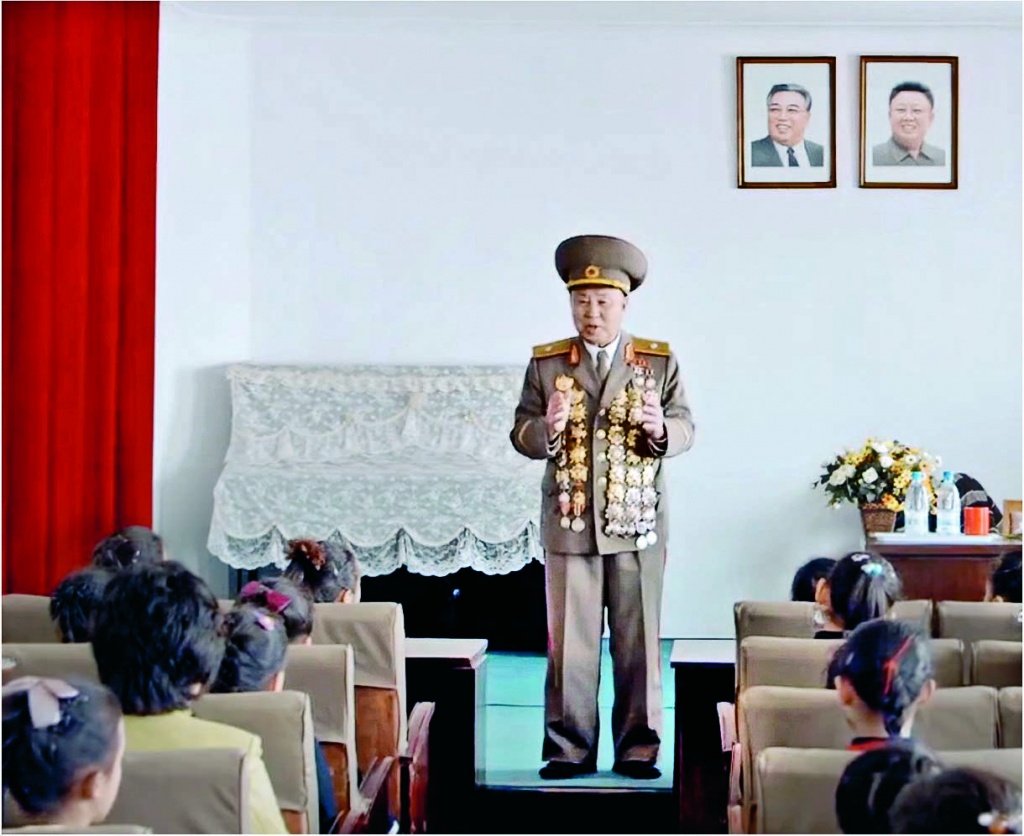
The veteran is not clear what war tells children about victories under the leadership of the great leader
You said that every day they had to take the footage. How did you manage to take out shots taken secretly?
The operator complained about his stomach every day and went to the toilet for 20 minutes. And he copied the shot material to another memory card. Honestly, this is probably my most difficult film - although I had many difficult films. But this was psychologically very difficult. For days under supervision, we speak with signs or go out into the corridor - but we had to discuss tomorrow's shooting, every night they barricaded in the room so that no one would enter at night, so that from outside it could not be opened at night ...
How many days did you shoot in Pyongyang?
- Although under a contract with the North Korean side they were supposed to 75.
“The operator complained about his stomach every day and went to the toilet for 20 minutes. And copied the material shot by secret to another memory card "
What happened later?
And then we were not given permission to enter - and so on until the moment when they found out that the film would be shown at the Film Festival in Tallinn: they did not know that the film was already going on almost the whole world. Then they invited us to return and finish the picture. But what's the point? Well, our Ministry of Culture, after the note of Koreans, asked to remove itself from the captions of the film. What is strange and stupid, because requests of at least 30 largest festivals around the world have already been confirmed, several countries have already bought a film for the television post, and in several European countries he goes to film distribution. And now my partners are discussing a contract for the release of this film in a film distribution in the United States of America.
Will the film show in Russia?
It would be worth, in my opinion, to show at a time when the program of Dmitry Kiselev is going on. But television did not contact me. As for the film rental, we will have to get a rental certificate - in the spring we, I hope, will do it.
Returning to the film: in the final of the picture, the girl suddenly burst into tears, your voice is heard behind the frame, and in response, Zin Mi begins to recite the oath of fidelity to the leader. What happened?
I think she cried because she felt a very big responsibility on herself, and she thought she could not cope. She was chosen. They chose to show the greatness, power of the country and devotion to her, and when she is asked a question that she answers, as she thinks, in insufficient way, she cries from confusion. She says: "I can’t understand if I did everything in order to be a grateful great leader." And from the feeling that no, not all, she begins to sob ...
Photo: YouTube.com, Personal Archive