
Translated material
A reminder of the Gallic War
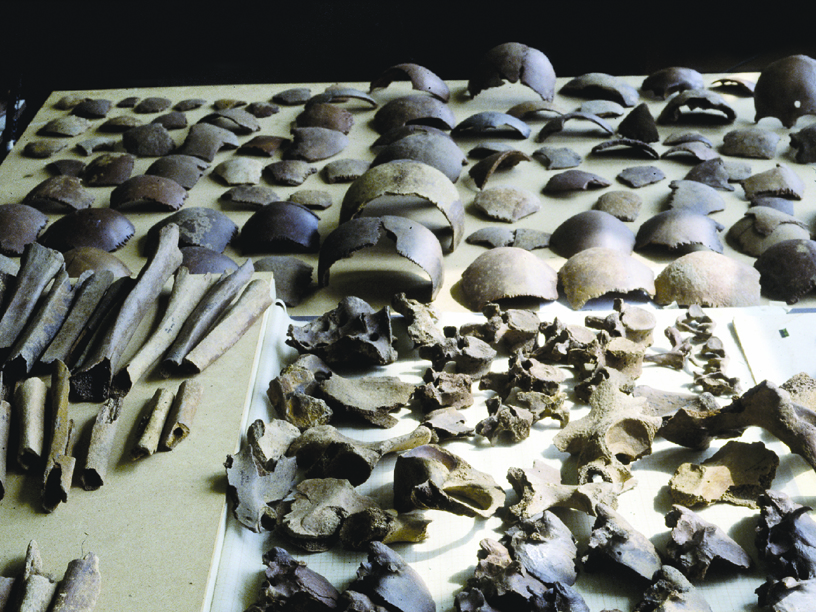
Dutch archaeologists discovered traces of ancient battle in the province of North Brabant. Scientists suggest that here in the 1st century BC, the army of Julia Caesar defeated the German tribes of tenkters and exceptas that came from the Rhine.
It was possible to localize the battlefield on the basis of numerous finds made in the area in 1975 - 2005, mainly during the work to deepen the bottom of the Vaal River. The battle occurred near the confluence of Vaal with the sleeve of Maas, 75 kilometers from the current coastline. Now weapons found in the battle area are stored in the Archaeological Museum of Alard Parson in Amsterdam. Among them are 20 swords, copies of copies, German cloak fasteners, Gallic cavalry helmet (the oldest of the found in the Netherlands), as well as the bones of more than a hundred people. Weapons and other items dates back to the 1st century BC, such a dating is confirmed by a radiocarbon analysis of bones. On the bones, numerous traces of wounds inflicted by swords and spears are noticeable on the bones.
Swords of the 1st century BC. e.
Recently, scientists from the Amsterdam Free University (Vrije Universiteit Amsterdam), having analyzed the isotopic composition of the bone remains found, discovered a strong argument in favor of the fact that these people were killed in Caesar’s battle with tenkters and uzipetts in 55 BC. e. The composition of stable isotopes in the toothache indicates that the owners of these teeth were not natives of this area, but came there from somewhere. Scientists continue to research to clarify where these people spent their childhood, but now they are comparing the result, indicating Caesar, the origin of tenkters and ulzipettes.
Jaws with teeth that were used for radioisotope analysis
By 55 BC, Caesar conquered almost all the lands of the Gauls. A few years later he had to actually repeat this after the whole Gaul was seized with an anti -Roman uprising, but so far he was not guessed and thought about strengthening Roman power over Gaul and the expedition to Britain. Suddenly, Caesar's plans violated the news of the invasion because of the Rhine of two German tribes. That's how he himself describes this in the “Notes of the Gallic War”:
“In the next winter (it was the year of the consulates of the Gn. Pompey and M. Crassus) two German tribes - amplifiers and tenkters - crossed a large mass of the Rhine River near its confluence with its confluence. The reason for this resettlement was that they suffered from the fresh for many years, which bothered them by wars and prevented the land to cultivate ” (hereinafter the translation of M. M. Pokrovsky).
Caesar with the army moved to meet the Germans. Soon, the ambassadors of tenkters and amplifiers arrived at him, who announced that “ if the Romans wish their friendship, then they can be useful to them friends; Then let them take the lands to them or leave them behind them with which they mastered with the help of weapons: they are inferior to only one fresh, with which even immortal gods cannot measure; And besides them there is no one in the world who they would not be able to win . ” Caesar refused to provide them with land in Gaul, but offered to settle for the Rhine next to the friendly Romans of the tribe of Kliyev, which he intended to protect from the Svevs. The Germans asked for thoughts for three days.
Caesar reports how he suspected that the Germans were simply dragging on time to succeed in their large horse detachment, who at that time went for the provisions of Mosa (Maasa). Therefore, he continued to move towards the camp of the Germans. The ambassadors asked him to stop until the agreed for three days expired, but he replied that he would move forward "no more than four miles." According to him, he sent a messenger to his cavalry, who was walking on the forefront, with an order not to attack the Germans, and in case of their attack, to limit himself to defense. In his notes, Caesar repeatedly repeats that all the requests of the Germans were a trick in order to win three days and let the German cavalry return.
In the meantime, the Caesar had no more than eight hundred German riders for five thousand horsemen, nevertheless, according to Caesar, the Germans suddenly attacked Caesar's vanguard and put him in. 74 people were killed, including the tsarist family of Pizon, who switched to the service of the Romans.
Caesar's actions against tenkters and excitations
After the news of the attack, Caesar decided to attack the Germans with the main forces as soon as possible, without waiting for the expiration of the agreed deadline. The next morning, the leaders and the elders of the Germans came to his camp with an apology for yesterday’s attack on his army (“treacherous and hypocritical,” Caesar writes about them). Caesar ordered to detain them, and he moved the army forward. Further events developed like this:
“ Having built the army in three lines, he quickly passed eight miles and reached the enemy camp before the Germans managed to understand what was the matter. They were all at once stunned: the speed of our offensive, the absence of our own and the impossibility, for a lack of time, consult with each other and take up weapons; In confusion, they did not know that it was better whether to bring the army against the enemy, whether to defend the camp or flee. While they discovered their fear with a noise and random running, our soldiers, annoyed by their treachery yesterday, broke into the camp. Here are those of them, who managed to quickly grab the weapon, resisted for some time and tied the battle between the separate carts. But the rest of the mass, consisting of women and children (they left their homeland and crossed the Rhine with all the people), rushed to flee the scatter; In pursuit of them, Caesar sent cavalry.
When the Germans heard a scream in their rear and saw their beating, they threw their weapons, left banners and rushed from the camp; But, having reached up to the place where Mosa merged with the Rhine, they had to refuse further flight: many of them were interrupted, the survivors rushed into the water and died, not cope with either their fear and fatigue or the force of the current. Our all to one, with the exception of very few wounded, safely returned to the camp, getting rid of a very dangerous war, since the number of enemies reached four hundred and thirty thousand people. Caesar allowed those who were detained in the camp, but they, out of fear of undergoing a painful execution from the Gauls, whose lands were ruined by them, said that they wanted to stay with him. Then Caesar gave them freedom . ”
Caesar exaggerated the number of enemy quite strongly. According to modern researchers, the total number of tenkters and exceptas was 150 - 200 thousand people, and not everyone participated in the battle with Caesar. And, although in the “Notes of the Gallic War”, Caesar in every possible way tries to justify his actions with the insidiousness of the Germans, even his contemporaries were in doubt about the ethics of Caesar’s actions, who seized the ambassadors and attacked tenkters and uzipettes during a truce. Plutarch says that when the Roman Senate “made decisions on the holiday and sacrifices in honor of the victory, Cato made a proposal to give Caesar the barbarians to cleanse the city from the stain of the oath -crime and turn the curse on the one who was guilty of this” (G.A. Stratanovsky and K.P. Lampsakov). The same Plutarch reports that the surviving part of the tenkters and the Uziputs returned for the Rhine, where it was adopted by the Germanic tribe of Swugambres.
Fragment of a woman's skull with a spear hole
So, the study of the dental enamel of the dead shows that they, like tenkters with the ulziputs, were aliens on the ground of Maas. Moreover, although male prevail among the remains, there are also the bones of women and children, which also corresponds to the story of Caesar. Although, for a more reliable confirmation, it would be good to detect objects that reliably indicate the participants in the battle, for example, the symbolism of the Caesar legions or coins related to this period.