
Translated material
The time when the word was expensive
What is close to us the story of a printing machine from Tolstoy to dissidents
What is close to us the story of a printing machine from Tolstoy to dissidents
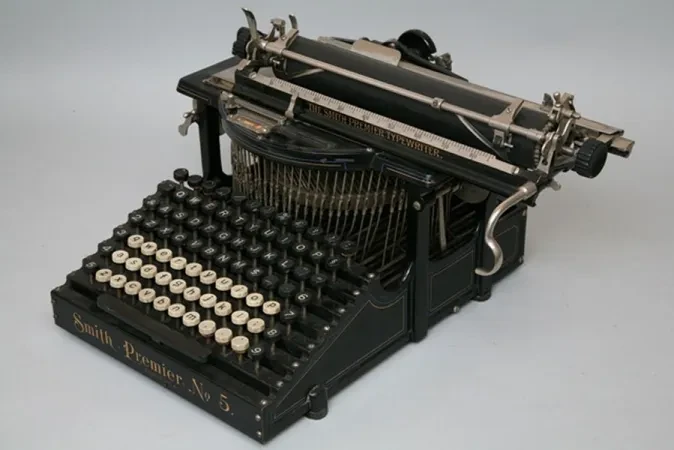
The exhibition “200 Bunning per minute” (author of the idea and curator Anna Narinskaya), who opened the other day in the Moscow Museum of Contemporary Art, at first glance has nothing to do with our realities. Printing machine is a distant artifact and not very past. But she helps to understand what it was we who lost by moving from industrial to the post -industrial world.
From the point of view of an advanced user, the time was monstrous. So I am writing this note now and corrected on the go. And the consciousness of a person printing on a typewriter did not imply this in principle. I was mistaken - print again. Nevertheless, the history of the machine is a history of errors and amendments. Here is a typewriter of Pasternak’s poem “Winter Night”. The touching word "mint" he rules the normative "blizzard". But the Roman of Ehrenburg, exhausted along and across the thaw. Here, errors corrected more ideological than grammatical ones. Sholokhova took care of the style. Instead of a “perch in a quarter of length” he inserts a “perch with a pencil stub”. So more precisely, this is a more visible image.
And the Mayakovsky rules mainly smashing into lines, made the famous "ladder". The rest of him worried less. From America, he brought the gorgeous machine "Remington", but he did not know how to print, asked the neighbor.
For Lev Nikolayevich, his daughter Sasha, with whom he was unusually strict. He forbade not only to meet men, but even think on this topic. And he allowed him to help him.
Solzhenitsyn printed on the very Gadeher "Erica", which Galich sang. But she really took only four copies, and the people needed much more. For Elena Voronyanskaya, who reprinted the Gulag Archipelago, this story ended tragically. During a hard interrogation in the KGB, she could not stand it and gave out the place where she hid typewritten. Then she hanged herself.
A similar story was with the seized machine -painting of Roman Grossman “Life and Fate”, a separate hall was allocated at the exhibition. But in this case, no one was hanging, the dissidents were stronger than the organs. They hid typewritten copies of the novel so reliably that they could not find them for many years. Then one copy went to the west, and the second was released in our perestroika.
The most popular joke of dissident. The son reads nothing but samizdat. Mother reprints “war and peace” for him at night. In this form, he is ready to get acquainted with Tolstoy.
And a joke, this time from Dovlatov. Lev Nikulin, Stalin Kholuy, was a front -line correspondent. Or maybe a political worker. In occupied Germany, he showed interest in bronze, porcelain, and wristwells. However, most of all he wanted to have a foreign writing machine. He once walked around the city. Sees - a crushed office. He looked. On the floor is a chic Underwood with a detailed carriage. Heavy, from cast cast iron. Nikulin plunged it into a tarpaulin bag. He thinks: "I will change the font in Moscow from Latin to Russian." In general, this bag was dragged by Leo Nikulin. For three months it was torn. He was guarded at night. Delivered to Moscow. I turned to the mechanics. He says:
- This is a Jewish machine. Prints from right to left.
So the Jewish god punished the political worker. ”
This, by the way, is an excerpt from Solo on Underwood. Dovlatov salted metaphorically, and years later, Alexei Aigi and his ensemble “4`33” played and recorded real music for the machine. With all sorts of Allegro and Andante, as expected.
Jokes jokes, and the type of production, strictly according to Marx, formed a completely special consciousness of writers. Since it is difficult to print, long and expensive (you have to pay the driver, and the cars themselves were expensive), the printed word was expensive. The text looked more final than now. And the writers were higher than the responsibility for him. This is not just a certain set of letters that easily arises in front of you on the screen, but something material, rude and visible. Associated with the continuous knock of the machine. Fingers, soiled ribbon and carbon carrier ... with heavy physical labor.
With the transition to computers, the average length of the literary text increased by 20%. Scientists calculated: writing physically it became much easier. The word began to cost cheaper. And they, words, became much more ...
Still, 200 beats per minute (the norm for engineers) is a lot. Through three more normal human pulse. Hence the literature of that era, a little inflated, feverish, with an accelerated pulse ... They planted it, it cost a lot of money, and sometimes life. And there was more love. In the very word, the engineer contained an erotic subtext. Explain why?
I asked Alexei Makarov, an archive of the international “memorial”, who advised the exhibition: “What would such an exposition look like on today's material?”
- I would exhibit texts that are prohibited to spread in Russia. There are many of them, and there are quite harmless ones. From any point of view. But I do not really imagine in which all this is exhibited. There is no equivalent of a typewriter today. What to put up? Modems? Hard discs? But this is already moving away. I'm afraid that such an exposition would be completely virtual. ”
The exhibition will last until March 13, 2016.