
Translated material
New "Sadist Law"
The State Duma allowed the FSB to shoot at the crowd, women and children
The FSB was allowed to use weapons against women, children and disabled people in case of armed resistance. In addition, security forces will be able to remove fingerprints from “suspicious” citizens on the border. New Gazeta asked deputies to comment on the law they adopted
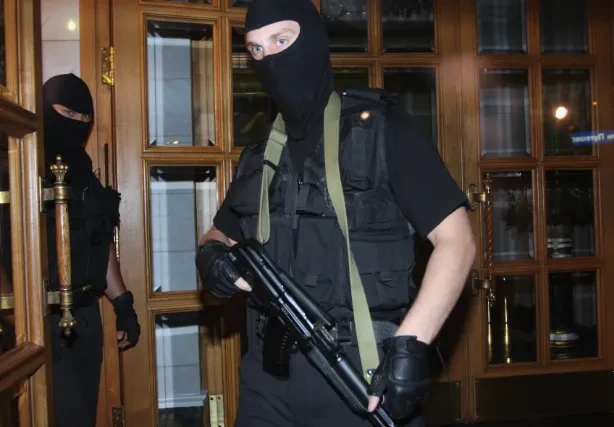
Deputies of the State Duma in the second and third, final, readings adopted amendments to the law on the activities of the FSB officers, expanding the powers of the security forces.
Initially, amendments were made in July this year, but until December, the State Duma was not made to discuss. On December 22, the document was submitted suddenly: parliamentarians learned about it in the morning, but the deputies were invited to vote for it in fact and without discussion. Meanwhile, 343 deputies supported the initiative, two voted against.
The security forces were allowed to use weapons against women, children and disabled people in case of armed resistance. In addition, the FSB will be able to remove fingerprints from “suspicious” citizens on the border.
The New Gazeta asked the deputies to comment on the law they adopted.
Will rallies affect
The main addition to the Law on the FSB was the expansion of the powers of special services in the use of special equipment. The security forces were allowed to use any means to suppress resistance to detain the criminal who can be armed with armed resistance, as well as to suppress the riots and block the movement of groups of persons.
In addition, the security forces received the right to use weapons against women, children and disabled people in the case of “armed resistance, the commission of armed or group attack that threatens the life and health of citizens or employees of the Federal Security Service, or a terrorist act”.
“There is practically no expansion of authority,” said Ernest Valeev, chairman of the Security Committee, who applied to the State Duma with a request to consider the bill. - The adoption of amendments is due to the fact that in the legislative act it is necessary to prescribe the unification of the application of physical force, special equipment and weapons in relation to all structures of law enforcement agencies. In fact, these amendments will simply record what is actually. The regulations were manifested on the use of special funds by the FSB officers in the accumulation of citizens. This measure applies to three situations: the prevention of a terrorist attack, repelled attacks on protected objects and during the operation to release hostages. I emphasize that the measure applies only to these three positions and will not affect other mass events and rallies, if there is no similar threat. For the most part, the amendments are similar to the provision that is spelled out in the law on the police. ”
Recall that in July, deputies of four factions introduced a law to the State Duma that expands the powers of internal affairs officers. According to the new rules, in order to “security of society”, police will be able to shoot to defeat women “without visible signs of pregnancy”. Nevertheless, the law was never admitted to the autumn session of the lower house of parliament.
The fact that the new amendments to the FSB law will record “what is actually”, Kirill Koroteev, a representative of the Beslan victims in the European Court of Human Rights, agrees.
“This is terrible,” Koroteev said Novaya Gazeta. - But in practice, this does not change anything. In Beslan, for example, the use of force was considered legal. But the most important thing is that in our country, not a single judge will question the actions of the FSB. ”
However, the deputy chairman of the Security Committee is sure that all innovations are necessary not in order to somehow limit the freedom of citizens, but to ensure the protection of the rights of each person.
In turn, deputy Dmitry Gudkov, who voted against the bill, said that amendments to the FSB law are similar to the bill on the application of force and special equipment in relation to prisoners. In October, the deputies in the first reading allowed the colony staff or the pre -trial detention center to apply special equipment regarding prisoners for violation of the maintenance regime, disobedience, and also if the prisoner could escape.
“The most unpleasant thing in this law is that the formulations from the“ Law of Sadists ”are migrated here, which means that to suppress resistance - and mass riots, including - FSB officers can use special equipment. For example, Ryklin stood on a picket - he was beaten, and by law they would be right, because the protesting did not want to leave, which means he prevented the execution and resisted to the security forces.
So the opportunity to get by the kidneys at a mass event has become much higher.
In my opinion, all these toughenings are quite serious, because employees of the special services will feel free and act at their discretion, while citizens will be defenseless before the arbitrariness of the security forces, ”the deputy summed up.
How to determine "tendency to terrorism"
In addition, parliamentarians endowed the FSB officers with the right to take fingerprints from “suspicious” citizens right during the passage of border control. At the same time, it does not matter whether it is entering a Russian citizen or a foreigner.
The reason for the surrender of biometric material will be suspicions of the FSB officer himself: among the controls undergoing control, he must find a person with signs “indicating the possibility of a citizen’s declination to terrorist activity, recruitment or involvement in a other way in terrorist activity” and carry him out in the procedure of dactyloscopy.
The main feature of the amendments is that these same signs in the bill are not indicated, and anyone can become the object of interest.
It is assumed that the signs will be determined by the leadership of the FSB, so the public will not find out about them.
After receiving prints, the FSB will be able to store, classify, use, issue and in every possible way dispose of the obtained biometric data at their discretion.
As Ernest Valeev explained, the need to adopt amendments is due to a terrorist threat, and the dactyloscopy at the border does not threaten ordinary citizens.
“Today, a large number of Russian citizens and the CIS take part in the activities of the Islamic State terrorist organization. Some of them returned, another part in the near future can be included in the country, so fixing biometric indicators in this case is necessary in order to prevent possible crimes. This measure will affect precisely those people in the relatively which the FSB has special information, for example, about their participation in terrorist organizations. We are not talking about ordinary citizens who are not suspected of anything, they will not take prints from them. But taking biometric material will help expand the capabilities of special services and complement the database of suspects in terrorism, ”the parliamentarian explained.
The State Duma deputy Dmitry Gudkov, who opposed the amendments, emphasized that the bill was directed against citizens and violates the right of each person to free movement.
“In this law, the provisions on biometry are not painted in any way, there are no clear criteria. Conventionally, the FSB officer can suspect you of something on any signs: they didn’t give a crap, ate Ukrainian borsch, they said the word Syria three times and so on. To take prints from everyone in a row - this already resembles a “big brother”, who controls everyone and everything. First of all, these amendments violate the constitutional right of each person to free movement. Why should I take prints on the border in my country? Am I a terrorist or a criminal? All this will lead to the division of people into the first variety and the second variety: there will be untouchable, and there will be those whom people in uniform will be pressed constantly. And the point is not even what they will do with these prints, and where they can then surfacing, but that the authorities directly violate the rights of each person, ”Gudkov explained.