
Translated material
Arrest for repost: folklore under trial - Soviet and modern

Researchers of modern folklore Alexander Arkhipov and Anna Kirzyuk compare the phenomenon of modern persecution for the “folk word” with the realities of the Soviet era.
Over the past two years, several events have occurred, after which (with all their apparent insignificance), a legal occasion appeared to talk about the return of Soviet repressive practices in relation to the expressed “folk word”. But do we have real grounds for this?
In March 2014, the RPR-Parnas activist Dmitry Semenov posted on his page on the VKontakte social network “Graphic image of a man with the face of the Prime Minister of the Russian Federation Medvedev D.A. In the papaha against the backdrop of a green flag with Arabic scribble and the text in the Russian language “Death of the Russian Gadin” ”, for which he was found guilty of calls for extremist activity and was a fine of 150 thousand rubles. Then Semenov was amnestied and released from the fine. The abolition of the fine does not cancel the failed fact of criminal prosecution for the repost of the demotivator - a very popular genre of “network folklore”.
This case caused a violent reaction and led to the emergence of demotivators on the topic of persecution for demotivators.
In December 2014, the Tatar activist Rafis Kashapov published several texts on his page on the VKontakte social network, including “Yesterday - Hitler and Danzig, today - Putin and Donetsk!”, Conducted by the demotivator, where their statements about Donetsk and Danzig, respectively, are given under the portraits of Putin and Hitler. As a result, Kashapov was accused of “exciting hatred or enmity” and of public calls to separatism and sentenced to three years in prison.
In July 2015, in Krasnodar, the activist of the Left Front movement, Julia, was brought to administrative responsibility for the "propaganda of Nazi symbolism." Just as in the case of Dmitry Semenov, satirical demotivators (this time - using a swastika) located on the VKontakte network became the reason for the persecution. The reason was, according to the Krasnodar activist, her opposition activity. In August, the Novosibirsk activist of the RPR-Parnas party, Alexander Maksimov, was fined for placing a drawing on his page with two hands, on one of which is a swastika, and on the other-a sickle and a hammer.
In all these cases, political activists became objects of persecution. The symbol or play of words turned out to be “dangerous” (propagandizing Nazism and “inciting hatred”) if there was a legitimate reason for persecution. But the farther to the forest - the more firewood. In 2014, Ekaterina Vologzheninova, a saleswoman from Yekaterinburg, who had never engaged in any political activity, posted on her page several pictures and poems that employees of the regional department of the FSB drew attention to. Among other extremist texts recognized by “extremist” texts, there was a caricature on which “a person similar to Putin President was inclined with a knife over the map of Donbass,” and the demotivator “The Border Service of Ukraine notifies that due to the lack of places in the morgues and a lack of refrigerators, the entry of Russian citizens into the territory of Ukraine is temporarily limited”.
Services that follow drug trafficking entered the war with network folklore. In July 2015, the FSKN Karelia brought an official of the official from the Petrozavodsk city hall for the publication in the profile of the social network of folklore poetic text - on charges of drug propaganda.
We will not quote the poem (so as not to share the fate of the accused), we will only say that on the Internet such rhymes with a violation of the expectation of rhyme are called “pies”-this is the genre of “network folklore” of Runet, which survived the peak of popularity in the early 2000s. For the past four years, a “pie” about amphetamine has been walking in a runet from post to post, sometimes on the so -called “airplane”, the function of which is, of course, laugh, but not to promote drugs at all.
The Petrozavodsk official, according to him, made the repost of the poem "for the sake of the joke." However, a linguistic examination was conducted at the trial, which concluded that the phrase from the poem is “close to the advertising slogan”, and the mention of the forbidden substance can be considered the propaganda of drug use among young people. After that, the official was sentenced to an administrative fine of four thousand rubles.
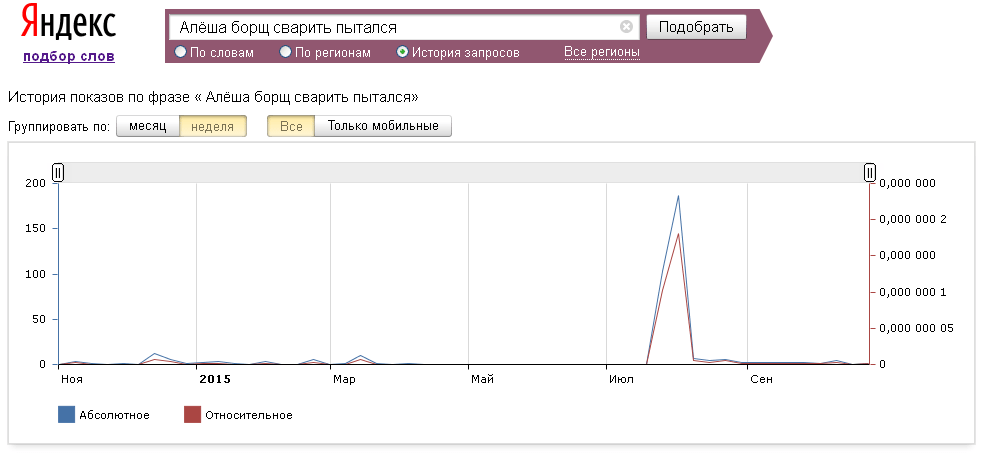
Paradoxically, the interest of the Internet audience in this marginal text arose precisely after the establishment of the case for its distribution. The “pie” was first recorded in 2012, but before and after July 2015 he was searched for by Yandex, while hundreds of people became interested in the Petrozavodsky official during the trial.
This type of “pursuit of folklore” naturally provoke persistent associations with the Soviet repressive policy, which, in turn, fit well into general discussions about the modern political situation. But do these two systems have real points of contact? And how much was the Soviet system in its assessment of folklore?
The notorious article of the Criminal Code 58–10-about “counter-revolutionary agitation and propaganda” (later “anti-Soviet”)-appeared in the mid-1920s. It was she who became the basis for the persecution "in the case of the systematic spread of rumors, gossip, jokes." The first mass arrests for jokes began in 1929 - for “counter -revolutionary propaganda in the form of Trotskyist jokes” and a little later, during collectivization - arrests for jokes “defaming the collective farm system”. On May 13 of the same year, historian Ivan Shitz recorded in his diary a popular rumor in Moscow: “The GPU seemed to circularly disposed of pursuing jokes that touch the Soviet regime” [1] .
Since 1934, Article 58–10 (“Anti -Soviet propaganda and agitation”) was used very widely, and those who sat on it were often called “jokes”. In the pre -trial practice of the NKVD, the emphasis was placed precisely on the spread of jokes, rumors and songs (it was not a question of their composition), which, of course, was connected with the wording of the article (“For distribution ...”). Therefore, coercion to retelling the jokes "weighed the sentence." So, in Tomsk in 1935, during the next cleaning of the Trotskyists, the military company who told each other political jokes was arrested. A certain A.P. Furman suffered more than the rest, because he, "taking advantage of what was a political worker, forced Dunaev and Glazkov he heard similarly by him, that is, Furman, counter -revolutionary jokes."
For the 1930s and 40s, the main composition of the crime was the spread of folklore texts and less often-storage of records containing them.
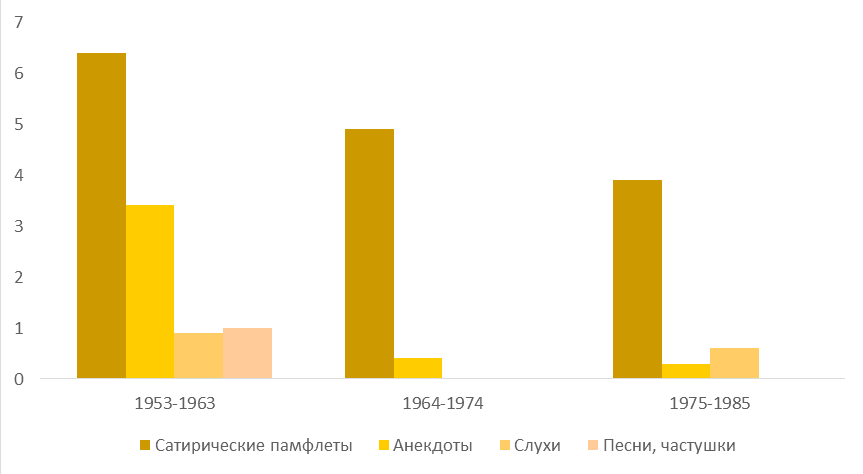
However, in the early 1960s, the strategy of Soviet punitive organs was changing: oral genres, which made up a significant part of the repressed seditions from 1953 to 1963, practically disappear from the field of view of the authorities. She almost ceases to be interested in rumors, songs and jokes. Something like a political folk pamphlet comes to the fore (“They cut off the oak on the Lukomorye, the gold chain was demolished into the traders ...”), close to naive literature. Such “Antihrushchev’s propaganda” in the mid-1960s was often found in places of cluster of the people, for example, in toilets or at stops: “And Nikita, like a bird, began to fly around foreign countries ...”. Such texts spread in writing, and not verbally, and it was they, together with another written sedition-political samizdat and naive religious literature-in the 1970-80s brought repressions to their authors and distributors.
The element of oral “anti -Soviet” as if generally ceases to be the subject of concerns of “relevant organs” or, at least, much less controlled. During the period of stagnation, the retelling of an ideologically dubious folklore text itself never caused arrest. Rather, he was perceived by the authorities as a convenient reason for the criminal prosecution of those who were engaged in active, as we would say now, “opposition activities”. One of the matters of the “developed socialism”, where the accused was charged with fixation and storytelling of jokes, is the case of Leningradka Irina Zurkova in 1983. The actual reason for the arrest was the connection of Tsurkova and the Fund for assistance to political prisoners. Due to some problematic pronouncing the topic of the fund, the prosecution party took advantage of the successfully tired notebook with jokes (we draw attention to the fact that it is about the written fixation of jokes).
But in the late Soviet period, the attention of the authorities increasingly attracts not oral, but the visual “creativity of the masses”, namely, nationalist drawings and cartoons for leaders. If from 1953 to 1963 the percentage of those arrested on such charges was very insignificant, then from 1964 to 1974 the number of arrested for caricatures doubled, and almost 4 times for images of Nazi and nationalist symbols. Even in “vegetarian” times, from 1975 to 1985, the number of accusations of this kind was more than in 1953. A typical case of this kind was, for example, the case of P. Starkch, who “in 1970-1972. He distributed leaflets calling for the struggle against the CPSU and with a pattern depicting a five -pointed star, connected by a sign of equality with fascist swastika ” [3] .
And now let's look at the affairs of some current activists, where images of the swastika (the cases of Julia Usach and Alexander Maksimov) and the comparison of Hitler with Putin (the case of Rafis Kashapova) were the reason for the trial. The extremely symbolically dangerous status of the swastika and in general any objects/characters related to Nazism is easily explained. Both in the Soviet and modern political topics, “fascism” is located in the locus of absolute evil (only recently it began to divide this space with ISIS prohibited in the Russian Federation). Therefore, in Soviet times and in 2015, the image of the swastika or Hitler next to the ruler is persecuted.
However, for carriers (anti -) Soviet folklore, the system of political meanings was clear, and the logic of symbolic repression was predictable. When Soviet people sent letters “letters in which they identified the Nazi fascist party with the CPSU” as amended by the newspapers and government bodies or painted a five -pointed star, connected by a sign of equality with fascist swastika on the leaflets, they perfectly realized in the seditaneity of their actions. The Soviet man knew where the political sedition begins, and could use this knowledge for his own purposes. The criminals, in order to change the zone (for example, with the aim of escaping from card debts), called the Soviet power “fascist” or made an appropriate tattoo, imitating an “exemplary” anti -Soviet statement, and thus sought the retraining of their criminal case to political.
Today, the Internet user understands that some sign can fall under the article of the administrative or criminal code. But he is not sure what exactly the context of use can make the sign “dangerous” because the policy of symbolic repressions in 2015 is unpredictable, which provokes some users to sad experiments. The other day, the Petrozavodsk journalist Vadim Shtepa posted on his Facebook page an image of the XIX century by the Sun symbol, and a photograph of a black boy with a similar symbol. According to Stepa, all this was done by him "in an ironic vein." The publication, however, attracted the attention of employees of the ED center. In the court of Steppe, he was found guilty of publishing posts with Nazi symbols and was put under arrest for one day for public demonstration of Nazi symbols.
Now the authorities do not always arrange the “red flags”, and the non -evidence of their location becomes the subject of jokes. The post of Karelian journalist, equipped with an ironic remark “Probably, will be imprisoned for this”, was aimed precisely at clarifying the borders of a “symbolic crime” (a month earlier, a Steppe was already fined for a photograph of the Finnish tank with a swastika).
How does the "guilt" of folklore occur? The interpretation of the “arrested” text (i.e., is the joke “slanderous”, and the demotivator/pie is extremist) in the current situation is partially carried out by the efforts of external experts, and partly due to the statements of the “indignant public”. For example, at the court in the case of Vologzheninova, the prosecution, an employee of Roskomnadzor V. Solodky, said that he experienced when viewing the page of the accused “a feeling of a spatched person, a citizen of the Russian Federation”.
However, in Soviet times, experts who extracted anti -Soviet maintenance from the "arrested" jokes were only the investigators themselves. This led to the emergence of a whole layer of folklore texts: “The judge and the prosecutor run out into the corridor from the courtroom, laughing loudly. - What's happened? - asks their policeman. “We heard such a joke joke, such a joke!” - Tell us! “We can’t, they have just been given for him for 10 years.”
But the main difference between Soviet cases and their modern analogues lies in the different understanding of the "authorship" of the folklore text. Different ideas about the role of the distributor (that is, the one who makes the repost of the demotivator or tells the joke is associated with this. At the court in the case of Dmitry Semenov, the defense insisted that the activist was not the author of the demotivator, but only made a repost. The lawyer of Ekaterina Vologzheninova cited similar arguments: “My client is not the author of the materials that she simply reposted. If they are extremist, why do investigators do not work to establish their authors and bring to justice? ” That is, from the point of view of the Internet user, the placement of the text (repost) on his page is just his transmission. The author of the dubious text can be convicted, not the one who spreads it. The question arising in such cases of the “distributor” can be formulated as follows: I posted the text on my page because I considered it funny. Thousands of people were placed before me, what is my fault? Nevertheless, modern judicial practice, judging by these precedents, considers the publication of such texts propaganda, which comes directly from who places them on his personal page. For Soviet punitive practice, the question of whether the defendant himself came up with, was not important (the fact of the spread of seditions was important). And the accused did not try to justify himself by the fact that the authorship of the text does not belong to him. In Stalin's times, wanting to soften his fate, he could say: “I said all this without any purposes and did not understand that it was anti -Soviet agitation” [4] .
So, the exact knowledge of the Soviet people about the composition of Kramola and the mechanisms of the following repression sometimes corresponds, and sometimes the opposite of the current situation, the specificity of which is the unclear of the boundaries of crime and punishment. One should only hope that their clarification will not become an relevant occupation for all carriers of modern folklore.
The material has been prepared with the participation of the portal "History Lessons" .
[1] Shitz I. I. Diary of the “Great Breaking” (March 1928 - August 1931). Paris: Ymca-Press, 1991.
[2] 58–10: supervisory production of the USSR prosecutor’s office in cases of anti -Soviet agitation and propaganda. Annotized catalog. March 1953 - 1991. M., 1999. Comp. O.V. Edelman.
[3] 58/10. Supervisory production of the USSR prosecutor’s office for anti -Soviet agitation and propaganda: an annotated catalog. M., 1999.
[4] From the materials of the supervisory production of 1955 http://corporatelie.livejournal.com/9934.html