
Translated material
C'est la vie at the end of the year
Christmas jazz. Exhibition 0.10
Ivan Tolstoy: Today's release over the barriers is made up of two topics. One of them will be a counterpoint throughout the program. Andrei Gavrilov called her "Christmas in Jazz." And since our program first comes out in the middle, between the two Christmas dates - December 25 and January 7 - no one should be offended.
Andrei Gavrilov: You know, Ivan, when Christmas comes, New Year, for example, it’s always interesting for me to meet him or at least think about how it happens in hot places. In hot, thank God, not political, not military, but purely climatic. I met most of my life in cold countries, in our climate. Sometimes I managed to get into hot countries for the New Year. Maybe because this is exotic, maybe because it was unusual, I liked it terribly, but still in recent years I celebrate the New Year where it is cold, where it is snow, but thoughts do not leave. And therefore, when I saw the play by Louis Armstrong “Christmas in New Orleans”, I immediately thought how it would probably be great to see what Christmas is in New Orleans, where, as I understand it, it should be warm and where, nevertheless, Dixyland was born, this is one of the Rodins of the world jazz.
(Louis Armstrong, "Christmas in New Orleans").
In 1818, a school teacher and, at the same time, the church organist Franz-csavier Grobert wrote a melody. He wrote a melody quite by accident in his small town of Oberdorf, when an assistant to the pastor of the local church came to him and showed a poem written on the occasion of the approaching Christmas. “Can this poem be put to music? You are an organist. " Gruber was an organist, but it so happened that their organ was broken at that time. But it was impossible to refuse the assistant pastor, so he took the guitar and wrote a musical accompaniment intended for the guitar. The melody was called "Quiet Night" or "Quiet Night." It so happened that after about 200 years, in 2011, UNESCO declared this melody part of the cultural heritage of mankind.
("Quiet Night" performed by the famous American trumpeter, a hurnist-hurnist and vocalist couple Baker).
Ivan Tolstoy: The second theme of today's release on top of the barriers is artistic, or rather, historical and artistic. Says Andrey Ustinov.
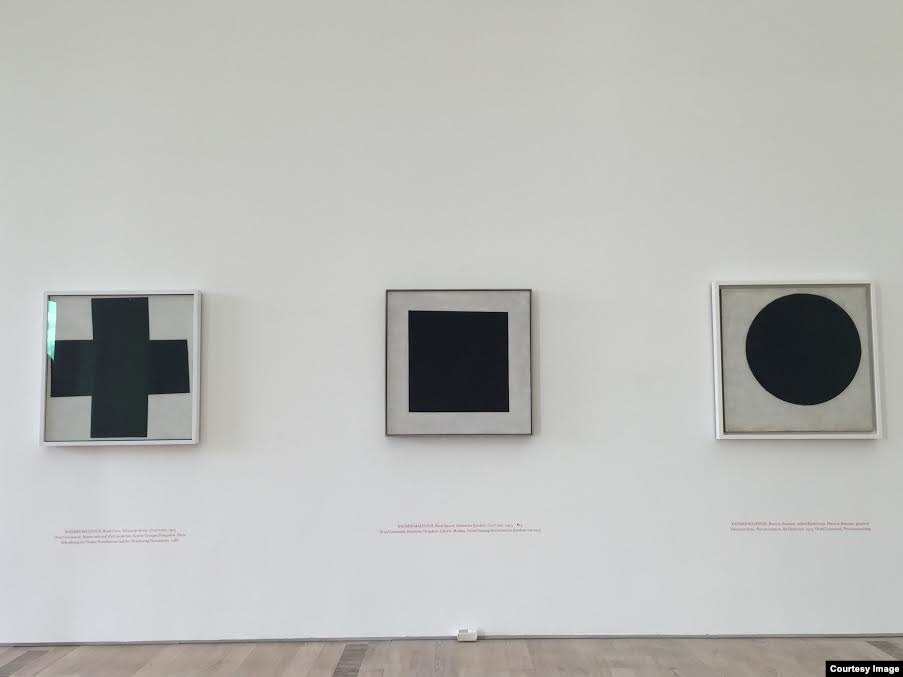
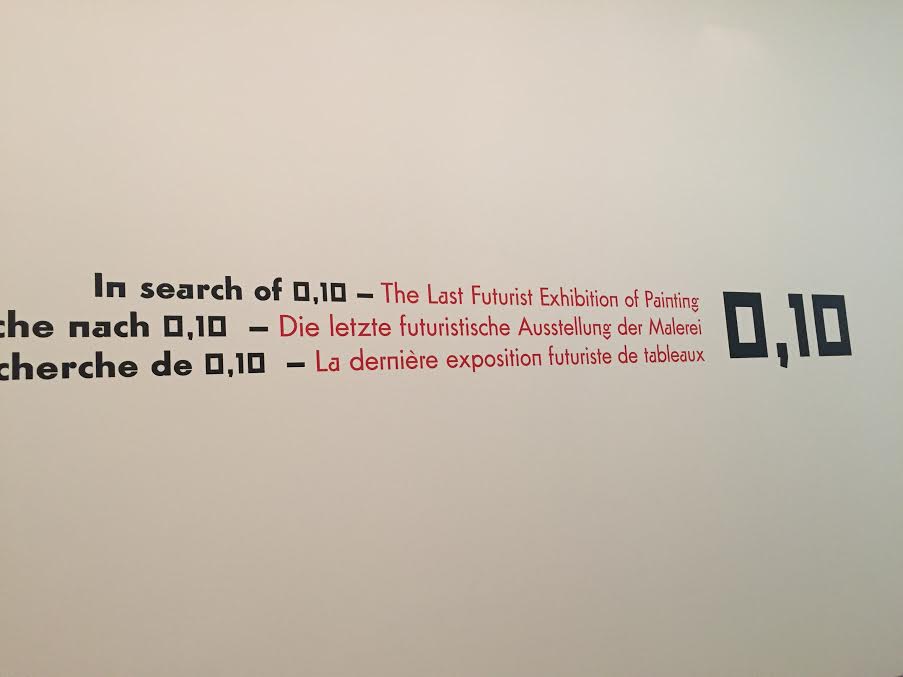
Andrei Ustinov: On October 4, 2015, in the Bailer Foundation in the town of Rien (such a small town, Basel’s suburb, in the famous Bayler Gallery building, built by the architect Renzo Piano), an exhibition called “In search of 0.10. The last futuristic exhibition of paintings. " This exhibition is open until January 10, 2016 and, as having visited it, I really advise you to visit it. What is the Bayler Foundation? This is an artistic fund, an art gallery that was opened by famous Swiss art dealers, a special building was built for it, and they arrange completely unique exhibitions. This exhibition is not the first, but the first, which is entirely dedicated to the Russian avant -garde. The exhibition was prepared by the invited curator, whose name is Meteus Jad, as far as I know, this is the American art critic and also art dealer, and on the day of the exhibition on December 19, 2015, he made a lecture under the name “From Paris and Petrograd. Russian modernism on the eve of the October Revolution. "
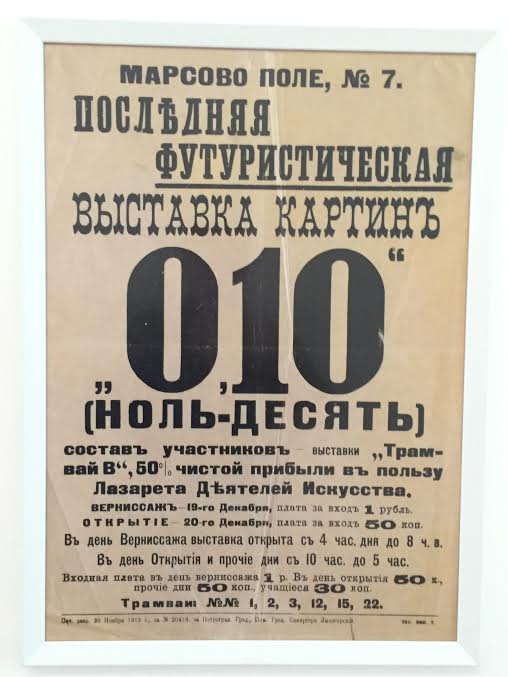
As you know, the exhibition “0.10” was wound as “The Last Futuristic Exhibition of Pictures” and opened on December 19, 1915 at the Madegracks of the Nadezhda Artistic Bureau, located in the house of Adamin on the Marse Field in Petrograd. The Vernissage fee was 1 ruble, and the official opening took place on December 20, the entrance ticket cost 50 cents. The exhibition lasted until January 17, 1916 and turned out to be exactly what it was declared - the last futuristic exhibition of paintings.
This name was not accidental. The organizer of the exhibition, the galleryman was Ivan Puni. Then the well-known artist is not yet, then he became famous, in the 20s, first in Berlin, and later in Paris, and for him this exhibition experience was not the first.
The first exhibition that he organized, returning from Paris, was called “The First Futuristic Exhibition of Pictures of the Tram B”, which took place in the same 1915 in the Hall of the Society for the Promotion of Arts in Petrograd, and opened on February 18, 1915. That is, 10 months have passed between the first futuristic exhibition of paintings and the last futuristic exhibition of paintings. At the exhibition “Tram B”, which was the first attempt to unite the left painters, primarily in Petrograd, 10 artists took part. Puni planned the same for the last exhibition, hence its name “0.10”. Zero, in this case, acts as an expression of the lack of subject forms, because this exhibition became famous for the first time Casimir Malevich announced the Suprematism. That is, zero is the lack of subject forms, a zero amount, primarily in Suprematism. And written through a comma 10 meant the number of participants who were invited to the exhibition.
In fact, 14 artists took part in the exhibition, but the name was no longer necessary to change, because it was also a reference to the exhibition “Tram B”, on which 10 artists were exhibited.
The significance of this exhibition in the history of the Russian avant -garde is huge. It was at this exhibition that Malevich’s works were first shown, which no one had seen before this exhibition and which later received the name “Suprematism”. First of all, we know about this exhibition from a photograph representing Malevich’s room, or rather, the hall where his paintings were exhibited. In the red corner of this room, a “black square” hung, declared in the catalog of the exhibition as a “black quadrangle”. At the same time, Puni did not allow Malevich to mention the word “Suprematism” in the catalog, so in the same room Malevich wrote by hand the slogans of Suprematism in painting, which were hung on both walls from the “black square” below. It was also written by hand and a list of paintings.
This photograph is widely known, and I must say that an attempt to restore the exhibition “0.10” in the Bayler Foundation is not the first. The first attempt to restore Malevich’s room was made at the Steedel Museum in Amsterdam in 2013 as part of the exhibition “Kazimir Malevich and the Russian Vanguard”. The designer of the exhibition was Marcel Schmalgimeer, and the curator was Gört Imans, with whom I had to work with the archive of the Steedel Museum, and I remember this with great pleasure.
Since the attempt to restore the Malevich’s room was already made in the Steedleik Museum, the organizers of the exhibition at the Bayler Foundation went a little differently. They did not try to restore Malevich’s room, but tried to collect as many paintings as possible, originally presented at the exhibition “0.10”. That is why the exhibition is called "in search of 0.10." Pictures were collected from a huge number of museums, including completely unexpected. Pictures were received from Astrakhan, from Yekaterinburg, from Makhachkala, from Samara, from Liechtenstein, from private collections and, of course, from the Steadeli Museum in Amsterdam, where a large number of Malevich’s paintings are stored, and from the museum in Thessaloniki, where most of the collection of George Kostaka is now stored, known as Kostaki's Sollection of Russian Avant-Garde. The organizers of the exhibition followed the path of the greatest representation - all 14 artists are presented at the exhibition, including the organizers of Ivan Puni, his wife Ksenia Boguslavskaya, and already forgotten artists - for example, the faith of the Premier, which does not appear in the catalogs dedicated to the Russian avant -garde, unlike Olga Rozanova or Udaltsova and Popova.
In addition, completely forgotten artists were also represented, for example, Anna Kirilova, Mikhail Minkov. In addition, the exhibition is represented by a separate hall Ivan Klun, the closest associate and student of Malevich.
And the exhibition makes an absolutely amazing impression not only by the volume of works presented, but also by the fact that it was possible to restore the context of this exhibition, first of all, due to explanatory inscriptions, where the concept of the exhibition was presented and the biographies of artists are given, and, in addition, chronology was restored - that is, what happened in the Russian art world before and after.
Separately, we are talking about the “Tram B” exhibition, reviews of this exhibition are presented, including the famous cartoons, as well as reviews for the exhibition “0.10”, including, for example, a small note signed by the “W” of the newspaper “Petrograd List”, which is called the “Futurist exhibition”. I will allow myself to read this review, because this is the usual reaction of artistic critics and newspapers to avant -garde exhibitions. So, "Futurist exhibition":
“Last year, a warm company of unaccounted for“ celebrities ”arranged an exhibition-trap, the“ tram ”they called. Many people fell on the bait of the gentlemen of the futurists, and paid their fifty dollars. Last year’s experience, apparently, liked it with a warm company and the same persons again threw their networks, opened the exhibition “0.10”, hoping to catch a small fraction of fifty-drawers on the entrance board. The open exhibition is no different from last year. The same reckless tin, the same cardboard tin cylinders, cones and bricks, stuffed on boards and the most unexpected motives in the catalog, such as “portrait of uncle”, “street”, “syntheses of beauty”, “suffering of blue joy”, “Suprematism of art” (moreover, the newspaper says “Subrematism”, and so on. In general, this exhibition is not nonsense of sick people, no, this is the crooking of the dodgers who expect to lure the audience and tear off the entrance fee from it - a fifty dollars. ”
Ivan Tolstoy: Let me remind you that today the counterpoint we have a musical theme "Christmas in Jazz." And for such topics, Andrei Gavrilov is responsible for us.
Andrei Gavrilov: When Christmas comes, many musicians record special albums, even sometimes several. The same was the same by the great singer Ella Fitzgerald - she had a whole album of Christmas songs. She chose a song written in 1939, which is called "Rudolph, Red -Beered Deer." This melody was written by Johnny Marx based on the book, which was called that, this song was conceived so that it was easier for children to remember the names of all the deer of Santa Claus, which were listed in this song. The song has become very popular and today it has been sold about 200 million copies. I mean records with records of this song in a variety of performance. Let's listen to Ella Fitzgerald. Rudolph is the main, the first deer of Santa Claus.
(Ella Fitzgerald, "Rudolph, Red Ben -Reindeer")
Of course, when a jazz musician plays Christmas songs, they can not always resist easy improvisations. Of course, lungs, because after all, people who buy Christmas records quite rarely want to hear the streams of music showing the improvisational skill of the musician, still, as a rule, buy in order to hear more or less familiar melodies. Nevertheless, of course, jazz musicians cannot completely resist the framework of classical performance. Here, look, Oscar Peterson recorded the song "Christmas spruce". In fact, this is a German song based on a folk melody, and it was initially dedicated to Christmas, it was a song about always green spruce, as a symbol of fidelity. The song told about the wrong girl who promised her love to one, then, in the end, gave her to another, and only the spruce, always green, forever faithful spruce, maybe her reproaches. But it so happened that gradually always green spruce became a symbol of Christmas, New Year, and the song became a Christmas song.
(Canadian jazz pianist Oscar Peterson, "Christmas spruce")
Ivan Tolstoy: Well, from musical art - to the visual. We return to Basel, where in the fall of 2015 an exhibition was opened in commemoration of the centenary of the famous Petrogradskaya “0.10”. Our storyteller Andrei Ustinov returned from Basel alive and unharmed.
Andrei Ustinov: In addition to the fact that Malevich put on “0.10” 39 paintings of a new Suprematist movement, he prepared a brochure for the exhibition “From Cubism to Suprematism. New picturesque realism ”, which was published by Mikhail Matyushin. Despite the expense of newspaper men, 50 percent of the net profit from the exhibition came to the disposal of the lasarens of artists. It was December 1915, the end of the second year of the First World War.
Why was the exhibition called the “last futuristic exhibition” if the “first futuristic exhibition” was held only in February? Because she summed up the whole direction. Ivan Puni, who came up with this exhibition, wanted to summarize the cubotourist period of Russian painting. The name Cubofuturism was used, but more on the ear was just futurism, so the exhibition was called "The Last Futuristic Exhibition of Pictures." And in the same way, Malevich, in principle, did not recognize futurism as directions, called his brochure "from cubism to Suprematism." It was the last futuristic exhibition, and for Malevich it was the end of the cubistry. From the memoirs and letters of contemporaries it is known that Malevich did not let anyone into his workshop, did not allow to look at what paintings he creates, and the name “Suprematism” did not appear in the catalog, so it is very curious to look at the paintings finished literally before the exhibition. Because on many of them on the white fields of his now iconic paintings - “Black Cross”, “Black Rectangle” or the same “Black Square” - his fingerprints are visible. Some of the canvases were presented at the exhibition not completely dried.
In addition to the review that I read, you can see the clippings from the newspapers and, above all, the famous article by Alexander Benois “The Last Futuristic Exhibition” from the newspaper Schu, as well as the books of Vasily Kamensky. Because he was also a participant in the exhibition, his paintings, as far as I know, he did not insert, however, I could be mistaken. In any case, there are no Kamensky paintings at the exhibition, but there are two of his books - “Naked among the dressed” and “Tango with cows”. They are represented here thanks to the Museum of Vladimir Mayakovsky in Moscow. That is, the originals are exhibited.
This is all the first hall of the exhibition. And then the organizers tried to hang the paintings differently than it was on “0.10”, but in the maximum approximation. Therefore, there are individual halls dedicated to Puni, the organizer of the exhibition, there is a separate hall dedicated to Ivan Klun, and two halls dedicated to Malevich’s paintings. And this makes a completely fantastic impression, because Malevich is a lot. Not all 39 paintings are collected, not all of the 21 paintings that are visible in the well -known photograph of the Malevich Hall from the exhibition “0.10” are represented, but Malevich is presented as much as possible. In addition, there is a separate room where the paintings of Rozanova, Popova and Udaltsova, which are called the “room of professional artists” are collected. There was a conflict at the exhibition, which is described in sufficient detail in Rozanova’s letters to Alexei Kruchenykh, related to the conflict with Ksenia Boguslavskaya. Ksenia Boguslavskaya is the wife of Ivan Puni. Naturally, he tried to present her paintings as well, but professional artists Popov and Rozanov did not accept her paintings or her behavior. This was due, on the one hand, with artistic discrepancies, and, on the other hand, with personal ones. As you know, Ksenia Boguslavskaya was not indifferent to women and showed her attachment in such an intimate way that, apparently, it was converted to the exhibition participants, up to the point that Rozanova calls her contemptuously “Punka” in letters to the twisted.
2015 can probably be called the next year of Malevich. In 2013, a huge exhibition was held at the Steedel Museum in Amsterdam, and in 2015, Malevich exhibitions are held in different cities of Europe. For example, the Malevich exhibition in the Museum of Contemporary Art in Bergamo is now being held, and the work of the late period is already presented there than the exhibition “0.10”. It seems to me that the most remarkable in this exhibition is just not to try to restore it in the form in which it was in the production bureau prey, but to present those artists who were exhibited in 1915, during the war, in Petrograd.
Ivan Tolstoy: And again the microphone Andrei Gavrilov. "Christmas in jazz."
Andrei Gavrilov: You probably remember, Ivan that at one time Churchill, at least, is attributed to him this phrase, called the USSR "a country with an unpredictable past." In the same way, we can say about jazz-the more time passes, the more old music-50-60-70 years ago-we begin to attribute to jazz, although in fact, when this music appeared, it went, at best, in parallel. We began to slowly take the blues to jazz, some even country melodies, and, of course, the melodies of Soul. Великая певица соула, которая уже считается великой певицей джаза, Махалия Джексон исполнит сейчас песню «О, маленький город Вифлеем!». Эта песня была написана еще в 19 столетии священником, который работал в Церкви Святой Троицы в Филадельфии. Он съездил в Вифлеем, на него это произвело большое впечатление, он написал это стихотворение и местный органист этой церкви Луис Реднер положил эту песню на музыку. Так и родился этот шедевр.
(Махалия Джексон, «О, маленький город Вифлеем!»)
Я говорил о том, как приятно оказаться в Рождество и в Новый Год в тех местах, где жарко, где можно ходить практически босиком, где снега нет, и вот выясняется, что далеко не все разделяют мою точку зрения. В 1945 году в Калифорнии была такая жара, что Сэми Кан, автор текста, и композитор Джули Стайн тосковали по снегу, им не хватало холодного воздуха, холодного ветра, настоящей зимы, и они написали песню «Пусть пойдет снег».
(Джазовый гитарист Джо Пасс, «Пусть пойдет снег»)
В 1934 году Джон Фредерик Кутс и композитор и поэт Хавен Гилеспи, они часто работали вместе, написали мелодию под названием «Санта-Клаус приходит в город». Они ее написали для радио-шоу, которое в ноябре 1934 года должно было начать предавать рождественские песенки. Сначала они хотели издать ее нормальным образом, не выпуская по радио, а напечатать ноты, все как полагается, чтобы застолбить за собой авторское право, но издатель им отказал, сказав, что это слишком детская мелодия и, в общем, она никому не нужна. И им пришлось сначала представить ее по радио. Через 24 часа было заказано 100 тысяч экземпляров нот и 30 тысяч экземпляров пластинки. После этого, разумеется, издатель прибежал к ним сам и заключил с ними необходимые договоры. На сегодняшний день продано более полумиллиона экземпляров этой мелодии. Мы послушаем, как мелодию «Санта-Клаус приходит в город» исполняет Билл Эванс.
Иван Толстой: Базель. Выставка «0,10» сто лет спустя.
Андрей Устинов: Производит эта выставка впечатление такое же, какое она произвела на современников. Совершено очевидно, что кубистический или кубо-футуристический период русской живописи подошел к концу, и что перед ней, перед русской живописью, перед русским авангардом открываются совершенно иные перспективы. С одной стороны, это супрематизм Малевича, с другой стороны, это предконструктивизм Владимира Татлина. Ощущение это не покидает, пока смотришь выставку, но организаторы пошли еще дальше, потому что параллельно с этой выставкой в соседних залах открыта выставка «Черное солнце», где собраны работы художников 20 века, которые так или иначе связаны с работами участников выставки «0,10», прежде всего, Малевича. Если на выставке «0,10» представлена картина Казимира Малевича «Черное и белое», то есть белый четырехугольник в левом нижнем углу, а остальной холст - черный, или можно это назвать «черный угол», картина, которая долго не показывалась, хранившаяся в коллекции Николая Ивановича Харджиева, то на выставке «Черное солнце» представлена картина Ильи и Эмилии Кабаковых, которая называется «Пропущенная Малевичем супрема Черный угол», написанная в 2006 году.
Выставка называется «Черное солнце» по огромной работе Дамиена Херста, нео-футуриста, в каком-то смысле, известного английского скульптора и инсталлятора. Основная работа этой выставки это как раз «Черное солнце», огромное полотно, которое, в общем, полотном назвать нельзя, потому что на белом холсте выложен черный круг, состоящий из трупов мух. Выглядит это, по-моему, немного по-идиотски, и лучше бы они выставили херстовскую «Акулу в формальдегиде», по крайней мере, у нее больше связи с авангардом чем у «Черного солнца». Но устроителям выставки, видимо, это показалось модным, чтобы выставить Дамиена Херста.
Гораздо большее впечатление производит работа швейцарского скульптора и художника Жана Тэнгли, которая так и называется «Tribute to Malevich». Это механические работы или механические скульптуры. Они представляют из себя холсты, на которых закреплены движущиеся фигурки, которые раз в 15 минут совершают свое движение. И, таким образом, пока они движутся восприятие картины совершенно меняется. В статичном виде они занимают одну форму, когда они начинают двигаться, они занимают другую форму, соответственно, возникает игра и движения, и теней, которые видны на холсте. И, в любом случае, стоит подождать до той минуты, когда эти скульптуры начинают двигаться. Помимо этого, особые впечатления на выставке «Черное солнце» производит зал Пита Мондриана, потому что, на мой взгляд, создатель группы Де Стиль и художник-беспредметник очень многое позаимствовал у Малевича, вернее, он вдохновился работами Малевича, которые были выставлены на Берлинской выставке.
Иван Толстой: О базельской выставке рассказывал наш специальный для таких тем корреспондент Андрей Устинов.
«Рождество в музыке». И микрофон другому Андрею – Гаврилову.
Андрей Гаврилов: Разумеется, не может быть какого-то разговора о рождественской музыке без Jingle Bells. Если вы помните, Иван, мы как-то с вами разговаривали довольно долго об этой песне, я не буду сейчас все это повторять, хотя у нее очень интересная история. Скажу только, что, как часто бывает, песня Jingle Bells в свое время была если не запрещена, то не рекомендована к исполнению детскими коллективами или в детских коллективах из-за некоторой неприличности, которую в ней углядели. Дело в том, что эта песня, вообще-то написанная к Дню Благодарения, а не к Рождеству, рассказывала о том, как парень с девушкой на санях уезжают подальше от внимательных глаз родителей девушки или тех, кто следит за ее благонравностью, и в то время это было чуть ли не единственной возможностью паре, которая состояла в неофициальных отношениях, поцеловаться, обняться. И в песне рассказывалось о том, как это приключение кончилось смешно, забавно и неудачно - у них сани перевернулись и их поймали, что они вдвоем были где-то далеко. Короче говоря, это было крайне неприлично по нравам того времени, а именно 19 века. Но, время прошло, нравы изменились, и Jingle Bells стала популярнейшей песней, в том числе, и в детских садах. Исполняет Уинстон Марсалес.
И в заключение - традиционная рождественская песня Auld Lang Syne, написанная в 1788 году Робертом Бернсом на народную мелодию. Песня, с которой прощаются со Старым Годом и приветствуют Новый Год в тот момент, когда часы бьют полночь. Исполняет оркестр Глена Миллера.