
Translated material
Accusation of Putinization of Europe
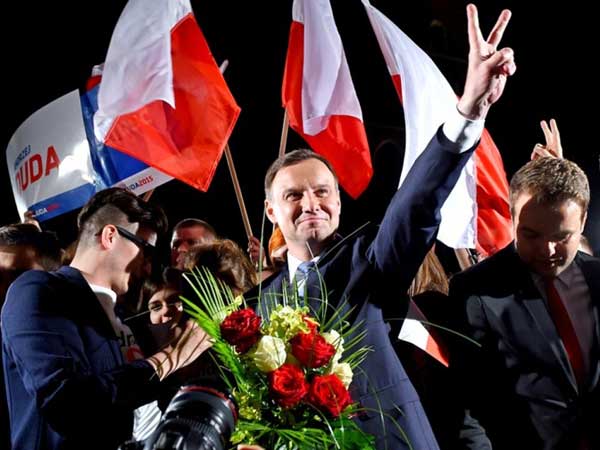
On January 7, Polish President Andrzej Duda signed a document introducing amendments to the media law, which provoked mass discontent of Polish journalists. In their opinion, the changes made overly enhance control over Polish media.
Amendments to the law on the media involve the expiration of the term of powers of current members of the board and supervisory councils of the state television company TVP and Polish radio. In addition, the right to appoint a new composition of the leadership “before the introduction of a new organization of state media” is received by the Minister of Finance of Poland, he will also get the opportunity to amend the charters of the state media so that they correspond to new amendments. New amendments led to a series of dismissals in the leadership of several Polish television channels.
This bill has already been adopted by the Sejm and Senate of the country. “It is very important for the president that state media be impartial, objective and earned confidence,” explained the head of the head of the office of the President of the President of Malgozhaya Sadurski in an official message on the website of the President of Poland.
These amendments instantly caused a violent reaction of all parties. Thus, a number of German politicians representing the Christian Democratic Union/Christian Social Union (CDS/CSS) in the Bundestag considered that the changes made by the president of Poland to the media law may contradict European values. In their opinion, it is quite possible that Europe will have to find strength and impose sanctions against Poland. According to a member of the Folker Cauder in an interview with Der Spiegel , the Polish government should know that it is unacceptable to violate the fundamental values of Europe . According to his ally, Chairman of the CDU/CSS in the European Parliament, Herbert Reul, economic sanctions against Poland will be necessary if the political dialogue does not give results.
On January 10, the chairman of the European Parliament Martin Schulz also made a loud statement, in an interview with the publication Frankfurter Allgemeine Sonntagszeitung, he accused Poland of Putinization of Europe. According to Schulz, the adoption of a new media law led to the fact that Poland began to build its policy on the model of Russia. “The Warsaw authorities consider their victory in the elections as a mandate to subordinate state well -being to the will of the winning party. This is a controlled democracy in the style of Putin, a dangerous Putinization of European policy, ” Kommersant quotes the policy.
Schulz said that on January 19, the question of what is happening in Poland will be raised in the European Parliament. In his opinion, the European leadership must unite in order to oppose the policy that the leadership of Poland is currently pursuing. He, like Kauder, believes that the political course of Poland is contrary to European values.
Soon after, there was information that the Minister of Foreign Affairs of Poland Vitold Vashchikovsky called the German ambassador to Warsaw Rolfa Nickel in connection with the “anti -Polish statements of German politicians”, reports Radio Poland. However, it is not specified which statements are meant. This meeting will be held on Monday, January 11.
In this context, one can recall the statement of the week ago, which was made by the European Commissioner for the digital economy and the information society Gunther Ettinger. In an interview, he said about the need to supervise Poland: “Much indicates that we will have to maintain control over the mechanism of the legal state and put Poland under observation.”
“The more we care that the state media can fulfill our mission being independent sources of information, the more we must strengthen the independence of the organs that are responsible for this,” says Mr. Ettinger.
In Poland, this statement was perceived very seriously. The Minister of Justice of Poland Sybignnev Zebro wrote a response letter to Ettinger, in which he explained that amendments to the media law are pursuing a different goal: they should “return objectivity and independence to the Polish media.” He compared the European Commissioner about the European Commissioner about the supervision of Poland with the methods of "the Second World War."
“You want to put Poland under surveillance, under supervision. Such words, spoken by a German politician, cause the Poles the worst associations. Including me. I am the grandson of the Polish officer who during the Second World War fought in the ranks of the Kraiova army with the "German supervision", ”Zebro quoted Radio Poland quoted .
In addition, the new amendments were sharply criticized as a journalistic community outside Poland (in particular, the European broadcasting union and the European Federation of Journalists) and within it. This is due, first of all, with the fact that relying on the changes made, the very next day in the leadership of large Polish media, serious rearrangements began. Two days after the adoption of amendments across the country, protests were held, which in total collected about 20 thousand dissatisfied, Gazeta Wyborcza reports . The protests were organized by the Democracy Protection Committee (code), moreover, not only in the cities of Poland, but also beyond: in Prague and Stockholm.
Participants in the shares criticized the current government and chairman of the ruling party Yaroslav Kachinsky, who was compared with the head of North Korea Kim Jong of the other, as well as with Russian President Vladimir Putin.
The organizers explained their initiative by the fact that the amendments led to the fact that the state media became dependent only on the government and the policy of the management of the ruling party. The code declares the rejection of such an environment for journalism.
The head of the Ministry of Finance of Poland David Yatskevich reacted to these protests, he stated that the committee was only trying to draw attention to its own requirements in this way, which have nothing to do with reality. He recalled that before, when a law was adopted, concentrating all the media in the hands of the ruling party alone, none of the code was against it.
Recall also that the European Commission has another reason for the discontent of Poland. At the end of December, Andrzej Duda approved the amendments to the Law on the Constitutional Court, which caused many disputes and discussions. According to the new law, the Polish Constitutional Court will no longer be able to terminate the powers of judges and will only have the right to prepare the corresponding request to the lower house of the parliament, and this applies only to especially egregious cases. Disciplinary sanctions against judges can also be applied only at the request of the President or Minister of Justice. The new law also expands the number of judges from 9 to 15, and the approval of decisions will be possible with the consent of two -thirds of the composition, and not the usual majority, as it was before.