
Translated material
"We are obliged to be silent oppositional"
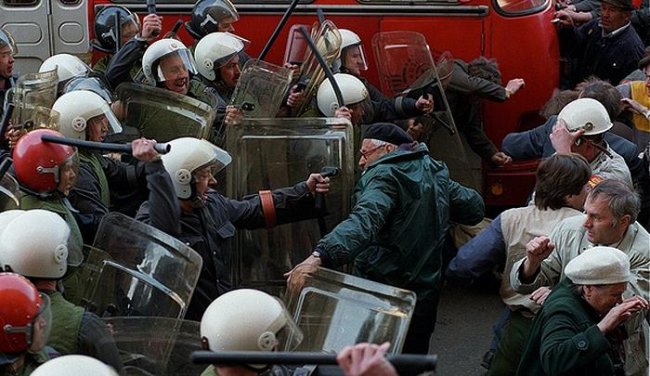
Journalist Yevgeny Buzev, who created on the VKontakte social network the group “It fell apart” dedicated to the collapse of the USSR, as well as preceding and following these events, tells about the history of the police of the special purpose (riot police) in the last years of the existence of the Soviet Union and the era of the formation of post -Soviet states.
The first riot police detachments appeared in the Soviet Union three years before its end, in 1988. Before that, with the riots, they fought the army and the “ordinary” police. But restructuring, along with publicity and acceleration, brought the mass riots of such a scale that the “ordinary” police were powerless against them.
If for the USSR “Riot Police” was a perestroika novelty, then the neighbors on the Eastern Bloc in this matter were overtaken by the Soviet Union for decades. The Polish special forces of the Zomo police have persisted dissatisfied from the end of the 1950s. Especially the "Zomovites" were noted, suppressing the performances of "solidarity": they did not hesitate to use firearms. In service, Zomo was a serious arsenal, which the Poles helped the "older brother." In particular, Polish manufacturers in the 1980s supplied the Soviet police with specialized armored bodies SHL-740, which were installed on police trucks.
The Soviet police special forces immediately drawn into a whirlpool of perestroika policy. Moreover, riot police appeared not only in Moscow and Leningrad, but also in the capitals of the Union republics, which have already begun an active struggle for independence. For example, a direct descendant of the first five Ukrainian detachments of riot police became the Berkut that is now disbanded.
The history of riot police is the history of military and social conflicts throughout the former USSR. Experienced and physically trained employees, those who served in the Airborne Forces and the Marine Corps, and ideally participants in hostilities were selected into the detachments. The veteran of Afghanistan was Cheslav Mlynnik, the commander of the most famous Soviet riot police - Riga.

The Riga riot police was considered one of the most prepared and cruel units in the entire structure of the Soviet police special forces. In May 1990, after the proclamation of the independence of Latvia, riot police saved young independence, dispersing the demonstration of Interfront, which went to storm the building of the Republican Supreme Council. Interfront advocated the preservation of the republic as part of the USSR. But soon riot police replaced political priorities.
This happened after the Minister of Internal Affairs of Latvia became Alozes Vaznis. Firstly, Vaznis banned the activities of the unit in the Viking security cooperative, which sensitively hit the policemen pockets. Secondly, Latvia did not require mainly Russian unit in composition.
In the republic, dual power reigned: at the same time, state bodies of two states - the USSR and the Latvian Republic acted. OMON chose the USSR and already in January 1991 began to periodically seize strategic objects. The riot police were not given resistance: there was no one to resist, the republican statehood was only formed, the power structures were in its infancy. Of the armament, Latvian security forces often had only hunting rifles, while riot police even had armored personnel carriers. The riot police captured the most serious arsenal of the republican police at the Ministry of Internal Affairs of the Ministry of Internal Affairs at the same time, in January.
On January 19, 1991, when the barricades were built in Riga, fearing that the troops would be introduced to the republic, as in neighboring Lithuania, someone still decided to fire the riot police in the area of the Ministry of Internal Affairs of Latvia. After a short battle, riot police without losses and in small composition took the building of the Ministry of Internal Affairs storm. Five people were killed during the shootout: police officers are defenders of the ministry (both Slavs by nationality), journalists and a passerby schoolboy. So far, both in Russia and in Latvia, the conspiological version that the clashes were provoked by the “third force”, in which they see the provocateurs from the Latvian side, or the special forces of the KGB of the USSR, were provoked.
In the spring, OMON began to make active raids beyond Riga, eliminating Latvian customs posts. Riot police officers behaved with Latvian customs officers, as with ordinary criminals. They burst into the post, put their faces in the ground, confiscated the weapon, if it was, and the post was burned. From the Lithuanian side, the “fraternal” riot police of Vilnius helped in this.
Vilnius riot police, like his Riga colleagues, began with the struggle for the country's independence. In January 1991, Lithuania was in a deep crisis, the government went to increase prices, this led to demonstrations of protest by pro -Soviet forces. From the assault by the dissatisfied, the Supreme Council of Lithuania rescued the detachment of the local riot police under the command of Boleslav Makutinovich (it is noteworthy that both commanders of the Baltic detachments were ethnic Poles, whose share in the national composition of the USSR did not exceed 0.4%). But just a few days later, when the troops entered Vilnius, the detachment took opposite positions and turned into direct subordination of the USSR Ministry of Internal Affairs. Evil tongues associated this with an extraordinary confession of the title of Makutinovich.
The story with customs posts ended in a tragedy. On the night of July 31, a cruel attack occurred at the customs point in Lithuanian Moidininkaye on the border with the Belarusian SSR. Seven employees of the post were killed, one seriously wounded. At the moment, the former employee of Riga OMON Konstantin Nikulin is serving a life sentence for this attack. A few more people are wanted and hidden in Russia. The riot police themselves deny their involvement in the attack.
In August, in Moscow, the State Emergency Committee began, and Cheslav Mlynnik opened the secret package, which contained instructions on the actions of riot police in conditions of emergency.
About a day it took the Mlynnik detachment to get full control in Riga. They occupied almost all state institutions with the exception of the Supreme Council. Near him, riot police waited for the last order to bring the "constitutional order." But the assault failed with the putsch.

Subsequently, both the Riga and the Vilnius riot police were evacuated from the territory of the republics, whose authorities breathed a sigh of relief.
But, as a rule, police special forces did not occupy a pronounced political position on the collapse of the USSR, but reacted to new statehood as a given. So did the Baku riot police, who took an active part in the Karabakh conflict. First, as a detachment of the Ministry of Internal Affairs of the Azerbaijan SSR, when he expelled Armenians from Nagorno -Karabakh during the operation “Ring”. In the first composition of the Azerbaijani riot police, the Slavs were enough, but the Armenians explained the cruelty of eviction by Muslim hatred.
After 1991, Opon (as the unit began to be called) fought for independent Azerbaijan. Among the Slavs, awarded the highest honorary title “National Hero of Azerbaijan”, like a military pilot Ruslan half, there is also riot police Yuri Kovalev. In honor of it, the school is even named. Kovalev died in 1992 in a battle with the defense army of the Nagorno-Karabakh Republic.

Sometimes the support had to deal with the “distant relatives” - the Armenian Omor (a detachment of police response). But the Armenians, unlike Azerbaijanis, had enough military specialists, and the Armenian police special forces did not play a serious role in the war.
The Azerbaijani support eventually decided to intervene in politics and finished worse than Riga. In 1994, Ruston captured the building of the Prosecutor General with political requirements for the president, and in 1995 he raised a military rebellion. Formally-due to smuggling copper, which commercial structures were exported from the territory of the republic under the control of the support, but without the knowledge of the authorities. The President of Azerbaijan Heydar Aliyev took advantage of the reason for a full -fledged military operation, and there was no sorted in Azerbaijan, and his last commander Rovshan Javadov died of gunshot wounds received during the confrontation with government forces. According to the opposition, Javadov was simply thrown in the hospital, forbidding him to help. By the way, the fate of copper, with which the power confrontation began, is still unknown.

In Russia, riot police never opposed the authorities, she well understood the importance of this tool. The detachments of the Russian riot police first defended the course of Boris Yeltsin on February 23, 1992, when they dispersed the pro -communist demonstration in honor of the Day of the Soviet Army, in which many pensioners participated. Since then, the image of a riot police beating the old man has become common in Russia.
In the same year, riot police eliminated the tent town of Labor Russia with Ostankino: the Communists demanded the broadcast. The camp acceleration happened on the morning of June 22, which gave the actions of the special forces in the eyes of the opposition special cynicism.
On May 1, 1993, in Moscow the most powerful street battles at that time in the entire short history of the Russian Federation took place, one riot police died. He was told about all the channels of pro -government television, practically bypassing dozens of victims of demonstrators, among which, as in previous skirmishes, there were enough elderly people.

For the death of his riot police, he recouped a little later, during the October political crisis, when the main severity of the struggle with supporters of the Supreme Council on the capital's streets fell on his shoulders. Losses on their part only according to official figures are calculated by dozens, although how many of them the riot police killed, and how much special forces of the Vityaz internal troops are unknown. In battles, the unit employees also died, such as, for example, the inspector of the OMON detachment Alexander Mavrin.
In the first Yeltsin years, the divisions of police special forces appeared in most subjects of the Federation, and one detachment was created three times. After August 1991, Chechnya and Ingushetia did not share the riot police of the Chechen-Ingush Autonomous Soviet Socialist Republic, but, having dissolved it, created their special traffic. In March 1995 alone, the Prositic Chechen riot police Ali Vadaev was first formed, but a year later, after the signing of the Khasavyurt agreements, he was again disbanded (Chechen riot police in the Maskhadovskaya Chechnya were considered collaborators) to recreate it for the third time in 2000. The few “riotes” of the Russian riot police are also associated with the war in Chechnya, for example, in the city of Bratsk, the Irkutsk region in 1995, the authorities were forced to disarm the local special forces detachment, which refused to leave Chechnya.

OMON became the main factor in the political calm of power under Yeltsin, and under Putin his role only increased. OMON remains the main force that is ready to recover any civilian performances. In fact, modern Cossacks are not mummers of all kinds of “Cossack troops” of varying degrees of identity, but riot police detachments: squads of professionals specially imprisoned for the fight against the opposition.