
Translated material
How do we get rid of snobbery?
The Art Newspaper Russia published an interview with the Tregulova Zelfira , a little less than a year ago, appointed by the director of the State Tretyakov Gallery . “Snobism must be worried in itself,” said the quote that was put into the title. In this material, Tregulova revealed the secrets of the successes of her short, but the effective period of work in the present position: to be where there is a dynamics in art; introduce more affordable solutions for the public like a free entrance on Wednesdays and extending hours of work; Remember the presence on social networks; be flexible in administrative and artistic decisions.
At the same time, Tregulova marked the problem of the lack of qualified personnel to work with the funds of the Tretyakov Gallery, which is an important part of the Russian cultural identity: “The problem is that there is no change. And where to get other Repin and Wanderers who, whatever one may say, is the basis of the collection of the Tretyakov Gallery? ”
Several art historians became interested in why there are not enough personnel of the key Russian institution - while there are many specialists in the country. What can be the causes of today's state of affairs? What are the reasons for the assertion that there is no shift, and who is responsible for it to be?
This text appeared from the discussion on the Facebook wall. Not all participants were originally familiar with each other. The dialogue on the wall went into the internal discussion, where in cooperation a decision was achieved on how the final material might look. Art historians used the potential of space documenting “fluctuations in the noosphere”, as a binder of the semantic field, virtual agora.
Zoya Katashinskaya : In my opinion, one of the pressing problems of the Russian art scene is very accurately indicated in an interview with Tregulova. “What specialists are not? Well, let's start with the most painful question: just specialists-artists ”(quote from an interview with Tregulova in The Art Newspaper Russia. - Ed .).
Anastasia Tarasova : An inaccurate statement, since there are enough specialists in the country, but there are practically no conditions for their full work, especially when it comes not about modern art.
About internships
Trifon Bebutov : What did the museums do to educate these art critics? Where are the internship programs? Partnerships with profile universities? Educational programs? What did their ministry for a student have the Placket of Moscow State University or FII RSUSU? In a country where there is no industry, specialized media, etc., it is very easy to say who and what is not. The mission of the upbringing of specialists and responsibility for it is equally lying on all participants in the process. Moreover, this is nonsense when the student is waiting for the museum to open his doors for him so that he blow off the dust from the paintings. This made a great impression when I studied at the Faculty of Art History, when I trained in these same museums, and later - and when I worked in them.
Katashinskaya : I agree one hundred percent. But this is rather not a stone in our garden, but a statement of fact. Still, the Tregulov Zelfira is more likely from our side of the barricades and herself passed this whole road. It’s just that it’s more about the rebranding of the museum more now (which is also necessary), but no one talks about the education of art historians, but there is something to talk about. The situation will not be solved overnight, but if the question is raised by the edge, I am sure that much can be changed for the better. And this issue is precisely what requires attention, discussion and decisions. Glad he surfaced.
And yes, museums are some of the main participants in the upbringing of young specialists and, probably, one of the “perpetrators” of the current situation, when you can’t get there for an internship, not to work with normal conditions. Of course, in such a situation, many prefer to go to another area.
The mission of the upbringing of specialists and responsibility for it is equally lying on all participants in the process.
Ekaterina Sharova : What are the solutions to the problem?
Bebutov : Well, students need to help. I do not want to switch to personalities, but if people who guide great institutions are talking about this problem, and there is an understanding that specialists are necessary, then it makes sense to these very leaders and begin to change something, create at least some kind of communication channel. No need to write about this in the “basement” of pages on sites, write on social networks, lay out leaflets in museums and on specialized departments of universities. It should be a kind of marketing.
Tarasova : Just an opportunity, not being personally familiar with employees, to write to the head of the department in the museum “from the frost” and it is already worth the advice is worth a consultation. As well as the opportunity to come and adopt experience, chat, so that you are not perceived as an empty place only on the grounds that you have come from the street. I do not mean satisfaction of idle interests, I mean researchers, students - both ours and foreign. The ability to work with collections for educational purposes. Or give yourself the work of viewing candidates for vacant positions using Open Call , without ignoring anyone on the grounds that you personally do not communicate, to give feedback - this is already coolness unrealistic.
A common picture in the Russian Federation: there is a museum where there is something important for training, and there are students who at all cannot drive up to this museum on the crooked goat. And they don't want to. And the museum does not want to.
Sharova : On the other hand, if all students write, then workers do not have enough responsibilities for other responsibilities ... but establishing communication and connections is yes. And this is not only about Russia.
Tarasova : It never happens that all students write. But we need some kind of regulation, of course. It should be a routine , not exclusive.
Sharova : Perhaps establishing constant contact between educational institutions and institutions?
Tarasova : Yes. I will give an example. I have an amesiriologist. This is far from contemporary art, but nevertheless about museums. He studied at the beautiful department at the RSUSU in the 2000s. In the State Museum of Fine Arts there is a whole collection of material that is interesting such as it. But neither the Plane nor the RSU was interested in each other: the RSU was driving students to the Hermitage, since their teacher from St. Petersburg works there, but not in Moscow, where there are two steps to take. When I worked in the Plane, it seemed to me savagery that no one goes there. And I organized the visit of students of the Russian State Humanitarian University to this department, in storage, only because I was familiar with everyone and it seemed appropriate to me.
In Europe, this is normal when students, researchers come to museums as part of educational affairs, and on their own initiative, as they know that communication will be successful. There are many where there are connections between educational institutions and museums.
How does kumovism differ from cooperation with friends? The presence of friends of competencies, which Kumov may not be completely.
I also have an example from Hong Kong, already about contemporary art and education. There, the initiatives of one archive, Asia Art Archive , influenced educational practices in two different countries. One of their influential projects was called Mobile Library , and he led to the fact that practices at the university changed. The project was implemented in Vietnam, Sri Lanka and Myanmar. Previously, there was a very archaic education, just like ours today.
Their study of the archive audience led to the conclusion that in Hong Kong itself students who are studying by profession related to art do not read their materials on the history of local art. The archive began to cooperate with the university as part of the project on history and ecology, as they call it, contemporary art in Hong Kong.
Sharova : And what served as the impetus for such a change?
Tarasova : Archive with students and university. In the case of Mobile Library , books. The project is educational, a list of literature is compiled relevant for the region.
Sharova : As I understand it, this is usually the initiative of a certain person. It is interesting, of course, in such processes to find out some patterns.
Tarasova : Patterns - yes! We must call sociologists. The scheme is the same that I described above with Assyriologists: in the museum - a resource, at the university - people, communications are zero. Profit is also zero. And resource + people = profit.
Sharova : Is there a scheme of outrageous snobbery?
Tarasova : How does the cumulative differ from cooperation with friends? The presence of friends of competencies, which Kumov may not be completely. There is, in European legislation, the distinction between network corruption and friendship, some kind of criterion ... This is already returning to horizontal connections and closed communities. Thoughts out loud: when one must turn into another, corruption into friendship and competent cooperation. Be easier and people will reach for you - so we will win.
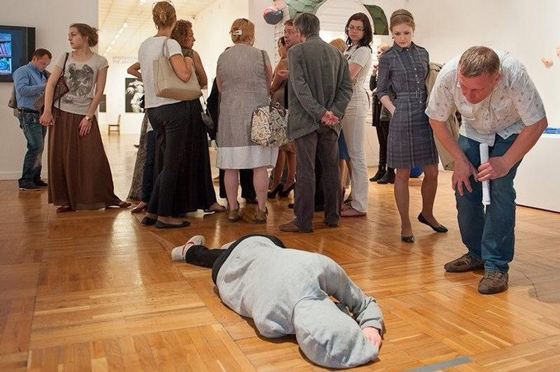 © Evgeny Alekseev Arseny Zhilyaev. Dreamer. 2012
About working conditions in the museum
Tarasova : The problem is that even those who themselves made their ways to internships, courses and other ways to improve their qualifications are often forced to either leave other profiles or even leave art.
Bebutov : Naturally, an obvious thing. This happened with most of my classmates. And now I have gone from the industry. But rebranding (in the GTG. - Ed .) Made, and Kolkhas will engage in the project of the Tretyakov Gallery . I do not want to say that this is bad, on the contrary - it is very important and correct. I will be the first to complain about poor -quality design and not adapted to the exhibition tasks of space, but I must emphasize that if you do not change the situation, then there are simply no exhibitions in these spaces. Because art historians and curators should be accumulated in a professional environment, in museums as a very important part of this environment. There should be a balance, one external is not enough.
Katashinskaya : I remember how, when I graduated from the university, in the Pushrooms there was a vacancy in a foreign department for a young specialist with knowledge of several languages and with a salary of 15 thousand rubles. With all my desire to work exactly there, I did not even send my resume ... It is unlikely that something has changed a lot. Roughly speaking, few can afford such a luxury as working in the State Museum. There were not so many diplomas on the art of the twentieth century in our course, but now many experts in revival, Byzantium, etc. They are engaged in completely different things, at best, combining graduate school with work in another area.
Tarasova : The system successfully squanders even very interested personnel. “When I graduated from the university, the crown of all dreams was in the museum. Pushkin Museum - for those who, according to West, the Tretyakov Gallery - for those who specialized in Russian art. Now, unfortunately. Now all the brightest, most interesting students go to other areas: go to PR , to private institutions, to educational projects ”(Quote from Tregulova’s interview with The Art Newspaper Russia . - Ed .). Yeah, what is it there.
On communication, the need for horizontal connections and the Open Call system
Sharova : In my opinion, there is no practice of communication between employers and educational institutions. The practice of discussion, debate, where there are unprogrammed questions and unplanned answers, and not the next series of reports.
On the other hand, in Scandinavia, where I mainly worked until 2015 and continue to do individual projects, it is very easy to apply for project financing to the curator or producer. The presence of permanent competitions and open funds from state funds at all levels provides dynamics and constant development of art, which can allow local art to be competitive. In Russia, often the best heads and funds for innovative projects pass by each other. There could be more platforms for the meeting: if they are, then a Russian VIP princide suddenly works. How to go out on the best heads if these are closed events?
However, the indicated problem is not characteristic only for Russia. Many of those who wanted to work with contemporary art at the University of Oslo came across challenges related to the lack of communication. At the master's program Kunsthistorie (history of art) they train specialists "for everything and nothing." The relationship with the local art environment is limited. The students themselves created, for example, the Paragone magazine and the group on the social network Kunstpause , where Oslo institution workers are now entering to publish their news. This group began to work in the functions of the communication channel, the development of which had no time or motivation for the administration of the program.
Few can afford such a luxury as working in the State Museum.
My colleagues and I are now working in the north of Russia, and I see that there are many bright heads in Arkhangelsk and Murmansk. But I also noticed that everything is arranged in this way: specialists in the field of culture have no motivation to support them. In some cases, young and talented, rather, as if interfering with work. Over the past three months, five acquaintances left for St. Petersburg. The best left. At the same time, state orders are made on strategies that are either not embodied or incarnated minimally. This is very interesting. There are reasons. Something does not work somewhere.
Tarasova : Catherine, it is unprofitable to work with bright heads - this is necessary to work! Moreover, it is unquenchable to get out of the cycle ... Under the cycle, I understand the standard routine of a museum worker, which does not change for decades, although there has long been a different world around. Young are full of enthusiasm even for a penny to do something, and the senior employees of the museum may have plans to quietly sit down to retirement in their swamp without dumbfounding. Young are perceived as competitors that destroy the usual habitat. Conflict of interests. Also, the general policy in the field of humanitarian knowledge is not in our favor. That is, they can be offered for free not only in Moscow, but also in Berlin, for example.
Sharova : Anastasia, in the north of Norway, I also heard this: “We cannot do Open Call , we have no workers (heads). Therefore, we will call those whom we already know. ” In fact, the same logic as there is a lot where in Russia.
Tarasova : There are places where people work jointly on the creation of the environment, and not between the parties, there is Open Call 's (yes, they eat resources, agree), but there is usually the opportunity to find funding (grants).
Sharova : According to my observations, work on the designated processes is underway in Scandinavia. But so not only in the field of culture, but at many other levels. The openness of Open Call 'OV, the Union of Artists , where there is the replacement of committees, an established dialogue between trade unions, the Winstre 's Workers' Party and the Party in Norway, the presence of open public discussion and generally the culture of discussion, and not knocking on the Bashmak in the department. Didn't the seminar about open systems just go in the Garage? This, in my opinion, is about this.
According to my observations, parts of the system are scattered, and the participants in the process often do not cooperate, do not communicate. This contrasts with a more familiar state of things in Norway. Although, of course, I could be wrong.
It is unprofitable to work with bright heads - it is necessary to work!
Tarasova : Absolutely. Again they returned to the topic of kum, instead of horizontal strong ties. I'm not talking about "do not communicate." Self -isolation exists. This is a real problem: to convince the older generation to reconsider the views in search of employees in the institution, for example.
Bebutov : Yes. But what a senior. Nastya, I'm sorry, I can show our peers.
Tarasova : Well, this is a question, since this does not depend on age.
Sharova : What are the solutions to the problem?
Tarasova : change tactics, seek communication, stimulate connections, create the possibility of communication.
The discussion took part:
Anastasia Tarasova (1980). Art critic. Moscow State University Lomonosov (2005), research scholarships DAAD (2007) and Gerda Henkel Stiftung (2010) in Martin Luther Universität Halle-Wittenberg , freedomer Universität LEIPZIG (2007–2010), in 2008 carried out a research trip in 2008 to the British Museum. In the past, Employee of the Mlibum named after A.S. Pushkin, now an employee of the scientific department of the Garage Museum (Archive), a participant in many exhibition and educational projects.
Zoya Katashinskaya (1988). Art critic. Moscow State University Lomonosov (2010). She worked as an assistant to the curator of the exhibition “Socialist Realisms” (2011, Rome), in the PaperWorks private gallery, and a two-month internship in the center of Pompid-Metz was internships. From 2012 to 2014 she worked in the scientific department of the Garage Museum.
Trifon Bebutov (1991). Museologist, graduated from the Faculty of History of Arts of the RSUSU (2013). He trained in theowers to them. A.S. Pushkin (2011), Museum "Garage" (2012-2013). Worked in the Moscow Academic Art Lyceum (2014) - design activity, the creation of a concept (written document) of the development of exhibition space; In the Jewish Museum and the Center for Tolerance (2014-2015) - the manager of educational projects. He gave a course of lectures on a modern art market for students of the creative workshop Rah (workshop A.V. Tsigaly, 2013).
Ekaterina Sharova (1982). Teacher, art critic, curator. Pomeranian State University (2004), Oslo University (2012). He worked for eight years as a teacher in the education system in Norway, in Vestfossen Kunstlaboratorium , Galleri Trafo , Pikene På Broen , the socurator of the project by The Mobile Institute ( Manifesta 10 , a parallel program), performed at the North Museum of Norway, Bergen KUNSTHALL , in the Northern (Arctic) Federal University. Participation in conferences in New York ( National Art Education Association ), Berlin Biennale , research in Havana, etc. is working on the development of an art center in the village of Nickel on the border with Norway. Сооснователь междисциплинарной группы Arctic Art Institute .
PS
Публикация не имеет претензии на законченность и предлагает векторы для дальнейшей дискуссии. Факт развития коммуникации в соцсети и последующего ее оформления в материал для публикации выражает потенциал подобных ресурсов в ликвидации разрывов в социальной ткани. Является ли его использование способом преодоления ограничений иерархического мышления, что может быть предпосылкой для создания новых смыслов в поле художественного? Приглашаем коллег к обсуждению этих вопросов.