
Translated material
The past as an area of creativity.
The first description of the phenomenon was made by Father Brown through G.K. Chesterton (story “The Ill Fate of the Darnway Family”, 1922). The scene is England, the deserted coast of the North Sea. The time of action is not precisely determined, although in the very first story of Brown's cycle a hint is given that all the events took place “a long time ago.” Perhaps this was the apotheosis of the increasingly decorative Queen Victoria, who loved Tennyson and Leighton. In any case, keeping the semi-parody mood in mind, it is most convenient to place this story there.
At the beginning of the story, two artists appear on a dull and deserted seashore. A little later we learn that one of them is a criminal, and the gloomy “Gothic” setting (in the sense of Horace Walpole and Anne Radcliffe, that is, much more radical than the “Victorian dampness” of Virginia Woolf) is a non-binding setting. The situation, however, is intensified with ironic insistence, forcing us to see in Chesterton a virtuoso master of “camp”. So: in a dilapidated castle, located almost below sea level, surrounded by half-crazed old servants, the heiress of the ancient Darnway family languishes (the surname sounds exactly like “done away” - “[they are] finished”), who, according to family tradition, must marry some distant cousin. The arrival of the cousin (from distant Australia) is expected any minute. But an artist who restores family portraits brings to light the image of a forgotten relative with the worst inclinations. The corresponding ancient legend (chilling sensations!) is attached. The villain has the ability to be reborn every seventh generation, and the arriving cousin is precisely the seventh descendant. The artistic criminal, as often happens with Chesterton, manages to mystify and intimidate everyone except Father Brown, who reveals the plan and saves the day. At the same time (driven by some higher considerations) he allows the evil artist, who is vying for the girl’s hand, to eliminate his cousin. Following this, the criminal, apparently sensing the danger of exposure, disappears from the story forever, and the wise priest passes the girl from hand to hand to the second (kind) artist and explains everything along the way.
The artist who “discovered” the mysterious portrait, “executed in a harsh and strong manner” of the 16th century, says that he is inclined to attribute it to the brush of Holbein, otherwise he will have to assume that an equally talented painter lived in those times. The paradox is that he talks about his work, which means that the contemporary and rival of the long-dead Holbein is himself. This move in itself is interesting, although not much more fantastic than the emergence, under the pen of Bernard Berenson, of the post-facto figure of “Amico Di Sandro,” the conventional author of works close to Botticelli’s style. But the fact that Chesterton’s alleged creator of the mysterious portrait is none other than Holbein looks significant. Of course, by attributing his work to the brush of a famous artist, the forger not only gives it additional value (here, however, this is not his concern at all), but also gives credibility to the dubious story. However, the mystery of what is depicted in the painting, fictionalized by Chesterton, refers to the mysteries of other, real-life images.
Hans Holbein the Younger is invisibly present in the story as the author of the famous and mysterious painting “The Ambassadors” (1533), which attracted the attention of many art critics. This is how Roger Caillois describes it in his book “Into the Depths of the Fantastic”: “The canvas is constructed like a coat of arms. Two solemnly static characters in ceremonial clothes (they are referred to in the title of the picture) seem to be holding a shield, the field of which corresponds to a rack, where a collection of devices and objects is displayed, symbolizing human knowledge and the liberal arts and usually represented in still lifes of the “vanitas” genre. With all the solemnity of the composition, in general there would be nothing particularly surprising in it, if not for one detail: just above the floor level, stretched out in an inclined position contrary to the laws of gravity and, obviously, other laws of nature, casting an implausible shadow, a certain body hung in the air, unlike any known object, shape, material, the presence of which is equally inexplicable. The dignitaries, looking straight ahead, do not notice the phantom object and, accordingly, do not show the slightest concern about it. But the spectators, whose attention he inevitably attracts, cannot share their indifference.” The mysterious object turns out to be an anamorphosis of a skull, but it is possible to identify the skull in it only from a certain angle, casting a farewell glance at the picture, almost parallel to the plane of the canvas. Caillois sees in this composition “the genius of the artist, who planned to confront the naive gaze with the mystery of skillful deformation.” These words could also describe the plot of Chesterton's story, which satisfies the most stringent requirements for fantasy, which should, according to Caillois, grow out of the very fabric of the narrative.
The beginning of the story contains a direct reference to Tennyson’s “Lady of Shalott,” who saw the world around her only in a mirror. According to William Holman Hunt, "The Lady of Shalott" is an allegory of a soul interrupting its asceticism and immediately being punished. In Chesterton, this allusion serves as a metaphorical warning to those who prefer artifacts to reality, and complex anamorphoses to a direct view of things as they are. The mirror motif in Chesterton's stories is always associated with deception (The Sins of Count Saradine) or, at best, with self-deception (The Man in the Lane, The Judge's Mirror). Here self-deception becomes more complicated, which corresponds to the complexity and fantastic nature of the criminal plan. “To the mistress of this (i.e. Darnway’s - V.D.) castle,” writes Chesterton, “the world appeared not only in a mirror image, but also in an inverted image.” The fake portrait and the fake legend fit perfectly into this inverted picture of the world. It is also worth mentioning that the doctor of the Darnway family, Dr. Barnet, turns out to be almost the namesake of the 17th century natural philosopher Thomas Burnet, the author of the “Sacred Theory of the Earth” (“Telluris Theoria Sacra”, 1681), which tells about a planet structured like a hermetic egg, from the depths of which the waters of the flood once burst out. Against the background of such bizarre esotericism, the rationalism of Father Brown looks especially cozy and reliable.
This kind of plot structure (including a story that chills the blood) occurs several times in Chesterton, for example, in the stories “The Curse of the Golden Cross” and “The Winged Dagger.” However, in the first of them, the criminal falsifies only the situation around the real artifact, and in the second he limits himself to impersonating the victim, attributing to her his own mystical inclinations.
And the Gothic theme in Chesterton is almost never presented directly. It is either ironically reduced, as in the story “The Purple Wig,” or translated into an ethical problem, as in “The Last Mourner.” But the game that is being played here turns out to be much more complex and multifaceted. In addition to the fact that this plot almost explicitly parodies The Hound of the Baskervilles, it contains an interesting philosophical subtext. Vadim Rudnev showed that Chesterton's Brown cycle depicts a conflict between teleological (Father Brown) and deterministic (everyone else) consciousness. Where Father Brown’s companions (as a rule, atheists or agnostics) are powerless to reveal, and sometimes even see, the criminal plan, he himself, being a rationalist-minded Thomist, reveals the whole background of the events and answers the question “cui prodest?”, which does not occur to the other participants in the action. At the same time, Father Brown’s explanations (as happened this time) contradict the principle of “Occam’s razor”, which is comfortably settled within the deterministic paradigm with which the clerical detective fights on duty.
Rudnev analyzes the construction of such Chesterton stories as “The Sapphire Cross”, “Strange Steps”, “The Broken Sword”, “The Honor of Jezreel Gau” and “The Cursed Book”. However, everything that is contained in the listed texts individually and corresponds to the successive points of Rudnev’s analysis could be immediately found in “The Evil Fate of the Darnway Family,” which represents the quintessence of Brown’s (and Chesterton’s) method. Here the impasse of determinism is shown much more clearly than in those stories that attracted Rudnev’s attention, if only because an important place in the narrative is given to an allegedly ancient object (and a text that seems authoritative due to its age). Deterministic consciousness, following the principle of economy of thinking, takes a fake, made literally yesterday, for an ancient artifact, thereby changing its own ideas about the past. Such an “antique” artifact is introduced into the imaginary past as a monument to certain supposed events. Since these events are fictitious, this artifact should be spoken of as having the property of retroactivity.)
The attempt to make the non-existent into the past, which is undertaken by the Chestertonian artist, from the point of view of Father Brown should seem like a theological paradox from the early Middle Ages turned inside out. Father Brown was probably well aware of the genealogy of these paradoxes, as well as the context in which they arose and, of course, what became of them subsequently. It was about trust in reason as such. "St. Peter Damiani, writes Frederick Copleston in The History of Medieval Philosophy, “...asserted that the universal applicability of the principles of reason in the field of theology cannot be taken for granted. Some other thinkers... believed that the claims of human reason were refuted by such truths as the Virgin Birth and the Resurrection of Christ. But in this case we were talking more about exceptional events than about the inconsistency of logical principles. Peter Damiani went further, arguing, for example, that God in his omnipotence can change the past. Thus, although it is actually true today that Julius Caesar crossed the Rubicon, God could in principle make that statement false tomorrow if he wanted to undo the past. If this thought diverges from the demands of reason, then so much the worse for reason.” But in the very first story of the cycle (The Sapphire Cross, 1911), Father Brown exposes the brilliant criminal Flambeau, who dressed in a cassock, because he attacked the human mind, and this, says Brown, is “bad theology.” In the biography of St. Thomas Aquinas, written by Chesterton in the last years of his life, emphasizes the deep trust in the intellectual abilities of the person on whom the great scholastic built his philosophy. But in the so-called detective stories, Father Brown defeats evil based on the same Thomistic premises. In medieval philosophy, the prevailing opinion was that God is limited by cause-and-effect relationships and is not inclined to change the past of the world he created. A retroactive object contradicts this fundamental principle: here the effect is considered to be prior in time to the cause that caused it.
By analogy with The Ill Doom of the Darnway Family, one can recall Peter Ackroyd's novel Chatterton, the action of which revolves around a painting depicting Thomas Chatterton, the poet and suicide, who has reached a venerable age and is surrounded by books whose titles coincide with the titles of the poems of William Blake. Yet the painting turns out to be a 19th-century fake, and Chatterton actually died at nineteen. But this is fiction, and from what remains in the annals of history, the activity closest to our topic is the work of van Meigeren, the author of the apocryphal “Vermeers”, famous in the 1930s and 1940s. Van Meigeren's story is widely known, and was even mentioned in William Wyler's classic film How to Steal a Million. However, it is worth repeating again so as not to sacrifice the coherence of the presentation.
Dutch artist Han van Meigeren (1889 - 1947) began his career as a forger by painting and selling two paintings allegedly belonging to Frans Hals in 1923. The forgery was discovered, but for some reason the name of the forger was not made public. He prepared much more carefully for his next venture. In order to produce a series of paintings with evangelical content that could be attributed to Vermeer of Delft, van Meigeren had to study not only the artist’s manner and painting technique of his time, but also everything that was written about him by art historians. And so, in the works of Abraham Bredius, the greatest specialist on Vermeer, he found those constructions on which the falsifier could rely. It is known that Vermeer's early works differ significantly in style from his famous later paintings. Bredius postulated the need for the existence of some unsurvived or undiscovered paintings by Vermeer, which would fill the stylistic gap and time interval. Van Meigeren was able to answer this challenge. And if he had not later, during the occupation of the Netherlands, sold one of his works to Goering, then the case of collaboration would not have arisen. And we might be confident that his creations are happily discovered paintings by everyone’s favorite artist. But van Meigeren had to admit to making counterfeits in order to avoid the much more serious charge of selling off national property.
The reason for classifying the famous forger as an avant-garde artist can only be scrupulous adherence to Vadim Rudnev, who distinguished between avant-garde and modernism in accordance with their artistic strategies. Avant-garde, unlike modernism, is focused on pragmatics, on non-traditional ways of communicating with the viewer, reader, listener. The fake canvas models a certain life situation: both in van Meigeren and in Chesterton. This, in fact, is the purpose of a retroactive work. And its inherent avant-garde strategy with an irrational background can bring to life many strange phenomena.
And if we talk about life situations, as well as historical situations, then precisely in the twentieth century there are those disasters from which it is possible to celebrate a happy deliverance from only one way: to erase, where possible, their material traces, and as quickly and thoroughly as possible. David Lowenthal, in the pages of his compendium “The Past is a Foreign Country,” speaks of the irrational, fraught with doubts about one’s own adequacy, impression that Warsaw, restored after the war, made on a person who found it in ruins: “The house in which I was born was destroyed thirty-six years ago, but I can go to my childhood bedroom, look out of the same window and see the same house in the courtyard opposite... Even the bracket lamps with an intricate curl hang in the same place. It's unnerving if you start to think about it. Is this “real” or not? You can, of course, lose faith in the reality of the present, but the task of reconstruction is different - to question the reality of the unpleasant past, or better yet, to abolish it altogether. The past (the horrors of war, and in the case of Warsaw, also national humiliation) is effectively made non-existent, despite the assurances of the scholastics that even God is incapable of this. In parentheses, it can be noted that the opposite tendency - to make what has not happened to be - died in the bud, although it was represented by such a respectable figure as I.A. Fomin, who was planning, in particular, to complete the construction of the second colonnade of the Kazan Cathedral. But this, like the restoration of Peterhof, was a long time ago, and, moreover, you still need to go to Warsaw (as well as to Berlin or Dresden, where large-scale reconstructions were also carried out). And yet, very close by there is an object on which all the contradictions of what would be worth calling historical reconstruction were most clearly revealed if this expression were not already used.
The famous Amber Room, as everyone no doubt knows, was in the Catherine Palace of Tsarskoe Selo from 1755 until its theft in 1941, and after 1944, it seems no one has seen it. By the beginning of the 80s, as, again, everyone knows very well, the USSR officially despaired of finding the lost monument, and they decided to make it again. And so, after the completion of long work that followed in May 2003, the new Amber Room was opened for public viewing. Now let’s ask ourselves and everyone around us a question: do we have the right to say that the newly made Amber Room has become the same monument that was lost during the war? Or, more precisely, under what external conditions will a perceived identity be more important than an absence of more than 60 years?
Naturally, we are not talking about the physical identity of the two Amber Rooms, in which there is not a single common element. It is also true that the true masterpiece of Schlüter-Rastrelli would have acquired later additions over time. However, clarifying the question of the critical number of additions that makes the monument a model of itself leaves us at the mercy of the well-known sophism about a heap of grain. In culture, things are somewhat different. From a semiotic point of view, it can be argued that in the history of the architectural monument called the “Amber Room” there was a period when it did not exist physically, but continued to exist as a sign. It would be logical to assume that the perception of this period of absence would begin to change over time. A hundred years will pass, and everyone will get used to the recreated Amber Room, there will be no more people who remember its absence, and, most importantly, the period of the new presence of the Amber Room will exceed in duration the time when it was not with us. The further you go, the less significant the gap in the physical existence of the monument will seem.
“The text is not equal to its copy,” reminds Vadim Rudnev, “...If necessary, it can be restored and, through an act of cultural canonization, the reconstructed text can be equated to the original.” When does such cultural canonization occur in the sphere we are considering? Naturally, when the physical existence of a monument in a given culture seems necessary, and the methods of its reconstruction satisfy the accepted criteria of authenticity. Japanese religious buildings are destroyed and recreated (in their previous form) every 10 - 20 years, but their life in culture is calculated in centuries. Here, however, we are faced with a special way of existence of objects: acts of destruction and subsequent renewal are just as necessary as the continuity of the existence of the object.
The focus on pragmatics unites the stylizations of the period of historicism and the restoration projects of the period of modernism that grew out of them, although there is one very significant difference between them.
In an article titled " Why are there no ruins left of the WTC?" » Grigory Revzin declares the modern practice of restoration to be the fruit of modernism and positivism. According to Revzin, the foundations of restoration belong more to the natural science paradigm than to artistic creativity: “Architectural form in scientific restoration arises not from artistic, but from scientific logic. That is, it should not be aesthetically convincing, but scientifically reliable. Scientific reliability, in turn, is determined through the correspondence of this form to something external to it - documents, drawings, analogies - things that have their own, non-architectural logic. In the same way, modernism substantiates the form from some other, informal grounds...” Here we inevitably have to talk about one degree or another of the reliability of our reconstructions: “The restoration form corresponds to scientific documentation. Since documentation is never complete, some gaps, undocumented voids always open up in the building, and, in accordance with the logic of science, they should be filled with neutral uncertainty, an architectural body without properties. Scientific restoration does not know the category of integrity of an artistic image; it operates with the concept of the authenticity of a fragment. As a result, any form turns out to be dismembered, torn into “documented” and “undocumented” parts, respectively, into “genuine” and “inauthentic”...
Restoring a destroyed building as a whole is a continuation of the same logic... The form that emerges as a result of such restoration fully corresponds to the criteria by which a form is generally “grabbed” by science - it corresponds to the documents, it is the same size, the same material and in the same place as the original...
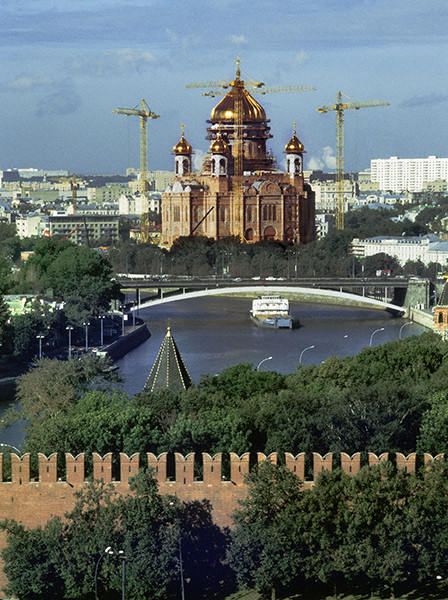
It is during the era of modernism that all the most famous restorations occur, from the post-war to the Cathedral of Christ the Savior. That is, they arise in an era when current architecture ceases to have any relation to historical architecture. The very act of restoration is a manifestation of this rupture. Instead of the artist as a subject of tradition, artistic forms arise as an object, in relation to which the author-restorer acts as a taxidermist-preparator - this is a form alien to him, for which he is responsible as a specialist, and not as an individual. Where the classic appears as an alien form, the classical tradition ends.”
Everything is correct, and the activity of, for example, Eugene Emmanuel Viollet-le-Duc, the central figure of the 19th-century restoration movement, in our understanding, comes down to artistic stylization, often quite arbitrary. He did not hide his desire to make architectural monuments more stylish than they were in the old days, noting on the pages of “Dictionnaire raisonne de l'architecture” that “restoring a building does not mean only repairing and strengthening it, but... bringing it to that completeness that may never have been achieved.” For a 19th-century stylist working within the framework of a traditional architectural system, it is important to make his own statement on the topic of a historical style that retains its relevance as a living heritage. But if we contrast history with heritage, as David Lowenthal did, we find ourselves challenged by the paradox described by Revzin. History is by definition “other,” and the discovery of the past is the flip side of Walter Benjamin’s discovery of modernity. And this “modernity” makes previous eras, with their characteristic modus operandi, similar to the Golden Age, i.e. separated from us completely and irrevocably. Plato wrote about the Egyptians mocking the Greeks, who were confident that they could descend from a god in the seventh generation. But no more than seven generations separate us from Nietzsche, who witnessed the death of God.
Григорий Ревзин пытается увязать практику реставраций архитектурных памятников и конец классической архитектурной традиции, совпавший (но еще вопрос — насколько точно совпавший) с концом Первой мировой войны. В традиционной архитектуре старый объект заменялся новым, вбирая в себя его смыслы. Напротив, современная (после 1918) архитектурная практика, порвав с классической традицией (т.е. с семиотически понимаемыми знаками «культурной преемственности»), выделила из себя восстановительные работы в качестве самостоятельной дисциплины, скорее научного, нежели собственно художественного характера. Представляется логичным, что берегут и восстанавливают нечто иное по отношению к преобладающей действительности, некую диковину. Исключение, подтверждающее правило, составляет, по Ревзину, венецианская кампанила, рухнувшая в 1902 году и отстроенная заново в течение последующего десятилетия — театральная декорация в насквозь театрализованном городе. Странно, что он при этом не упоминает Реймсский собор. По всей вероятности, дело заключается в том, что ужасы Второй мировой войны отодвинули память о Первой мировой в далекое прошлое. Тем не менее, практика крупномасштабных восстановительных работ берет начало не в 1945 году, а в 1918, и велась она в то время средствами традиционной архитектуры. Масштабы разрушений оказались настолько велики, что потребовали (во Франции и Бельгии) выработки особой государственной политики. «Политику восстановления… — пишет Арнольд Уиттик, — можно назвать в некотором роде сентиментальной — она диктовалась общим желанием восстановить города в том виде, который они имели раньше… Отклонения от старого сводились лишь к тому, чтобы то или другое сооружение, которое раньше выглядело слишком современным, заменить новым в стиле ренессанс, больше гармонирующем с главными памятниками. Таким образом, когда время и погода оказали свое благотворное действие, некоторые города приобрели вид более старинный, чем в довоенные годы… примером может служить городок Ньепор, который был разрушен полностью… Весь город приобрел лишь то отличие от довоенного, что принял более ренессансный вид в результате восстановления уже не существовавшей перед войной ратуши XVI столетия. Другие города восстанавливались в том же духе; отступления от старого допускались только в тех исключительных случаях, когда здание явно было испорчено прежними реставраторами».
Но прошло тридцать лет, и пациент в лице традиционной архитектуры оказался скорее мертв, чем жив, когда в нем снова возникла надобность. Видимо, все сомнения в «подлинности» восстановленных и заново отстроенных памятников продиктованы именно тем, что реставрация не имеет ничего общего с массовым строительством. Но ведь помимо ансамблей Петергофа или центра Варшавы есть еще Ковентри и Роттердам, которые не были приведены к довоенному облику — то ли по экономическим причинам, то ли из соображений правдивости. Для модернизма традиционная архитектура есть нечто «другое», и она остается таковым и в процессе своего сочинения, и при изготовлении. Нет нужды напоминать, насколько нынешние строительные технологии (не говоря уже о массовой практике) отличаются от технологий столетней давности. Но учитывающему все сказанное реставратору и стилизатору эпохи модернизма важна сама возможность сделать что-либо от модернизма отличное. Поскольку «сейчас так не делают», он приобщается к ретроактивности. Но общего между ним и его предшественником из XIX века все–таки больше, нежели различий: общая нацеленность на создание некоей жизненной ситуации перевешивает. Жизнестроительство, одним словом. Но именно жизнестроительство Ревзин считает основополагающей чертой модернизма, в частности архитектурного.
Когда мастер эпохи историзма в точности воспроизводил исторический стиль, что предполагалось получить на выходе? Якобы старинный (т.е. долгое время существующий) предмет, способный быть в нашем восприятии свидетелем некоего реально существовавшего прошлого. На бытовом уровне получается нечто вроде мнимого наследства реальных предков.
Дэвид Лоуэнталь в упоминавшейся книге не разбирает причины сознательного искажения и «улучшения» исторических стилей в позднейших подражаниях. У него получается (или в Англии только так и было?) что готические стилизации XIX века оказываются более правильными, более стильными, нежели подлинная готика. Видимо дело в том, что оригинальность произведения архитектуры, выдержанного в каком-либо из нормативных стилей, может состоять только в отступлении от канона. Стилизатор же нагнетает признаки правильности, иногда осознанно. Барочные люкарны на куполе Казанского собора нарушают стилистическую чистоту классицизма. Ретроактивные стилизации в петербургской архитектуре закономерно развивались от семиотически невидимых (и поэтому мыслимых несуществующими) пристроек к старинным зданиям до полномасштабных построек, обманывавших профессионалов. Например, такой эрудит, как Г.К. Лукомский, считал дом Тимофея Дылева (1849), построенный Ипполитом Монигетти на Обводном канале, старинной постройкой «растреллиевского стиля», а сходство решения несохранившихся ворот Шереметевского дворца («Фонтанного дома») и служебного флигеля того же дворца, возведенного Н.Л. Бенуа в 1867 году, ввело в заблуждение автора статьи в профессиональнейшем журнале «Зодчий».
Честертоновский фальсификатор произносит весьма примечательные слова о живописной манере Гольбейна. Как жаль, говорит он, что живопись не остановилась на этой стадии. Здесь явное предпочтение прошлого настоящему объединяется со стремлением вжиться в чужой стиль, нивелировав свою индивидуальность — ведь все, к чему он стремился как художник, уже было сделано другим человеком, жившим сотни лет назад. Голомшток пишет об отсутствии собственной манеры у ван Мейгерена, хотя неизвестно, насколько стиль Вермеера отвечал его исканиям в области художественной формы.
Единственная лазейка для проявления собственной манеры, наряду с выбором прототипа, может заключаться в видоизменении этого прототипа, но в рамках стилистической достоверности. Кажется, и эта дорога была пройдена до конца. То, что мастера эпохи историзма понимали под развитием исторического стиля, должно было вызвать к жизни заведомый симулякр, вещественное доказательство некоего виртуального прошлого. Таким способом мы осуществляем стилизацию истории сообразно нашим желаниям, изображая ее менее противоречивой и более цельной, более стильной. Переводя рассуждение на бытовой уровень, скажем, что это подделка родословной, позволяющая скорректировать прошлое в нужную нам сторону. Когда же приходит осознание приблизительности всякой реконструкции, архитектура начинает свободно комбинировать знаки разных стилей. И это — начало конца. Если бы не появился модерн, можно было бы представить, как эта разностильная одежда зданий становится все легче и ажурнее, пока не приходит к едва заметным намекам.
В статье на сайте «Проект Классика» Ревзин проводит параллель между вспомогательными биологическими дисциплинами и реставрацией в архитектуре. Странно, что он упускает возможность уподобить реставрацию палеонтологическим реконструкциям. Если бы слово «палеонтология» все–таки было произнесено, оно могло бы вывести нас на новые нетривиальные обобщения.
Если судить по хронологии событий, наука об ископаемых организмах была таким же детищем романтизма, как чувство истории и стилизаторская архитектура. Мишель Фуко провозглашает Жоржа Кювье (1769 — 1832) первым представителем современной научной парадигмы и, в силу этого, родоначальником новой, собственно биологической науки, ориентированной на время, в отличие от статичной естественной истории времен Линнея. Но повествование в «Словах и вещах» останавливается как раз на пороге XIX века, высветившего новые параллели между различными областями человеческого знания. И вдобавок, Фуко ни единым словом не упоминает о том, что барон Кювье доказал возможность вымирания биологических видов и основал палеонтологию, изображающую прошлое как принципиально иной, но познаваемый мир, который может и должен быть реконструирован. Палеонтолог, пытающийся воссоздать «другое», действует как реставратор, воссоздающий или имитирующий традиционную архитектуру, но живущий при этом внутри модернистской парадигмы. Один работает на грани искусства, другой — на грани науки. К тому же принципиальная неполнота не только «палеонтологической летописи», т.е. свидетельств последовательных эволюционных изменений, но и большей части ископаемых находок, обеспечивая исследователя видимой достоверностью, не дает для этой достоверности исчерпывающих оснований. Каждая реконструкция больше говорит об уровне знания и настроениях своей эпохи, нежели о реальном облике вымерших чудовищ.
Первая волна увлечения динозаврами и соответствующий ей расцвет реконструкций их облика пришлись на викторианскую эпоху, которой Кювье уже не застал. Все начинается с того, что в 1825 году Гидеон Мэнтелл обнаруживает и описывает скелет игуанодона. Внешний облик животного будет им реконструирован по аналогии с современной игуаной, увеличенной до гигантских размеров — в первом динозавре трудно было разглядеть собственную образность, отличную от всего, что мы видим вокруг. (Впрочем, это было только начало того славного пути, в конце которого мы получили «Парк Юрского периода»). Лавры культуртрегера достались пришедшему чуть позже Ричарду Оуэну, чьи скульптурные реконструкции динозавров (вопиюще неточные) находились в Хрустальном дворце среди экспонатов выставки 1851 года. Иллюстрации в популярных сочинениях того времени изображают динозавров ожесточенно терзающими друг друга — в полном соответствии со словами Теннисона о природе «с алыми зубами и когтями». Правда, оценить степень серьезности этих изображений сейчас трудно. Важно, однако, другое: открытия палеонтологов предоставляли различным интерпретаторам повод фантазировать уже не об истории, а о бытии как таковом. Первые реконструкции доисторической жизни окрашены неподдельным энтузиазмом и при этом совершенно произвольны. Казалось, не только художники, но и руководившие ими ученые были заворожены открывшейся перед ними возможностью воспроизвести во всех деталях мир, лишенный света человеческого разума и никак не осознающий себя. Динозавры, соразмерные не человеку, но крупнейшим из творений человеческих рук, виделись им триумфом неразумной плоти, чудовищной в своем величии. И сама эта чудовищность, казалось, отменяла вопрос о том, для чего было нужно все это роскошество чуждых нам обитателей земли. До картин предполагаемой жизни на других планетах оставался один шаг, но он, кажется, так и не был сделан в эту эпоху, в большей степени поглощенную расширением своих временных, нежели пространственных границ.
Фантазии обретали плоть, пусть даже это была бумажная плоть реконструкций. Буквально через несколько лет после игуанодона Мэнтелла происходит открытие человеческой доистории: Буше де Перт находит каменные орудия первобытного человека. Останки же неандертальца (1856) породили весь спектр мыслимых истолкований, отрицающих его древность, включая совершенно анекдотические: от современного идиота до русского кавалериста 1814 года. Но воздух эпохи был уже проникнут сознанием неотвратимости изменений и ожиданием конца. И как раз в середине столетия физики Клаузиус и Томпсон (лорд Кельвин) формулируют второе начало термодинамики, открывая дорогу спекуляциям о тепловой смерти вселенной, бывшей физическим аналогом идеи исторического регресса.
В самом конце века эти настроения — вне всякого декаданса и в одеждах наукообразия — увенчаются картиной гибнущей Земли в «Машине времени» Уэллса. Мир был стар, как сама королева Виктория, и находил удовольствие в рассуждениях о конце истории и «грядущей расе». И сама эпоха могла бы закончиться печальной и трогательной нотой, подобной блекнущему сознанию умирающей королевы, двигавшейся от менее вероятного состояния жизни к более вероятному состоянию смерти. Ее заботили мертвые вещи и память об умершем принце Альберте, и если память она привыкла хранить без посторонней помощи, то вещи приходилось заменять, но заменять точными копиями. Смерть подступала не в виде сгущающихся сумерек, а как постепенно высветляющееся поле зрения — вплоть до белого фона.
“Memory fades, must the remembered
Perishing be?” (Walter de la Mare).
(«Память слабеет. Ужели мы сами
С ней выцветем без следа?» — пер. Алексея Кокотова).
Чернила выцветают, и остается белый лист бумаги, но и он по воле режиссера распадается на множество снежинок, которые, кружась, уносятся вдаль.
Vladislav Degtyarev Владислав Дегтярев Авторы издательство "Новое литературное обозрение" ретроактивность прошлое артефакты причинность