
Translated material
An alien
In the 70th year, the great musician and singer David Bowie passed away
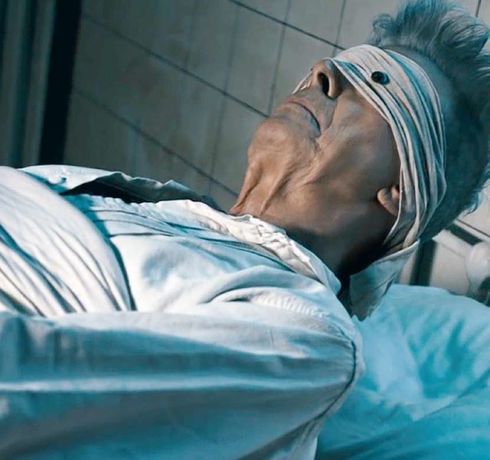
The frame from the farewell video clip David Bowie, released three days before his death: Lazarus (Lazarus)
He flew to another planet ”,“ He returned home, to Mars ”,“ We thought he was immortal ” - typical reactions to David Bowie’s departure make it clear that people who lived with his music have seen either a little prince or et from Spielberg’s film, and this is not only artistic exaggeration. Both the songs and the image of Bowie hinted that we have something like a Martian or demigod, the being of extra- or superhuman origin- too perfect to be true. Bowie’s death was also a shock because his public image, aging, suffering and extinction in a hospital bed did not fit into his life program - the heroes do not die, aliens are even more so. And this is the first cunning of Bowie - to make the whole world look at himself as a unique, a miracle of nature, a guest from other planets.
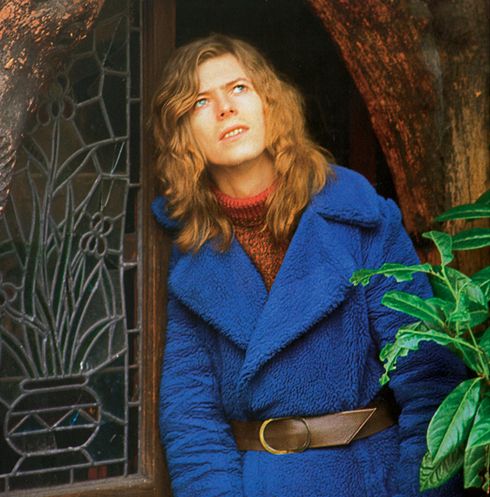
1970, the beginning of the ascent to glory
Be a chameleon
Photos of the young Bowie do not betray his divine alienity - tangled hair, crooked teeth, a slightly crazy look, in which no one has yet distinguishes signs of divine radiance. Bowie famous different eyes are the result of not a genetic mutation, but a teenage injury: they moved to the eye from behind a girl. The consolidated brother, who introduced him to the records of Mingus and Coltrane and with books on Tibetan Buddhism, quite early got into the psychiatric hospital, and in 1985 he fled from the ward and lay down on the rails before the train rushing past the station; We will never know how the drive and passion of Bowie were formed by the fear of inherited insanity and early death, but references to this deeply personal story constantly flicker in his songs.
Saying that Bowie raised pop music to the rank of art, we do not always remember that he himself was his first work; He pulled himself out of his own phobias and injuries. Not a unique nugget, but an independent work of art, not Redimeid, but self -meidman. The uniqueness of this humanized work is also that it is completely impossible to determine, to fix it. It makes sense to ask about Bowie: in what style does it play? His masks and alter ego have no number. Even his voice varies (sometimes in the framework of one track) from a desperate cracked scream to a lulling plush baritone. The only constant passing after four and a half decades of his career is an aristocratic intonation, proudly raised up the chin. Bowie Hameleon, Bowie, constantly changing identity, is his only identity. His sprint race through different styles and images in the mid-70s is perhaps the most amazing in the history of pop-muses by an explosion of creative energy, comparable only with the last years in The Beatles career. If we measure its world-historical significance on some supermarous scales, it will probably turn out that its main civilizational contribution is that Bowie legalized oddities in popular culture, made an acceptable and even attractive androgenicity, travesty, theatricalization and all kinds of bizarns.
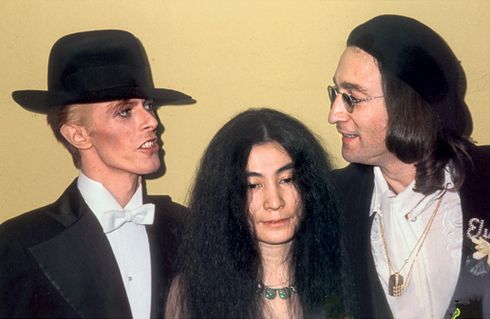
1975, with Yoko it and John Lennon (together they recorded the song FAME)
Talent of appropriation
In fact, in the slap in the face to the social taste that were heard in popular music starting with Elvis, by the time Bowie appeared on the stage, there was nothing unusual. Neither open (even ambiguous) sexuality, nor outfits pulled out of the theatrical costume, in the early 1970s it was no longer a surprise. He took another step, protecting not just the right to be not like everyone else, but the opportunity to be not like yesterday. A person for him is not a constant value, but something constantly becoming, and in this stream of transformation the most living energy, the most genuine life lurks.
Bowie’s death was also a shock because his public image, aging, suffering and extinction in a hospital bed did not fit into his life program
Another focus is that this bulk -boiling fireworks of originality did not contain anything particularly original; Each of his album, each of the masks can be decomposed into the components, indicating who did the same, but a little earlier and bolder. Glam aesthetics of the early 1970s went from Mark Bolan, with whom the young Bowie played and often intersected; Claustrophobic Berlin period-from Kraftwerk and academic minimalism, glossy hits of the 1980s were generally a triumph of common places. “I will take my own where I will see my own,” Boris Grebenshchikov, who once adopted the methodology of senior colleagues, will sing, and this formula in the case of Bowie looks not boasted of the plagiator, but by evidence of the maximum openness and sensitivity. The talent that did not change him until his death is the ability to catch ideas and impulses flying in the air, to feel unmistakable what works here and now, to bring other people's intuitions to a logical conclusion and an unthinkable splendor. Artemy Troitsky in the recent text for the BBC recalls how surprisingly it was combined in Bowie Charisma, a distinctly tangible “starry”-and the most sincere, friendly interest in the world around him. On the network there is a list of a hundred beloved books of Bowie, compiled by him two years ago for an exhibition in the Ontario Gallery; At first glance, this set of incompatible names gives an intellectual posture, but having read it more attentively, you begin to understand, perhaps, the main secret of Bowie: until the very end, everything was interesting to him.
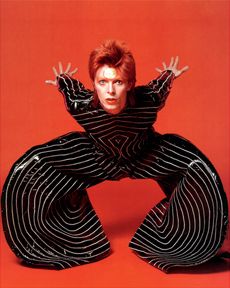
Glam rock early 1970s
Black star
Bowie actor, Bowie-Pighon, Bowie Estete-his proudly raised chin, he is always different, but the music invariably produced to brilliance forced to find arrogant-zero features in it. His final artistic gesture-the output of the album with a black star on the cover, with songs about death and resurrection, two days before his own care-today looks like a manifestation of some final, superhuman arrogance: look, death, he and you outwitted, and you have become part of the performance he invented. It is all the more amazing that in the memoirs of Bowie - even if they begin with on -duty lamentations about a man who flew to the star - so many human, touching, living, as if the rays emanated from Bowie did not connect him with the imaginary Martian commemoration, but directly with each of us. Its first hit Space Oddity, which gradually turned out to be one of the main songs on the time, is the embodiment of the same contradiction: a song whose hero is dissolved in cold space without hoping to survive, sounds like a promise of final reconciliation and forgiveness. And this is the most amazing trick done by Bowie - to hide under the glossy, extremely artificial surface of his music and images so much love, life, warmth: all that will remain with us forever, wherever this man, pretending to be a messenger from a distant star.
Seven lives of Bowie
Artist masks - and song "keys" to them
Decadent Folk (1969–1971)
Bowie begins with idyllic songs under the guitar in the tradition of Dylan and Donovan, which is more than natural for the late 1960s. It does not pass even two years, the music becomes heavier, the texts are darker, the artist begins to go out in an interview in a women's dress, and a hip -sign of the hair of the hair is made out in the opening forehead on the cover of the Hunky Dory album.
Album: Hunky Dory
Song: Space Oddity
Space Glam (1972–1973)
Bowie is trying on the person of the space alien ziggi Stardast, goes on stage in full combat coloring and catapults to the heights of glory. The most inspired hits, the most tenacious riffs, the most elaborate costumes and lightning drawn on the face - everything from here.
Album: The Rise and Fall of Ziggy Stardust and the Spiders from Mars
Song: Starman
White Soul (1974–1976)
Bowie moves to America, gets friendship with John Lennon, noticeably leaning towards black music - as usual, polished on his albums to shine, tightly sits on exciting substances, welcomes the crowd at the London Station by the Nazi salute, invents a new stage mask - “the exhausted White of the Duke” and, which, coincides With its own way, it comes to complete exhaustion.
Album: Station To Station
Song: Young Americans
Berlin Vanguard (1976–1979)
Bowie moves to Western Berlin, makes friendship with Brian Ino, rides a bicycle around the studio in Kroutsberg and tries to cope with his own paranoia in the city, which has become a symbol of paranoia from the Cold War. The result is three amazing solo records where electronics, minimalism, an emboss, German kraut-Cro-Cro-Cro-Cro-Cro-Croums are mixed-plus two more albums for IGGI POP, with which Bowie rents a Berlin apartment and travels on a trip along the Trans-Siberian Railway.
Album: Low
Song: Heroes
New Wave (1980–1988)
Bowie returns to secular life, star status and pop music in its very glossy embodiment. Bowie of the 1980s is the hero of the newly arising MTV, the beginning of the movie star, the initiator of the duets with Jagger, Mercury and Tina Turner, the artist from the highest world pop-league and at the same time a person with the most impeccable hairstyle in the world.
Album: Let's Dance
Song: ashes to ashes
Experimental 1990s (1989–1999)
Bowie collects the Tin Machine group and turns to the most straightforward rock (without much, however, success). The next few years is a series of unpredictable stylistic jumps: Bowie enters either industrial, then in drama-n-beice, then in futuristic funk; In an amazing way, all these throwings occur against the background of the, finally gained family happiness with a black model of Iman.
Album: Outside
Song: Hallo Spaceboy
Quiet 2000s
Bowie calms down, reunites with the producer of his best albums of the 1970s Tony Visconti, writes down several pacified records that look like dedication to his best times, gradually stops performing with solo concerts and give interviews-in January 2016 to return with the Blackstar futuristic album, with a grand farewell gesture that made it unexpected care.
Album: Blackstar
Song: Blackstar
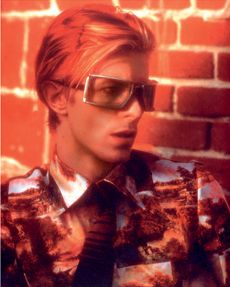
1974, Punk invention
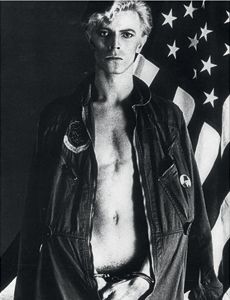
1976, Bowie in the USA
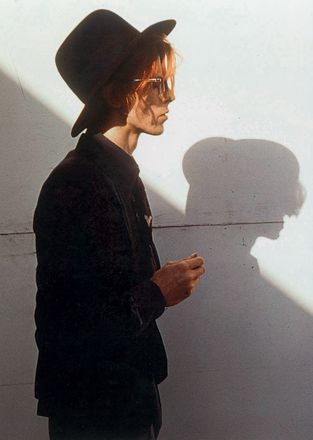
Before moving to Berlin in the 1970s
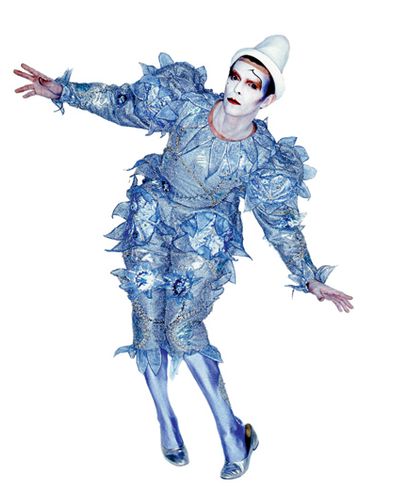
Beginning of the 1980s, the disco era and the image of the clown
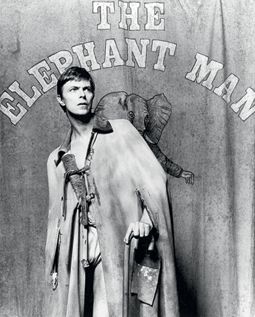
1980, in the title role in the Broadway play "Man-Slon"
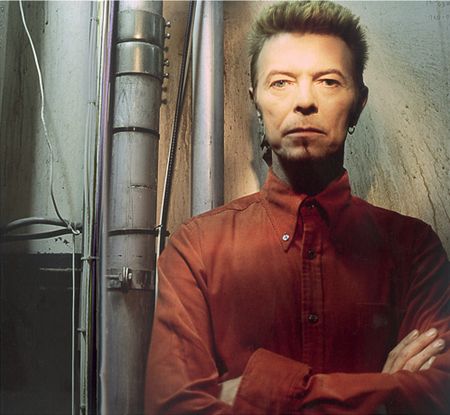
1997, Bowie plays alternative rock
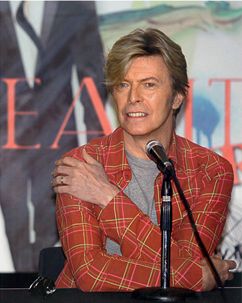
2003, calm Bowie
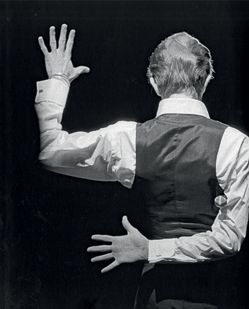
Photo from one of the late concerts
Photo: Bowie, Album by Album, Paolo Hewitt