
Translated material
Oil: In search of the bottom
The prospect of repeating the fate of the USSR loomed to Russia
The Russian economy is experiencing the next acute phase of the crisis
On January 13, oil for the first time in the last 12 years dropped below $ 30 per barrel. The RTS index collapsed to minimums in 2009 (the index struck the level of 650 points), and the dollar updated the historical maximum. However, unlike the panic December 2014, a quick rebound is not necessary to wait. Forecasts regarding the immediate prospects of the oil market for Russia, where the economy in recent years has become dramatically dependent on the cost of a barrel of black gold (if in 2004 the share of oil revenues in the budget was less than a third, then in 2014 it exceeded 50% of the entire revenue of the budget), far from optimistic.
Forecasts
The three largest US investment banks - Morgan Stanley, Goldman Sachs and Citigroup - expect that oil will be recorded below $ 30 per barrel. “The rapid growth of the dollar can send oil quotes to $ 20. Not only does the dollar and oil have a reverse correlation, the amplitude of black gold fluctuations exceeds the amplitude of the vibrations of the American currency, ”Morgan Stanley analysts write in their January report. The American and British banks are not far behind. The worst, perhaps, to date, the forecast has been voiced by Standard Chartered economists: “The price may fall to $ 10 per barrel, before most asset managers admit that the fall has gone too far, the report of this British bank. “Oil quotes depend exclusively on the financial flows caused by fluctuations in prices for other assets.”
Back in December 2015, Barclay's analysts
It was believed that the average annual price of Brent for 2016
will be in the area of $ 60, and already in January they
revised their forecast to $ 37 per barrel
$ 10 per barrel is an extreme scenario, and so far few people consider it. The bulk of experts and analysts see a potential “bottom” in the area of $ 25 per barrel. Russian officials are also talking about the same levels, discussing the "worst" scenarios for the Russian economy. Speaking at the Gaidar Forum, Minister of Economic Development Alexei Ulyukaev said that his department was developing a stress scenario based on $ 25 per barrel and a dollar higher
80 rub. for $ 1. All forecasts, of course, concern the North Sea brand Brent: this means that the Russian Urals will be more than $ 1.5–2 cheaper.
An excess of hydrocarbons
For the Russian economy, a much more unpleasant signal than the “extreme” forecast of Standard Chartered economists should be the last report of the British Barclays: its analysts believe that after the collapse oil will not really bounce off - back in December they believed that the average annual price of Brent for 2016
It will be in the region of $ 60, and already in January they revised their forecast and set $ 37 per barrel. This means that the consensus prevailing at the end of last year, that the worst for the oil market will happen in the first half of the year, after which the recovery will begin, gave a crack. Now, according to JPMorgan analysts, the idea of a long period of cheap oil has been firmly imprinted in the minds of governments, industry players and investors. “However, prices have not yet groped the bottom, and if everything is clear with the concept of a long period of low prices, then the questions are how low, and how long they remain without an answer,” -
They write in their review.
Former partner of George Soros, billionaire Jim Rogers, speaking last week in Singapore, noted: “Giant reserves have accumulated in the world, the spending of which will take time. Even in the case of falling quotes to $ 20, the offer will be reduced slowly, therefore, the reversal of oil prices will be just as leisurely. It is not easy to balance demand and demand. Even if American and Canadian shale companies leave the market, Iranians will come in their place. In addition, if a global recession begins, this will have a huge negative impact on demand. ” In fact, Rogers called the key factor in the cost of oil costs: the world produces and sells much more black gold than consumes it. On January 12, 2016, the US Energy Information (EIA) reduced the forecast for daily oil demand for oil this year from 95.22 million barrels to 95.19 million, and also increased the forecast for world production from 95.79 million barrels to 95.93. Excesses, which this year will be almost three quarters of a million barrels per day, are stored in the form of stocks, the storage capacity of which is almost exhausted. And while the balance of supply and supply will not be restored, it makes no sense to talk about any significant increase in prices. Therefore, it is worthwhile to figure out what factors led to the current situation, which will make it possible to soberly evaluate the prospects.
Battle for markets
There is nothing fundamentally new in the oil prices for a year and a half for a year and a half. A similar situation was observed in the mid-1980s, when the country united in the oil cartel OPEC Tired of observing how their markets are rapidly conquering independent exporters led by the USSR. They stopped limiting the prey and began to offer their raw materials at dumping prices. From November 1985 to March 1986, oil prices fell by 67%, and their restoration took about 15 years to the levels of early 1985 and this happened in the new millennium. All the current conversations that OPEC has lost control of the oil market and is unable to force their own participants to observe quotas, nor dictate prices, are only partially true. It is precisely for the control of the share of the market, which would allow the organization to return the status of a monopolist, a cartel led by Saudi Arabia began the battle in 2014. At first, Russian experts reassured themselves and surrounding the reasoning that the main target of the price war should be shale projects in the United States, in which the cost of production, as it was then believed, exceeds $ 70 per barrel and “victory” over which seemed fast and simple. However, the events of last year - attempts to establish oil supply from Saudi Arabia and Iraq to Europe, the traditional Russian market, and at prices, significantly more attractive than exchange, have clearly demonstrated that the Middle East participants of the cartel are ready to fight all competitors, including Russia. Moreover, members of the organization are ready to compete for the most attractive markets and among themselves.
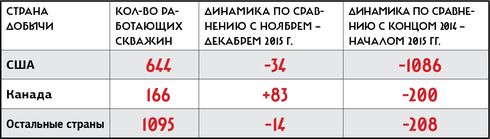
The number of oil wells at shale deposits as 01/08/2016
Source: Baker Hughes, 2016
Middle Eastern paradox
In the early days of 2016, the world witnessed a unique situation. The conflict between Saudi Arabia and Iran, which nearly resulted in a military confrontation and entailed a breakdown of diplomatic relations between Shiite Iran and a number of Sunni states of the Middle East, not only did not lead to an increase in oil quotes, but, on the contrary, became an additional factor for their collapse. The traditional “geopolitical prize”, which investors and speculators laid in prices, instantly disappeared after Saudi Arabia, in anticipation of Iran, began to offer discounts on the exchange price and sell oil below $ 30 European consumers. Iran also does not lag behind opponents, whose official representatives at the end of last year have repeatedly stated that the country after lifting international sanctions firmly intends to conquer its market share, for which it is ready to supply oil at almost any prices.
The average annual price of Brent variety oil is $


Source: International Energy Agency, 2015
The failed blitzkrieg
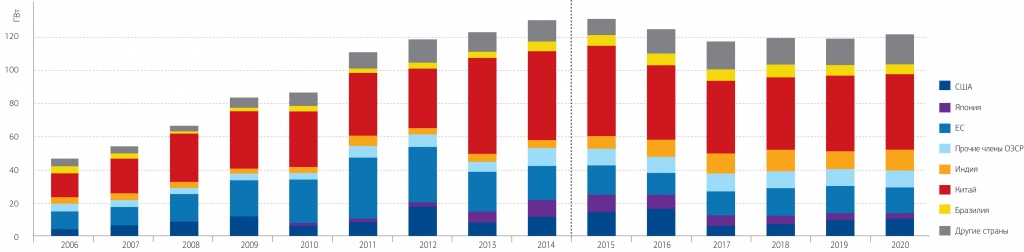
However, Iran is only one of the participants in the trading war for the destruction, in which Russia enthusiastically also participated in the last year, the record for the production and export of oil: production, compared with 2014, increased by 1.3% and set the post -Soviet record - 533.6 million tons: even Russia overtook even Saudi Arabia. Export grew by 7.5% - up to 338 million tons. Even the United States did not stand aside, which abolished the export of black gold at the end of last year. And this war is far from the end. Even the slate, which seemed to be easy prey, has not yet been able to win. According to the US Treasury, in the first week of 2016, about 9.2 million barrels of oil per day were produced in the country - 1% more than a year earlier. Ed Mors, the head of the Citigroup commodity market research department, notes that shale oil manufacturers were able to reduce costs by 30%. Close to a similar result and oil manufacturers at deep -sea fields in the Gulf of Mexico. Morse notes that the commissioning of already drilled wells, as well as wells, the development of which has not yet been completed, can lead to an increase in the production of 400 thousand barrels per day, or by 4.3%. Yes, and in this price war, neither Saudi Arabia, nor Russia, nor anyone else were still. To regain even the share that OPEC occupied at the end of the last century will not work. The world has seriously changed, and not least thanks to a rather long period of high oil prices. It was they who forced the pragmatists from the governments of developed countries to listen to ecologists and invest hundreds of billions of dollars in alternative energy and made it profitable. Moreover, as soon as mass production began in the sector, the cost, as is usually the case, began to drop sharply. According to the International Energy Agency, the production of electricity from renewable energy sources over the past 10 years has tripled - the capacities have increased from 45 to 130 GW. It was expensive oil that provoked the rapid development of technologies for its extraction from under the ground, from under the water, from under the Arctic ice-from where it is only possible. Multi -billion dollar investments in oil extraction projects at hard -to -reach fields have already been made, the infrastructure has been built, and the extraction there will no longer stop before their exhaustion.
Energy production from renewable sources

Source: International Energy Agency, 2015
Slow down China
Another factor that has a serious impact on the oil market is the processes taking place in the Chinese economy. In the past one and a half decades, it was this economy, which managed to break out in second place after the American, was perhaps the main source of constantly growing energy demand and other raw materials. However, China is no longer able to grow in the same pace. Since last year, the Celestial Economy is seriously slowing down, which causes concerns regarding the stability of demand in world raw materials. Moreover, even if China can avoid
A serious crisis, the structure of its economy is changing. The country is rapidly developing towards the service sector. According to Bloomberg, last year, the share of the growth of the Chinese economy related to oil consumption has decreased to 50% compared to the average over the past 30 years at 67%.
Back to ...
On the Gaidarovsky Forum, which was held last week, few of the speakers, struggled to recall the nineties from temptation. The problem is that in the current situation, the analogy is more appropriate with the end of the 1980s, when prices fell from $ 35 to $ 10 per barrel and when attempts to clash the ineffective state economy drove the country into a systemic crisis and resulted in the collapse of the empire, accompanied by local wars on the outskirts, forced “shock therapy”, hyperinflation and dramatic fall economic indicators. At the same time, unlike the leadership of the CPSU, which has tried to give socialism the “human face”, the current authorities prefer to simply wait for oil growth, wasting time and bringing the time when the reforms will become forced. That's just this time with the reformers of Russia may not be lucky.
Photo: Shutterstock.com