
Translated material
The inevitability of historical choice
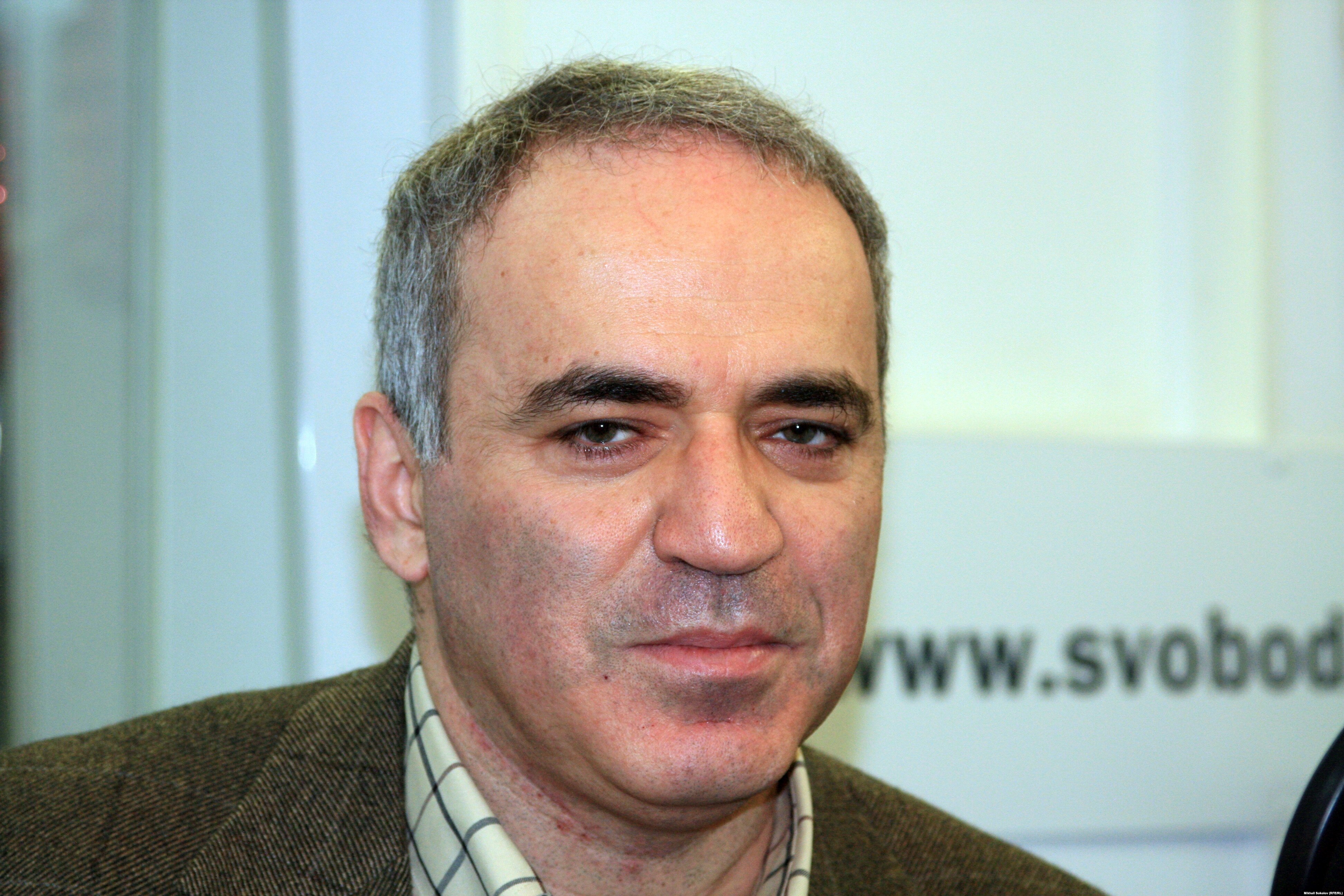
Harry Kasparov - About Russia after Putin
I am watching with interest the discussion that unfolded after the publication of my article " Russia after Putin ." For the first time in recent years, the theme of the post -Putin structure of Russia has ceased to be perceived with skepticism, and became the subject of discussion for a significant circle of people. The very fact of this discussion indicates that the thinking part of society no longer perceives Putinism as something non -alternative (at least in the foreseeable future), which means that in the very near future the desire for changes can cover much wider layers of society.
Speaking about possible changes, we are dealing with an “equation with many unknown”, therefore, of course, it is impossible to predict exactly how changes will occur in Russia. However, having a large amount of information about the regime and the accumulated historical experience of falling various dictatorships, it is quite possible to analyze and indicate likely scenarios of the development of events after the collapse of the regime, difficulties and traps that threaten Russia in the framework of these scenarios, as well as ways to overcome them. The practical side also has a similar analysis: the assessment of possible options will create a “road map” of the transition period, and the understanding of what will happen in the country after the collapse of Putinism will help many people get rid of fear of unpredictable changes, and for someone will become an encouraging motive for actions. At the same time, it is necessary to be aware that it will not be possible to avoid serious shocks of the political and socio-economic nature of Russia: the degradation of all spheres of public life in the country over the years of Putin’s reign has gone too far so that it could be counted on a stable recovery.
One of the most important factors that determine the further development of events will be how Putin will be suspended from power. The option with more or less voluntary care based on the example of Pinochet or Yaruzelsky should not even be considered seriously, since it is fundamentally incompatible with the basic logic of the existing regime. Variants of the palace coup and mass protests individually also have relatively little chance of success. Most likely, the regime will fall as a result of a certain combination of these two scenarios, when, against the background of mass excitement caused by a socio-economic collapse and a series of foreign policy defeats, the most sane part of the ruling elite will finally decide to get rid of the bankrupt leader.
With this development of events, the country will initially be in the hands of one of those who today are part of the ruling regime. It doesn’t matter whether these are “liberals” or “security forces”: like the direct heirs of Putinism, they will control the entire executive system, including law enforcement agencies, they will have obedient courts and beatings, a powerful propaganda machine and huge financial resources. Immediately holding new elections in such conditions with almost one hundred percent probability will end with their victory, which will ensure the new government external legitimacy. In fact, this will mean a restart of the regime, the result of which will be a certain Putinism-Light, only without Putin himself. The updated regime may well make some concessions and carry out partial liberalization, however, the essence of the regime and all its generic vices, including total theft and lawlessness within the country and aggressive expansionism in relations with neighbors, will remain. There can be no question of building a legal democratic state with a normally functioning market economy in such conditions.
In order to prevent such a development of events, the unsystematic opposition should be ready in the very first days after the change of power, when the new government has not yet had time to gain a foothold and will be extremely vulnerable, organize total pressure on power from below with the aim of imposing its script for it. It is important to understand that after the fall of the Putin regime, the situation will be much worse than in 1991: then Yeltsin as a popularly elected president, as well as a system of couples formed as a result of relatively free elections of people's deputies of different levels, were able to ensure a relatively smooth transition of the country to new political reality. In the post -Putin period, Russia will inevitably be in a legal vacuum, since the legitimacy of parliament and government has long been zero. Such a state of affairs will be even more critical than after the fall of the monarchy in February 1917: then there was still a legitimate legislative body-the State Duma, which ensured the possibility of the formation of a temporary government recognized at that time by all the main political forces of the country.
The only way to get out of this legal vacuum may be the convocation of the Constituent Assembly, designed to carry out a kind of “reloading” of the state, breaking legal and historical continuity with the Soviet Union and proclaiming the creation of a new Russia - the heiress of Russia historical, destroyed by the Bolsheviks in 1917-1920. As part of the state update, the Constituent Assembly must resolve fundamental issues about the form of government and the form of the state structure of future Russia, adopt a new constitution, critical laws on lustration and desevetization, as well as approve the new electoral legislation.
The main goal of the democratic opposition should be the construction of a rule of law with a sustainable democratic system
The problem is that such a constituent assembly cannot be elected immediately after the fall in the regime. First of all, as already mentioned, during this period, the main administrative-lilac, media and financial resources will still be in the hands of forces associated with the Putin regime, which will allow them to have a decisive influence on the elections and their result. On the other hand, the state of society itself plays an important role. The holding in the USSR relatively free elections in 1989-1991 also became possible because a few years before that Gorbachev proclaimed a publicity policy. Of course, the publicity in the understanding of the “surgery of perestroika” did not mean a full freedom of speech, but even in such a very truncated form, it made it possible to conduct a political discussion in society, a discussion of various views on the future of the country. It was this political discussion, at a certain stage, which has gone out of the control of the communist authorities, that laid the base for the formation of political pluralism and holding competitive elections.
Today, Russian society is in a much less favorable situation. Any hints of free political discussion were scorched by Napalm during the years of the Putin dictatorship. Raughty imperial propaganda is falling on Russian citizens 24 hours a day seven days a week, convincing them that the whole world declared the war of Russia, alone, alone the opposing forces of universal evil. The result of the work of this propaganda machine was, among other things, a position in which a significant part of the society either simply does not know about the existence of any opposition forces, in addition to the parties of the "systemic opposition", or considers them the "fifth column" in the service of the forces of hostile forces. It would be a height of naivety to believe that in such conditions it is possible to conduct truly free and competitive elections.
The only way to resolve the contradiction between the need to choose the Constituent Assembly as soon as possible and the inability to do this immediately after Putin’s removal from the authorities may be the formation of a transition government, the main goal of which will be the preparation of the conditions for conducting elections to the Constituent Assembly, as well as the organization and holding of elections. This transition government will, in particular, implement the next set of measures:
- cancel all acts of the Putin authorities that violate the Constitution and norms of international law, including the annexation of Crimea;
- begin the process of "decastes", open access to the archives of special services, eliminate the omnipotent Ephesbash monster and such odious punitive structures as the Office for the Combating of extremism of the Ministry of Internal Affairs;
- eliminate censorship and restore freedom of speech, conduct a radical renewal of state media states, cleansing them from those whose hands were built by a state of state propaganda;
- to conduct a personnel update of the executive authorities, including power - a truly free election is impossible, while the positions of governors, heads of the Internal Affairs Directorate of the Federations of the Federation and other key posts are occupied by people who were part of the Putin regime and directly participated in the power pressure on the opposition;
- ensure registration of all political parties in a notification manner;
- organize a wide public discussion about the principles of holding elections to the Constituent Assembly;
- approve, taking into account the results of public discussion, the provision on elections to the Constituent Assembly;
- to form new election commissions to hold elections to the Constituent Assembly with the provision of a representative office in them of all newly registered parties.
The above list is not ideal or exhaustive, a specific set of measures can and should be discussed and supplemented, but without the implementation of at least the proposed minimum, no free elections are impossible in principle. In addition to preparing the necessary "foundation" for elections to the Constituent Assembly, the transition government will have to solve a number of urgent problems facing the country. Including one of the most important tasks will be the elimination of all corruption schemes, allowing now the nearest Putin environment by criminal means to assign many billions of dollars.
I understand the position of those who are afraid that the abandonment of the election immediate and the formation of a transition government with fairly broad powers can lead to the establishment of a new dictatorship. Yes, the proposed plan is not perfect, however, as already mentioned, the problem is that the implementation of any other scenario will almost guaranteedly lead to a new reincarnation of imperial authoritarianism. As for the risks associated with the formation of a transition government, they can be minimized.
Firstly, the maximum duration of the transitional period from the date of the formation of the transition government to the day of the election to the Constituent Assembly (say, one and a half years) should be approved immediately during the formation of the transition government, the vesting of this authority is unacceptable for an indefinite period. Secondly, in the formation of the transition government, its members will have to assume an official obligation after the end of their authority to abandon a long term (at least ten years) from the right to nominate their candidates for elections of any level and occupation of any positions in state authorities. As for specific personalities, their choice should already become the subject of a serious discussion in the opposition community.
It would probably be reasonable to establish for members of the Constituent Assembly (including the relevant norm in the provision of elections of this body), the ban on taking part in the first elections after the new constitution of Russia entered into force. This will allow fathers to the founding of the new Russia to avoid the temptation to write a constitution and, even more important in this context, electoral legislation "for themselves".
Speaking about the possible scenarios of the development of post -Putin Russia, it is extremely important to be aware that the main goal of the democratic opposition should be the construction of a rule of law with a stable democratic system, and not just as fast as possible to conduct new elections. Without preliminary implementation of the necessary set of preparatory measures, such elections will become the next form of mimicry for the vertical of power, thereby crossing out all the chances of our country to building a full -fledged democracy.
Today, the ratio of a significant part of the opposition community to the elections resembles a certain cargo cult. In their view, the elections are almost a magical ritual that can solve all problems overnight. But before holding the elections, you need to answer at least three questions. Firstly, where are the elections: which body and with what powers do we intend to elect? Secondly, by what rules? Thirdly, who organizes this complex multi-stage process from registration of candidates to votes? Elections are the culmination of a democratic procedure for rotation of the authorities at all levels. Without answers to the listed questions, it is pointless and, moreover, counter -productive.
Of course, the proposed script is quite radical. However, it is necessary to be aware that the existing regime not only discards Russia to the side of the world civilization, but is also in principle incompatible with its further existence. Our country can get a chance for the future only in the event of a complete "restart" of its statehood.
Harry Kasparov - Russian politician and public figure, head of the International Council of the "Human Rights Protection"
Opinions expressed under the heading "Law" may not reflect the point of view of the editorial office