
Translated material
I went to the premiere
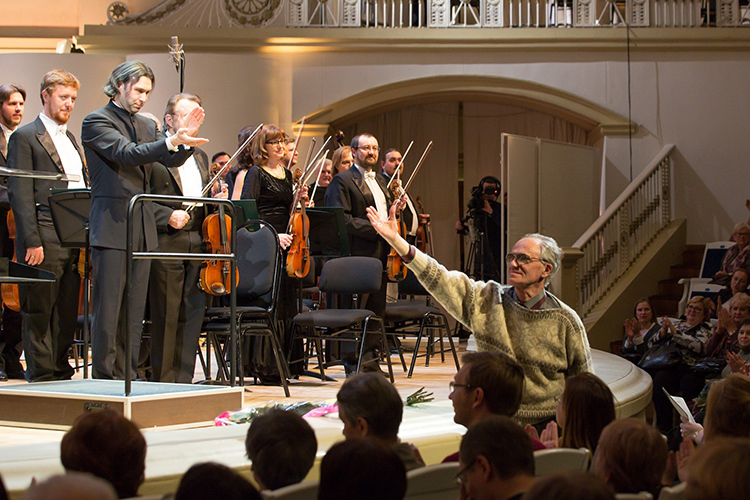
The culmination number of the current session of Vladimir Yurovsky and the State Core lasted about five minutes. But these were an extremely successful five minutes, a certain energy clot, not a formal checkmark in the graph of the “world premiere”, but a powerful statement that excited and delighted the hall. “Lukery’s song” Alexander Vustin is really a Christmas song recorded by him during a folklore expedition to the Arkhangelsk region in the summer of 1977 from a certain grandmother of Lukerya Yakovlevna Druzhinina. The recording for a long time was waiting in the wings and was recently turned by the composer into a laconic, dense and dynamic author's score, where there is a film with that voice from the 70s, the popular voice of Live (at the concert in the Tchaikovsky hall, Natalya Boriskov sang) and a large orchestra with an extended composition of drums.
At the beginning of this season, Yurovsky made a dizzying statement about 80 premieres on the occasion of the 80th anniversary of his orchestra. It should be borne, however, to take into account that the maestro will never go for the ways out and almost everything that he performs, whether Beethoven in the editorial office of Mahler or Rachmaninov’s romances in the orchestration of his own grandfather, Vladimir Yurovsky Sr., is also the premiere. But he, of course, pays particular attention to the currently living composers, who only on his and Kurentzis condemn the crowd.
Woustin does not remember when he was the last time he was performed by a symphony orchestra, he does not know how to bow, accept and give flowers, the audience, meanwhile, goes in a standing ovation, in general, everything is like in a movie
In the fifth year of his reign, Yurovsky decided that it was time to accustom the Philharmonic audience and musical institutions to the mysterious foreign concept of Composer in Residence , by and large does not have an adequate translation into Russian. And the first composer with whom the state order will cooperate during the year or more, is just called Alexander Vustin. This is a very beautiful choice. Just exemplary. The composer of the older generation, a student of Frid and Fere, a participant in the avant-garde post-Soviet, led by Edison Denisov, the Association of Modern Music in the 90s, even a bright, even fiery author and an incredibly modest person, almost unknown outside his workshop. He does not remember when he was last performed by a symphony orchestra, he does not know how to bow, accept and give flowers, the audience, meanwhile, goes into a standing ovation, in general, everything is like in a movie.
True to his idea to derive modern music from the ghetto, Yurovsky usually inserts it into the program next to the older works, loves to observe the emerging dialogue, as well as with a microphone in his hands professionally and boring to prepare the public for it. He began the season with another important participant in the Denisov ASM-2 Vladimir Tarnopolsky, fulfilling his composition “Breathing of exhausted time” surrounded by Bartok and Rachmaninov. The frame for Woustin, who devoted, as usual, his freshly inflated “Lukery” by its first conductor was the predecessors at the Russian composer school Tchaikovsky and Stravinsky - of course, also with their most sprayed opuses.
Orchestral suite No. 2 of Tchaikovsky (it was especially stipulated that it was performed in the original version) turned out to be a fascinating collection of timbre miracles and diary entries: a completely unexpected harmonica was filled, a child’s lullaby led to an alarming dream, somewhere even a German from the still not composed “peak lady” had rolled up. The music of Stravinsky’s ballet “Fairy kiss” from the era of neoclassicism sounded, on the contrary, in the late edition of 1950. Yurovsky called this subtle, lace and discreet essay, sweaty from delicate references to Tchaikovsky, one of the best among Stravinsky and really performed it with touching love, skillfully led to that nicer moment when Clarinet in the hands of the accompanist Mikhail Neznosov gently sang no, only the one who knew. "
So, the main Russian orchestra took a new step towards Europeanism, cunningly nodding respectfully and aside the "sea". The next portion of the premiere from Yurovsky is waiting in March-April.