
Translated material
Cure for stellar disease
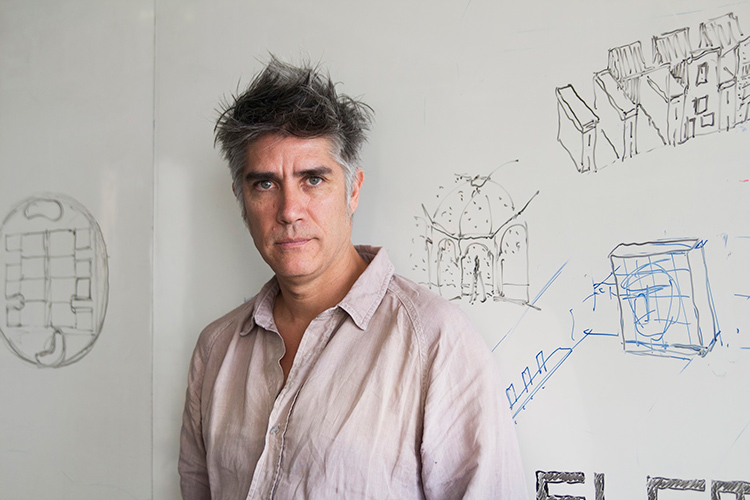
The Chilean architect Alejandro Araveno became the laureate of the Pritzker Prize - the main architectural award of the world. The community reaction to this event reflects the emerging fracture in the criteria for evaluating architecture.
The award of the Pritzker Prize “The Architect for the Poor” Alejandro Araven is not such a surprise. His activity most of all meets the sustainable interest of recent years in the social aspects of architecture, for the same reason Aravenwas chosen by the curator of the next architectural Biennale in Venice . The turn to the social is associated with fatigue from the narcissism of architecture, affected by the starry disease of the last decades, and the reference point can be considered the 2000 Biennale under the motto "less aesthetics, more ethics." Since then, ethics and aesthetics have been flush - a gravity to asceticism has contributed to the 2008 crisis, but the "Starchitecture" over 16 years has not lost its position. Awarding of Araveni plays a significant role in this struggle, because the bonus is usually given to the authors of spectacular buildings - Araveno is primarily guided by considerations of accessibility and common sense. In this regard, the discussion of the event within the community is curious.
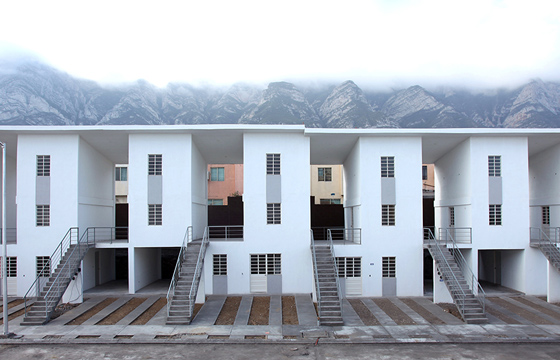 © Elemental example of “Architecture for the poor” Alejandro Araven: Social housing in Mexican Monterrera
If professional criticism, in which the “stars” have long been obsessed with the teeth, took the award of this year with approval , and in some places with enthusiasm , then the representative of the “Starchitecture”, the director of the Zha Hadid bureau and the propagandist of parameterism, Patrick Schumacher, expressed the opposite point of view. Schumacher is outraged by the valuable values - those that allowed to award the most prestigious bonus in the world of architecture for ethical component. The discontent of Zahi Hadid's partner is argued by the fact that from now on the role of architecture is to “maintain social and humanitarian needs”, respectively, the result is evaluated by this criterion. Thus, according to Schumacher, architecture loses its special social task, and innovations are replaced by noble thoughts. What Patrick sees a special social task of architecture, which for some reason is lost in the process of servicing social needs, is not very clear.
Of course, the search for an ideal form is the most important part of the architect’s work, but it is desirable that it be guided not only by the need to hit the imagination of the next Middle Eastern monarch.
As a value contrasted with current attitudes, he leads the concept of innovation - from the context it follows that the author considers himself to be innovators and speaks out of their behalf. To find out how innovations look in practice, it is enough to dial in the search for Zaha Hadid Architects tokio Stadium (one of the last developments of the bureau). Anfas - a giant toad settled on the lawn. Technocratic volumes of toad remind the Japanese about a bicycle helmet: it was such a nickname that the project eventually received. In general, judging by the recent works of Zahi Hadid, innovation is a hysterical manipulation with a form, taking increasing sizes in both direct and figuratively and leading to curses , or even to refuse construction . The results of this process - gigantomania, ignoring the context and bloated budgets - can hardly be considered innovation, on the contrary: all these are quite typical and often discussed satellites of the "stars". And the fact that manipulations with objects are performed using the most advanced means of modeling and are carried out by the hands of the most talented graduates of architectural schools, it seems only discredit these tools, reducing a completely working tool - parametric architecture - to an apolitical overwhelming with a shell at the level of invariability of the Dymkovo toy.
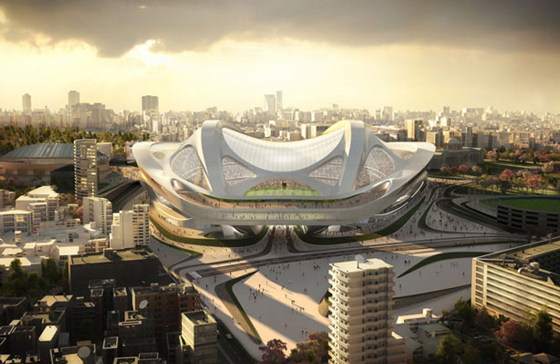 Tokyo National Stadium, which was nicknamed the "bicycle helmet"
 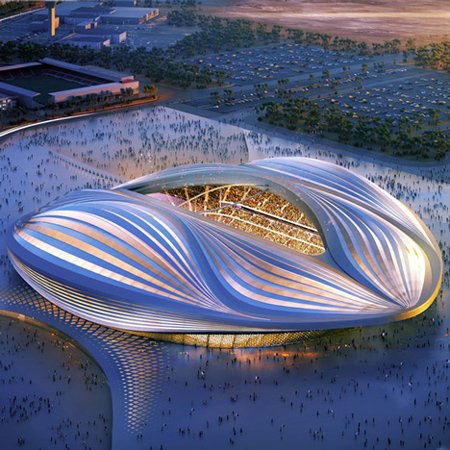 The stadium in Qatar, according to the architect’s plan, was supposed to resemble not a vagina, but a traditional boat DOU
If Hadid's early Suprematic-Brutalist work (from the last of this period, the Maxxi Museum in Rome and the Evelyn Grace Academy in London) caused admiration for interesting plastic finds and a clash of concrete structures, then in the projects of the victorious parameterism the elegance of the plasticism, based on the flawlessly dynamic graphic work of Zaha, gives way to some kind of somewhat flooded pretentiousness of forms gravitating to zoomorphism. Now, if Zaha recalls the influence of the “Russian avant -garde”, this only gives rise to a feeling of awkwardness. The courage of the approach to shaping in the avant -garde paradigm was due to the search for the possibilities of social transformation. Zakha maintains the usual status quo, supplying glamorous trinkets to rich oil states under the sauce of innovation. Of course, the search for an ideal form is the most important part of the architect’s work, but it is desirable that it be guided not only by the need to hit the imagination of the next Middle Eastern monarch.
He claims that the poor should not be a priority for the largest architects of our time.
Another important detail is the mention of the noble aspirations for which they give a prize. Here one could agree and scold some kind of strokes, under the influence of the moment masked under the defenders of the oppressed for the sake of obtaining a profit. This criticism would be quite appropriate, it would not come from Patrick Schumacher. Because with noble aspirations of the bureau of Zahi Hadid, things are even worse than with innovation - if they exist, then nothing is known about them. But it is known about the attitude of Zahi to the death of workers in Qatar, where the "star" erected a stadium for the World Cup. In his comments on the voiced deaths of more than 800 migrant workers involved in the construction sites of Qatar when preparing the infrastructure for the championship, Zakha said that it has no attitude to this and the state should solve such problems: “I have no opportunity to influence this, the world is imperfect” and “I am more worried about death in Iraq.” Such an answer led to a negative reaction in the press. Of course, no one expected the abandonment of the project or exposing the actions of the Qatar government, but a little empathy would not have prevented at least at the level of commentary. Another scandal ended in the construction of the Heydar Aliyev Center in Baku - for the sake of a new construction, 250 residential buildings were demolished with violent eviction of residents. In response to the followed attacks, Zakha and Patrick began a crusade against ill-wishers: Patrick erupted with a conviction text in a favorite Facebook format, and Zaha dragged one careless critic on the courts.
 Patrick Schumacher's statements on Facebook often become the reason for the reciprocal jokes within the community
But back to the Pritzker Prize. Carried away by the discussion, Patrick in his reasoning goes even further. He claims that the poor should not be a priority for the largest architects of our time. The poor and the middle hand of masters is enough, moreover, the poor have all the possibilities to build their own housing on their own. The position of Schumacher, despite the tendencies, should be taken seriously, because it demonstrates a gap between the self -perception of the "stars" and the assessment of their work by the architectural community. Architecture has a new dimension. The production of intricate volumes for the sake of a WAU effect becomes not enough, concern about the interests of the user is added, and this is a serious burden for any innovator. It is at this point that Patrick is behind the steam locomotive - the future of architecture is largely associated with the hope of new sociality, and not with intrusive forming. Another thing is that not only Zaha sins them - this is a common place for many "Starchitectors". It’s just that the rest behave in public more accurately and do not allow sharp attacks. Zakha, in his usually rude manner, causes fire on herself, making it clear that she does not care about any conventions, and gets a ton of negativity, and Patrick, meanwhile, is trying to defend the legitimacy of the bureau to defend. Together, this creates a tragicomic effect.
Meanwhile, the official turn from the "Starchitecture" to something, as if possible, seems to be gaining strength. Sensitive to the conjuncture, Rem Kolkhas even tried to put this process under his banners, intentionally not inviting any of the “stars” to the Biennale - 2014 Venetian Biennale . The next Biennale, under the leadership of the Aravians, is devoted to the social role of architecture and is designed to demonstrate the challenges that different countries face. Let's hope that at least the expansion of a standard “star” set awaits us, and at the maximum, a demonstration of new ideas, approaches and solutions.