
Translated material
Without five minutes nine
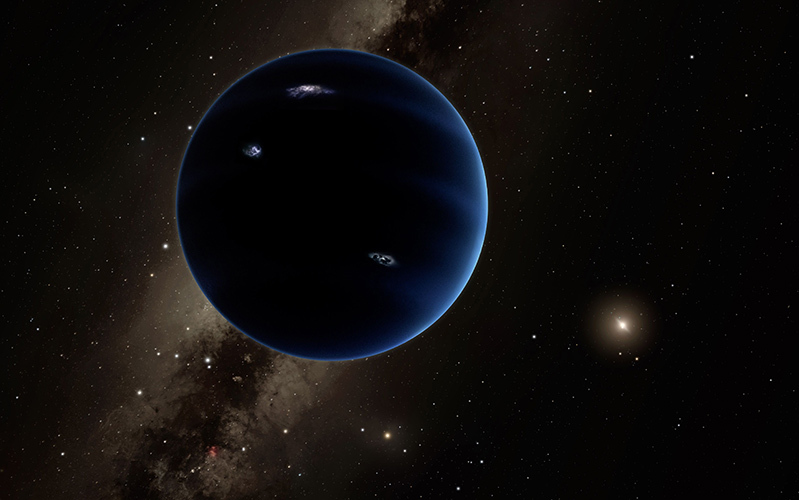
In 1952, in the article “Is God”, the mathematics and philosopher Bertrane Russell, the famous reasoning appeared about the teapot in space: “If I began to say that a porcelain kettle rotates between the earth and Mars around the Sun, no one could refute my statement, I add a prudent that the kettle is too small to find it even with the most powerful telescopes ".
It is impossible to exist in the status of a Russell teapot - or not, it is impossible to prove - the fate of many bodies in the solar system. Everything that is less than 50 meters in diameter (the height of the 16-storytakes), modern earthly telescopes have no chance to notice; This is often said in connection with the possibility that once such a flying sixteen -story building will crash into the ground without warning and will kill tens of millions of people from a blow.
Can the celestial body go unnoticed by the Earth? It seems that it can, and this is a full -fledged ninth planet. Unlike the remaining eight and even Pluto’s planets, no one has yet seen it, but the astronomers claim that she simply must be.
January 20 Astronomical Journal has published a scientific article with the understandable name "Evidence of existence in the solar system of a remote giant planet." If it exists, then he is at least 10 times harder than the earth, solid, ice and makes one revolution around the Sun in 10-20 thousand years. And even at the closest point of her route, it is still 250 times further than the Sun (therefore, this planet is not suitable for the role of the mythical planet Nibiru or Trierov melancholy, which will come close and tear the earth - this planet keeps us a distance).
The stone ninth planet is perhaps a failed workpiece for a giant planet like Jupiter, thrown into the periphery with gravitational indignation.
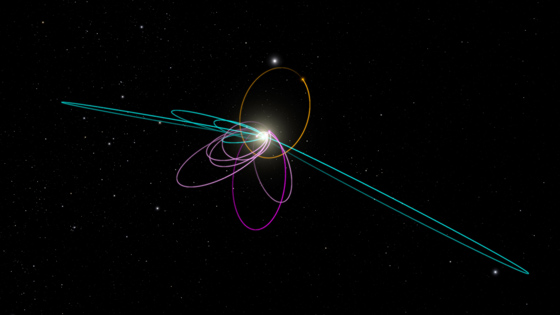
The whole article is a detailed theoretical reasoning: such a planet would well explain the unnaturally elongated orbits of other transneptun bodies - small planets of Sedn, 2012 VP113 and some other neighbors of Pluto along the Kuper belt. To write off their behavior for a clean case-without the participation of any additional planet-giant-it is possible, but only with a probability of 0.007 percent.
The authors of the article are two astronomers from the California Technological University, and both with the name. Professor Michael Brown in 2010 published the book “How I killed Pluto and why it was inevitable.” In 2003, Brown discovered the Sedna’s small planet and provoked a discussion in the International Astronomical Union about what to consider a planet and what to count-as a result, Pluto lost the status of a planet.
29-year-old Adjunct Professor Kaltha Konstantin Batygin (who at the age of 13 left his parents from Russia) is also no astronomer. In January 2015, American Forbes included him in his selection of young scientists “30 of those who are not 30” . His surname has been mentioned for eight years now and there in popular magazines about the science of the level of New Scientist or Scientific American . In 2008, for example, Batygin calculated the apocalyptic scenario, according to which the solar system will die much earlier than the sun goes out: after 40 million years, from due to gravitational outrage of some planets, the movement will become chaotic, then Mars and Mercury will be thrown far beyond the orbit of the rest of the planets, and nothing good shines, and the earth is also not good. In 2010, Batygin described the situation where gas giants like Jupiter begin to behave like a bear-allergic, bit by bees: they swell under the influence of an almost weightless swarm of space particles .
 © Caltech / R. Hurt (IPAC)
All these studies are knocked out of the logic, which from the school cabinet of astronomy imposes a school-visual layout of the solar system with an electric motor, where in the role of planets-balls on the rods. In the layout of each planet - its own orbit, given once and for all a soldered rod that imitates solar attraction. In addition to this attraction to the ball in the center, nothing else connects them, the planets are autonomous as islands, and they do not converge together.
For Batygin’s models, trying to take into account the complexity of the real space, this is incorrect: everything affects everything here, and instead of one day stuck in the rosette of an electric motor, which always drives the same bodies in a circle, an unstable balance, when a wave of butterfly wings at one end of the world causes a storm on the other.
Small influences with high consequences are described by the physical theory of disturbances. Batygin and Brown purposefully searched for such gravitational indignation that could make a whole family of transneptunal small planets group and occupy their current very elongated orbites. This indignation, most likely, create periodic meetings of light small planets with one heavy-the very invisible ninth planet-giant. All its properties astronomers brought out of the parameters of the orbit of already open objects, Sedons and another five others.
Gigglates-giants begin to behave like a bear-allergic bonded by bees: they swell under the influence of an almost weightless swarm of cosmic particles.
The new solid giant planet does not fit well into a row, which begins with small solid planets like Mercury, Venus and Earth, continues with gas giants and ends with stone crumbs on the periphery-transneptunal small planets. Why is something big follow again? According to one of the hypotheses, this is the failed nucleus-giant for the planet-giant like Jupiter, thrown into the periphery of the early solar system with the same gravitational disturbances that in the future can be thrown out by Mars and Mercury.
Will this hypothetical planet be easy to find? Not very: it is 10-30 times further from the sun than Pluto (which in the best telescopes of the Earth looks dull with a muddy point ), and in addition the sun illuminates its surface by tens of thousands of times weaker than the surface of the earth. In a word, this teapot of Russell is very distant, and very dark. So looking for him in a very large and dark space room will be at least curious.
When (and if) the discovery is still made, the astronomers will have to reduce the boundaries of the solar system, which were once spent directly behind the orbit pluton, and now they are associated with heliopause-a place where the pressure of the interstellar medium stops the solar wind. According to calculations, the farthest point of the orbit of the new planet lies several times further than heliopause. Therefore, the planet itself is not the main prize in this game. Its role is like some kind of unsuitable stone island, barely sticking out of the water, which allows the state to move its sea borders into hundreds of kilometers deep into the ocean.