
Translated material
Family "Seagulls"
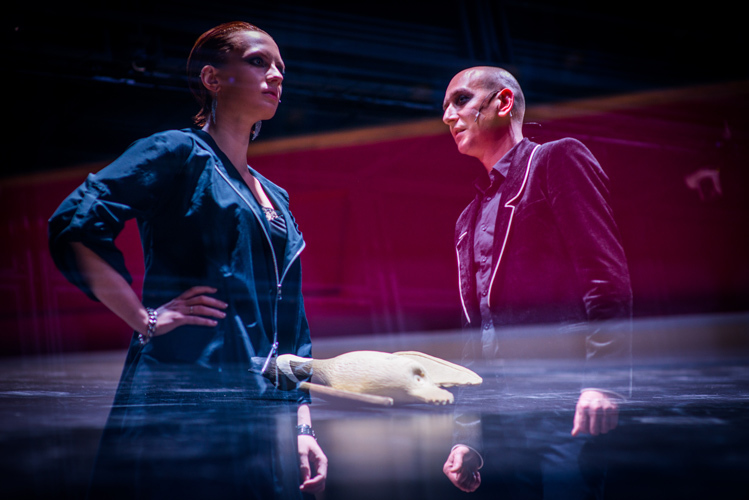
The first in the new year, the premiere of the Stanislavsky electricheatter on January 23 will be a joint project with the production company Vottebe, which made itself the name of the sensational projects “Theater Insomnia” and “Theater Almanac”. The current “insomnia” is the Vottebe team - in addition to the founders of Ksenia Orlova and Saba Lagadze, the director Olga Sorotokina and Theater Sciences Anna Banasyukevich and Elizaveta Spivakovskaya are included today - she decided to devote to the Chekhov “Seagull”. Three directors - Kirill Potoptov, Yuri Kvyatkovsky and Yuri Muravitsky - divided the text of the play among themselves, dividing it not into four traditional acts, but into three parts. If we take into account that each of the directors will play the role of Treplev, the night "Seagull" looks like a statement to the generational statement about the nature of creativity - and, unlike other projects of "theatrical insomnia", this production after the premiere will enter the constant repertoire of "Stanislavsky". The creators of the performance told Anton Khitrov about why tomorrow's night should be spent tomorrow's night.
- Like the rest of the theatrical insomnia, the Seagull goes all night. How does the fact that he does not just spend the evening in the theater affects the audience perception, but literally spends the night in the auditorium? This is a fairly powerful tradition-from the classic "Mahabharata" Brook to the recent 24-hour "Mount Olympus" Jan Fabra ...
Yuri Muravitsky : This format, I think, establishes somewhat more intimate relationships with the theater and with other spectators. I remember how I came to Zim for Psychonoch Lyubimovka : when you see people who are ready to spend the night with each other in the theater, a special atmosphere is formed by itself - on the “theatrical insomnia” this has always been. Well, for the theater itself, for artists-when they agree to a night project, for them this is also some kind of step, a challenge.
Kirill Protatoptov: Some artists go to the site only in the last part. We do not know how this will affect the performance.
Yuri Kvyatkovsky: In the evening, in the afternoon during the performance, you forget about the time of day. Night is a completely different matter. Night is also a context. Night is, perhaps, the main reason to do a "Seagull". From the play of Chekhov, the feeling of night. The first act is an evening, the fourth act is dark. There is a night all the time, the moon. The bone of Treplev's decoration is again night.
Potoptov: When people gather at night, they accumulate energy, they are configured to the adventure - and over time it goes into a fundamentally different state of perception.
- Do you even imagine your audience? Who are these people who are ready to watch performances for the whole night?
Muravitsky: I have the feeling that over several years of the existence of projects such as “Night Museums”, “Night of the Arts”, “Night Show” or “Theater Insomnia”, a special segment of the public - consumers of night events was formed. Maybe they are sleeping in general during the day - and at night they go to walk around museums, in theaters. Of course, this is all an alternative to club pastime.
Kvyatkovsky: And it seems to me that these are the same theater -goers. You saw on the last "insomnia" - an ordinary theatrical party. Well, maybe a little younger. On Friday, Saturday, everyone is ready to have fun, spend time together; If this is not a cafe, not a club, not a disco - where will you go? Moscow does not offer any alternatives, so any non -traditional night venture immediately causes a stir. The experiment is that the “seagull” is a rather complex material, it requires concentration from the viewer.
It was impossible to just take and miss a hundred years of the existence of the Chekhov play.
Stepptov: I do not know how much our "seagull" will be rich in meanings for a thoughtful viewer.
Kvyatkovsky : Without context, the viewer will be able to watch this "Seagull"? Not knowing anything about the play? How will it work? This is definitely not the case when the viewer can come unprepared.
Potoptov: I do not agree. An ignorant person can always offer something. If I do not know the plot, then at least I see an approach, I understand in what relations the performers are with the text, I will be interested in the method of communication.
Muravitsky: So I put myself in the place of the viewer who has not read or does not remember the “Seagull”, but bought a ticket. In some places I would fall asleep, but in general it would be interesting for me to see what it is between people.
“But it's still Chekhov.” Does the cargo of previous interpretations crush you?
Kvyatkovsky: crushing. Principal. Maybe this pressure "insomnia" is dedicated ...
Muravitsky: ... or release from him. And we will not break out of the context. It was impossible to just take and miss a hundred years of the existence of this play. Of course, I had to somehow work with this.
Kvyatkovsky: All the gut sitting here is thin to follow the Chekhov text ...
- That is, your performance will not begin with the textbook “Why do you always walk in black”?
Kvyatkovsky: Of course, no! The first part (in the production of Yuri Muravitsky.- Ed. ), In which I play Treplev, as, in fact, the other two, is the deconstruction of the play, inventing some my own language. Specifically, this part grew out of acting verbal garbage - you know, when people in the process of rehearsals are funded about the situations of the play. Improvisation turned into a literary basis over time - the playwright Andrei Stadnikov worked on it, who focused on certain remarks, which contains the meaning of a particular scene. The first part turned out, on the one hand, wildly formal, on the other hand, some very real-precisely because it grew out of verbal litter. In the end, everything took the minimalist, intelligible shape of a kind of fagon-plane-all three parts are united by the unified decoration of Nana Abdrashitova in the form of a podium, which each of the directors beats in their own way. At first, this is actually a podium as a decoration for a defile and a fashionable show, then rather a gymnastic path for crushing athletes ...
Potoptov: In the second part of our "Seagull" Yura (Kvyatkovsky. - Ed. ) Put everyone in a situation of spontaneity. Very dissimilar artists with different theater background are trying to unite in a single improvisational field. Naturally, scenes from the second and third acts of the play are the reason. This is a story about a group of artists who perceive Chekhov’s canonical text as an occasion for an endless game existence on stage - when everyone can become any character if he knows his text or at least a little feels his topic.
Muravitsky: In the finale, the podium turns into a bar: Kostya Treplev watches how the heroes of the play, miraculously crossed with celebrities of the last century, again and again pass the circle of their relationships under one beautiful song ... Chekhov’s text is again deformed, but not as much as in the previous two parts. I would like to do without spoilers - I can only say that the final dialogue of the bone with Nina will end quite unexpectedly.
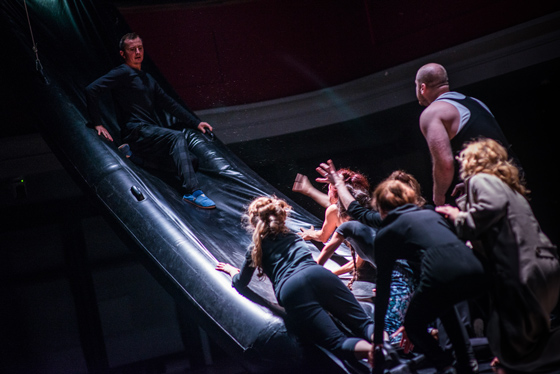 © Olympia Orlova Chaika 2. Kvyatkovsky
- Can you hope that Treplev will survive?
Kvyatkovsky: No. There is no hope there.
Muravitsky: Everything is absolutely hopeless. He had not yet shot, but already dead.
- How much did you, playing with each other, was easy to accept the idea of a colleague?
Kvyatkovsky: If you dig deeper, we did not offer any particularly complicated intruders to each other - except that we were even more confused. Maybe such a time, such a generation that plays trinkets - and due to this, the performance really becomes a generational statement. The artists are all cool, I must say - next to them I forget that I am not an artist, but a director. I have the main joy of this project is connected with the stay in the healthy microclimate of the electrheater - the troupe on the rise, their utopia has come to life, and over these two years, having tried different directions, they became completely universal actors. Being inside, you just dissolve in their energy.
Muravitsky: It was difficult for me from the very beginning - and it is still not easy. The point is not that it is difficult to accept the rules of the game, but that when they do not give me a set of rules, I fall into some kind of stupor, I do not understand the direction of movement. But any set of rules leads to unambiguousness. Here's how I explain to myself the way of work of Cyril (Potopptova. - Ed. ): The complexity, ambiguity of the sensations at the input leads the actor to an interesting effect at the exit.
Potoptov: I don’t even remember what we, in fact, began with Yura Kvyatkovsky. Now he gives me greater freedom as a performer and as a director-in the process of improvisation, I can become an organizer of some situation as a playing coach.
- Another of your colleague is involved in the project - Philip Grigoryan, playing Trigorin.
Muravitsky: We thought about it for a long time, consulted, almost voted. The candidacy for the role of Trigorin is not at all random. The fact that Phil is the director, of course, important.
Kvyatkovsky: I wanted to add more contexts.
Muravitsky: Phil, of course, is not much older than us - but we were looking for the candidacy of a person who not only has an obvious status, but also can cut into our game. It is also important that Phil is also a very cool actor.
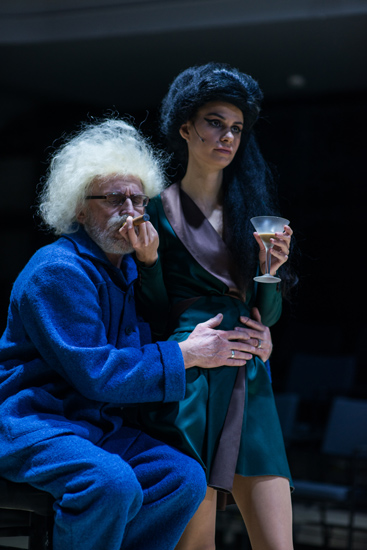 © Olympia Orlova Chaika 3. Potoptov
-Each of you will still be compared with Treplev-this is laid in the concept of the project, so I will ask: do you feel in the opposition to the previous theatrical tradition or traditions, like your hero? Or maybe they felt before?
Kvyatkovsky: If this was, then I already forgot about it. Another, more relevant, dialogue appeared than a dialogue with the championship in the art of routers. Now we are rather in opposition to each other. We have no feeling that we are doing the same.
Muravitsky: Only one thing can unite us: we want to do what we want. I recently gave an interview on one radio, and the man called the air - I still did not say a word about the project, and he was already fought in hysteria: “Leave Chekhov alone! Stop, do not touch, write the plays yourself! " What is valuable to us in Chekhov’s history? Treplev accuses Arkadin and Trigorin of the fact that they are absolutely ossified people in terms of art, but he wants to like it, he depends on the assessment, wants to get the five on them: the whole conflict in this. This is our common problem - we depend on the status, our fees depend on it. That is why this story concerns us. And external conflicts ... As Treplev rightly says, it is not at all a matter of them.
Potoptov: The opposition does not exist in relation to someone else, but in relation to itself. I think each of us feels like Kostya in the fourth act of the play. It is unlikely that one of us believes in our exclusivity-in the sense that you can offer a coming idea out of the ordinary. The question is not in the rebellion, but in how to move on. At some point, it is great to be an amateur, at some point-a rebel: it is important to understand what quality you gain at one time or another. Your riot should grow, change with you.
- I remember that in GITIS at the theatrical criticism, we discussed the “seagulls” of Butusov and Bogomolov - in 2011 they came out almost simultaneously. My classmate then noticed that when the director puts a “seagull”, he, as a rule, has to answer the question of each of the four heroes-artists-about two actresses and two writers: are they talented? I’m not sure that each prisoner of “Seagulls” thinks about this, but the question, in my opinion, is far from idle.
Kvyatkovsky: This question has arisen at each rehearsal. Does Kostya have a reason to think that he is a writer? Does Nina have a reason to believe that she can really deal with theater? In my part, the action is built in such a way that the answers are changing every second: here you are a talented person, and the next minute is a mediocrity that, in principle, is not capable of a creative act. But actually, the modern world teaches us that everyone can be an artist.
Stepptov: The category of talent is difficult to grab and convey on stage. I will never believe that the heroes are talented, if the actors are inach. Therefore, it was strange to operate with the theme of talent at some point for me-it is more important that the vector chooses for himself this or that character.
Kvyatkovsky: Chekhov’s material for each of us suggested thinking about our own giftedness. And this is a process, I confess, not too pleasant.