
Translated material
Return to zero
The Russian currency is getting worse: by noon on January 21, the dollar flew up to almost 86 rubles, the euro came close to 94. The authorities seem to have no sane action plan. What to wait?

The Russian authorities will not determine in any way what way the economy will go
The acute phase of the crisis continues. On January 21, the ruble once again fell victim to low oil prices and sales in the stock market. The head of the Bank of Russia Elvira Nabiullina was forced to cancel the trip to the World Economic Forum to Davos, apparently preparing to take emergency measures in case the situation began to get out of control, as in December 2014. Rumors are already circulating on the market that exporters are again recommended to sell currency revenue.
January 22 "released" a little. The day before, to the American exchange session, oil began to grow on the expectations of serious cooling and heavy snowfalls on the east coast of the United States and in Europe, as well as information about the possible convocation of an emergency OPEC meeting. The growth continued to the Asian session, as a result, the cost of a barrel of Brent flew by almost 10 % - higher
$ 31/bar, and the dollar at the opening of the Russian market fell below
80 rubles. However, everyone understands: it is pointless to talk about the change of trend, the oil supply is still exceeding demand, the reserves are growing (last week in the United States they grew by almost 4 million barrels when growing by 2.2 million growth), and Iran competes with Saudi Arabia in the amount of Bloomberg discounts, discount on Iranian variety Heavy exceeds $ 6 per barrel). The head of the Civil Initiatives Committee, ex-Minister of Finance, Alexei Kudrin, warned in Davos that the peak of the crisis in Russia is ahead, and oil could fall to $ 13-14 per barrel. The chairman of the Board of Directors of the Bank MDM Oleg Vyugin, in turn, did not rule out $ 10 per barrel.
Mutually exclusive forecasts
The probability that the Central Bank next time will move from the persuasion of oil workers and bankers (on January 21, a closed meeting was held by the deputy chairman of the Bank of Russia Alexei Simanovsky with the heads of leading Russian banks and representatives of banking associations), analysts regard decisive action as a rather high one. On the eve of the collapse of 21 Anvar, the Bloomberg agency published the results of a survey of leading experts of the foreign exchange market, who believe that at a course above 90 rubles. For the dollar, the Central Bank can resume foreign exchange interventions.
Almost simultaneously with this Bloomberg material, the Bank of America Merrill Lynch analytical report appeared, whose economists calculated: when oil prices fall up to $ 25 per barrel for the deficiency of the Russian budget for 2016, the dollar should cost 210 rubles. And for the execution of the budget with a three percent deficit, which Putin called the maximum in December, the dollar should cost 140 rubles.
The most indicative is that these two forecasts for the development of the situation in the Russian economy are essentially mutually exclusive. If Bloomberg experts proceed from the fact that the Bank of Russia will adhere to the inflation targeting policy and at some point will be forced to counteract the ruble devaluation-the powerful factor that spuriferous inflation expectations-then Bank of America believes that the priority for the Russian authorities will be a sustainable budget. It is impossible to achieve simultaneously two goals - both the short -term inflation and three percent, even taking into account the declared sequestra, budget deficit at the current dollar rate and the current oil price - it is impossible. Neither the President nor the prime minister directly governing the economy in their speeches nor the word mentioned what they were going to do. Vladimir Putin only saw a chance to get away from raw material dependence, and Dmitry Medvedev complained in difficult times and promised new economic incentives. The key ministers of the economic bloc - the Minister of Finance and the Minister of Economics - are arguing at the Gaidar forum about what to do next, offering mutually exclusive recipes, Putin's adviser Sergei Glazyev demands to curb speculators and fix the dollar, and the Central Bank took up a circular defense, fighting off from all sides of the proposals to include a printing press. In fact, today there are three groups of experts and officials offering their recipes for the crisis.
Tighten the belts
The most consistent supporter of budget expenditure in accordance with the received income is Alexei Kudrin. The need to reduce government agents and carry out unpopular pension reform, one of the main elements of which would be raising the retirement age, he speaks almost from the moment of his resignation. However, so far, in his opinion, the government is inclined to go the other way, and the withdrawal was made “based on the analysis of the actions and statements of the government, as well as key politicians of United Russia. “If we do not touch defense expenses and social expenses, then the probability of increasing taxes, even small, even large - 99.9 %,” Kudrin explained in Davos. He himself considers it more correct in the current situation to cut subsidies to various sectors of the economy, except for infrastructure construction and agriculture.
“Key ministers of the Economic Bloc - Minister of Finance and Minister of Economics - argue about what to do next, offering mutually exclusive recipes, Putin's adviser Sergei Glazyev demands to curb speculators and fix the dollar, and the Central Bank took up a circular defense, fighting off from all sides of the proposals to include a printing press”
However, the main idea that Kudrin is trying to bring to the authorities: "We must abandon hopes for high oil prices and do it unconditionally." In fact, this proposal to return in 2004, when a stabilization fund was created, designed to accumulate all oil out -of -residuals received by the budget from prices exceeding the bar established by the government. In the early 2000s, in the framework of the discussions about the creation of a stab fund, one of the initiators of its creation-the then presidential adviser, And-Rare Illarionov, proposed to establish a “cut off price” at the level of $ 12 per barrel. Now Kudrin offers $ 35–40, which corresponds to approximately $ 20 in the prices of 2004 - the level from which the stab fund began to form. The removal of oil overpromitations at one time quickly had fruit. Already in 2006-2007, the main sources of growth of the Russian economy were the financial sector, retail, services and industry, not related to the extraction and processing of raw materials: assembly enterprises in Russia were massively opened by car and household appliances.
In the government, Kudrin’s views are divided by his successor as Minister of Finance Anton Siluanov, who made it quite harshly made at the Gaidar Forum that the sequestration of the budget is a resolved issue, and if necessary, the costs will be reduced further. The fact that expenses still have a fact is evidenced by the fact that the Ministry of Finance has been published last week: the Ministry of Finance has been about trillion rubles allocated, allocated but not spent last year with ministries and departments. Moreover, the ministry of defense, which has more than 700 billion, became the record holder for undeveloped funds.
Do not finish off the dying man
The head of the budget by all means is resisted by the head of the Ministry of Economic Development Alexei Ulyukaev, who continues to believe that oil is about to begin to grow again. At the Gaidar forum, he stated that a U -turn in the market could happen by the end of the first quarter. Realizing that the Ministry of Finance does not find his position, Ulyukaev, responsible for economic growth, decided to try his luck in the Central Bank. Last week, he said that he still “sees the opportunity” to reduce the refinancing rate, which could reduce interest on loans and at least somehow facilitate the position of business and the banking sector.
In their fears regarding the negative impact of the reduction of state expenses on the economic prospects of Ulyukaev, it is not alone. According to the former deputy chairman of the Central Bank, Sergei Aleksashenko, a policy of reducing expenses and holding the nominal budget deficit of 3% of GDP is erroneous. “In the market state for the Russian economy, it is more important to maintain state demand than to formally fight for a reduction in the deficit,” he said. This, however, does not mean that the Bank of Russia should immediately include a printing press and begin to directly lend to the government. “As for the credit issue, it is directly prohibited by law and will disperse inflation, which is already quite high,” the expert adds. - The Central Bank is already seriously supported by budget and quasi -ybery expenses. According to my estimates, last year approximately trillion rubles were sent for these purposes. ”
Both Ulyukaev and Aleksashenko proceeds from the fact that the government could allow a temporary excess of budget deficit in order to avoid even more compression of the economy and, accordingly, the tax base, which, in turn, will force government departments. If this script is adopted, the government will begin to spend reserves accelerated pace, but the general economic situation will be slightly easier than in a tough scenario from the Ministry of Finance.
Manual control
Paradoxically, there are many supporters and the applicant for the role of the Savior of the Russian economy - presidential adviser Sergei Glazyv. His recipes were announced last year at a meeting of the Stolypin club: to fix the ruble exchange rate, print money and start distributing them to “priority” industries and enterprises. To do this, in order to avoid an inflation leap, is proposed under strict control over the targeted use of funds for investment in modernization and expansion of production. However, if you distract from a fixed course and controlled monetary emissions, Glazyev’s proposals are the quintessence of manual management policy, introduced by Putin in crisis in 2008. The fruits of this policy of “accelerated modernization” and state support of “breakthrough” industries are observed today.
*** budget deficit at different pricesFor oil and ruble course, % of GDP ***
| Oil price Brent , $/barrel | | The rate is $, rub. | 70 | 65 | 60 | 55 | 50 | 45 | 40 | 35 | 30 | 25 | | 60 | -0.6 | -1.3 | -2 | -268 | -3.6 | -4.4 | -5.3 | -6.3 | -7.3 | -8.4 | | 65 | 0 | -0.6 | -1,4 | -2,2 | -3 | -3.9 | -4.8 | -5,8 | -6.8 | -8 | | 70 | | 0 | -0.8 | -1.5 | -2.4 | -3.3 | -4.2 | -5.3 | -6.4 | -7.5 | | 76 | | | 0 | -0.9 | -1.7 | -2.6 | -3.6 | -4.7 | -5,8 | -7,1 | | 84 | | | | 0 | -0.9 | -1,8 | -2.9 | -4 | -5,2 | -6.5 | | 94 | | | | | 0 | -0.9 | -2 | -3,12 | -4.4 | -5.7 | | 105 | | | | | | 0 | -1,1 | 02.3 | -3.6 | -5 | | 120 | | | | | | | 0 | -1,2 | -2.6 | -4.1 | | 140 | | | | | | | | 0 | -1,4 | -3 | | 168 | | | | | | | | | 0 | -1.7 | | 210 | | | | | | | | | | 0 |
Source: Bofa Merrill Lynch Global Research, 2016
Economists Bank of America Merrill Lynch calculated: when the price of oil falls up to $ 25 per barrel for the deficiency of the Russian budget for 2016, the dollar should cost 210 rubles.
The rate $/rub. At the MICEX from 18 to 22 January 2016
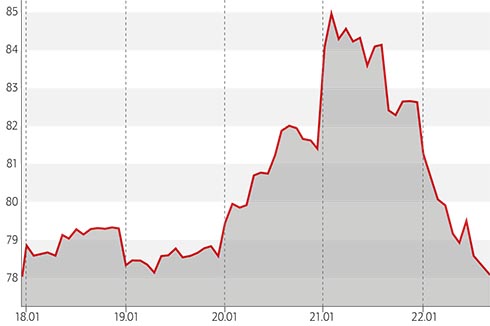
Photo : wikipedia.org