
Translated material
"The worship text in Russian is possible"
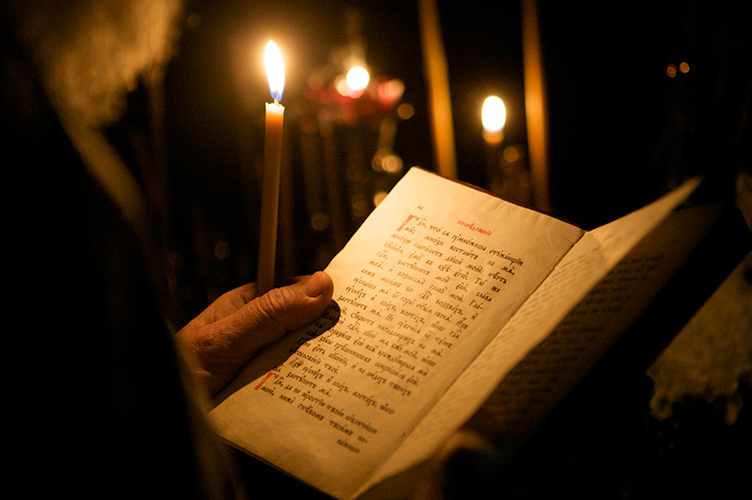
A meeting of liturgical texts and psalms, translated from Church Slavonic and Hebrew languages into Russian by the poet Henri Volokhonsky, is published in the Moscow Publishing House of Supreme Arbitration Court. In addition to the chosen psalms, the book includes the liturgy of John Zlatoust and Vasily the Great, the Sacrament of Baptism and Marriage, a collection of Sunday troparia and kondakov, as well as a brief service for commemoration of the deceased. Colta.ru publishes a preface to the book of Olga Sedakova and a translation of the blessing of water from the sacrament of baptism.
Georgy Fedotov, reflecting on the transfer of Church Slavonic worship to a modern Russian, suggested that this would only be possible if a real poet had taken up the translation, while a church and a large philological culture had a large philological culture. The combination of three such properties in one person is almost unbelievable. But the stars came together. Henri Volokhonsky and turned out to be such an almost incredible translator. I think we can congratulate us on his translation.
But I will begin with an attempt to explain what, in fact, is the special difficulty of the translation of Church Slavonic liturgical texts into Russian. Why is it difficult so that this task may seem unfulfilled.
First of all, between the Russian and Church Slavonic languages in the tradition of Russian culture have developed extremely peculiar relations. The Russian and Slavic (as Church Slavonic is usually called in everyday life) have never been perceived as two “parallel” language, as, say, Russian and French, so in the very fact of translation from one language to another would not have any emergency. But the use of the Russian language and Slavic was mutually exclusive: where the Slavic acts, the Russian is silent - and vice versa. So translating from Slavyansky to Russian would mean translating from a “sacred” language to a “profane”. But even this is not the only difficulty in relation to two languages. The whole dictionary of a high register in Russian is simply borrowed from Slavic. But these words often resolutely changed the meaning. To translate liturgical texts to “tall Russian” with an abundance of Slavism would be a great displacement: the language of these texts would be perceived while museum and pompous - which is completely not in the original. The original - where it is clear - touches as a simple and living word. But the translation into “ordinary” modern Russian would inevitably be perceived as a decrease and sometimes even as a parody.
Another fundamental difficulty of such a translation is that liturgical texts are poetry, and poetry of a special kind. Almost all liturgical prayers and hymns are translations from Greek; New ones were written from their prescriptions. Byzantine poetry is a complex, rhetorical, built on the principle of πλέκειν [1] , that is, “Confluence” or “Weaving Word”. Behind this rhetorical term is the image of a wreath (winner), a wreath of words. There was no such poetry in the Russian literature. We are used to her only in the Slavic guise. Her “confusion” (the cunning order of words, inversions) will have to be simplified, otherwise these verses will be incomprehensible in Russian.
From the fact that liturgical texts belong to poetry, several important things follow. First of all, the need for the beauty of verbal construction is not as an external text in relation to the “meaning” of the text, but as a reference to the deepest layer of this meaning. Ugly said, these texts cease to mean what they mean. They become powerless. Beauty is a direct power of meaning, one might say, its will and persuasiveness. One of the main signs of this verbal beauty is the rhythm. As you know, many Byzantine hymns were written by a regular verse that Slavic translators did not imitate. But this does not mean (as some researchers think) that what turned out to be in Slavic, is just a substrate. The Slavic text clearly follows some complex laws of rhythm and euphony; This is a prayer -down verse whose nature is still not clarified by the poetry. One example of a rhythmic device: the formula "now and in the forever and ever." Henri Volokhonsky conveys it like this: “Now, forever and ever and forever” - excellent! In one of the latest Russian translations, we read at this place: "Now and always and forever centuries." On this “and always” we seem to fall into a rhythmic hole. “Prison”, of course, means “always”. But much more means that we are talking about some special endlessness, which expresses the rhythm of shock syllables and repetitions more than a word or another. The formula, almost spellless meaning of the rhythm disappeared. Perhaps just a modern poet, accustomed to the irregular rhythms of Verlibra, is more capable of creating something similar to a prayer-laying verse than poets of the classical nineteenth century.
But the fact that in a poetic statement is no less important than verbal beauty and rhythm is his special relationship with meaning. The translator inevitably interprets what he translates. Each translation is already an interpretation. But the translator, brought up on a prosaic sense, will “interpret to the end”, “to complete clearly”, to some unambiguous meaning. Even if this “final” meaning is really enclosed in the words of a liturgical verse, they are not limited to the case. The poetic meaning is by no means embarrassed and not approximate, it is accurate in its own way. But there is certainly openness in it, there is a semantic scope, there is some inappropriate strangeness. He, with the words of the block, is wrapped in color fog ":
And the world will again appear strange
Wrapped in colored fog.
The poetic scope, oddity and rainbow of meaning carry the words of liturgical texts. This does not contradict the fact that liturgical texts are not secular lyrics, but a poetic presentation of dogma.
And now, having listed only some of the difficulties stopping the one who would like to translate from Church Slavonic, I can say with surprise and joy: Henri Volokhonsky coped with them! A subtle poet who knows the price of the word and rhythm, he connects the Russians and the Slavic words that remained unequer that we learn all these texts as relatives. They became more transparent - but remained themselves. They sound, they are full of ambiguity, they do not lose in beauty. There are arbitrariness, mannerism, capricious preferences, all kinds of remakes - everything that you wait with fear and boredom, revealing a modern translation - all this and the shadows are not translated by Henri Volokhonsky. He works chastely with the original.
Volokhonsky-Poet has his own, immediately recognizable dictionary and metaphor: but here he seems to leave all this outside the doors. Only the thinnest, most core in the gift of a real poet helps him: love for silence.
These texts will still be discussed. And I could name some places that, in my opinion, could be translated differently. But this is another conversation. The main thing was found. The worship text in Russian is possible.
Olga Sedakova
[1] Weave, Vit (Greek)
Blessing of water
(from the rank of baptism)
The priest (loudly leases) :
You are great, Lord,
Your deeds are worn out
To sing your miracles,
There are no words (three times) .
All of you will be revealed in being out of non -existence,
Your power holds the universe
Your architecture is based on the universe.
You combined four in being,
He weaved four times with a tape of years,
Any reasonable spirit honors you.
The sun sings to you - the moon singsion
The stars praise you, and the light hears
You will hesitate and command rivers,
And the sky spread like a bright fabric.
You erected the earth on the waters,
The sea fenced the sea
You sighed and exhaled the air
The army of angels in your heights await the deals,
The choirs of the archangels are extended before you,
Even multi -legged cherubs and six -winged Seraphims,
hiding before the throne, hide in horror of the face
From impenetrable radiance.
And you, oh God,
Nonal, indescribable, incomprehensible,
And you are on earth - like a slave, in the guise of man.
The lord is merciful, you could not stand the spectacle
Satanic oppression of the human race:
appeared, saving us.
So, we proclaim about grace,
We will thank mercy, declare a blissful miracle:
Humanity is now free!
The bosom of the Virgin became
your birth is holy
The whole creature glorifies
Your phenomenon in the world:
You - God - appeared on earth,
You lived with us
You consecrated from above
the power of the Holy Spirit
The water of the Jordan
And he crushed the chapters
Zmiev, there are elastic.
So, come now,
O Tsar Hummouses,
come and this water
Consider your holy spirit (three times) :
Give her the grace of salvation
Jordanian blessing,
Inal source, let it be
Give her a gift of consecration
the healing of ailments, sins of forgiveness,
so that herself, endowed with angelic power
and impregnable enemy army,
Demons destroyed, and yes run from her
Everyone who is yours
Creation, oh Lord, slander,
For he called your name
marvelous, glorious and terrible enemies.
Three times draws a sign of the cross on the water, blows and says:
Yes, they will die under the sign of your cross
All hostile army (three times) .
We pray to you, Lord,
Let all obscure air ghosts immediately dissipate,
And let the dark demon not hide in this water,
may not take possession of the baptism of the demon.
Pearing souls into darkness and minds in a riot.
And you, the ruler of the world,
Tell us this water:
The water of the salvation
consecration water,
Cleaning the flesh and spirit,
Forgiveness of sins,
Tearing the shackles,
souls - enlightenment,
The firing of life is eternal
for being updated from above,
The gift of adoption
and update of the spirit,
impaired blanket,
Life Source.
For you said, Lord:
- Cool - and you will become clean,
From your souls, expel vices.
For you gave us a new birth from above:
From water and from the spirit.
Come, O Lord, in this water,
Give it to accept baptism to transform,
let him leave the former person in her,
in the temptatory lusts of the decaying,
And in a new one puts on himself
renewed in accordance with the likeness of the creator,
so that in baptism merging
With the image of your death,
He was risen with you
And, holding the gift of your Holy Spirit
and returning the key to your grace with an excess,
Awarded the Higher Personal Honor
Among the first -born whose names in heaven
Drawn in you, oh god,
And in our Lord Jesus Christ.
For you are glory
And power, and honor, and worship
Together with the father of the hopeless
And with your spirit, saints,
good and life -giving
Now, forever and ever.
Amen.
Peace to everyone.
Put your heads in front of the Lord.
Translated from Church Slavonic Henri Volokhonsky