
Translated material
Intrigue with the Arabian flavor
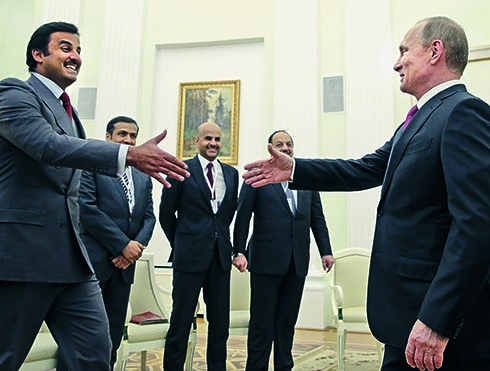
Emir Katara Hamad Al Tanya arrived in Moscow in a good mood. Why? On January 25, the next round of intersiral negotiations under the auspices of the UN was scheduled in Geneva. A week before, the impressive Qatarian emir Hamad Al Tanya came to Moscow to Moscow. Is the accident? The visit of Al Tanya, who spoke with Putin for more than two hours, was presented by television officialdom as the unconditional diplomatic success of Russia. Formally, this is true. Because of Syria, Russia ruined relations with the most part of the Muslim (Sunni) world. Qatar is not just among such countries, it can be said to be an avant -garde in them: the small monarchy of the Persian Gulf is part of the military coalition under the auspices of the United States, competing with the coalition under the auspices of Russia in the fight against the Islamic State*. Moreover, Qatar supports in Syria those forces that even more than IG*gets from Russian aviation. It turns out that now the head of this monarchy has come to agree on something almost to the enemy. And if so - we are now no longer “almost opponents”, but “almost partners”.
Nevertheless, after the departure of the emir, there was a taste of some lack of nothing and even riddles, what is the reason for the visit? Applications of the head of the Russian Foreign Ministry Sergei Lavrov and his Qatari colleague Khaled al-Ali on this subject are equally vague. It is clear that Syria was the central issue, and we now know the overall position of the two countries: “The Syrian people must determine their own destiny,” and the faster the better. But after all, the same was discussed in the negotiations on Syria in Vienna last fall, the results of which did not affect the Syrian situation: the Syrian people already decide their own fate since 2011, and quite radical methods. Another thing is that the true meaning of Vienna was different: everyone then recognized Russia as a full -fledged interest in the Syrian issue. In January 2016, Emir Katar confirmed this: he told Putin that "in matters of regional stability, the role of Russia is the main one."
Qatar vs Russia
This is an important detail, because bilateral relations are generally problematic. And the first blow to them was inflicted on them by Russia back in 2004, when two employees of the Russian intelligence services arrived in Dochu and committed the murder of one of the leaders of the Chechen separatists Zelimkhan Yandarbiev. Moreover, they did this, as we are expressed in a “socially dangerous way”: with the help of a mining minced control, the Yandarbiev’s car was blown up, as a result, the guards were killed in addition to him, and his 13-year-old son was seriously wounded. In fact, Russia committed a real terrorist attack in Qatar. And Qatar did not forget this.
In the fall of 2011, the Qatari side went beyond the flags: the Russian ambassador Vladimir Titorenko was greatly beaten at the Dochi airport by the local police-due to the inspection of the diplomatic mail, which he had with him. As a result, the diplomat almost lost his eye. The go -ahead for this attack was given at the very top, which, in fact, the police themselves reported Titorenko, and the head of the service of the Catar Foreign Ministry was watched by reprisal.
Strictly speaking, this was by no means the answer of the Dohi to eliminate the Yandarbiev, but the reaction to the position on the Syrian issue, which Russia had just occupied by supporting Bashar al-Assad.
“Most likely, Emir Al Tanya enlisted the promise of Moscow in the future to lobby for Qatari gas pipeline plans in exchange for support at the UN”
However, the scandal with Titorenko in Moscow was lowered on the brakes and even sent him to resign, hinting that, they say, he himself provoked everything.
After that, for two years, Russia did not have an ambassador in Qatar. Nevertheless in February 2012
At a consultation in New York, the Qatarian Prime Minister Hamad Al Tanya proposed to Russian Permanent Vitaly Churkin not to vested the Syria resolution, promising in return an arms contract for $ 33 billion, plus the obligations of his country to respect the “Russian zones of influence” in the Mediterranean Sea and all the interests of Moscow in Syria. In response, our diplomat ridiculed the Qatari, retorting him to the remark in the spirit that, being a representative of a great country, he was ready to negotiate only with equal to himself. And in general, they say, when the Russian fleet plowed the waters of the Persian Gulf, Katar did not exist yet **.
Qatar vs Saudi Arabia
To understand how the apparent desire of Qatar is dictated by relations with Moscow, it is important to take into account another factor - Saudi. The relations of Qatar and Riyadh are no less cool-countries openly compete for influence in the region, and in 2014 it reached the recall of the Saudi ambassador from the Doha.
Fraud arose back in the late 1990s: the Kingdom of Saudi referred to Katar, approximately like Russia-to Ukraine. An independent foreign policy that began to pursue, enlisted American support, the father of the current Emir, was perceived in Riyadh as a challenge. The Arabian Donbass did not reach, but now for the Saudi royal house, Qatar, as for Russia-the West, with its hostile NPOs, abstract-warrous political ideas, well, and the Al-Dzhazira television channel (with headquarters in Doha), a kind of information atomic bombing: the channel of the superpowers in the Arab world and, according to the Arabic world, and, according to the Arabic world. The Saudi leadership is planting a "dangerous worldview."
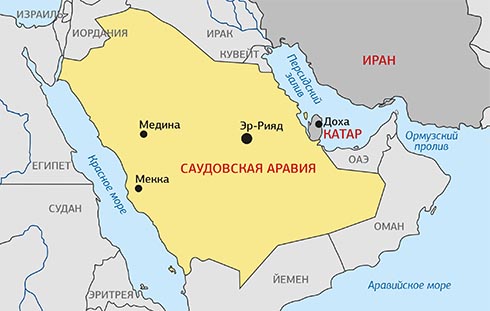
In the affairs of the region, little Qatar seeks to play an equally role than the "big" neighbors
Source: World Atlas, 2015
Before the Syrian war, the Saudis annoyed the Qatari softness in relation to Iran: in Doha they considered the Iranian support of the radical Palestinian group of Hamas, while the Saudis, who completely learned to get along with Israel, did not like this actively.
It was Qatar, and not at all Saudi Arabia, was the main factor in the support of the Arab Spring, primarily the Egyptian Muslim brothers (in Saudi Arabia they are considered a threat to the conservative monarchical regime), which overthrew President Hosni Mubarak in February 2011. The Saudis jealously watched the growth of Qatarian influence in Egypt and sighed with relief when the Egyptian Isismist President Mursi was overthrown by a secular military junta under the leadership of General al-Sisi, who used just Saudi financial support.
Even in the Syrian question, Qatar and Saudiya are opponents. They support different groups that equally resist both Assad and IG*. Moreover, they compete tightly among themselves. Katar sponsor the battle wing of the Syrian Muslim brothers-the Ahrar Ashham group, which is considered relatively moderate. At the same time, Saudi Arabia supports the Salafi Jabhat al-Nusru-the Syrian branch of Al-Qaeda ***. In the context of the Saudi-Katar disagreements, the meeting of Putin and Al Tanya in Moscow happened exactly one week before the intersiral negotiations in Geneva under the auspices of the UN.
Saudi Arabia vs Russia
The main intrigue of the Geneva negotiations: what Russia and Saudi Arabia do not put on or, conversely. Apparently, in Geneva it will be decided who can be considered an opposition worthy of deciding the future fate of Syria and agree with Assad’s supporters - all the others will be declared “terrorists” with whom the conversation is short.
Er-Riyad insists on the forces that are in alliance with the kingdom, however, Moscow requires that this block be expanded primarily at the expense of representatives of the Kurdish militia.
The Saudis have good chances to simply disrupt negotiations if the events are not developing according to their scenario - it is enough for this that representatives of the groups controlled by them leave the deliberation room.
Strictly speaking, to whom in Syria it is destined to become an opposition, and to whom-terrorists and how to withstand the pressure of Er-Riyada is the most urgent issue that Putin and Al Tanya could discuss at a meeting in Moscow. Apparently, Russia managed to get at the most crucial moment an important ally, ready to annoy Saudia as part of its own political course and interests, the Russian Foreign Ministry, obviously, managed to turn a split among the Arab opponents of Bashar al -Assad in their favor.
In exchange for willingness to cooperate with Moscow, perhaps, an additional bonus will receive. There is a conspiracy theological hypothesis: they say, the whole Syrian history occurred due to the desire of the Qatar to stretch through the Syrian territories a gas pipeline in
2009. Bashar al -Assad destroyed the plans of Emir - in Damascus they considered that a similar gas pipeline will be carried out by Iran friendly through Syria.
It is unlikely that the Syrian civil war happened exclusively due to the competition of the Qatari and Iranian projects. But the projects really were. Another thing is also known: in addition to political issues, Emir Al Tanya discussed in Moscow an economic bloc, which we know almost nothing from official sources. However, most likely, the emir enlisted the promise of Moscow in the future to lobby for Qatari gas pipeline plans in exchange for support to the UN - just as the Doha at one time proposed guaranteeing Moscow to maintain its positions in Syria if she did not object to the overthrow of Assad.
Saudi Arabia vs Iran
In this case, Russia will be forced to sacrifice its friendship with Iran, and this is just understandable. Due to Iranian oil, black gold prices in the world market fall even more. And now it is a headache for Putin.
At the same time, Iran should understand: Iran does not have any desire to put on Russia, like Saudi Arabia deliberately dropped oil prices in the 1980s in order to deprive the USSR of financial resources used for intervention in Afghanistan. It was just that the situation was so that Iran, our ally in Syria, is our rival on the Economic Front, for Ayatollah Khamenei, as for Putin, the price of oil is a matter of internal stability.
“In the case of a direct clashes between Saudi Arabia and Iran, the price of oil will not only return to $ 100/bar - with this scenario it will fluctuate in the range between $ 200 and $ 500”
The question is, no less jealous than Russia, the leader of this market, Saudi Arabia, is also watching the emergence of Iranian hydrocarbons in the international market.
In fact, Iran and Saudiya, although so far indirectly, are already at war: at the Syrian theater of military operations on behalf of Iran, the Hezbollah’s Lebanon and the Corps of Guardians of the Islamic Revolution, which are opposed to part of the rebel groups based on the support of Er-Riyad. But in addition to the Syrian theater, there is also Yemensky, where the Shiite groups of the North supported by Iran are opposed by the forces of President Mansur Hadi, who once fled from the country, but in September last year on Saudi bayonets.
The new round of exacerbation between Saudi Arabia and Iran began after the execution of January 2 on the verdict of the Saudi court of the Shiite preacher Nimra An-Nemire-in response to this in Tehran, the Saudi embassy was defeated, which led to the breakdown of relations. But all this is just an occasion. The true cause of Saudi nervousness is the prospect of economic strengthening of the main geopolitical enemy after the relief of sanctions.
The main weapons of the Saudis, having the lowest cost of oil and free capacity, allowing to sharply increase production, will be even greater collapse of oil prices. Of course, the kingdom will also lose on this, but it is able to transfer it easier than anyone. Saudiya produces almost 4 times more oil than Iran, and its budget for 2016 is a reversed at the rate of $ 30 per barrel, while Iran has $ 40/bar.
These prospects do not delight Russia at all, where they hoped that oil in 2016 would cost $ 50/bar. As a result, Moscow can only hope for a very small, but existing chance that Iran and Saudi Arabia, in addition to a hybrid war in foreign territories, will enter into a direct collision. If this happens and the exchange of attacks directly on oil infrastructures (strictly speaking, even a direct collision of the two powers does not mean at all that they will be guaranteed to destroy the oil industry of each other), then the oil price will not only return to $ 100/bar - with such a scenario it will fluctuate in the range between $ 200 and $ 500. The very case when someone is war, and to whom is the solution to all problems.
*“Islamic State” (IGIL, ISIS, Daish) - a terrorist group prohibited in Russia.
** Qatar became an independent state in 1971, freed from the British protectorate.
*** The Al-Qaida and Jabhat al-Nusra groups are recognized in Russia with terrorist organizations, the Ahrar Ashham group is not yet.