
Translated material
Influenza 2016: Officially
Comments of the Minister, the Councils of the Doctor and Rospotrebnadzor
Comments of the Minister, the Councils of the Doctor and Rospotrebnadzor

"Do not storm pharmacies"
Although the flu epidemic will last until the end of February. Tips of Professor Pavel Vorobyov
In the central regions of Russia, the most influenza weather was established: it got warmer, but the viruses love it. Director of the Institute of Virology. DI. Ivanovsky, Academician Dmitry Lvov, the media stated that the epidemic would last until March, will illuminate 6-8 million Russians during this time. Deadly cases are no longer only, they only register them under other diagnoses, the academician claims. With the question of “how to live on?” We turned to the chairman of the Moscow City Scientific Society of therapists, Professor Pavel Vorobyov.
- First, tell us about how not to get sick? In pharmacies, everything that is considered antiviral and controversial was sold. Medical masks have risen in price at times ...
- I will upset your readers: there is no magic remedy, do not chase as advertised medicines and overpay. Not a single antiviral drug has proven effectiveness. With the Swiss Tamiflu in the West there was also a big scandal: the results of clinical trials were tapped.
And my recommendations are boring: to be less in public, wash your hands, maximum - wash your nose with salt water, you can dilute the salt of 10 g per 1 liter of water yourself.
It is absolutely not necessary to buy dressings at all, they do not protect from viruses. They are good during a sandstone, but unfortunately, the viruses are not an obstacle. The dressings can be worn by the patients so that the droplets of their saliva in a conversation, with a cough and sneezing, do not fly around. Healthy masks are not needed.
- What to do if you are already sick?
- Lying, in no case do not go to work, extinguishing the symptoms and knocking down the temperature. Drink a lot. One liter of fluid drunk per day must be added to each degree of temperature. If you usually drink one liter per day, then at a temperature of 38 you need to drink two, at 39 - three. It is good to drink sour drinks, for example, tea with lemon. Raspberries and honey are also suitable, although no one has conducted clinical trials for them: there is no evidence base - only experience.
You do not need to knock down the temperature with tablets (only to children, if they do not tolerate it poorly: convulsions, vomiting). It must be reduced by physical, not chemicals: wipe with a napkin moistened with cool water. If you decide to knock down, then an ANALGIN (not by paracetamol, not aspirin - does not knock aspirin, paracetamol is toxic to the liver, its use in the world is reduced).
It is said a hundred times, but not superfluous to repeat: antibiotics in viral diseases do not help. They only kill bacteria, do not act on viruses in any way. Complications do not prevent. Treatment of SARS and influenza is not pills, but reasonable help to the body so that he himself can deal with the disease.
- These days on an ambulance - Abral. When do you really call a doctor?
- Even high temperature is not a reason to call an ambulance. Drinking, peace, maybe cool wipes, and there is no need to tear off an ambulance from really severe patients.
But with pandemic flu, it also happens that by the end of the first week the disease becomes better, the temperature subsides, but suddenly shortness of breath appears. Here you need an ambulance. Perhaps an insidious complication is a specific viral pneumonite. It happens, as a rule, in young people. The older generation has already encountered this flu in the 70s, and has immunity against it.
With pulmonary complication, the struggle should go already in the hospital. We need intense therapy. And not only oxygenation is oxygen enrichment. The patient's blood thickens, microcirculation worsens. DVC-syndrome is developing, characterized by multiple thrombosis and polyorgan lesions. An active struggle is necessary to impaired blood coagulation: the blood diluting blood, plasmapheresis. In the last epidemic of the flu in 2009/10, this tactic was actively used in Barnaul clinics. The number of deaths there compared to other regions turned out to be 10 times less.
Recorded by Lyudmila Rybina , "New"
officially
All under control: 70 people died
Health Minister Veronika Skvortsova spoke at a meeting in the government
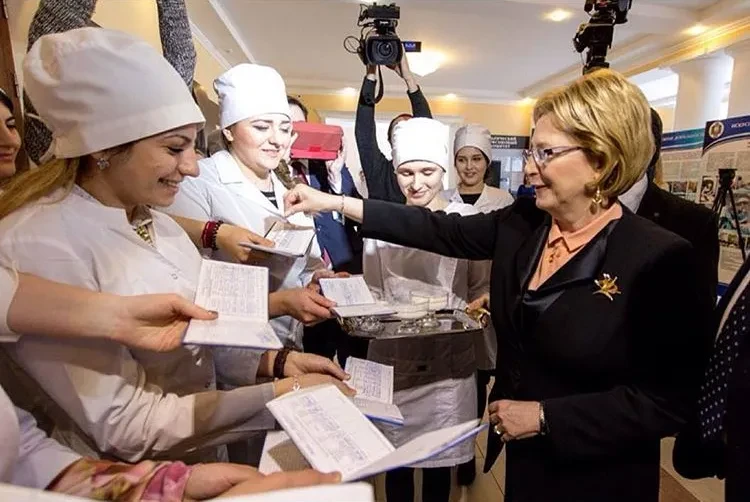
The minister said that the situation with the flu is controlled and does not go beyond the borders of a regular seasonal one, “and we hope that it will not work,” the minister encouraged. “For the epidemic situation of this year, we began to prepare very seriously since the summer of last year,” Skvortsova continued, “and for the first time in the history of observations, we instilled more than 45 million Russians - this is a third of the country's population,“ that contain vaccines that contain the stags relevant for this epidemic. Therefore, in general, the population is ready to either not get the flu, to those who are vaccinated, or, accordingly, to transfer it in an erased and non -woven form. ”
An increase in the epidemic threshold of influenza was reported by the minister, began in the second week of this year, and somewhat unusual from the southern regions of the country, these are the Rostov, Volgograd regions, Stavropol Territory. And also - from epidemically dysfunctional regions of Eastern Europe, including from Ukraine.
If we talk about the prevalence of strains, then mainly pork flu H1N1 (from 75 to 95%), other strains are significantly less represented, says Skvortsova. Not vaccinated, especially from risk groups: children under two years old, pregnant women and adults suffering from chronic diseases.
I would like to note, the minister said that the situation is completely controlled, the system is ready in terms of monitoring the influenza situation and the provision of medical care. “We increased the antiviral drug market this year by 1.5–2 times. There are drugs in all regions with a “fireless” margin of up to two weeks. The situation in the pharmacy network can be considered stable. In those regions where the epidemic threshold is exceeded, there is periodic excitement demand, but, as a rule, these are temporary logistics difficulties that very quickly leave taking into account the redistribution of drugs from regional warehouses on the pharmacy network. ”
The network of infectious hospitals is completely made in readiness, 100 thousand infectious beds and 15 thousand infectious resuscitation beds are deployed, completely equipped with respiratory equipment, in case of heavy forms of influenza and the development of viral pneumonia, Minister Skvortsova reported.
The director of the Fund of Independent Monitoring of Health, a member of the Russian Public Chamber, Eduard Gavrilov, disagree with her: “I'm not sure that the situation is under control by the ministry. January has not yet ended, but 70 deaths were officially confirmed. ”
According to Gavrilov, a deficiency of infectious disease doctors and a limited number of beds in hospitals will be a serious challenge to the healthcare system.
“According to Rosstat, in 2013, 7461 infectious disease specialists worked in the Russian Federation, and in 2014-6796 specialists. Reducing by 9%. In Moscow, 139 infectious disease specialists became less for the same period: instead of 565, 426 remained to work. There is no data for 2015 yet, but I believe that the trend has been preserved, ”Gavrilov said.
He also recalled that in 2013-2015, more than one hundred thousand beds were reduced in the Russian Federation. To a greater extent, the reduction affected rural areas, where specialized beds were eliminated, including infectious ones.
Prepared by Lyudmila Rybina , "New"
Rospotrebnadzor recommends: how to protect against influenza?
Rule 1: often wash your hands with soap
Hand hygiene is an important measure of influenza prophylaxis. Washing with soap removes and destroys microbes. If there is no way to wash your hands with soap, use alcohol -containing or disinfectant napkins.
Rule 2: Follow the distance and etiquette
Avoid close contact with sick people. Observe a distance of at least 1 meter from patients.
Avoid trips and crowded places.
Cover your mouth and nose with a scarf with coughing or sneezing.
Avoid touching your eyes, nose or mouth with your hands. The influenza virus spreads with these ways.
Do not spit in public places.
Wear the mask or use other improvised protective equipment to reduce the risk of the disease.
Rule 3: Healthy lifestyle
Observe a healthy mode, including full sleep, food consumption, rich in proteins, vitamins and minerals.
The most common symptoms of flu A (H1N1) 2009
• High body temperature (97%)
• Cough (94%)
• runny nose (59%)
• sore throat (50%)
• headache (47%)
• Far breathing (41%)
• muscle pain (35%)
• conjunctivitis (9%)
Complications of influenza A (H1N1) 2009
A characteristic feature of influenza A (H1N1) 2009-the early appearance of complications is already on the 2nd-3rd day of the disease.
Among the complications, primary viral pneumonia leads. The deterioration in viral pneumonia is rapidly pace, and many patients develop respiratory failure for 24 hours, requiring immediate respiratory support with mechanical ventilation of the lungs.
What to do if someone has a flu in the family?
Give the patient a separate room in the house. If this is not possible, observe a distance of at least 1 meter from the patient.
Limit to a minimum contact between patients and close, especially children, elderly people and people suffering from chronic diseases.
Veil the room often.
Wash your hands with soap often.
When caring for the patient, cover your mouth and nose with a mask or other protective means (scarf, scarf, etc.).
Only one family member should take care of the patient.