
Translated material
The principle of the hammer
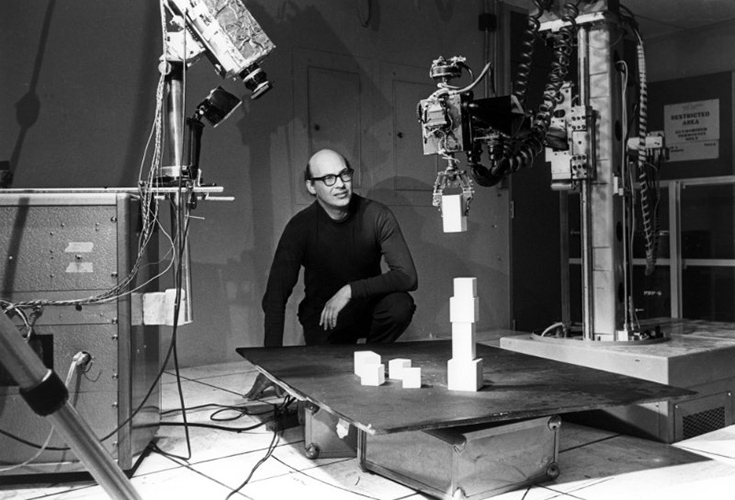
The news of the death of the “father of artificial intelligence” Marvin Minski found me to write the text about why children are forbidden to show a finger - and why it is actually showing a finger and even necessary. Believe it or not, but I was just thinking about whether to mention the ideas of Marvin Minsk in that text or it would already be too much for the book, which should be clear to ordinary parents, and not to professors of cognitive sciences.
Okay, let's start with a simple one. Simple aphorisms are almost always false, but there are areas of human activity that are perfectly described by such aphorisms - precisely because in these areas there are a lot of artificial, simplified and false. For example, the whole history of cognitive sciences is perfectly described by an English proverb: “If you have a hammer, all problems will seem to you with nails.”
Although no, wait. If I say “history”, then we must take into account the great merits of previous generations! Therefore, the main principle of intelligence science is better to formulate this: “Even if you have a microscope, all the same, all the problems will seem to you with nails - because the previous hundred years you had a hammer.”
In other words, our ideas about the work of our own brain are very dependent on the fashionable technologies of the past generation. Remember the medieval concept of "god-seeker"? A purely technical metaphor for a long time determined mechanistic representations even in those sciences that we call humanitarian.
The joke program written in 1966 in 200 lines imitated a psychiatrist who simply repeats the phrases of the interlocutor in the form of questions.
In the 20th century, the main model of intelligence became a more advanced, “book-computer” model. You probably met her under various other, beautiful and scientific names. But let's cleanly: this model represented intelligence as a Word processor that performs symbolic operations with abstract concepts and categories. What will be the main principle of cognition in such a model? Learning new abstract concepts, of course!
Simplied scientists, such a religion, of course, did not like it. Biologists and doctors already in the middle of the 20th century knew something about the structure of the brain-there were no signs of a “symbolic processor”. But there were neural networks working on completely different principles.
The contradiction reached a special intensity in the development of artificial intelligence (AI) - it was a combat test of cognitive theories (fighting in the sense that huge Darpa grants could be sawed). In the late 50s, a serious confrontation of two approaches was outlined. The “descending” AI is just the idea of describing the whole world “from top to bottom”, in the form of abstract concepts and grammar so that the machine can draw “reasonable” conclusions. And the “ascending” approach, that is, “from the bottom up”, is attempts to simulate the brain as it works at the physical level. Perceptron , neural networks , cell automatic machines , genetic algorithms and other strange models that only sin are in the “descending”. “If in the spring you wanted to get a lover, you should not take an amoebu and wait until it is evolving,” said one of the pioneers of cybernetics, Warren McCallowh.
At the same time, the audience admired the banal dialog bots such as Eliza Joe Wiseenbaum: the comic program in 200 lines written in 1966 imitated a psychiatrist who simply repeats the phrases of the interlocutor in the form of questions. Thousands of people took the joke seriously. This is artificial intelligence, they decided; It is only necessary to collect more concepts and more precisely paint grammar.
Where in this war Marvin Minsk? That's the drama that he was on both sides. With one - as the creator of the first self -learning neural network Snarc (1951) and the author of the theory of neural networks (1954). However, ten years later his views are changing: he writes works on semantic processing of information and at the same time in the book “Persepthrons” (1969) criticizes the “ascending” approach, showing the restrictions of parallel calculations.
As a result, the “descending” win: the term “artificial intelligence” will mean for many years to mean consistent symbolic calculations in attempts to simulate human logic and natural languages. The most fashionable criterion of “intelligence” is the Turing test (which is declared insolvent even in the very work of Turing, where it is first described).
It is difficult to say what influenced Marvin Minsk and made him go to the other side of the barricade. I suspect that for him, as a scientist with broad views, there was no barricade at all. And there were just different approaches to one common problem. Later, Minska more than once apologized for the fact that his publication dedicated to the restrictions of only one model of perceptron, spoiled the reputation of the entire approach “from the bottom up”.
“If in the spring you wanted to get a lover, do not take an amoebu and wait until it evolves.”
Such a split, by the way, occurred not only with him. Until now, in professional literature (literally today I saw) there is a stupid term “Nonfontneuman architecture” as applied to systems of parallel calculations. Although it was John von Neumann that was the first to build a self -reproducing car based on a cell automatic. It’s much more parallel! Another big lover of cell automatic machines, Stephen Tolfram, is now better known as the creator of the Wolfram Alpha reference system.
In general, there were alternative concepts. But they were not accepted by society, because they did not fit ... I want to say "in the head", but no. The neural networks work perfectly in the head. But it did not fit into the book-computer model of intelligence, which reflected the fashionable technology of its time. Classic consistent computers were already put on stream, they made useful calculations in science and industry, they quickly decreased and cheaper, ready to enter every house. A hammer in hands seems more reliable than a tit in the sky. Why not solve all the problems with this familiar hammer? It doesn't work? Buy a hammer more powerful. Buy five hundred hammers.
Alas, it did not work. At the end of the 20th century, most developments in the “descending” direction of the AI were rolled up after they wasted their multimillion -dollar grants. Attempts to sell talking bots on the Internet are taking place now, but the boto builders quickly go broke - except for those units that sat on the tail of a dinosaur, ready to go bankrupt for them (as in the case of a funny, but useless Siri toy). In 2006, Marvin Minski finally repented, releasing the book “The Emotion Machine” , in which he defeated the book-computer models of consciousness.
Meanwhile, the “ascending” AI with its neural networks and Bayesov analysis gradually gained strength in various fields. Even the search engines, praying to the semantic network and all sorts of miracle algorithms of paga-wrapps, slowly switch to self-learning networks ( Matrixnet in Yandex ). Yes, and in Turing tests for talking bots began to win systems like Alicebot , which do not “analyze the grammar”, but self -learning on a large number of “images” of the correct answers.
But this does not mean that the symbolic AI lost. He continues to develop in those special environments where he (and not at all to a person!) Lives best. In special symbolic worlds. These are the bots of high -frequency trading and bots for network attacks. These are exactly the places where the terminator is now born. Only he does not at all look like a sweet old man Arnold. He kills in completely different ways.
And then I can finally tell how it all relates to children. It is only necessary to add one bundle in the form of a quote from Philip Dick: "Fake reality can give rise to fake people."
Many believe that "pointing with a finger" is indecent; They manage to inspire this superstition even to small children. And parents in some modern manuals are even advised to turn away from the child when he shows something-and demand that he call his goals in words. Allegedly, speech and intelligence in general develops from such an appeal in children.
Call words? Is this the most important thing in development? Personally, I see here precisely that book-computer model of intelligence that infected our culture in the last century. It’s just that psychologists again stole the scraps from the table of engineers. In the same way, after the appearance of computers, they came up with "neurolinguistic programming." The name itself directly says where the spoons were stolen.
Parents in some modern manuals are even advised to turn away from the child when he shows something-and demand that he call his goals in words.
Only by the beginning of the 21st century did they finally reach the idea of another, sensory-net, model of intelligence. In psychological magazines, publications appeared under the slogan of Grounded Cognition , literally “grounded”, “basic” intelligence. In this model, the basis of cognitive processes is not abstract symbolic calculations, but multimodal simulation, that is, the reproduction and modeling of visual, motor and other sensory “impressions” obtained in direct interaction with the outside world.
It even came to studies that prove that "a lot of complementary organs of the child’s feelings allow him to study independently - without a specific task and without a teacher - simply interacting with the outside world." What a blow throughout our parish education system! It turns out that the sensory systems of the child - visual, auditory, motor, tactile, olfactory, vestibular, and so on - teach and adjust each other without any correct words. And it is precisely such parallelism that allows them to react much “smarter” than abstract rules.
It is funny that the work quoted above was published in 2005 in the journal Artificial Life , and its main idea is what artificial intelligence developers can learn from infants. I would add that such things should first of all teach the parents of those same babies. I know how difficult it is to muffle the stereotypes of the book-computer training model in order to better see the sensual-net.
Why do small children repeat the same movements and strange gestures so many times? Why are they swinging or circling in place? Why strive to turn all the objects upside down and gnaw? Why, starting to crawl around the house, are they so stubbornly tapping cabinets and walls? Why do the first words appear in them simultaneously with the ability to walk - and why do you think better when walking?
Everything becomes much clearer if you throw a hammer of turing from the head. In fact, we guessed this in childhood, when we read how Pinocchio sold the alphabet and went to study the world on pure practical experience. But we need another hundred cool peppers like Marvin Minsk, so that this technique does not seem fabulous.
If you like the author’s ideas, you can support the publication of his new book for parents .