
Translated material
The son of a Jewish and inspector Luftwaffe goes to Kaliningrad
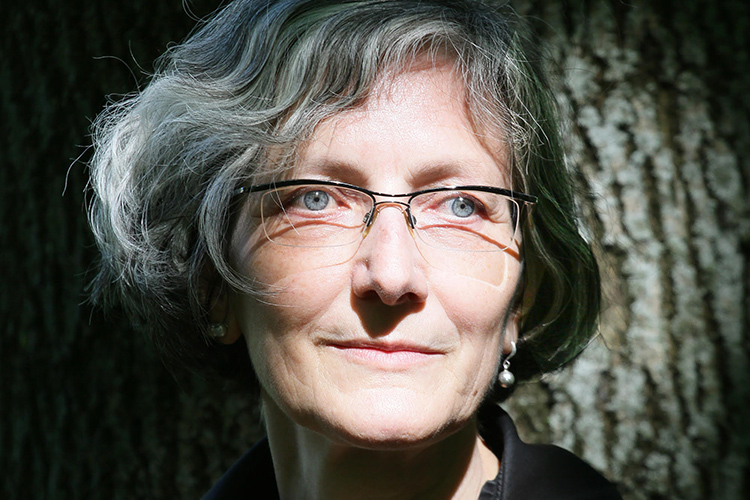
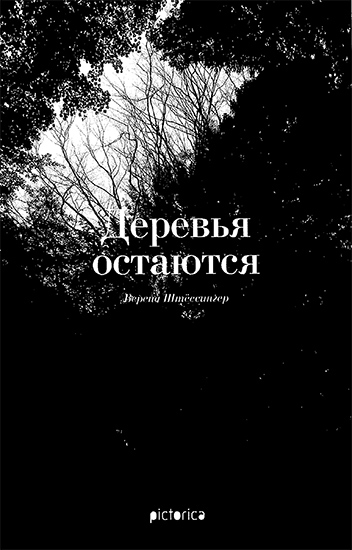
Today, January 29, in Nizhny Novgorod, the Swiss-Russian festival “Days of Basel” will open , at which the writer Veren Steussinger will present her book “Trees remain”. The presentation will be attended by her husband Jurgen, who has become the main character of the book - she represents a piercing description of the trip to the places of his military childhood, from which he had only a few photographs. The son of the Polish Jewish and the government inspector of the Luftwaffe, Jurgen returns to the current Gdansk, Kaliningrad and Guryevsk (Neuhausen), where he had to bury his mother who had died of hunger at the age of 12. Together with his wife, he restores the history of his family, which broke up as a result of the war. “Trees remain” published in many countries, including Russia. COLTA.RU talked with Stessinger on how this book was created.
- “Trees remain” distinguishes attention to the slightest details - this is a very “visible” narrative. How did you work on the book?
- My husband himself invited me to participate in this journey. To be honest, I was a little scared - because I understood that this would be due to very strong emotions. In the end, I decided to simply fix everything that we see, what we were talking about - as a result, a written notebook was left from each trip. All this material was formed in the book.
- Why did your husband decide on this trip only in 2000, and not immediately after the fall of the wall and the collapse of the USSR?
- For such a trip you must be internally ready. In addition, he was very busy: he is an actor, he worked a lot and toured at that time. But with age, thoughts and memories of the past intensified until finally came the moment when he thought: “We must go now, then it will be too late.”
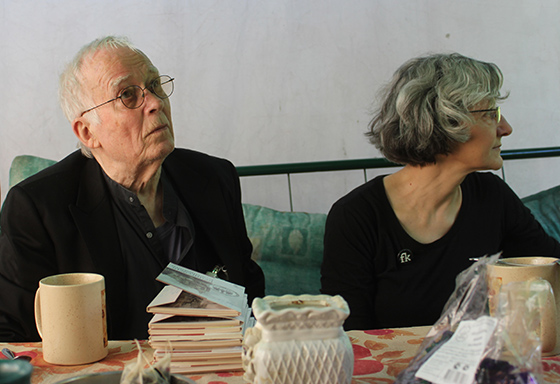 © Jaromir Zezula Verena Shtössinger with her husband Jurgen
- Based on the book, your husband leaves the impression of a taciturn and restrained person - sometimes there was a feeling that he wants to figure out his history himself, and his wife only interferes with him.
- This is really exclusively his story, I just wanted to make it a work of art. My wife, as a character, I don’t really like this book either, she talks too much. But I needed to create just such a hero - who will provoke a little Jurgen, or something.
- You discussed everything you want to write in the book, with your husband?
- No, they did not discuss, this is my book. But I promised him that she would not come out without his consent. He, as a creative person, perfectly understands me - he realizes that the book should have one author, it is impossible to write it together.
- And you have no disputes on any of the episodes?
- No, we did not argue. And Jurgen perfectly understood why we needed non -cocked, invented parts of the book.
- What impression did Kaliningrad leave you during the first trip?
- On the one hand, it seemed to be a return during a long time. On the other hand, there was a feeling that the city was constantly changing. The old residents are traveling, and the new ones are trying in every possible way to convert the city - it is wonderful that they are doing this, remembering the past. Each time we came there again (and we were there six times there), something new appeared in his life. In general, the city is becoming more and more Russian, now it is really Kaliningrad, and not Koenigsberg.
- The book has an episode associated with the “Tilsiter” cheese: your spouse claims that it was originally made in East Germany, and you are that he is from Switzerland. How did you like the Kaliningrad version?
- Very nothing. But I generally adore any cheese - my grandfather had its own cheese shop. Cheese, sour cream, oil, eggs - everything was available.
- I was always interested in how the Swiss lived during the war. It is clear that the country retained neutrality and the inhabitants did not have to experience the hardships that the warring countries experienced - but still. What did your parents tell you?
- Everything was quite calm. Of course, Switzerland interacted very much with the Third Reich, first of all, economically. In the war years, problems began with oil, other products ... But most importantly, almost no one died. Maybe there were victims due to random bombing, but this cannot be compared with the situation in the rest of Europe. What Jurgen told me about the war years was even difficult for me to imagine.
- That is, your post -war childhood, unlike my husband, was quite happy?
- Yes. Perhaps we lived more modest than now, but everything was quiet and calm. There were a vacation, there were travels, a completely cloudless childhood. A little boring, really. I am from a Catholic family, I was actively introduced to religion. As soon as I graduated from school, I decided to leave for Bern - I wanted to discover a big world for myself.
- You are also known as a specialist in Scandinavian literature - how did it happen that you became interested in her?
- It happened after a trip to Denmark - I liked the country, I began to learn the language. I already liked the Danish literature - from Hans Christian Andersen to Seren Kierkegaard. I have such a warehouse of character that if I learn something new, I want to understand this as best as possible. After some time, I opened the literature of the Faroe Islands , which are located in the Atlantic Ocean between Scotland and Iceland. 50 thousand people, 200 thousand sheep - but nevertheless their own language and original literature. These islands were the possession of Denmark, for several centuries, residents were forbidden to write books in their own language. And only from the 20th century they began to teach Freet in schools. The largest Faroe writer is considered by William Heinean, who was born in 1900 and therefore was first published in Danish. But now all his books are transferred to Farres.
At the presentation of the book in Poland, the old man began to say that the Germans themselves started the war, so there is nothing to write compassionate books about it now.
- What attracts you to his books?
- He has a very rich and bright language of the 19th century, he has very warm humor, he loves people - and he manages to talk very touchingly about his country, depicting all layers of society, from marginals to the elite. Now I am just working on the editing of a collection of his stories, which have not yet been transferred to German.
- I was surprised to learn that the “trees remain” did not want to publish in Germany.
- Yes, but exclusively for economic reasons - this is in no way connected with politics. It seemed to publishing houses that it was impossible to sell such a story, but, fortunately, the book was still published ... I really liked how the Kaliningrad presentation of the book was held-there were about fifty people, including German students. We talked very thoroughly: Jurgen talked about his life, I - about literature, about how best to present such a story. In general, in my memory there was only one unpleasant incident - at the presentation of the book in Poland, one old man began to say that the Germans themselves started the war, so there was nothing to write compassionate books about it now. Apparently, he was not aware that I was actually from Switzerland-he decided that this was a German book ...
- Is the story of your husband's family already an inverted page? Are you planning further trips to Poland and the Kaliningrad region?
- Of course, this story has no end. We have a daughter, who is also very interesting - she did not get into the book. I think that we will come to Kaliningrad all together. In addition, I would really like to visit Moscow and St. Petersburg again, we came there many, many years ago. While Jurgen is able to travel, we will return. And then, I think, I will come to Kaliningrad and Guryevsk alone.
The Russian edition of the book "Trees remain" can be found here