
Translated material
Deadment for the Kremlin
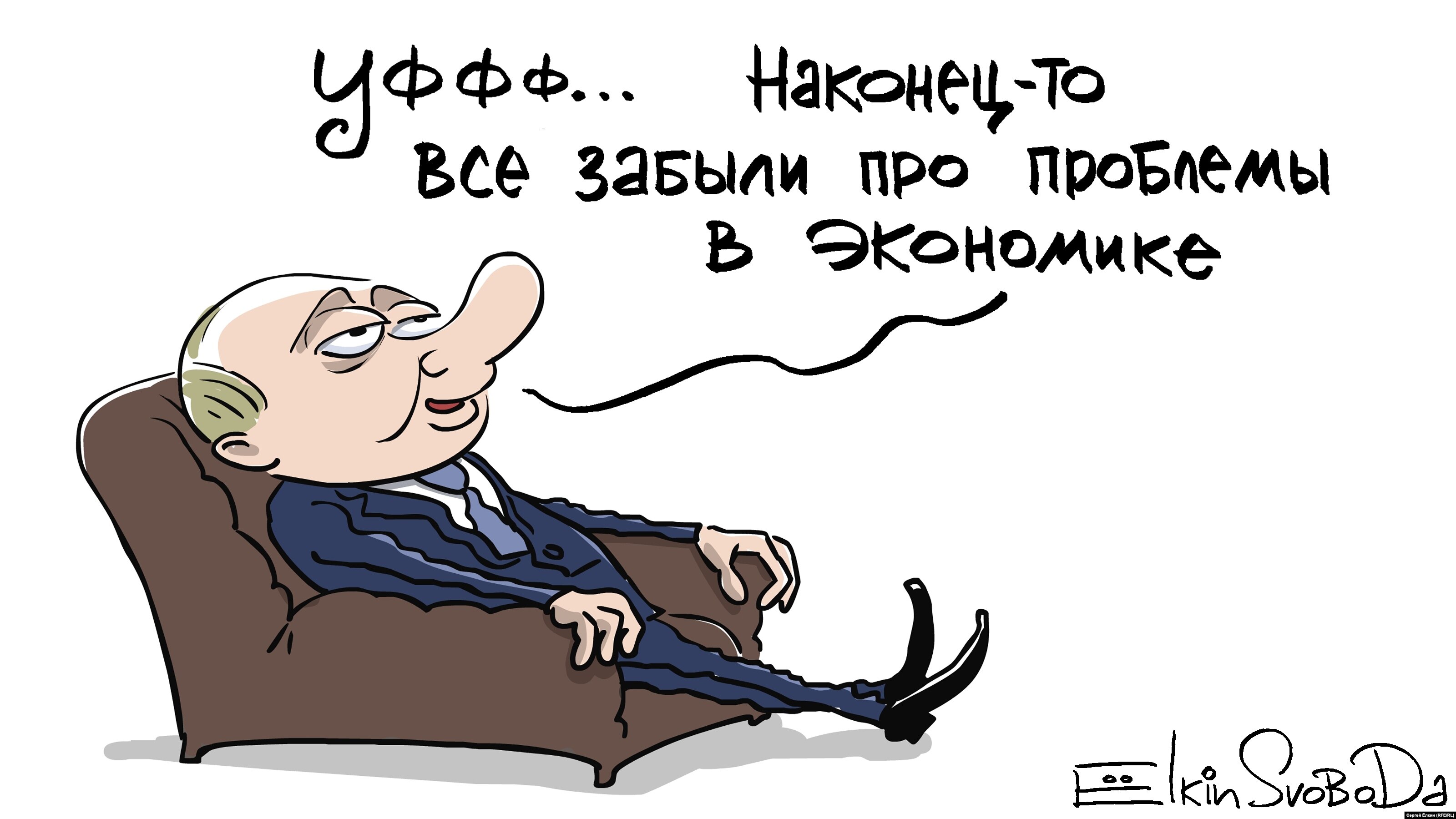
The strengthened ruble and increase in oil prices give time for reforms - but obviously they will not be
After a rapid fall in mid -January, by the end of the month the ruble exchange rate rose to the mark of 76 rubles per dollar. This, obviously, was also facilitated by rising oil prices - from the level of 28 to about $ 33 per barrel.
Can the Kremlin, the predictions of the collapse of the economic policy of which can be heard more and more often, breathe a sigh of relief? Sergey Romanchuk , president of the ACI Russia - The Financial Markets Association - calls what is happening a respite that makes it possible to carry out the necessary reforms, which he himself does not particularly believe.
At the same time, Romanchuk is not waiting for the performance of terrible scenarios that have recently drawn, such as the introduction of a tough exchange rate in the region of 40 rubles per dollar or forced transfer of dollar deposits to ruble:
-Still, these conversations are subtle, if only because I did not hear that such proposals come from serious people. The return of the ruble course in recent days cannot be called small. The dollar from the maximums in the region of 86 rubles fell and 76, this is a rather significant movement that can be interpreted as a correction, or it is possible as the end of the rising trend. Perhaps this is exactly what we believe that the worst times for oil are behind, at least for the medium term. It may well be so. Oil has made a significant way up, and the market analysis shows that quotes are unlikely to be below $ 30 per barrel for some tangible time. Many indicate that this level greatly complicates investments in new deposits. And if this is not done, then naturally the world oil production will noticeably fall for a couple of years. This compensates for the current excess of proposal regarding demand. Well, demand itself can respond to a cheap price for oil and increase. This means that over the next few years, maybe the lower oil has been passed. In this case, there is reason to believe that in 2016 the dollar is unlikely to exceed the level of mid -January, the price per dollar between 70 and 80 rubles may be close to equilibrium, and maybe the ruble will strengthen even if there is more oil correction. The price of oil remains the main factor that determines the cost of the Russian currency, plus the possibility of borrowing.
Social expenses, military spending is quite difficult to politically reduce
It is clear that even at the current oil prices that have moved away from the lower classes, the budget deficit is probably already in the region of 5% of GDP - despite the fact that 3% were laid in the plan. This means that the government will either have to allow a greater deficit and finance it in some way, or to carry out sequestration of expenses. Most likely, both will be done. Until now, the government and the Central Bank manage to use the reserves available to them, so as not to aggravate the situation. The only time that instability in the financial market has shown itself greatly, this is December 2014. Then they made mistakes, but their repetition this year seems unlikely, although the current situation still makes our authorities do something, if only so that everything does not fall apart and Russia does not cover a full banking crisis. Problems remain in the field of public finance - swollen expenses: social expenses, military spending, which is quite difficult to politically reduce. They strain finances. And reserve funds, depending on how well he will behave oil, can be exhausted this year in a bad situation. With a good one - probably, for two years, there will be enough of them, which does not remove from the agenda the issue of gaining a new paradigm - how to move on to economic growth.
Economic stagnation with the continuing fall in GDP in 2016, it seems to me, will continue. But the authorities still have every chance to maintain macroeconomic stability. Operationally, most likely, everything should be in order, including with the ruble exchange rate, and with transferring savings from rubles to dollars. As the last leap showed, the population was much more patient to the course compared to devaluation in 2014. Now such a massive shift of deposits from rubles to currency and the removal of money from banks did not occur, which is a positive signal for the ruble. Because ultimately everything is determined by the trust in the currency, trust in the banking system, which was demonstrated. At least, we did not see any significant shock here.
The government may not, and the president still does not want
- Is it necessary to understand that all panic scenarios for the Russian authorities did not take place? No dangers happened, roughly speaking, the authorities waited and everything was difficult behind?
- Locally behind. The market, most likely, will provide the authorities with another delay in order to somehow try to radically change the situation, restart economic growth. The delay is given ... Russia retains a competitive advantage from the point of view of a weaker currency, it can stand the development of some other, non-oil and gas businesses focused on export. Of course, a terrible business climate does not contribute to this, but just with these authorities it is necessary and you can do something. At the same time, as before, neither the government nor the president ... or rather, the government may not be able, and the president still does not want to change the situation, first of all, to change the situation with the business climate, to make this climate favorable so that it is possible to demonopolize the economy, to develop the middle and small business, to return the secondary class to their homeland recently from Russia.
Sooner or later, oil as a strategic product will lose its value
- You say - this is a delay. This means that everything will last like this, stretch, and then there will be a new collapse?
-The current crisis, most likely, cannot flow according to the scenario of 2008-2009, when oil after a fall, comparable with the current in depth and speed, returned to the previous levels. Almost no one expects such a scenario now, for a long time the position of oil as the main energy carrier is called into question due to the development of technology. In the long run, to expect oil return to the level of 100 and above dollars per barrel, in general, unfounded. Accordingly, this is why this is a respite. Divine is local in the sense that for several years oil can be at the current levels and slightly higher. And then it may well try to look for levels and below, if this replacement occurs. This, of course, can stretch for a longer time, since cheap oil prices themselves reduce the attractiveness of the transition to new energy technologies. But the vector of progress is unlikely to change. And, accordingly, sooner or later, oil as a strategic product will lose its significance and will be a more niche product, of course, important for the chemical industry and so on, but from the point of view of energy, sooner or later, of course, a replacement will occur, which cannot but affect prices. Although, as we see, the slightest fluctuations in supply and supply can very much drag the price of oil. And no one can predict it reliably in advance. But the common trends are as follows. And to put everything on the fact that the price of oil will return to some levels of previous years, the period of the relative prosperity of public finance and the growth of the economy, which was fueled precisely by oil and gas revenues, Russia does not have to. You need to look for some new growth paradigm. On the other hand, there is absolutely no guarantee that it will be found. We see examples of many states that were in the club of world economic powers for some time, and then for a long time went down the stairs of income and specific GDP per capita. You can take an example of Argentina, one of the stars of the beginning of the twentieth century, which for the whole second half of the century with varying success tried to get out of poverty.
The only option to restart economic growth is to terminate the confrontation policy
- I read your article that "in order to maintain financial stability in low oil prices, Russia will be forced to shift the focus of its foreign policy towards reducing tension and finding compromises with the main trade and financial partners." Here we can suspect that we are talking about the West, with which now the relationship from the hands is bad. Do you still think that the current situation is pushing for something like that? Do they see this market? Is it possible to judge this by the behavior of investors?
-I do not see that the markets were strongly believed that such a reversal will happen right now, although still foreign investors would be ready to buy securities on the Moscow Exchange. Here, of course, we need some kind of political signal. Because there are economic premises for this political signal. Not a single country in the world in the twentieth century was able to ensure a steady rapid economic growth without cooperation with leading countries of the world, primarily with the USA and Europe. Because capital is there, and alternative sources of capital, in fact, does not exist. Some hopes were assigned to China, but we see that China, firstly, is much more closely related to the United States, and secondly, the problems in China are such that they are now not up to the export of capital. Accordingly, to wait for the capital to come from the east, as if there is no need to. In general, objectively, the only option to restart economic growth is to terminate a confrontation policy, primarily with Western countries. Naturally, the question remains how to do it politically, in what form it is to be clothed. But it seems to me that our authorities have repeatedly demonstrated enviable flexibility in the change of vector of their policy. Therefore, they will find any way. The economic situation is pushing for this. At the same time, the same United States hinted that the sanctions may well be lifted, if this is done. In principle, nothing is possible in this. It is, first of all, about the Minsk agreements. It seems to me that the situation in Ukraine has now lost its acuity for Russia that it had some time ago. In the event that the process of peaceful settlement is completed and, let’s say, this tragic page of our history will be turned upside down, I think this will open the way to at least a significant part of the sanctions, financial sectoral sanctions can be lifted. This will be the very signal that foreign investors are waiting for in order to invest in Russia. In fact, Russian investors who have money in many ways abroad - the turn of these flows is quite possible if political will is manifested. In the event that it is not manifested, Russia is waiting for a continuation of sliding into stagnation and recession. Then, ultimately, this cannot but end with some acute situation-after a while. Through which - it is impossible to calculate.
Excellent from zero and less than 50%
- I heard the opinions of economists that the authorities have sufficient reserves to reach until 2018, when there will be presidential elections, that the president is not particularly interested in this and is engaged in politics in the vein that we see the last 2 years. Can you evaluate as a percentage that the authorities will make political decisions about some U -turn?
- Own I would probably not have become, it is not clear to me how to measure it. This would be perfect such a fortune telling.
-Do you think that this probability is different from scratch, that the authorities will undertake some ..?
- Yes, it is different from scratch, and, of course, it is less than 50%. But more precisely, I cannot determine.