
Translated material
Cubans open America
Two out of five candidates claiming the US presidency from the Republican Party have Cuban roots
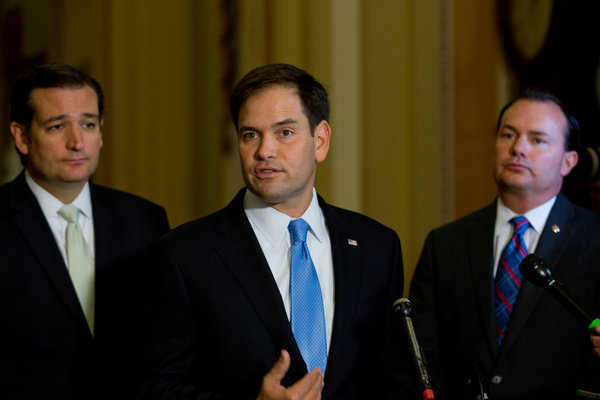
Left - Ted Cruise, in the center - Mark Rubio
In the primary elections in Iowa, five candidates from two parties to the US president were determined. On the primaries in the state of New Hampshire, this composition will almost certainly not change. However, the main sensation of coks in Ayov was not the victory of the ultra -conservator Ted Cruz over the favorite Donald Trump (it was predicted by numerous polls of public opinion before), and the fact that another contender Rubio came in the race. As already reported, he received 23% of the vote, only one percent of the lagging behind Trump. Thus, the Five included two candidates from the Republican Party with Cuban roots, both senators, Cruz - from Texas, Rubio - from Florida. According to the Spanish -speaking newspaper Cafe Fuerte, “and before that, Cuban policies were elected high posts in the governments of the States and at the federal level, their presence is very noticeable in the US Congress, however, in American history, candidates with Cuban roots have not claimed a White House.”
Ted Cruise purposefully and methodically led his election campaign in Aiova for three years. First of all, he was looking for the way to the hearts of extremely religious and conservative residents of this agricultural state. On numerous trips to all the corners of Aiva, he was accompanied by his father, Cuban Rafael Cruz (the mother of the candidate - American, which, according to the law, gave him, who was born in Canada, the right to be elected to the presidency). Cruz Sr. told the parishioners of local churches the history of family emigration from Cuba, talked about how devalue and morally clean his son is. This ultimately took the action, and led to the victory of Cruise over the extravagant and not restrained in his statements Trump.
Marco Rubio had a completely different strategy in Iowa. There he visited the last time in November last year, but out of five days he was a weekend - instead of meeting with voters, Rubio decided to watch American football on TV. Nevertheless, he came the third, and, as the newspaper of the Capitol Hill, The Hill Rubio writes, and not Cruz "became a real winner of coks in Ayov." As American political scientists predict, the primaries in more liberal than Iowa, New Hempshire on February 9, Rubio will come the second after Trump, pushing Cruise to third place. Shortly before this second sample of Rubio forces, the well -known politicians in the country, and among them, the former senator from Pennsylvania Rick Santorum, who was also among the applicants from the Republicans in the current election campaign, but left it after Iova.
On this, the main sensations of the 2016 elections end and continuous paradoxes begin. This is due to the fact that immigrants from the families of immigrants - Cruise and Rubio - took a very strict position in relation to Hispanics illegally located in America, from Latin America, primarily from Mexico and Central America. Moreover, both senators are critical in relation to the current law, which gives the right of asylum in America to their former compatriots. Rubio, a senator from the state with the largest number of immigrants from Cuba, submitted a bill in the congress, according to which the right of asylum should continue to receive only those refugees to the islands who would be able to prove that they were persecuted for political reasons. The rest will be awaited by immediate deportation back to Cuba.
Such moods of presidential candidates (Cruz shares a similar position) led to an increase in even greater emigration from Cuba. Over the past three months of last year, the number of refugees who have reached the United States has doubled compared to the same period in 2014 (17,071 versus 9219). The reason for this almost panic flight is obvious. The inhabitants of the island were frightened that the new US president would generally cancel the existing law on receiving asylum in the United States. After all, only a negligible part of the refugees can be attributed to the “political”, while the overwhelming majority runs from the poverty of the barracks of the Castro brothers and the absence of any prospects for finding a decent job, to find normal living conditions.
Rubio probably calculated that his strategy will bring political dividends in Florida and throughout the country. Indeed, often refugees from Cuba, having received asylum in the United States, begin to engage in illegal commerce, in particular - smuggling of goods from Florida to Cuba and Back. However, many famous American journalists who know the topic of immigration well believe that both Rubio and Cruise have made the wrong bet. “Republicans are ready to commit political suicide and lose to democrats in the election for the third time,” says NT, the famous Columnist Andres Oppenheimer. - Three “friend” - Cruise, Trump and Rubio - follow the path of candidate Mitt Romny, who had fallen in the past elections, who proposed the “autodeportation” of all illegal migrants. ” Oppenheimer reinforces its conclusion with numbers. In 2012, Romni supported only 27% of the US Spanish -speaking voters, while Barack Obama gave his sympathy 71% of citizens of this social group. For comparison: the last victorious president-republican George Bush Jr. won the 2004 election, having 44% of the votes of Hispanics support.
Meanwhile, the situation for the Republicans this year is complicated by the fact that the number of migrants from Latin America participating in the elections increased to 27.3 million people (in 2012, according to the Pew Research Center, it was 23.3 million). They are 45% treated by the Republican Party as a “hostile” political force, and 39% believe that the Republicans “simply do not excite the problems of migrants”. Apparently, it is no coincidence that the current vice-president of the country Joe Biden called the republican primaries “the gift of the Lord” for the Democrats.
However, on the way to the White House of the leading candidate from the Democratic Party, Hillary Clinton is also waiting for serious difficulties associated with Cuba. President Obama announced his intention to visit the island until the end of his term, but this can become a trump card not for him, but for his opponents. Cuba, after normalizing relations with the United States, has become a “fashionable” country for America and the whole world. In 2015, it was visited by 3.5 million tourists. The number of guests from the United States who wished to see the country that previously closed to them increased by 75%over the year. It is expected that this year, after the opening of regular commercial flights between the two countries, it will increase several times. Florida is preparing powerful ferries for transporting tourists to the island. California winemakers are ready to turn Cubans, known for their attachment to Roma, into lovers of American Chardon, Zinfandel and Caburne.
The idyll would be complete if not for one circumstance. The island not only did not stop repressions against dissenters - according to the Human Rights Watch human rights organization, they after December 2014, when it was announced to normalize the attitude between the United States and Cuba, only intensified. In the American press, there are reports of all new arrests of dissidents daily, which, as a rule, occur on Sundays, after the next peaceful rallies and protest demonstrations. According to the Spanish -language newspaper of the United States El Nuevo Herald, "Obama's visit will mean the indulgence of a decrepit Cuban dictatorship, which is trying by all means to stay in power." And, as a result, such a visit will become a bad gift by Hillary Clinton, who supported the restoration of relations with Cuba.
Historical paradoxes do not end there. If Hillary and the Republican Candidate Marco Rubio come together in the final battle for the White House, the latter can lose due to his Cuban temperament. Many American bloggers write in the comments on the news that the gestures and rhetoric Robio are already painful to them the manners and oratory techniques of the young Fidel Castro, who performed in Gavan squares in 1959.
Creditpophoto: Stephen Crowley/The New York Times
Credistephen Crowley/The New York Times