
Translated material
Virgin at the well
The oldest image of the Virgin was found at Yale University

In the Art Museum of Yale University, perhaps there is the oldest image of the Virgin-a wall painting from the ancient city of a fool-Europe, located on the territory of modern Syria. This image is well known, but it is usually interpreted as a fragment of the scene of the meeting of Christ and Samaritan by the well. However, the American scientist Michael Peppard, a specialist in early Christian architecture and iconography from the Fordeman University (New York), suggested that in reality this is a scene of the Annunciation, and we see the image of the Mother of God itself. At the request of Medusa, journalist Julia Stutina talks about the Pepard hypothesis.
Wall murals from the house church to a fool-Europe are well dated: it is assumed that they were created no earlier than 232 years old and no later than 256. This church is considered the oldest of the still found, and therefore everything that is found in it is of particular interest to historians of early Christianity. On the walls of the Church, the following plots were preserved: Adam and Eve in paradise, a good shepherd, the healing of the relaxed, Jesus and Peter go through the water, the procession of the world-bearer and the so-called meeting of Jesus and the Samaritan by the well.

The head of the expedition to the fool in the European Auropos Clark Hopkins (1895-1976) in the book “The Discovery of Dura-Europos” recalled that the shock he tested by him and his colleagues was huge (1930s). The very fact of the existence of a prayer room with images on gospel themes in the first half of the III century was amazing. Hopkins and his companions at first suggested that the unknown author of the murals tried to have at least one plot from each synoptic gospel on the walls, but then it became clear that only a few fragments had survived. So there is no need to talk about a single plan - for lack of confirmation.
Art historians and archaeologists from Yale University, including an outstanding scientist of Russian origin, Mikhail Ivanovich Rostovtsev, in the first preliminary report on the results of the 1931-1932 season noted that the murals of the house of the house are combined by Western and oriental elements. So, they wrote, Adam and Eve are shown strictly symmetrically, which is characteristic of oriental images. The procession of the world-bearer is also very reminiscent of oriental patterns-for example, the same plot in the later Ravin Church of Sant-Apollinar-Nuovo. At the same time, in the images of a good shepherd and the healing of the relaxed, parallels with Western interpretations are easily guessed. Since the painting, which depicts a woman from the well only partially, Hopkins and all subsequent researchers decided that only the left part survived from the stage, and the right one, with Christ, who talked with the Samaritan woman, did not reach our days. Subsequently, the same Hopkins pointed out that in the Roman catacombs, our most important source of knowledge about early Christian art, only one figure was often depicted, according to which the viewer was supposed to catch the gospel plot. So, perhaps, the artist from a fool-Europe was limited to a Samaritan woman alone.


The version of Hopkins and Rostovtsev was quite convincing. The image of a woman at the well did not raise questions for 80 years, while Michael Pepard , a historian and art critic, who was engaged in the late Roman Empire in general and a fool-Europe in particular, did not begin a monograph on the house church. Pepard also drew attention to the fact that the murals combine eastern and western features. He was skeptical of the assumption that the figure of Christ did not survive: from his point of view, there is simply not enough space for her. Pepard also rejected the idea of Hopkins that the ancient artist refused the image of the Savior, limiting himself only to a woman at the well: there was no analogues to such a compositional solution either in the West or in the East. Pepard turned to eastern iconography, where the scene of the Annunciation often looks exactly as a painting from a fool-Europe: Maria is standing at the well and listens to the voice of an angel, announcing that she would increase the Savior according to God's word. We will talk about the origin of such an iconographic scheme below, but for now a number of beautiful examples from Western Europe:
- The lid of the Adelefi sarcophagus (Syracuse, the end of the 4th century). The scene on the left is Maria at the water source, and the source is depicted both as current water and as a bearded man: this is still an ancient symbol.

The bone panel of the so-called Verden box, made at the turn of the VIII-IX centuries in Germany according to an earlier Italian model. It is stored in London, in the Victoria and Albert Museum.
Five -footed Milan diptych (bone salary of a liturgical book). The Annunciation scene is located in the second row on the left. The salary dates from the second half of the 5th century.

Now let's take a look at the "eastern" examples. By the way, there are a lot of them in Russian icon painting.
Dionysius, "Annunciation at the Kladeza." The painting of the Cathedral of the Nativity of the Mother of God in Ferapontov.
The icon "The Mother of God Tikhvin" from Pskov (XVI century): the second on the left of the stigma in the upper row.
Byzantine mosaic of the cathedral of St. Mark in Venice.
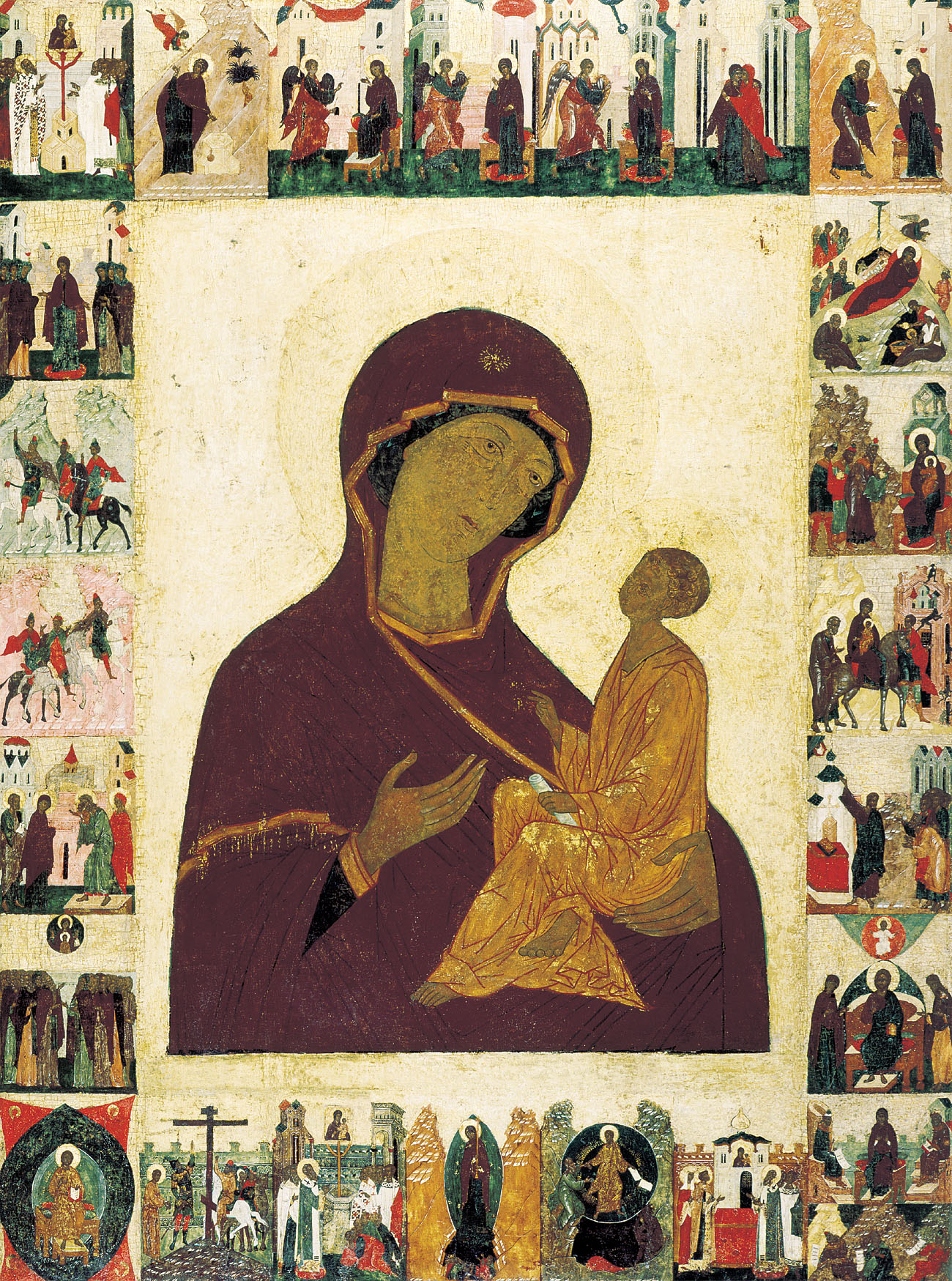

The iconographic plot “Annunciation at the Kladey” is associated with the apocryphal text, called the “Proto -Board of Jacob” ), where there are the following lines: “And, taking the jug, [Maria] went for water; And she heard a voice announcing: Rejoice, fertile! The Lord is with you; You are blessed between wives. And she began to look around to find out where this voice came from. ” This text is dated to the second half of the II century. Despite the fact that the “Proto -Gospel” remained an apocryphus, in the east (and in particular in Byzantium) he was very well known and appreciated. It is with the lines cited above that the image of the Annunciation of the well is connected. By the way, another element frequent in Russian icon painting - a spindle and a red thread in the hands of the Virgin - is also associated with the "Proto -Gorestry of Jacob": "And Maria, taking a crimson, began to spin."
Based on iconographic examples, Michael Peppard assumed that in his home church there was an image of the Annunciation by the well in a fool in a fool. Since the dating of this room is very accurate (in 256 the city was forever left by the inhabitants), the painting may be the oldest of the images of the Virgin known to us.

Until the Peppard has published its hypothesis, the oldest of the Virgin was considered the fresco from the Roman catacombs of the Priscilla, which depicts Maria and the baby and the male figure (it is interpreted as the prophet Isaiah or the soothsayer Valaam). This painting, like a fragment from a fool, dates back to the 3rd century, however, a number of modern researchers indicate that the frescoes from the catacombs of the Priscilla were very restored at the beginning of the 20th century, and there is reason to believe that it was “corrected”: so, in the first drawing, the male figure pointed to the woman and the child, and the expected spacecraft raises his hand in the latest photographs To the sky. It is believed that this fresco is still a pagan funeral portrait of mother and child, not related to Christians.

We will finally return to a fool. The existence of this city in Europe was learned at the very end of the 19th century. The first excavations took place in 1920, the largest studies were conducted between 1928 and 1937, in 1986, the work resumed thanks to the joint Franco-Syrian project of the Mission Franco-Syrienne Dʼeuropos-Doura (MFSED). Archaeologists have discovered several of the most important objects in a fool: the aforementioned ancient house church, a unique synagogue with wall murals, the temple of Mitra, the temple of the Palmyr gods and other monuments. Apparently, not one of the religions was dominant in the city, and they coexisted quite peacefully. Defending himself from the Persian troops in the middle of the 3rd century, the inhabitants of the fool-Europe fell asleep with sand, many buildings adjacent to the city walls. This saved invaluable buildings, murals and numerous artifacts for descendants.
For a number of reasons, finds from a fool-Europe were scattered around the world: something is stored in Damascus, something in Paris, and the paintings from the house church at the Museum of Yale University in Connecticut. It turns out that the “imperialist” approach saved these rare images for future generations, because in the chaos of the Civil War in Syria and the advance of the “Islamic state”, the looters feel with impunity. The analysis of the city satellite images , coupled with personnel made on the ground, shows that black diggers work there without lingering hands. It will not be possible to evaluate the true scale of destruction very soon.
Julia Stratotina