
Translated material
Open data and transparency. Knight News Challenge contest projects
Tracking the unlawful actions of the police, the collection of state unstructured data, increasing digital literacy in local communities and other victorious projects of the annual Knight News Challenge contest.
Knight Foundation , an American non -profit organization that supports advanced ideas and projects aimed at involving the community in civil activity, published a list of winners of the annual Knight News Challenge contest: 17 projects that will receive $ 3.2 million.
The theme of the competition this year was the data how they can be used to improve communities. Thus, several winning projects are aimed at increasing the transparency of the police: a group of researchers from Stanford University developed Law, Order, and Algorithms: Making Sense of 100 Million Highway Patrol Stops , an initiative that analyzes the work of the road patrol, and in the Chicago project Citizens Police Data is creating a database of reports on unlawful police actions.
Another winner was the project of Colombian University of Security Force Monitor, within the framework of which unstructured data from government sources, the media and public organizations are collected in order to monitor the police and the armed forces in different countries.
Other winners of the competition were projects such as Foia Mapper -an attempt to create an open source Foia card, a project that visualizes search queries on the state website , and Charlotte Zipbus - a mobile platform designed to improve public transport in the city.
Submitted projects
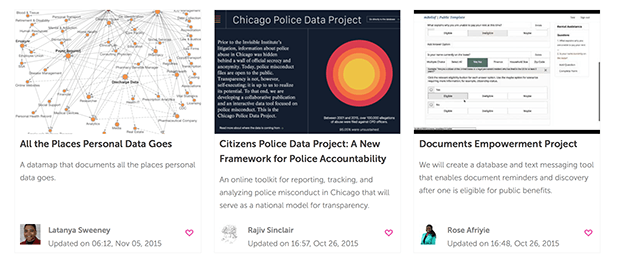
All the Personal Data Goes
The project, the purpose of which is to answer the question of where all our data actually go. To do this, a crowdsourcing resource is created, which with the help of users document how and where various companies and organizations transmit data. The project contains an element of gamification - users become “data detectives” and receive points for information about the distribution of data by organizations.
Citizens Police Data Project
The project creates an instrumentation that can greatly simplify actions such as filing complaints about the illegal actions of the police, viewing the history of complaints regarding this police officer, and an interactive analysis of complaints depending on various factors - geography and demographic signs.
Data Equity for Main Street
The project aimed at improving the digital literacy of libraries and local communities - as part of the project, they will be taught how to find and use open data.
Documents Empowerment Project
For Americans living in poverty, access to state benefits is associated with the need to provide various documents confirming that they have the right to receive this support. The purpose of the project is to create a platform with which it will be easy to understand which documents are necessary to obtain benefits.
Law, Order and Algorithms: Making Sense of 100 Million High Patrol Stops
The project, in which it is planned to collect and analyze more than 100 million stops of the road patrol in the United States. The resulting data set will significantly increase the degree of transparency and accountability of the police, as well as help communities and journalists to investigate issues such as racial discrimination against drivers.
PublicBits: Breaking Down Open Data Silos
The project that solves the problem of searching and using open data - the application created as part of the project will allow you to search and download data from different resources, will notify that your data set is outdated, and will also allow you to share data sets with other users.
All over the world, open data regarding the police and the armed forces, as a rule, are not structured and are in different sources that are not related to each other. In order to solve this problem, the Security Force Monitor project collects data from various sources, which allows monitoring the activities of the police and the armed forces.
Weighing the Wisdom of the Crowd
The aim of the project is to create online tools that will allow any person who does not have special knowledge and skills, conduct mass surveys and eventually receive reliable, reliable results.
Prototype Fund projects
- Seaglass: Bringing Transparency to Cellphone Surveillance : An open system for detecting and monitoring tracking of cell phones.
- Charlotte Zipbus : a mobile platform designed to improve the work of public transport depending on the needs of passengers.
- Foia Mapper : open map Foia (Freedom of Information Act).
- Democratizing Data Through Visual Search Results : A project aimed at making access to data on the state site is easier and more understandable due to visualization of the results of search queries.
- Legislation Tracker: Beond the Bills : A tool for tracking all the bills adopted in New Jersey.
- Civic Infrastructure for Workers : A tool that will help workers improve their labor conditions thanks to the opportunity to share working problems and discuss issues regarding their work.
- Excellence in, Excellence Out - Data Quality Uplift for Government : A project aimed at improving the quality of state data.
- COULD YOUR DATA Discriminate? : An online tool that will identify hidden discrimination in the data and help to fix it.
- Quantified Self Data Experience: Understanding Your Data and The World It Creates : A project that will inform people about digital security, data exchange and personal information on the network through interactive art, digital education and public discussions.