
Translated material
New scrapers
What is the victory of the book “The Tale and Life of Danila Terentyevich Zaitsev” at the literary prize “Nose”
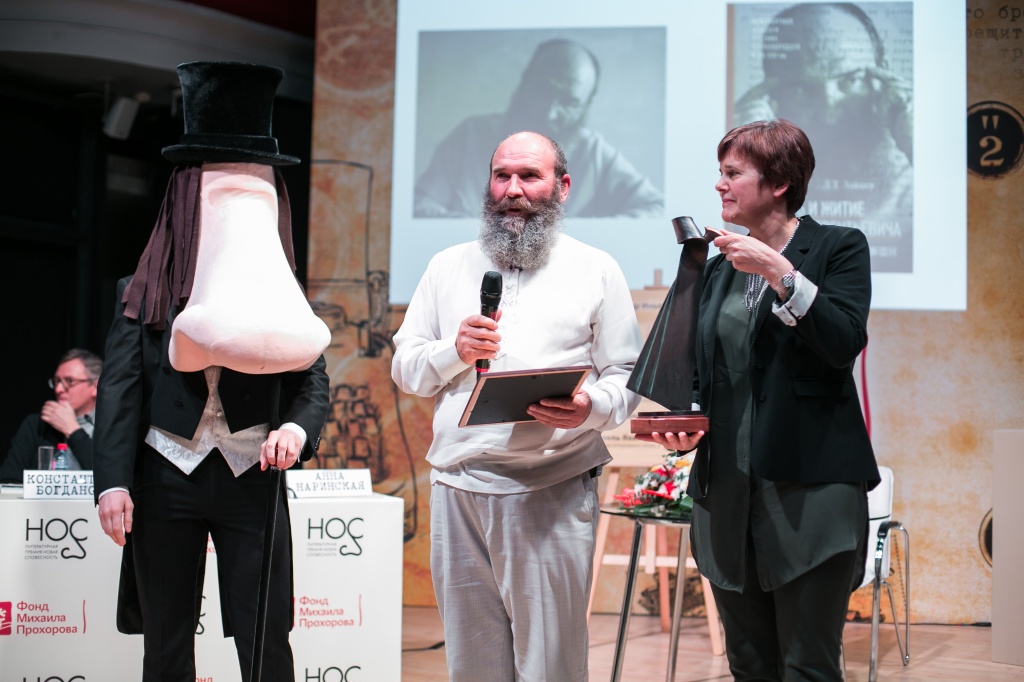
Danila Terentyevich Zaitsev, the author and the hero of his own life, between the supervisor Irina Prokhorova and the hero of Gogol - a revived nose
In the Russian literary process, two epoch -making events occurred. The first is that the jury of the Literary Prize “Nose”, having conducted, as usual, public debate, as a result of open voting presented (probably for the first time in the history of Russian literature) a person literally illiterate. The second event is this text itself, the phenomenon is really unique: "The story and life of Danila Terentyevich Zaitsev."
Document and myth
Danila Terentyevich Zaitsev - a Russian Old Believers, born in 1959 in the Chinese province of Sinjiang. He grew up in Argentina, where the family moved in 1961. He wandered all his life, living around Uruguay, Brazil, Bolivia, Chile, USA, Russia. The text of his book in the seven “notebooks” edited, commented and adapted for the reader a dialectologist Olga Rovnova, who acted as a producer of this book: Zaitsev himself has four classes of the Argentinean school and writes a phonetic letter.
His “Tale ...” is an extremely interesting linguistic, ethnographic, historical and human document created by the bearer of mythological consciousness, for which Nikonian persecution of the Old Believers is as relevant as Soviet repression and corruption of modern Russian officials. In the "Tale ..." Danila Zaitsev conveys the story of the flight of his ancestors from the Soviet regime - first to China, and then to South America. Zaitsev himself with his family (eleven children, fifteen grandchildren) had to wander fifty once, and this, among other things, allows him to describe the life of different Old Believer communities in exile in detail, from the village gossip to the epic history of the confrontation of the “Xinjanians” and “Harbinians”, as well as various Old Believers “consent”, that is, the trends - Spasovsky, Belokrinitsky, Belokrinitsky, Belokrinitsky, Belokrinitsky. Pomeranian and chapel, to which Baysov himself belongs. A separate, almost detective plot is a failed project to relocate the Old Believers to Russia, the pioneer of which was Danila Terentyevich.
The reader for the most part is conservative, “loves those objects that make him shed tears of delicate sorrow,” and his interests are not at all the same that the professional community
The text is full (especially at first) of leisurely biblical transfers: Ilarivon gave birth to Savely, Savely gave birth to Evdokey, Korniliy gave birth to Martyan, Martyan gave birth to Terenty. This applies not only to the storyteller’s family, but to any person who comes to question, and the reasons for this are not literary, but quite practical: living in a closed population, the Old Believers carefully consider kinship to the seventh knee to avoid the bloodstorming. Along with the description of wedding customs and various crafts, these are these historical, pages, where old lost customs come to life, are most exciting and are read by one spirit: “Here they went further into the forest, and the Soviet government was behind them. In 1931, they decided to go to China, and the whole was on Fedos Timofeevich, since Fedos Timofeevich was an experienced hunter, he knew all the forests and knew the border. They fled with their clans, avoided betrayal. Here in the winter of 1931, Fedos Timofeevich gathered his rosy - twenty -four families, twenty -four carts - and went to China across the Iman River. "
This, I repeat, is a wonderful document. But the decision to give the author the literary prize seems quite dubious, and this is why: it seems reasonable to give literary awards for literary work, it usually turns out. However, Danila Zaitsev, obviously, interested the jury not what he did, but what he was.
The jury of readers
The Nose Award, that is, “New Literature”, was established by the Mikhail Prokhorov Foundation in 2009 and immediately became one of the most interesting events in the literary calendar. Its difference from other awards is that when determining the short leaf, and then the winner, the jury members consult publicly. The format was run by members of the jury of the first two seasons - sociologist Alexei Levinson, poet Elena Fanailova, philologist Mark Lipovetsky, writer Kirill Kobrin and journalist Vladislav Tolstov. Passing the stage of formation, the organizers began to change the composition of the jury annually, from season to season, rapidly democratizing. Accordingly, the ideas about the literary novelty stated in the name of the prize.
As the chairman of the jury, theater director Konstantin Bogomolov, emphasized at the beginning of Debatov: “We are the jury of readers, so we decided not to adhere to the criteria for ideology, but to the criteria of taste. We tried to be simple in a good way. I hope we have not completely experienced. " I dare to notice that there was no need to try so. This time, the jury, according to Gogol's expression, was “gentlemen, several carefree about literature”-and this is not an evaluative judgment, but a statement of the fact: in addition to Bogomolov, the jury included the editor of the Russian Forbes (and earlier-“Snoba” and GQ) Nikolai Uskov, the director of the Volga-Vyatka branch of the State Center for Modern Art, the head of the Foundation “Oral History” Dmitry Sporov and RBC editor Timofei Dzyadko.
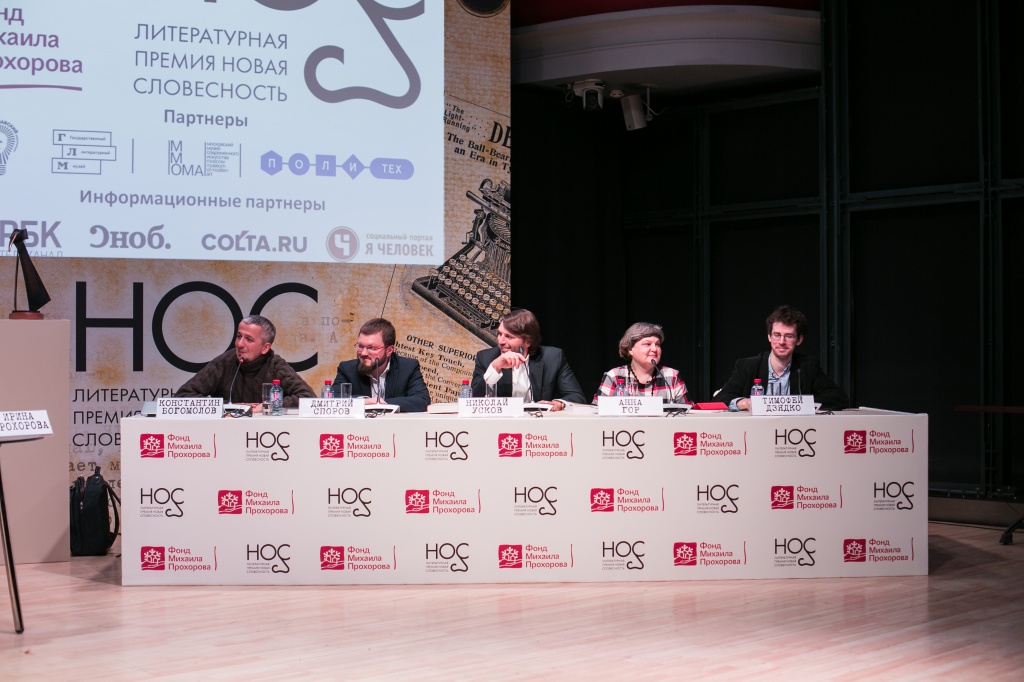
Members of the jury led by theater director Konstantin Bogomolov (first on the left)
Experts - literary critic Anna Narinskaya, philologists Konstantin Bogdanov and Tatyana Venediktova were called to balance this motley company. However, only Narinskaya took the ungrateful role of the professional, rightly indicating that any literary prize is an ideological thing: “The meaning of the literary prize is to reward a book that is the best metaphor for modernity.” The colleague of her Bogdanov in unison with the jury spoke out to "stop being experts and interpreters, but simply turn into readers."
I do not want to refuse readers the right to my own judgment - moreover, it was precisely for this that a special prize of reader sympathies was provided to vote with his heart: the reader is, as a rule, conservative, “loves those objects that make him shed tears of delicate sorrow,” and his interests are not at all the same that the professional community has. In these two anti -destroyed processes - conservation and updating - a culture lies. When we abolish the expert opinion, in principle, we remain, as a member of the former jury Kirill Kobrin, "instead of modernism - fiction, instead of modernity, noted at the end of the discussion - it is clear that."
Autocracy of the mind
The specifics of the “Tale ...” Zaitsev is such that it is difficult to talk about her without moving to personality. And no matter how much I would like to avoid this, it cannot be noted that with all the value of the certificate, no “autocracy of the mind” spoke about, which Nikolai Uskov spoke, remembering (in our opinion) the traditions of Old Believer literature and Protopop Avvakum, in Zaitsev’s prose is not observed: as soon as he is distracted from the detailed exposition of life and twilights and jokes, his conclusions are reduced to quite wild Conspirological theories: in general, "the truth went to heaven, and the lies covered the earth" and "whatever globalization is, the faster the end of the light." It would be sinful to laugh at Danila Terentyevich, and this is not included in my intentions, but it is impossible to keep silent, since the jury rendered him a bad service, appointing him with some kind of a rubble of Russian spirituality.
The writer Peter Aleshkovsky writes in the preface to the “Tale ...”: “I am deeply convinced: anyone who sees the Latin American Old Believer will fall in love with him in the blink of an eye. They are our utopian dream of lost paradise. ” In the same spirit, members of the jury reasoned, which awarded the New Literature Award this year for scrapers - not to choose another word. Cracks in the “Tale ...” are evident, with all their positive and negative sides: really a huge impression is made by the child love and performance of Zaitsev and members of his family. Say, his 15-year-old son Sophonia, a guest in Russia by Hermann Sterligov, while his father watched the lands for a potential resettlement, "hired a tractor, prepared and sowed forty-five buckets of potatoes." But the Old Testament life of the Russian Old Believers is similar to paradise. Back in the 1980s, the “Harbinians” “Sinzian” “right in the molane with wet ropes, they have been stolen by the blood of the SS? La”, and to this day everyone has been beaten by children and wives (“Once drowned, my mother began to freeze, we warmed her in the Russian furnace”). Although Zaitsev himself complains that his parents took him from school after the fourth grade, one daughter studied from his own eleven children. Members of the closed community who have nowhere to get away from each other (“you will come to get married”), with quarrels, grab the rifles no worse than their South American neighbors. The epic hero Fedos Timofeevich, who lived the long and glorious life of the pillar of society, ended his days on the chain: was damaged by his mind, relatives chained so that he would not run away.
One gets the impression that both Aleshkovsky and the jury simply listened to the music preserved in the exile of Russian speech, without delving into its content.
Historical person
About the “living paintings” of Polina Barskova and the “pensions” of Alexander Ilyanen, the works of complex and really innovative ones, which, must be given tribute to the jury, also entered the short list, during the discussion it was extremely few, as if the jury simply did not know how to approach them with their school instrumentation. During the discussion, Uskov called on his colleagues “not to show off” and scolding Ilyanen “a trivial postmodernist”. The non-trivial journalist found in another: “I’m used to it,” said Uskov, “that the main lyrical hero of Russian literature in recent years is such an intellectual-loser <...> with not very confident potency.” The journalist contrasted the “little man” (obviously with great potency), who, from his point of view and his pleasure, returns to Russian literature, to this unsympathetic type.
One gets the impression that the jury simply listened to the music preserved in the exile of Russian speech, without delving into its content
Flying out with peasants in literature, of course, is not news. However, it is one thing when it was, as George Ivanov put it about Nikolai Klyuyev, a “peasant-grass” who, with a collar and tie, reads Heine in the original. And a completely different matter is when the subject of the literary process is assigned a genuine “simple -minded”, the bearer of tradition, the object of research. In general, as the Ukrainian by the Ukrainian book of the sea fleet said in Zaitsev’s book: “Oh, Danila, I see, hto you are, you are a pure Russian soul. I see a fairy tale in you. Your ceremony is a beard, a point of vision on life, your behavior is a purely Russian historical person. ”
Assigning a historical person to the exponent of a new literature, members of the jury, “voting with the heart”, like Moliereovsky Jourdain, who did not know what he was prose, put him under the magnifying glass of interpretations - in a literary context that he does not belong to himself, except in the spirit of the Shukshin hero from the story “cut off” (expressive patterns of this venerable folk polemic tradition We observe in the "Tale ..." everywhere).
The text of Zaitsev is really important, he will incredibly enrich our knowledge of the life of Russian Old Believers and our conversational speech. But if we talk about the literary process of recent times, it remains only to borrow the favorite saying of Danila Terentyevich: “At first everything is blessed, and then neither cool nor ... a army.”
Photo: Andrey Yartsev