
Translated material
There will be no revolution
Why is the “uprising of the elites” against Putin and his immediate environment in Russia is impossible
2016 brought additional problems to the Russian economy and politics. The average price of Urals oil in January was only $ 28.75/bar, which is 44 % lower than the average for 2015. The government was forced to recognize the unrealism of the recently adopted budget and talk about the anti -crisis program. In the United States, at the official level, the corruption of not only Russian officials, but also the president was first noted; The UK announced the awareness of Vladimir Putin about the prepared elimination of Litvinenko; The European Parliament spoke hard against the revision of sanctions against Russia. In such a situation, politics and experts are increasingly sorting out options for the development of the country, especially since Russia is drawn into the 2016-2018 electoral cycle.
The priority of the economy
Undoubtedly, at a new stage, the economy will play the main role: not so much because it is a weak place in the current regime, but for the reason that it is almost impossible to increase further. The continuation of the Ukrainian scam is unlikely: no captures of Mariupol and the new phase of the struggle for the “Russian world” are visible, and the voter is tired of the exaggeration of these topics. In Syria, the intervention passed into the routine phase; Negotiations with Western "partners" in the near future will not give anything, the "Islamic state" * will not be able to destroy. The intensity of anti-European and anti-American rhetorics is such that it will no longer be able to do something more on this “front”. In the new electoral cycle, the politician will not go anywhere, but it will remain a kind of background, a canvas on which the economic picture of the future will be written.
This picture does not look exciting. The results of 2015 show: the economy was reduced by only 3.7 %, mainly due to the growth of export and public procurement and investments, while the final consumption made a negative contribution to the GDP by almost 9.5 %. In the context of falling prices for Russian goods (in 2015, exports sank by almost 40 % compared to 2013 and continue to fall this year) and the growth of budget deficiency of this year may be even worse than the past. The main question, however, is not how bad things will be, but in how much the reaction to the society will turn out to be.
Monolith Elite
In recent years, the authorities in Russia convincingly proved: they will not “adapt” either to the people or to entrepreneurs-this is well shown the path from the reaction to the monetization of benefits in 2005 to the reduction of the indexation of pensions and benefits in 2016. As, however, the consistent changes in tax legislation and the preparations of funds from oil companies as a result of the next revision of the norms and rules. In the foreign policy arena, signs are noticeable that Russia will be represented as fully by the country of the Rogue, which is worthy of sanctions, if not in connection with the annexation of Crimea and the occupation of the Donbass, then because of the murder of civilians in Syria, the involvement of its authorities in criminal schemes and the export of corruption to Europe and the USA. Exactly for this reason, certain sanctions will remain in force even with the perfect execution of the Minsk agreements. In the coming years, the price of oil will change - rather a little up than further down, but nothing more.
The continuation of the Ukrainian scam is unlikely: no captures of Mariupol and the new phase of the struggle for the “Russian world” are visible, and the voter is tired of the exaggeration of these topics
In such a situation, changes in the country depend, firstly, on how low the raw materials will be when reserve funds will be wasted and how fast the rise in prices for basic goods in the conditions of invariable wages will become. However, another is no less important: whether a certain “split of the elites” will take place or will there be the same confrontation to their people in the form of a monolithic whole that we are still observing.
There is no answer to the first question today. We do not know either the trend of oil prices, or the policy of the Central Bank and the government regarding the ruble, nor the depth of possible budget adjustments, nor the readiness of the authorities for large -scale privatization, nor most other factors significant for the economy. The second topic seems to be more predictable: such a split is impossible, as it is impossible to “uprising of the elite” against Putin and his closest environment.
A hundred years ago, a deputy of the State Duma, lawyer and publicist Vasily Maklakov published his famous pamphlet “Tragic position” (“Russian Vedomosti”, 1915, No. 221). It describes the situation as two drops of water similar to today: living in the country, you feel like “rushing by car along a steep narrow road; One wrong step - and you died irretrievably ... and suddenly you see that your driver cannot rule; Because he does not own the machine on the descents or is tired at all and no longer understands what he is doing, but he leads to the death of both you and himself. ” However, both the driver and passengers (among whom are “there are people who know how to rule the car; they need to be behind the wheel as soon as possible”) in a stupor look at the road, realizing that now is not the time to transplant differently. The driver “blinded and does not see that he is weak, and does not think, out of professional pride or stubbornness, but he tenaciously grabbed the wheel and does not let anyone in ... laughing at your anxiety and impotence:“ You will not dare to touch! ” The author admits: the driver is right, no one will touch him: “Moreover, you will try not to interfere with him, you will even help with advice, indication, action.”
These words were written a year and a half before Russia was plunged into the largest tragedy in its history - a tragedy that has not been fully completed to this day.
It is not worth being afraid of the conspiracy of Elit Putin , Moscow, December 3, 2015
As you know, everything that the Russian elite of the mid-1910s took a chance-this is the murder of Grigory Rasputin in December 1916, a daring but did not change the act. Today in Russia there are persons more than reminiscent of Grigory Efimovich, but in our time the doubts in the right of the first person to do everything that it wishes is much less than a hundred years ago. At the same time, three main factors affect the consolidation of elites.
Consolidation factors
Firstly, this is the process of “stratification” of large businesses and people who can influence political processes for more than one year: dissatisfied and doubters, either leave the country, either transfer their main activity abroad, or concentrate there such a part of property, the preservation of which allows you to forget about any losses in Russia. This is in the early 1920s former deputies of the State Duma, generals and industrialists worked in Paris by taxi drivers-in the early 2020s this will not happen again. The “output” strategy, well -developed, remains much more rational and less risky than the resistance strategy, especially when you consider that the rest of the elite becomes even more “stubborn” (excuse me, conservative). Its loyalty is bought and will be purchased by budgetary funds and redistribution of property - and no indignation is expected.
Secondly, this is the extreme “youth” of the Russian top class: all conditions and careers are made in such a short term that their owners do not even feel the slightest degree independent of the regime. Moreover, in the highest layers of Russian society there are not even hints of meritocracy, and therefore it is completely incomprehensible who can not even replace Putin, but at least demand a significant correction of the course from him. Since the country has not and has not been “social elevators” for a long time, only those who do not think of themselves outside the regime are ascended to those that are available, and these people quite rightly believe that the personalist system of government will not survive the change of ruler (it is enough to look at Venezuela). Therefore, the very idea of “moving” the president for the vast majority of both political and business tops looks deeply irrational. All other development options, obviously, seem to these people worse than the continuation of the current course - and in such a situation the task is to strengthen the system, and not its undermining. The threat here is more likely that the steps in such a strengthening can ultimately be counterproductive, but this is another topic.
By the time the Putin era was completed in 2024, the country will be proposed a model resembling Chinese
Thirdly, the elites do not see significant threats “from below” today: in Russia a hundred years ago there was a war and the country was full of armed people; The events of 1905-1907 were fresh in the memory; Abroad there was a well -organized opposition, and in the country the “fifth column”; Large cities shook strikes and strikes. Today, the situation is completely different: the people are silent, civil society is absent, political parties are not real subjects of social processes. The “palace coup” in such conditions is meaningless, since there is no one to support it, not to initiate.
Go to China
In such conditions, I would venture to give a political forecast, which is significantly different from what most Russian democrats and liberals are counting on. The worsening economic situation in 2016-2017 will force the Russian elite to consolidate even more than now. Economic difficulties will only simplify this process: many private companies and banks will go bankrupt and transfer to state control, and their current owners will fall out of the game; Some state -owned companies will also be reorganized as unpromising. Most likely, both extreme liberals (from Chubais to Gref), as well as the radical control (starting with Kadyrov) will be “cleaned up” from the authorities. At the same time, the “medium” and non -distinguished bureaucrats will rally around the leader and actively participate in the division of property and financial flows. The factor of the "external enemy" will allow the people to keep the people in a state of numbness for several more years. Oil, the quotes of which have already begun to grow and in the not too remote future will fall into the drift in the range of $ 40–60/barrel, will allow you to stretch the reserves until 2018-2019, when the economy stabilizes, providing the population with an average of 15–20 % lower than the current (as shows, for example, the experience of Belarus, this is quite reasonable without significant risks for the stability of the regime).
At the same time, the crisis of 2015-2018, of course, will make a much greater impression on the power elite than the fleeting collapse of 2008-2009. After the difficult elections of 2016 and 2018, the main task of the elite will find the development of the transition scheme from maintaining the mode to the system - and apparently, by the time the Putin era is completed in 2024, a model will be proposed that either Mexican, or guaranteeing the top of infinitely long control over the country. Given the number and scale of the experiments set over Russia just over the past hundred years, such a long state of peace is neither incredible nor causing rejection of the broad masses.
* "Islamic state" (IG, ISIS, Daish) - a terrorist organization,
forbidden in the Russian Federation.
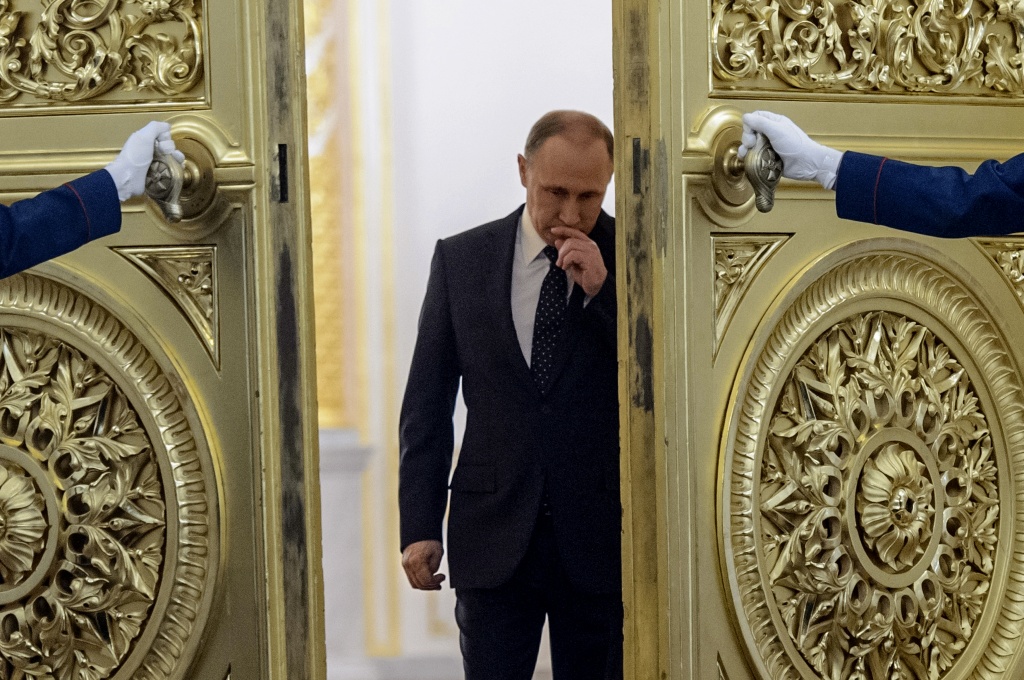
Photo: Dmitry Azarov/Kommersant