Date
Author
Татьяна Лиханова

Preserved copy
Translated material
Caressed blindly
Gratitude to the head of KGIOP was provided by the voices of strangers
Most of the deputies who supported the awarding of the head of the KGIOP found it difficult to give specific examples of Sergei Makarov’s contribution to saving monuments. And they admitted that they have a very vague idea of what is being done in the field of heritage protection. Those in the subject voted against: deputies known for their activities in the field of protecting monuments.
Low quality service
The news of the Legislative Assembly’s gratitude to the head of the KGIOP was not reflected on the official website of the department - it is not mentioned either in the news section or in the “Press about KGIOP” section. The latter is replenished with extreme selectivity: despite the fact that in the general information flow the committee is mentioned almost every day, the selection for its website sometimes takes two months without finding anything suitable (that does not contain criticism). And here there wasn’t much to choose from. The headlines, where “gratitude” is next to the words “absurd”, “scandal”, “indignation”, “slap in the face”, “kowtow”, “protests” and “demands for resignation”, are already upsetting.
It must be assumed that Sergei Makarov himself is no longer happy with this whole undertaking, which provoked a wave of criticism on his head: both the media, and opponents at the Mariinsky, and the civil activists who stood outside its walls recalled all the mistakes at once. As a result, although the gratitude was fought out (28 votes out of 50 were scraped together), the official’s Lilliputian rating was already dangerously tilted toward the plinth.
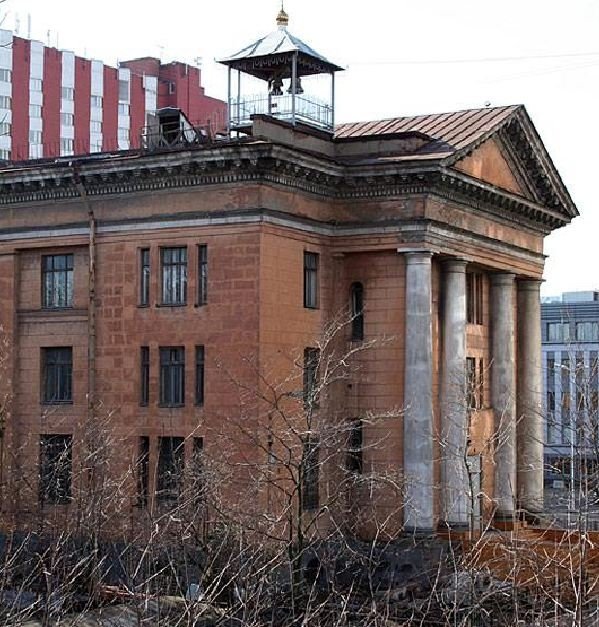 Church of St. Nicholas the Wonderworker and St. Martyr Queen Alexandra at the Putilov plant
It is characteristic that all those deputies who are more or less involved in the work of protecting the heritage and are familiar with the state of affairs first-hand assessed the activities of Sergei Makarov extremely negatively and voted against - like Alexey Kovalev, Boris Vishnevsky, Vyacheslav Notyag, Maxim Reznik, Irina Komolova (14 in total).
And those who ensured the adoption of the “necessary” decision have a very superficial understanding of this area, if not, they don’t understand a damn thing. This is confirmed by the results of a survey conducted by our colleagues among those who voted “for”. Since the nomination for the award used the wording “for outstanding personal achievements in preserving the cultural heritage of St. Petersburg,” parliamentarians were asked to provide examples of such merit in relation to specific objects.
The party said - it is necessary!
Anna Evstigneeva admitted to a Zaks.Ru correspondent that she had no contact with the head of the KGIOP in the field of urban protection activities, but supported the proposal because “not only his work as head of the committee was assessed.”
Sergei Soloviev proceeded from the same logic. At the same time, agreeing that “maybe there are questions about how conscientiously Makarov fulfills his duties as chairman of the KGIOP,” and not even excluding the possibility of “agreeing with the criticism expressed by deputy Maxim Reznik.” At the same time, Deputy Solovyov did not hide the fact that he voted “for” “because the party said so.”
Igor Vysotsky and Sergei Nikeshin also explained their choice by submitting to the requirements of party discipline. Both emphasized that they have no complaints against the official, they have known him for a long time, and they treat him well. Although, it seems, the absence of complaints and personal rejection does not qualify as “outstanding personal contribution.”
Deputy Alexander Kushchak said that he did not interact with Sergei Makarov at all (“this is not my profile”) and “did not participate in the discussion of whether to present him with gratitude or not.” But he trusts “his comrades who made this decision.”
In the very opportunity to convey his position to voters - which, in fact, our correspondent suggested taking advantage of - Mr. Kushchak saw almost an overseas trick. “Why are you even asking? You ask provocative questions in the style of American correspondents!” – the parliamentarian was indignant.
Evgeny Marchenko explained that he was absent from the meeting room due to family circumstances, but “his neighbor, deputy Svetlana Nesterova, voted for him by proxy.” At the same time, the deputy could not remember not only any merits of the head of the KGIOP, but also what exactly he entrusted to his neighbor: “In the power of attorney, I indicated an obligation to vote for the appointment of Mikhail Petrov as a member of the City Election Commission and to support the election bill, but I don’t remember whether I instructed to vote for gratitude to Makarov.”
From a sick head to a healthy one
And deputy Andrei Chernykh saw signs of problems with the head of those of his colleagues who criticized the chairman of the KGIOP - only because they always confuse him with the previous chairman Alexander Makarov: “Much of what was said today about Sergei Makarov related to his predecessor with the same name. The people who spoke passionately from the podium did not understand that these were two different Makarovs. Much that was attributed to the head of the KGIOP relates to his predecessor. And I voted completely calmly, because I realized that my colleagues were mistaken in their criticism.”
None of those “who spoke from the podium” considered it possible to evaluate the version of the mass delusion of opponents presented by Andrei Chernykh as anything other than complete nonsense.
Thus, Alexey Kovalev said: “Thank God, I am in my right mind - unlike some. It is impossible in principle to confuse one Makarov with another, their attitude to the matter is so different. We had disputes with the former head of KGIOP Alexander Makarov. However, unlike the current chairman, who shows absolute indifference to the fate of the monuments, his predecessor sincerely supported the task assigned to him and actively cleansed the committee of corrupt officials like Grishin who had settled in it. Whom Sergei Makarov returns to the committee, and even publicly praises as an excellent worker. This excellent employee will now appear in court on a corruption case. Or another example: thanks to the intervention of the first Makarov, we managed to stop the demolition of the Shagin House and start the process of its full protection through assigning the status of a monument. And the second Makarov pushed through the reduction of the subject of protection of this house to one front wall. How can you confuse one with the other?!”
Boris Vishnevsky is also inclined to characterize the argumentation chosen by his colleague Chernykh as an attempt to pretend to be a fool: “I based my criticism of the current head of the KGIOP on specific examples - like the Stable Department or the House of Mordvinovs, where Sergei Makarov publicly defended the interests of investors, based on considerations of the economic benefits of projects. I have repeatedly stated to his face in the presence of many witnesses: you behave as if you are in charge of a property block, and not a committee for the protection of monuments. We are now in court with him regarding the House of Mordvinov, where we demand that the permit issued by the committee in July 2015 be declared illegal. Am I, in the opinion of Chernykh’s colleague, not understanding who I’m arguing with and for what reason?”
Dubious achievements
Of the deputies surveyed, only two attempted to give specific examples of Sergei Makarov’s contribution to the cause of saving cultural heritage. But both turned out to be failures.
Andrei Vasiliev pointed to the restoration of the Putilov Church (48 Stachek Ave.): “In Soviet times, the domes and towers of the church were cut off, left as a barn, and defaced. At first, the Krasny Putilovets factory club was located in this building. Then the Sever factory. In the 2000s, the factory was evicted and the building was given to the church. I have been involved in the fate of the temple since 2012, and Makarov personally helped me a lot in this matter... Under Makarov, this building acquired the status of a newly identified cultural heritage site.”
For information: this building was included in the list of identified cultural heritage sites back in 2001, listed on the list under No. 785: “Church of St. Nicholas the Wonderworker and St. Martyr Queen Alexandra at the Putilov Factory (with a house for changing brides)" (St. Petersburg, Stachek Ave., 48, lit. A, B). Since 2006, comprehensive repair and restoration work was carried out on the ground and first floors, the passage to the church from Stachek Avenue was opened, and by 2010, restoration of the porch was carried out in agreement with KGIOP. In 2013, by order of the committee, scientific and design documentation (including a comprehensive survey of the site) for restoration was developed, paid for from the city budget in the amount of over 2 million rubles. Actually, under Sergei Makarov, further steps were taken in the direction set earlier - based on the results of a competition held last June, a contract was signed to conduct a historical and cultural examination (about 1 million more), its findings were presented on the committee’s website last December. How exactly MP Vasilyev himself “participates in the fate of the temple” and in what way Makarov “helped him personally a lot” remains unclear.
The official’s merits in the so-called restoration of the Benois dacha, which deputy Anatoly Drozdov tried to classify as “outstanding merits,” are also questionable. As presented by the parliamentarian, the story unfolded like this: “In 2001, the dacha burned down. When I worked as the head of the Akademicheskoe municipal organization, I received many requests from residents who asked to restore the dacha. Many investors abandoned this project. And then, about two or three months ago, I was invited to the opening of an exhibition in a newly built dacha. Sergei Makarov spoke at this event and supported the restoration of the monument. I don’t know Makarov personally, but he spoke so enthusiastically about the history of St. Petersburg at that time that I realized that he was not lying, he was speaking from the heart. It’s great when young energetic people know the history of the country and defend it.”
From the deputy’s story (who omitted the main event part - what happened in the interval between the time he re-read the residents’ appeals and the time Makarov, figuratively speaking, cut the ribbon) again, you cannot draw any conclusions about his personal contribution. It may, however, be for the better in this case. Because experts assess the result extremely negatively – as the construction of a “dummy”, but not the reconstruction of a monument. The wooden dacha was reproduced from concrete, the walls were sheathed with planks, double-glazed windows were installed, and the roof was covered with metal tiles on steel beams. The massive porch looks wild (here you have concrete, brick, cobblestone, and polished stones), leading to a glazed vestibule with no longer even pretending to be a historical door a la “24-hour store.”
According to one of the most authoritative experts in the field of restoration of wooden architecture, Mikhail Milchik, such work makes no sense at all: “This is no longer a monument, but a fake. There can be no talk of any re-creation here.”
Since the 1990s, city defenders have been trying to draw attention to the dying objects of the Benoit Forest Dairy Farm complex with a park and two ponds (a monument of regional significance).
By 2008 - “taking into account numerous appeals from citizens” - the issue was submitted for consideration to the government of St. Petersburg. Valentina Matvienko, having distributed earrings to the Culture Committee and KGIOP, instructed that the object, burdened with security restrictions, be put up for auction. Only in 2011, four buildings included in the complex monument, including a dacha, were acquired by the Best company. The restoration of the dacha and the restoration of the remaining buildings were specified in the terms of sale. The approval procedure dragged on for quite a long time - in any case, as of the end of 2013, the entire package of permitting documents had not been collected. At the time when KGIOP was headed by Sergei Makarov, builders had just begun to build a concrete box with metal reinforcement under the guise of “recreating” a wooden monument. So Sergei Vladimirovich has the opportunity to make some choice - either to disown the dubious merit attributed to him by Deputy Drozdov, or to share responsibility for such a result.