
Translated material
Big scientist
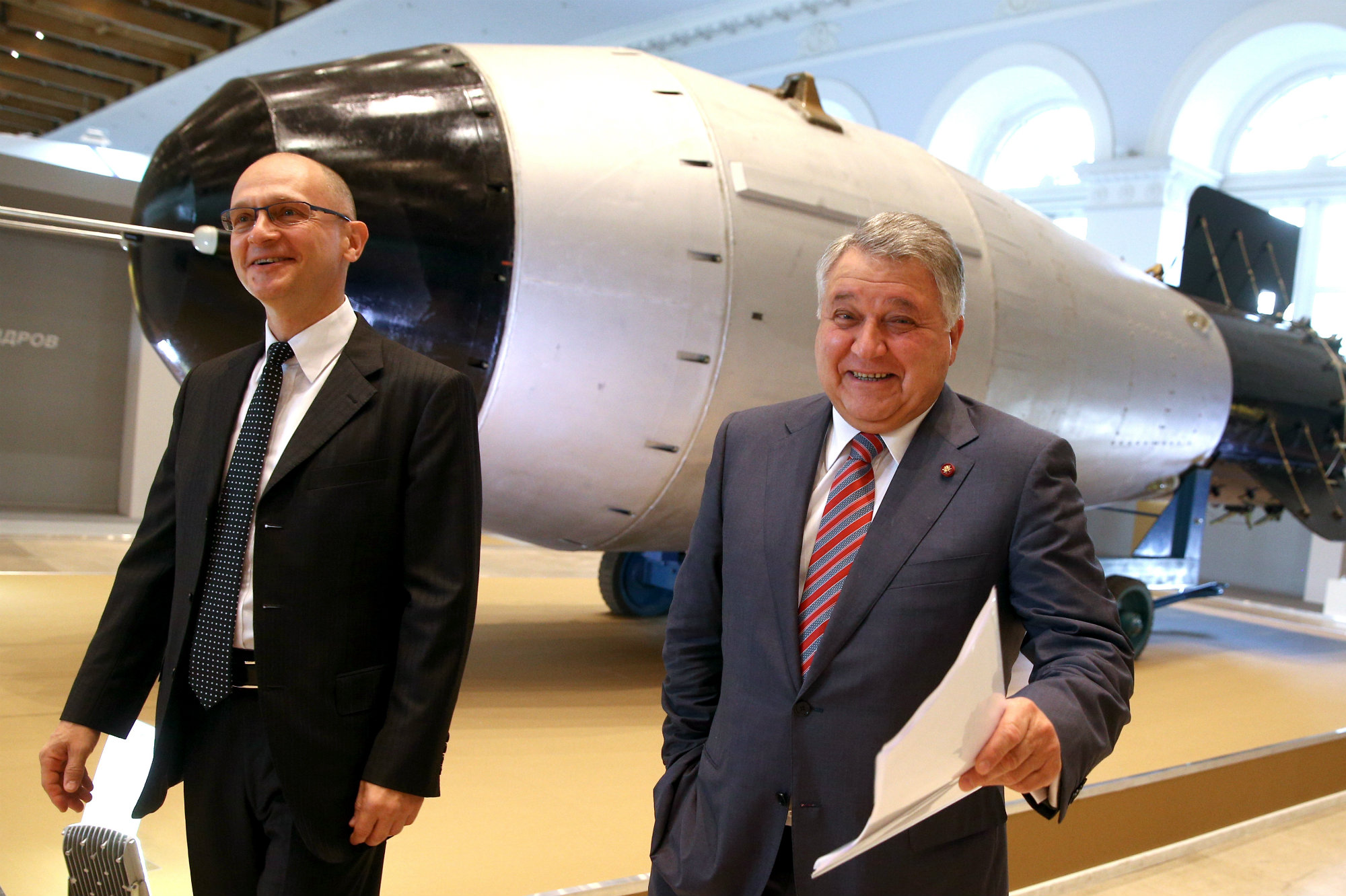
Even 15 years ago, Mikhail Kovalchuk made the impression of a serious scientist, his scientific works had a fairly high level of citation. But now the brother of Putin’s close friend has become a symbol of the destruction of Russian science. Sergey Nemalevich talks about the dizzying career of the director of the Kurchatov Institute
Exactly three years ago, in early February 2013, I stood at the Passing Institute of Theoretical and Experimental Physics, ITEF, on Bolshaya Cheremushinskaya Street. The guard carefully studied my passport and checked the data with the ordered pass: on the other side of the metal turntable is a nuclear facility.
However, in 2012, ITEF became a little less nuclear-the main experimental installation, ITEF-Twn accelerator, built back in the 1950s, burned down at the institute. Through the year between the fire and my visit to ITEF, the repair was not even started, but this was far from the largest nuisance, which was written by ITEF employees on the Save Itep website - “Save the ITEF”. I discovered this site, was horrified and went to the Bolshaya Cheremushkinskaya to find out what was happening with the institute.
Almost simultaneously with the fire on the accelerator, ITEF formally completed the transition from the jurisdiction of Rosatom to the structure of the Kurchatov Institute. “In Rosatom, we were hard,” one of the interlocutors tells me, “we were in an incomprehensible position there. They became a commercial organization that could not finance fundamental science: they simply did not have legal forms for this. ” The studies that were conducted in the ITEF were not particularly interesting to the state corporations, at the same time, the Rosatom’s leadership had views on the territory of the institute, the former Cheremushki-Baners' estate with an extensive park and a pond that once belonged to Menshikov, Golitsyn and Yakunchikov. In 2007, the representative of Rosatom Denis Kozyrev announced that the main office of the corporation, a 150-meter skyscraper with an underground parking, is cooler than that of Gazprom, and much closer to the center of Moscow.
Then the transition from Rosatom to the composition of the National Research Center created on the basis of the Kurchatov Institute of the National Research Center seemed to be a salvation to many. “Motivation was unconditionally justified,” one of the ITEF employees explained to me. “Kovalchuk, director of the Kurchatov Institute, wrote to President Medvedev completely reasonable letters that science should be maintained as science, and not as an appendage of industry.” But something went wrong. In 2010, a new director, Yuri Kozlov, appeared in the ITEF. A graduate of the Faculty of Physico-Chemistry of the Moscow Institute of Electronic Technology, Doctor of Technical Sciences (that is, not even a physicist!), Kozlov held various administrative positions almost all his life-first in the Research Institute of Materials, then in one of the departments of the Federal Agency for Science and Innovation, then at the Kurchatov Institute, where Kozlov came as deputy director-Mikhail Kovalchuk. From there, the unknown person in the scientific community was sent to lead one of the strongest fundamental physical institutions in the country, ITEF.
My interlocutors talk about Kozlov almost with contempt. “The new director spent the first year without leaving his office,” one of them recalls. - Our theorists even joked that he did not go to the toilet, because if he had come out, he would at least guess him. Now he finally began to enter the territory. He was horrified: "How you do not respect yourself, you have such a territory!" After that, several asphalt paths were laid. But in general, it can be seen that he is not very interesting, he doesn’t like it with us, he is suffering from us. ” Without ambitions for the construction of a skyscraper, Kozlov turned the institute into a quiet bureaucratic fairy tale. He inflated the administrative staff, instead of purchasing new equipment, he returned 120 million rubles allocated to the budget (sic!). I strengthened the capacity so that it became almost impossible to get to the ITEF by a foreign scientist, even from the CIS countries. Kozlov was not happy with young researchers and did not give them bets and at the same time accepted a new salary grid that hit the pockets of scientific employees. This was not even in Rosatom - for the first time in the history of the institute, scientists were on the second roles here. Now, ITEF has ceased to be liked by physicists, they were tormented and began to slowly leave-someone abroad, someone to other Moscow institutions.
It is noteworthy that when I asked about the role in what was happening in Mikhail Kovalchuk, my interlocutors, ready to openly mock Kozlov, were expressed carefully and even with some hope. “Kovalchuk knows about this situation and, I think, will look for a solution,” one said. “Kovalchuk made a large personnel mistake and must find another job for Kozlov, more appropriate for his talents,” another noted. “Kovalchuk in any case is really interested in science,” said the third.
When a few days later my ITEF report was ready for publication, one of his heroes called me, the most authoritative and respected.
“Sergey,” he said, “sorry, but we decided to ask you not to publish anything.”
- But why? - I was surprised.
- We hope that we can convey our vision of the situation to senior management and deal with all our own forces.
Today, three years later, not one of the four heroes of my report is no longer a full -time employee of the Institute of Theoretical and Experimental Physics. Formally, one of them left of their own free will, but in fact they were all dismissed-both for the Save Itep website, and for free-mindedness in general. It would be naive to assume that, they did not refuse to go out with their history in the media, everything could turn out differently. But it is significant that then, in early 2013, the scientists were still ready to see in Kovalchuk a possible savior, a good king with bad boyars. A few months later, in Russian science there were few people who would have such illusions.
Incorrect Academy
Mikhail Kovalchuk is the elder brother of Yuri Kovalchuk, a member of the Lake Cooperative, Chairman of the Board of the Bank of Russia and, as they say, one of Vladimir Putin’s closest friends. Both brothers graduated from the Faculty of Faculty of Leningrad University (the eldest-in 1970, the youngest in 1974), but if Yuri since 1991 left an academic path and went to commerce, then Mikhail devoted his life to science, or more precisely, the career of the scientific administrator.
In 1988, Kovalchuk-Sr. defended his doctoral dissertation (recently a review of it was discovered by the corresponding member of the USSR Academy of Sciences, Alexander Afanasyev, who claimed that its results are “either erroneous or repeated to a large extent the results of other authors without a corresponding link to these works”), and ten years later, in 1998, headed the Crystallography of the Russian Academy of Sciences. In 2005, Mikhail Kovalchuk replenished the collection with another institute-he was also appointed general director of the Kurchatov Institute Research Center, an organization that is not part of the Academy’s structure and has been directly subordinating to the Russian government since 2009. It was as the head of the Kurchatnik, as the Kurchatov Institute is often called, Kovalchuk became one of the most noticeable figures of the Russian scientific bureaucracy and soon entered the many years of undeclared war of officials against the Academy of Sciences - of course, on the side of the first.
The corresponding member of the Russian Academy of Sciences in the separation of general physics and astronomy Kovalchuk was elected back in 2000, and then it seemed that this was only the beginning of his victorious march at the academy. In 2007, President of the Russian Academy of Sciences Yuri Osipov appointed Mikhail Kovalchuk the acting vice president of the Academy. According to the charter, the position of vice president can only be occupied by a full member, so the appointment with the crafty prefix "acting" It was a kind of advance, and many were sure that Osipov sees Kovalchuk not only an academician, but also his successor as president. However, on May 28, 2008, the general meeting of the Academy of Sciences rolled Kovalchuk: 204 members of the general meeting with a passing minimum of 248 votes voted for his election. Osipov was surprised, called the decision of the academicians a mistake, and his protege - "not only an outstanding organizer of science, but also scientists worthy of election with a full member of the Russian Academy of Sciences." But even more the incident was upset by Mikhail Kovalchuk himself.
In the next five years, Kovalchuk concentrated on Kurchatnika: NIC took three scientific institutes - ITEF, the Institute of High Energy Physics from the Protvino and St. Petersburg Institute of Nuclear Physics. If the first two moved to Kovalchuk from Rosatom, then the last one, Piyaf, was specially withdrawn from the structure of the Russian Academy of Sciences. Mikhail Kovalchuk himself collected not only controlled institutions, but also magnificent positions: today he is a member of the Presidium of the Council under the President of the Russian Federation for Science and Education; member of the Presidential Commission on the modernization and technological development of the Russian economy; Member of the Government Commission on High Technologies and Innovation; Member of the Board of the Ministry of Education and Science of the Russian Federation and this is far from a complete list. However, all these trinkets only emphasized that the everywhere honored Kovalchuk was still not even an academician!
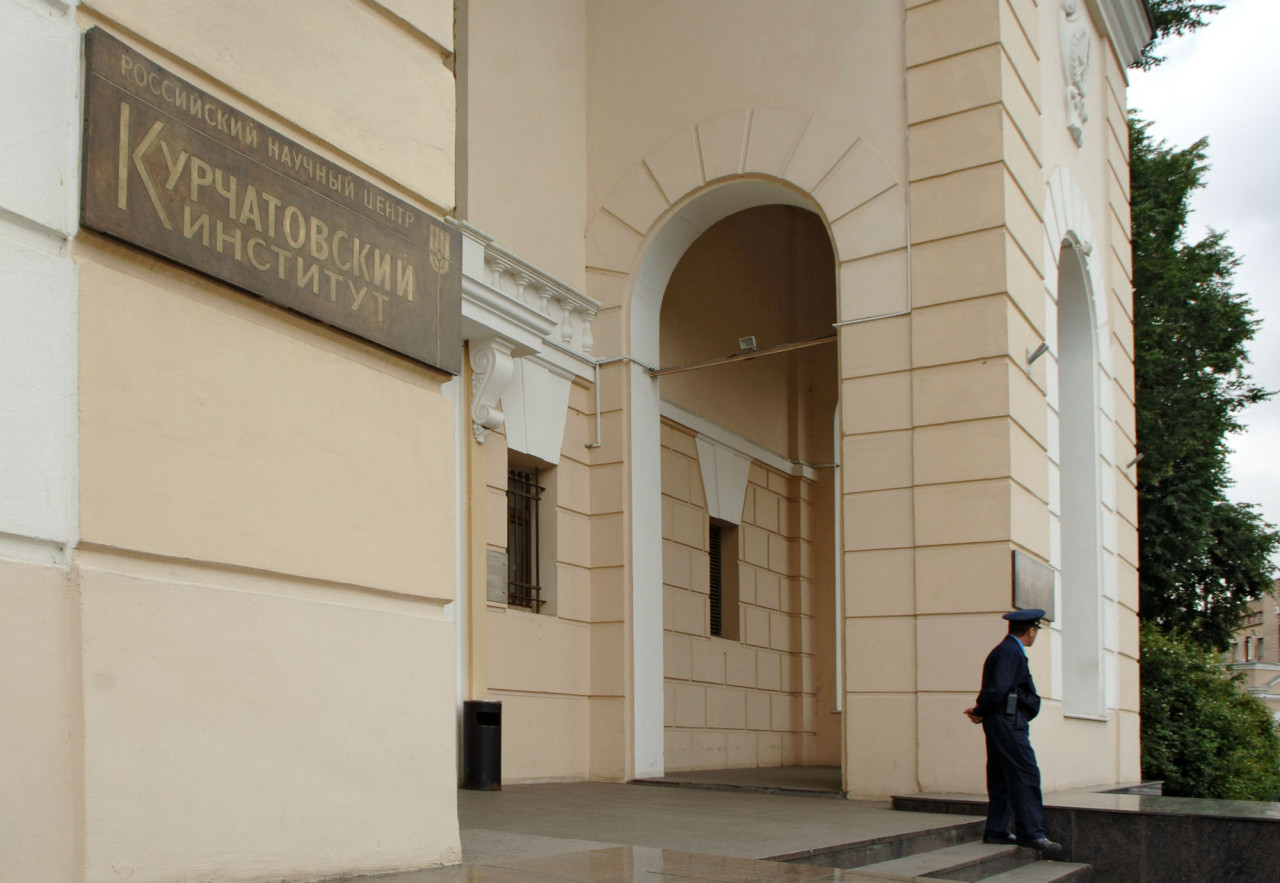 NIC building "Kurchatov Institute" Photo: Grigory Sysoev/TASS
In May 2013, large elections were held at the Academy of Sciences, the general meeting was to elect a new president. At the same time, the members of the Department of Physical Sciences chose the director of the Institute of Crystallography, Mikhail Kovalchuk held this position for 15 years. On May 27, to leave Kovalchuk at this post for another term, 57 people voted with the necessary 67. The Presidium of the Russian Academy of Sciences, then still led by Osipov, recommended that the department reconsider his decision, but three days later, at a second vote, Kovalchuk rolled again, he received 66 votes with the necessary 73-x. The director of the Kurchatov Institute lost the last noticeable position in the structure of the Russian Academy of Sciences. One of the creators of the Dissernet community, physicist Andrei Zazakin, recalls,
"If I do not need an academy, then we do not need this academy" Twist this quoteThat his teacher, Academician Dmitry Shirkov, retold Kovalchuk's words, said on the sidelines of this meeting: "If I do not need an academy, then we do not need this academy."
Two days later, on June 1, 2013, Mikhail Kovalchuk gave a bright (both in meaning and as an example of speech manners) an interview with “Echo of Moscow” about the academy and academics: “This is difficult. I want to say that, you know, there is a collection of great, at least in the past, people, a large number, you see, old. They are worthy people. What they have in my head, it is difficult for me to imagine. [...] The fact is that, you know, they are used to a certain life, they are used to living, and as if they were falling further. And the Soviet greatness disappeared. And in order to clean the faded tablets, you need to bend down. And they, on the one hand, are old, and on the other hand, some are already completely lazy and incompetent. They cannot do this. " If the Academy faded the tablets, then at the Institute of Crystallography, as Kovalchuk told the correspondent, marble steps, flowers on the lawn, and even, yes, painted fence. The Institute of Crystallography, unlike other institutions of the Academy, does not rent its premises for commercial companies. Is it not this fundamental, Kovalchuk hinted, prevented him from re -election?
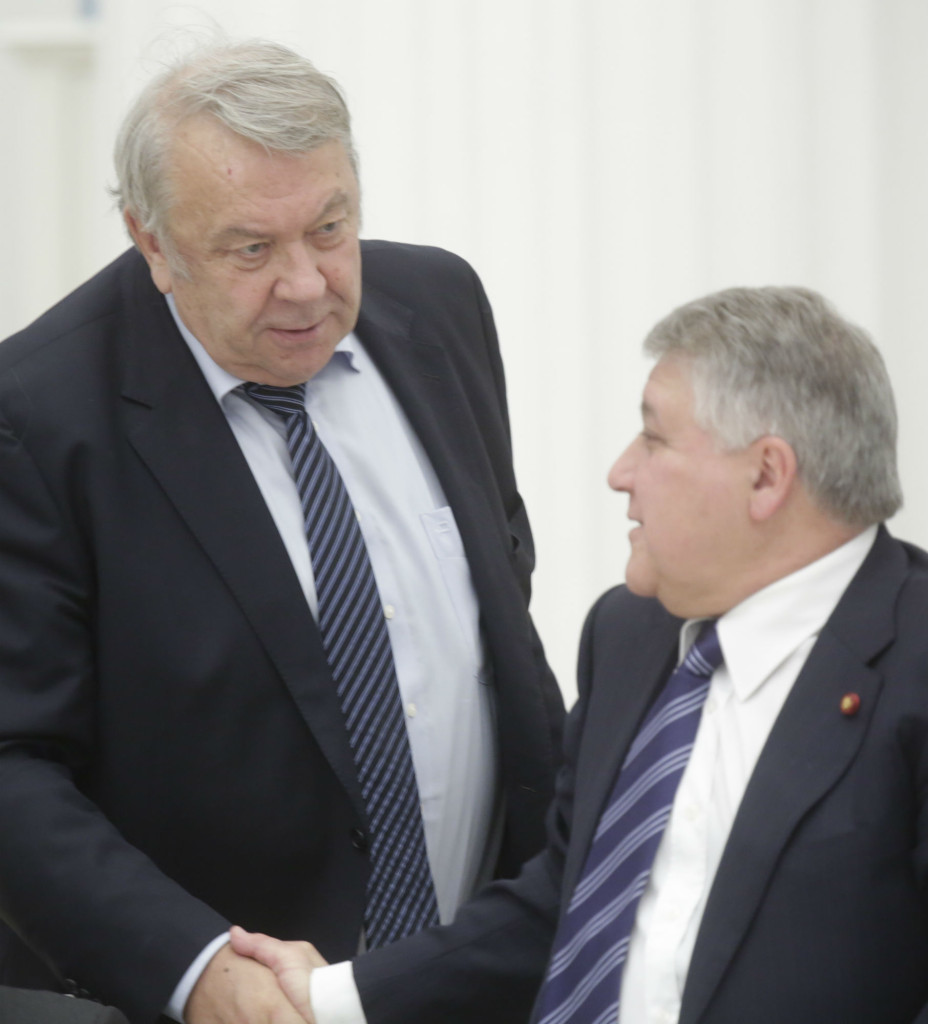 President of the Russian Academy of Sciences Vladimir Fortov and Director of the Kurchatov Institute NIC Mikhail Kovalchuk during a meeting of the Council on Science and Education in the Kremlin. Photo: Mikhail Metzel/TASS
In fact, Kovalchuk was most likely removed from the post for more prosaic reasons. Some noticed that he occupies so many leading positions, others paid attention to Kovalchuk’s sharp public statements to the Russian Academy of Sciences (for example, “the Academy must inevitably die as a Roman Empire”). Finally, there were rumors that Kovalchuk plans to do with the Institute of Crystallography in the same way as with Piyaf: to take him out of the wounds and attach to his Kurchatov Center.
But the Academy with the new President Vladimir Fortov, who was chosen thanks to his reform program, and without Kovalchuk, it remained to exist in the usual form already very few. A month after the election, in late June, the State Duma was submitted to the State Duma “On the Reform of the Russian Academy of Sciences”, which deprived the Academy of all its scientific institutions (they were retrained by the new body - the Federal Agency of Scientific Organizations), turning the Russian Academicians into a kind of club of academicians, almost no influence on bureaucracy and finances in Russian science. On September 27, 2013, the law was signed by President Putin, and the Russian Academy of Sciences, created by the Decree of Peter I in 1724, was in essence collapsed.
Spectrometer in the box
The specific role of Mikhail Kovalchuk is that most Russian scientists consider the defeat of the Russian Academy of Sciences, one can only guess. The hardware struggle against the Academy for many years led the Ministry of Education and Science, and the offense inflicted by academicians to a person entering the immediate environment of the president could become a trigger for a decisive attack on the Russian Academy of Sciences.
"The system created by Kovalchuk is a feudalism in which scientists are reduced to the role of fumes"Today, two years later, it is too early to evaluate the results of the Academy’s reform, but one thing is clear - she instilled pessimism to the scientific community. Scientists were moved away from the distribution of financial flows, and most importantly, from decision -making. In an amazing way, this is very reminiscent of the situation at the Kurchatov Institute itself. Speaking at the general meeting of the Department of Physical Sciences in May 2013, Leonid Ponomarev, at that time, the head of the Laboratory of the Institute of General and Nuclear Physics of the Kurchatov Institute, said that “the system created by Kovalchuk at the once glorious institution is the feudalism in which scientists are reduced to the role of quarrel men who feed the widespread and the whimsical and the whimsical and the swollen and Beded bureaucracy. "
In September 2013, Leonid Ponomarev left the Kurchatov Institute. On October 27, 2015, a new director - Doctor of Technical Sciences, expert in the field of fire safety Denis Minkin, according to the Dissertinet community , who defended the dissertation almost completely written off from other sources, was appointed in the structure of Kurchatnik Piyaf. On October 30, 2015, a world -famous physicist Mikhail Danilov was dismissed from an ITAF's structure. The order contained a wording according to which there are no vacancies corresponding to its qualifications at the institute.
According to another former ITEF employee, the goal of Mikhail Kovalchuk is to turn subordinate scientific organizations into “institutes on paper” with loyal employees and a minimum of scientific activity, which almost do not require financing, but under which you can knock out huge budgetary funds. Today, the Kurchatov Institute is one of the richest scientific organization of the country, the most modern scientific equipment was purchased here, some of which, however, are not even unpacked in buildings. One of the physicists who visited the Kurchatov Institute several years ago said: “Kurchatnik made a strange impression on me. There are full of places that shine, sparkle, but do not work. There are many young people, but she is strange. Siemens specialist tells them how to work with equipment through a translator. This is a nonsense that students of the fifth or sixth courses cannot understand the technical English language. ” The level of publication activity of the Kurchatov Institute does not correspond to the generous financing of the institute.
In fairness, it is worth noting that in the “Kurchatov Institute” itself, and in the sponsored ITEF, Piyaf and IFV, separate strong researchers and entire scientific areas still remain in Protvin. Many employees retain formal affiliation with a hears, actually working in the West, for example, on a large Adron Collider. They do not take out the ICs from the hut, do not publicly tell about the situation at the institute, but their publications prepared in the Cern and other Western institutions with Western money are formally considered made in Kurchatnik, this is quite consistent with the philosophy of the “Paper Institute”.
The invasion of zombies
On September 30, 2015, Mikhail Kovalchuk read a prostrate report in the Federation Council. Most of it was the description of the threats that modern science carries to humanity, and especially Russia. “Today there has been a real technological opportunity [intervene] in the process of human evolution,” said Kovalchuk. “And the goal is to create a fundamentally new subspecies of Homo sapiens, an official person.” The head of the Kurchatov Institute explained to the senators that a service person has a limited self-awareness, his reproduction is under external control, and genetically modified organisms serve him “cheap food”. Mikhail Kovalchuk never once said who was busy creating a “official person”, but made it clear that the technologies necessary for this are actively developing in the United States. Среди прочего это «абсолютизация свободы личности», которая, как объяснил Ковальчук, приводит к уничтожению суверенных государств, а также «внедрение в массовое сознание представлений, противоречащих естественным» (здесь речь шла об отказе некоторых семей заводить детей и о движении ЛГБТ) .
Разумеется, для создания зомби одного массового одурачивания мало, нужна еще и фундаментальная наука. Служебный человек может быть создан, с одной стороны, благодаря прорывам в нано- и биотехнологиях, а с другой — с помощью информационных и когнитивных технологий. Так как же быть прогрессивной части человечества, которой угрожает превращение в послушных рабов? Ковальчук напомнил об опасности «одностороннего владения технологиями одной страной» и предложил задать в России новый стратегический приоритет научных исследований, — на базе «опережающего развития принципиально новых междисциплинарных конвергентных фундаментальных исследований и междисциплинарного образования». Другими словами, в мире начинается новая нано-био-инфо-когно-гонка вооружений, и Россия обязана включиться в нее пока не поздно, бросив как можно больше денег на нечто, называемое конвергенцией НБИК-технологий.
В начале 2016 года стало понятно, что выступление в Совете Федерации было лишь первым элементом гениальной двухходовки. 14 января президент РАН Владимир Фортов разослал по отделениям Академии наук документ под названием «Концепция «Стратегии развития конвергентных технологий»». В сопроводительном письме говорилось, что текст подготовлен Межведомственной рабочей группой Минобрнауки, но упоминания Курчатовского института и лично Михаила Ковальчука встречаются в концепции так часто, что в действительном авторстве текста остается мало сомнений.
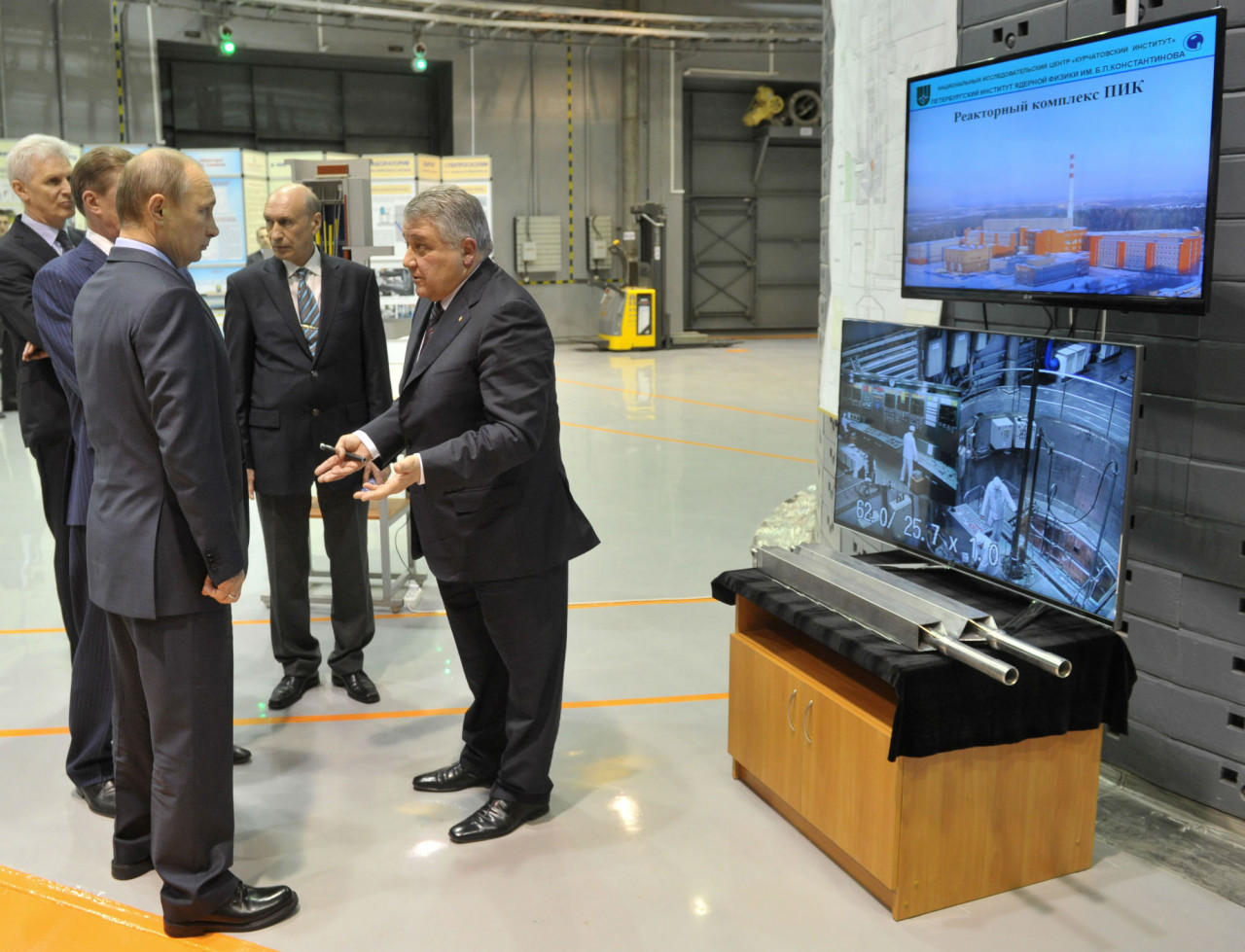 Владимир Путин и директор НИЦ «Курчатовский институт» Михаил Ковальчук (справа) во время посещения Петербургского института ядерной физики имени Б.П. Константинова в Гатчине Фото: Алексей Никольский/ТАСС
Концепция написана куда более сдержанным языком, чем выступление Ковальчука в Совфеде, но в то же время их риторика во многом совпадает. Основа предложенного «развития конвергентных технологий» — приоритизация исследований, лежащих на стыке наук, входящих в аббревиатуру НБИКС, здесь к нано-, био-, когнитивным и информационным технологиям добавились «социо-гуманитарные». По мнению авторов, НБИКС и конвергентные технологии должны быть вписаны в качестве приоритета во все ключевые документы, описывающие перспективное развитие российской науки и ее финансирование. При этом на финансирование конвергентных технологий предлагается выделить 5-10% от всех расходов на гражданскую науку, то есть десятки миллиардов рублей, причем не выделенных в качестве дополнительного бюджета, а перенесенные с других направлений. Что именно из этого должно выйти, концепция не раскрывает, примеров технологических и научных прорывов, к которым должна привести конвергенция НБИКС, в тексте нет. Зато отмечается, что «концепт нашел широкое применение в области экспертных разработок в различных странах начиная с 2000-х годов, и на его основании во многих государствах впоследствии была сформулирована политика внедрения этой парадигмы в целом».
Последнее заявление — правда, но лишь только наполовину. Концепция НБИК действительно была предложена в 2002 году двумя чиновниками американского Национального научного фонда. Тогда на волне моды на идеи трансгуманизма она даже легла в основу некоторых решений по научному бюджетированию США, но вскоре была забыта и отправлена в стол. Через пятнадцать лет Михаил Ковальчук стряхнул с нее пыль и представил в качестве свежей идеи, которая должна определить будущее российской науки и защитить россиян от нашествия «служебных людей». Несколько представителей научной общественности рассказали мне, что концепция «конвергентных технологий» должна была быть представлена президенту Путину во время заседания Совета по науке и образованию 21 января. Однако этого не произошло, как говорят, из-за активного противодействия президента РАН Фортова, успевшего получить отрицательные отзывы на документ от нескольких отделений Академии. Слово «конвергенция» на заседании прозвучало несколько раз, но сам Михаил Ковальчук так и не заговорил о НБИКС. Зато, говоря об ответственности «ведущих научных организаций» в России, он процитировал поэму Пастернака «Высокая болезнь»:
«Тогда, его увидев въяве,
I thought I thought endlessly
About his authorship and right
Дерзать от первого лица».
Последние четыре строчки поэмы, которые Ковальчук не стал читать, таковы:
Read also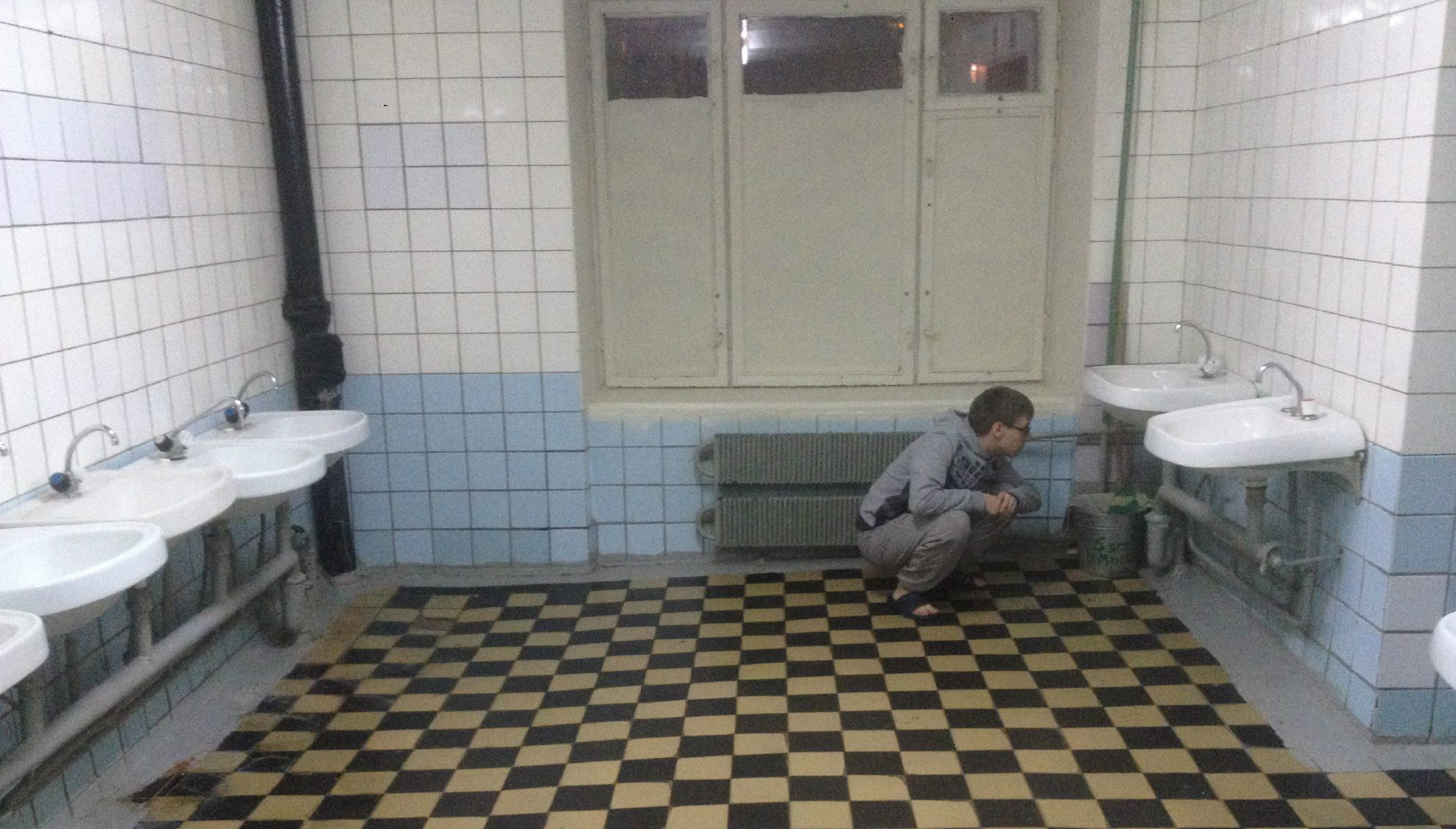 Оккупай МГУ Студенты МГУ устроили забастовку из-за катастрофических условий в общежитиях. Ivan Chesnokov went to a branch of the House of Students on Lomonosovsky Prospekt and studied local life - with cockroaches and without a shower
 «Из ряда многих поколений
Выходит кто-нибудь вперед.
Предвестьем льгот приходит гений
И гнетом мстит за свой уход».
Никто из моих собеседников из научного сообщества не считает, что Ковальчук действительно верит в нашествие зомби и прочие научно-фантастические ужасы. Конвергентные технологии — удобная риторика для получения новых сфер влияния и бюджетных средств, красивые слова, за которые никто не собирается нести ответственность, бумажные планы для бумажных институтов, следующий шаг большого наступления Михаила Ковальчука на российскую науку. А зная упрямство, с которым Михаил Валентинович привык идти к поставленной цели, можно не сомневаться, что чтение президенту Пастернака было лишь тактическим отступлением, и аббревиатуру НБИКС мы услышим еще не раз.