
Translated material
The right to judge
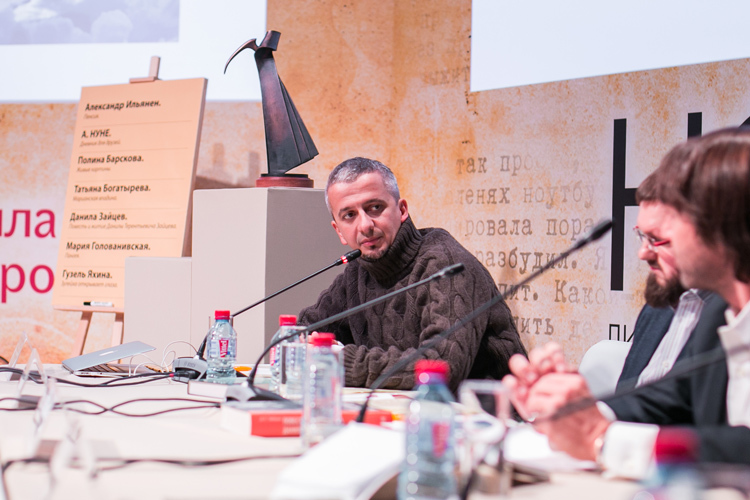
Publishing the polemic response of the chairman of the jury “Nosa” -2015 Konstantin Bogomolova to the article by Elena Rybakova regarding the last bonus debate, the editors of Colta.ru is far from the idea of considering the dispute to be finished and invites all interested participants to the discussion.
It seems to me it is necessary and important to answer the text of Elena Rybakova, dedicated to the debate and the results of the “nose” award, whose jury I headed. Moreover, in the text of Elena there is a direct appeal to me ...
First.
About the level of discussion, about "amateurs" and "experts."
This jury caused bewilderment in many in the expert community. Not a single professional. And the debate, as I understand it, confirmed the fears of this community regarding the quality of the discussion. You, Elena, were embarrassing to hear the statements of the “amateur” of Up to “tectonic shifts of the evolution of the lyrical hero” - it seems that it was formulated? I admit, I, too, could not help but smile about these formulations, as well as about the discussions about “little people” and “humanistic pathos”. What to do. This is what was taught in schools and institutes. And a man is unprofessional, of course, simply does not own other tools for a serious conversation about literature.
Yes, I am ready to admit the primitiveness of the discussion. However, this is the problem. Participating the jury for the second year, I see that from the other pole the pole of the “expert” - such a pretentious and completely closed banality is heard, only dressed in more complex terminological constructs, which for me personally ceases to exist between the naive judgments of the “amateur” jury and the reasoning of the experts.
The words of Kirill Kobrin, the head of the “Council of Elders”, that he feels “Viktor Borisovich Shklovsky, reading Ovsyaniko-Kulikovsky,” is a sad example of the salon wit, from which he becomes embarrassed for the witty. But God is with him, with the quality of wit. As with the one who feels himself. If Kobrin feels himself Shklovsky (albeit ironically, but surely, quite sincerely), then why resent about the presence of the “nose” of the “nose” of the editor gloss? The problem is that this salon wit, in fact, is the superiority of the "expert" over the "lover". The “amateur” produces banality, but the “expert” cannot present a single complex argument in favor of the protected text, operating only with a “naming”: this book is such, it is about that, it fits into such a “trend” and is an example of that, and therefore it is beautiful. And what does it matter to me that in one case the “trend” is from the school course, and in the other - from professional discourse. The quality of the materials does not cancel the elementary of the mental structures on one and the other.
You can sneak on the performance of Up, considering him the level of school works, but do not forget: there will always be the one who sags over you. Frankly, I do not see the great difference between the “tectonic shifts of the lyrical hero” and passages about the “mythology of old and new writer's tools”. All this is some kind, forgive Lord, Novikov-Lansky. Philologically cultural "Lego". From this “Lego” you can collect products of varying degrees of complexity, but the components are equally standard - which means that the results will be standard.
 © Nos-2015
Both literature and the theater are experiencing some powerful and radical screening today, and a critical thought there and there clearly does not have time for what is happening. The previous optics does not work. There is no new one. That’s why Ilyanen’s thin and exquisite book can be obstructed by one of the experts (and without any serious arguments, it is on the “amateur” principle of “like-not like”-and it turns out that when the book causes irritation, the expert is experiencing something “human, too human” and breaks down into primitives), and the book of Polina Barskova about the blockade is prerelated in their form And in fact, the dead and, in my subjective opinion, which is flirty painting of real skulls, I repeat, perfect in form and precisely in my perfection extremely archaic, but the main thing is understandable and, unlike the same Ilyanen, which does not cause irritation - this book is realized as an achievement and the top.
So “amateurs” and “experts” converge in the zone of “understandability”. “Cognitiveness” of various kinds. The former speak of "understandability" in the philistine sense - the plot, topic, language. And the hearts of the second respond to the “understandability” of a high order - the ability to enter the text into their mental constructions and their vision of the literary process. And well, the designs would be really complicated, but these constructions, I repeat, are archaic, so that all claims to “amateurs” lose their meaning. It is obvious that it is not about the tendency of barbarization or archaization that you need to talk, but about the fatigue and wear of the “critical apparatus”.
Second.
Several comments about Zaitsev’s book.
I will say anything about the “political” claims to the book and the choice of the jury-they say, this choice portends the coming of some gloomy times and is in line with the total archaization as a state-ideological trend. It seems to me that when such non -power arguments are used, this is a decrease in the level of discussion. The criticism of the text of Zaitsev as “archaic” is repelled from external signs (genre, linguistic, style), as well as from the supposedly primitiveness of the author’s consciousness. "Archaic" is served as something negative for the literary process. At the same time, deliberately or unconsciously, in the heat of discussion, Rybakova does not distinguish between archaization as an artistic technique and archaic as a secondary (in this sense, the text of Yakhina is many times more archaic than the text of Zaitsev - that would be the victory of the “archaizing trend”). However, the critic prefers to print the book by telling the audience that the naive and illiterate author “caught”, reading the “protocols of the Zion sages”, and thus exposing the poor author, multiplying to add: “Have you read, gentlemen from the jury and experts, to this place? ..”
Elena writes: “Another absurdity is to give a bonus for a new (new literature and new sociality, about which the“ nose ”is baked by the charter), not that a stylizing archaic, poorly individualized consciousness, but directly generated by this consciousness. The confession of the Old Believers Danila Zaitsev, half written, half-drawn by the author, of course, is an interesting document, although he promises a folklorist and an anthropologist than a literature researcher. ” It is difficult to disagree with this. This is really a production project. And indeed this text is not reflected not by the author, but by “publishers”, “producers”. In a sense, this is an “unconscious” product. But the book of Ilyanen, who is in a very specific technique, is the same “Project” located in a very specific technique. Only the project of oneself. Judge for yourself. In the first case, the producer and the source of the text are separated from each other. In the second, this is the same person trying to “objective” himself. I personally would be interested in the battle of these two texts in the final. But this did not happen. However, it is strange not to see that these two texts, being at different poles, are a reflection and behind each other. In one case, a group of “producers” actually turns chaos into a structure and “collects” the author from the void. In another, the author, combining in himself both the author and producer, the subject and object of the study, tries to turn the structure into chaos, imitating the unconscious. This is what a dispute could be about - how conscious construction of an unconscious can compete with truly unconscious.
As a result, in front of us in one case is the hologram of the author. In another - a living author. The victory of the hologram is seductive to name the fiasco. But, it seems to me, more honestly to call it a challenge. A proposal to experts and professionals finally make a mistake and leave the room.
And the last.
Elena Rybakova’s article is similar to a call to protect the literary process from barbarism. Or a bonus necrologist. Meanwhile, the language, and literature, and the literary process (and the prize is part of this process) do not need protection. Art suffers more from defense than from an attack. And this article, struggling with “guardianship”, can itself be considered, paradoxically, as a protective one. Only in the role of the defended “cultural heritage” does professional judgment and criticism act here. This is funny and strange, but why not. In the end, Shklovsky’s books do not need protection. And the right of other modern critics to judge is very necessary.
Everyone survives as they can.
Sincerely,
Konstantin Bogomolov