
Translated material
Urgently in the room
“The focus” of Thomas McCarthy received an Oscar in the category “Best Film”
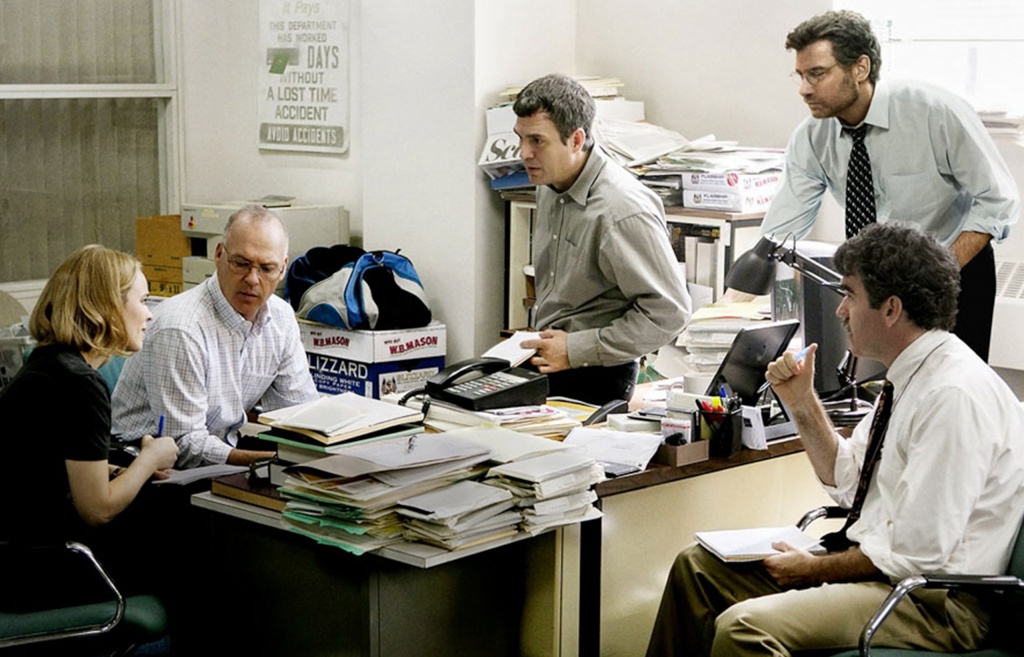
The film unfolds in the offices, but it does not get less exciting (in the photo: Rachel Macadams, Michael Kiton, Mark Ruffalo, Liv Shreiber, Brian d'Arsi James)
This year in the Oscars pool there are several unusual paintings at once, in which the topic and its solution are more attracted to the participation of stars or the loud names of the directors. Next to the “Reducing game”, Adam McAke, a caustic comedy about the economic crisis, is a thoughtful and alarming film-investigation by Thomas McCarthy “In the Facific”, the history of the confrontation of the journalists of The Boston Globe and the omnipotent Catholic Church. Today, bookmakers consider these two ribbons the most likely applicants for the Awards of the American Film Academy for the best film of the year. Actually, if it were not for a solid number of nominations, both paintings could not get into the Russian rental - the distributors would elementarily consider them too boring for our viewer, more accustomed to entertaining cinema.
Unequal forces
“The focus” is an extremely clumsy translation of the name Spotlight, an accurate and simple equivalent of which does not exist in the Russian language. Like the phenomenon itself. Spotlight is the name of the small department of the large and influential daily Boston newspaper The Boston Globe, which is exclusively investigations. The shortest possible time, which four journalists are spent on preparing the next publication is a couple of months. But it happens that work on the material is delayed for a year, even one and a half. Moreover, they write no slower than any colleagues in Peru: if necessary, they can set up a “urgent room” for half an hour - the daily pace obliges. It is about the search and thorough processing of the topic that will not lose topicality with the course of time, and when publishing will affect and interest almost everyone, thereby paying off the efforts spent.
We get acquainted with the SpotLight team in 2001, at the time of the change in the editor -in -chief of the newspaper. Just then these four - their roles are played by the famous artists Michael Kiton, Mark Ruffalo, Rachel Macadams and Brian d'Arsi James - are waiting for the next topic. The new boss (excellent, although Liva Schreiber) gives them an idea that at first it seems unexpected: to investigate the case of sexual harassment of the Boston priest in relation to minors. It seems that there were already several publications about this in the headings of the “incident” and “Religion”, then the observer wrote a column - what else? The editor -in -chief explains: could an influential cardinal who suspiciously quickly hesitated the case know about it? And in general, is this incident - the first and only?
“In the spotlight” - the film is smart, calm, correct, accurate in details, merciful and merciless at the same time. How, obviously, the journalistic investigation on which his scenario was founded
So the epic begins, during which a lot of skeletons were taken out of the closet - it would be enough in a small cemetery. Having passed with the native city and the country the attack on September 11 and all its consequences, the reporters of The Boston Globe continued to dig a topic and as a result made the impossible. They challenged the Catholic Church - one of the most powerful institutions in the world, - having documented that hundreds of priests, not only in the States, but also in Latin America and Europe, rape children and adolescents in their power daily. A series of publications on this subject was the effect of an exploding bomb. The newspaper was awarded the Pulitzer Prize for Serving Society.
Thomas McCarthy is a rather modest author. In the past, a serial artist (however, who starred among other things in the cult “wiretapping”), he managed to play in “Acquaintance with his parents” and “Good night and good luck”, simultaneously with this, gradually trying his strength in directing. On his account, in particular, the excellent social drama “Visitor”, who received a prize for the best male role at the Moscow International Film Festival, and then the Oscar nomination for Richard Jenkins, and, oddly enough, the co -authorship of the script for the brilliant cartoon “Up”. Undoubtedly, his main luck is “in the spotlight”, the film is smart, calm, correct, accurate in detail, merciful and merciless at the same time. As, obviously, the journalistic investigation on which his script was founded.
The weight of the word
Without touching the creature of the plot, it is interesting to understand the genre of a film that has such a deafening success: “in the spotlight” has already received several dozen awards, including six Oscar nominations. For Russia, a picture based on a journalistic investigation and consisting of continuous dialogues (no action, no special effects, no strawberries, except for the heartbreaking confessions of the former sacrifices), it seems something impossible. Like another branded Gollywood genre, almost not exported: a judicial drama. Here is a curious paradox. The viewer is still ready to believe that in a distant unfamiliar America the situation is this: the journalist is almighty, all the doors are opened in front of him, and he, armed with a notebook with a notebook (maximum a voice record), is able to destroy any empire, even the president to shift how this happened during the Watergate scandal. But so that at least one domestic screenwriter tried on this on our context, “translated” a similar film or tried to write its analogue on Russian material? Unimaginable.
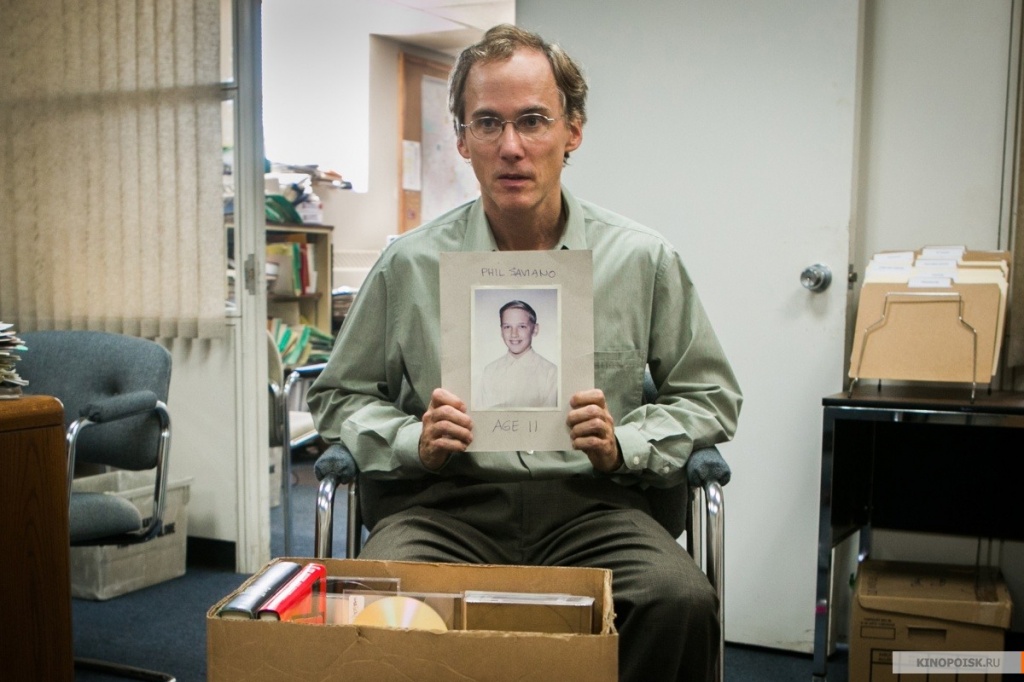
Neil Huff in the role of Phil Savyano, a key witness in the case of pedophilia
One of the fundamental foundations of America - the country of very religious ("in the spotlight" confirms this reputation) - faith in word. Therefore, “spoken cinema” is not a sentence at all, but a definition that causes the interest of an adult viewer. Here is the reason why both judicial and journalistic dramas are watching. After all, the law for an American is never equal to hooking, cunning, tricks: it is as immutable and weight as a shot from a revolver of a ranger who once sent justice for the frontier. The journalist is a representative of the Fourth Power not because these or those agents of influence are behind his publication. His power is not ghostly and not abstract. He writes the truth and does not work for the employer, but for the reader (listener, viewer).
It affects the contrast between the victims of harassment that the life of each of them somehow irreversibly changed after children's injury - and the enabled priests or their lawyers, confident in their impunity
The devaluation of journalism as a profession in Russia is closely connected with the long -standing traditions of the double -humming and organized hypocrisy of the official press, only at times growing to the metaphors of the Ezopov language. Simply put, there is no faith to the journalist, this is the “second ancient” - and it is not a fact that outside Russia many will immediately understand the idiom familiar to us. At the same time, according to regularly updated ratings, our country has not been one of the world leaders in the danger of the journalist’s work. As a result, it is simply impossible to imagine a popular and believable film about a newspaper investigation in the Russian Federation. And in the states of such films there are a huge number, and they are popular.
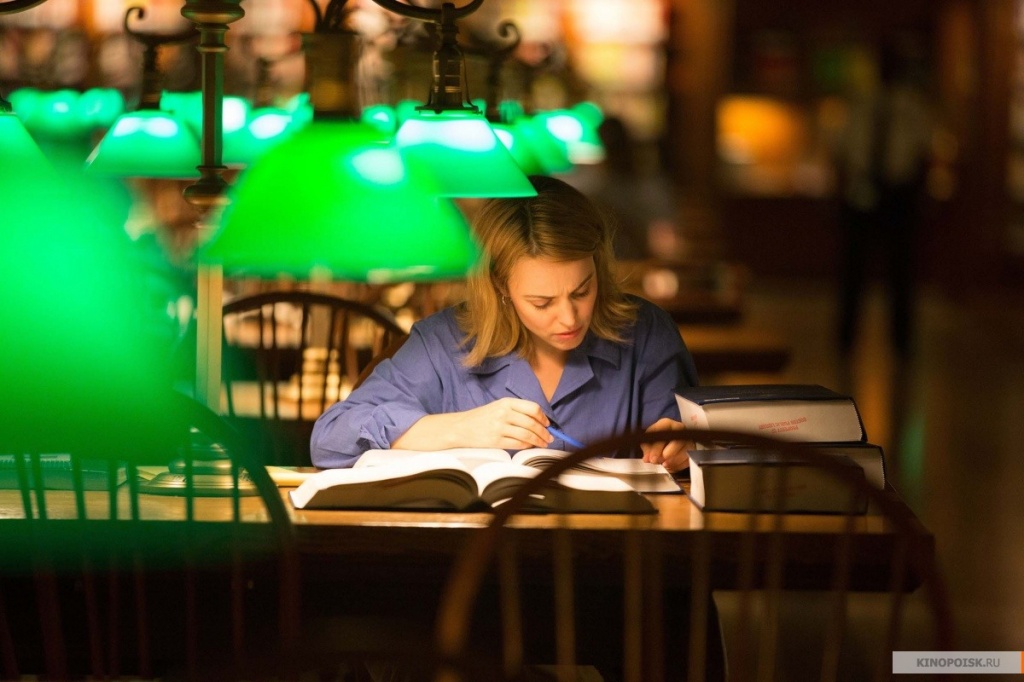
A trip to the library in the United States is an obligatory component of the work of the presentation of the reporter, on the screen and in reality (Rachel Macadams)
By the way, the unprecedented speed of the decline of Russian print media is also connected with this, incomparable with the pace of the same inevitable process in other countries: the word is a muffled price, it can become a source of threat, but it is unlikely to help anyone or open the eyes. But from the universe of the giant newspaper in the film, McCarthy is breathtaking - this is a whole parallel world, with its laws and miracles. The immutability of a printed, not a virtual word, is its foundation. Therefore, now to believe that once American newspapers will die and close forever, it is strongly impossible.
Man or system
If you ask the authors and producers why they shot “in the spotlight”, they will be confused. These are generally European questions, they are unclear Americans. For them, any film is, first of all, a way to tell a story that was still not told - invented or real, it does not matter. And this one is even more so. What rivets to the screen of the viewer of the film, the whole action of which takes place in conversations? Of course, a fascinating plot, the course of the investigation, divided into several lines; The individuality of the main characters - it is no coincidence that actors of such a high class are busy here. For each of them, a similar film - a challenge and a test (two - Ruffalo and Macadams - deservedly received by nomination for Oscar).
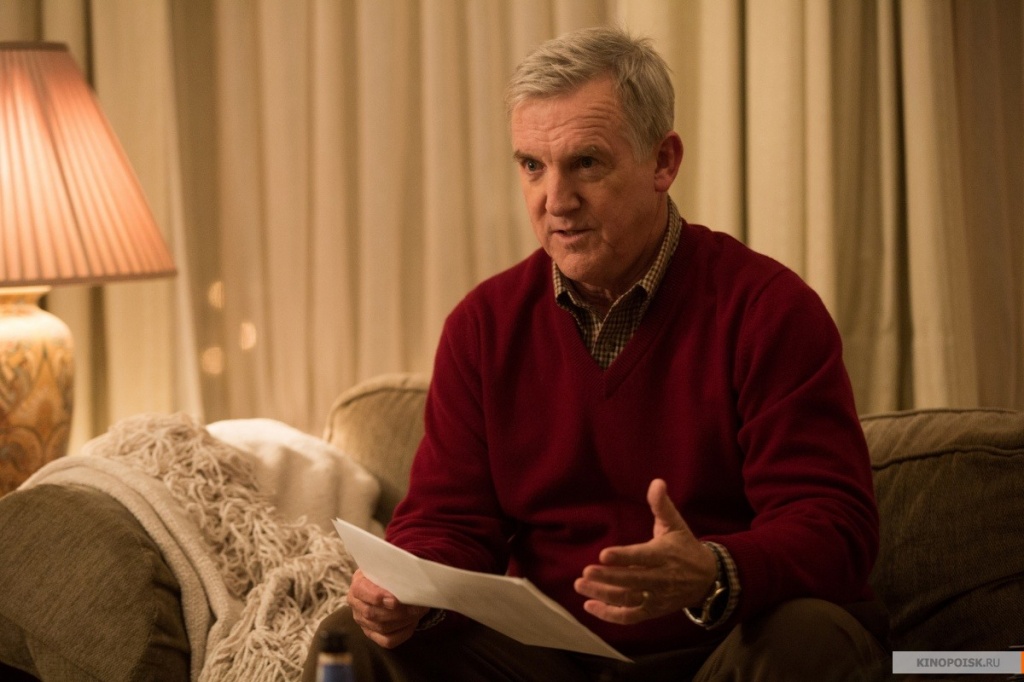
Journalist Jim Sullivan (Jamie Sheridan) is one of those who helped the churchmen hide their sins
But, of course, the true answer to all questions and the main reason for the fascination of the picture is its internal conflict. “The focus” is a real anthem of journalistic work and at the same time uncompromising exposure of suppression mechanisms used by the Church. The contrast between the produced victims of harassment is striking - the life of each of them somehow irreversibly changed after children's injury - and the elongated priests or their lawyers, confident in their impunity and not intended to violate the long -established order - in fact, institutionalized violence. It is no less about circular bail that does not allow you to feel individual guilt - and the mechanism of transferring guilt from the rapist to the victim. Ultimately about a more global contrast of publicity (that is, words) and silence. It is publicity that allows the person to take revenge in a duel with an unshakable, seemingly system.
It is necessary to understand: when academics or critics cast votes for such an emphasized modest, albeit impeccable film, they do not vote for acting or directing. And not only for the national traditions of journalism or against hypocrisy of modern Tartufs. They vote for freedom of speech - and, as a result of this freedom, for his omnipotence. And the indicator of this is not only a Pulitzer or Oscar, but also, for example, exclusively the highest points set by the film “In the Facificy” of the Vatican by all the media.
Photo: kinopoisk.ru