
Translated material
What gave Medvedev’s trip to Munich
"Carnegies" on "Medusa": Dmitry Train - about the new software speech of the Russian prime minister
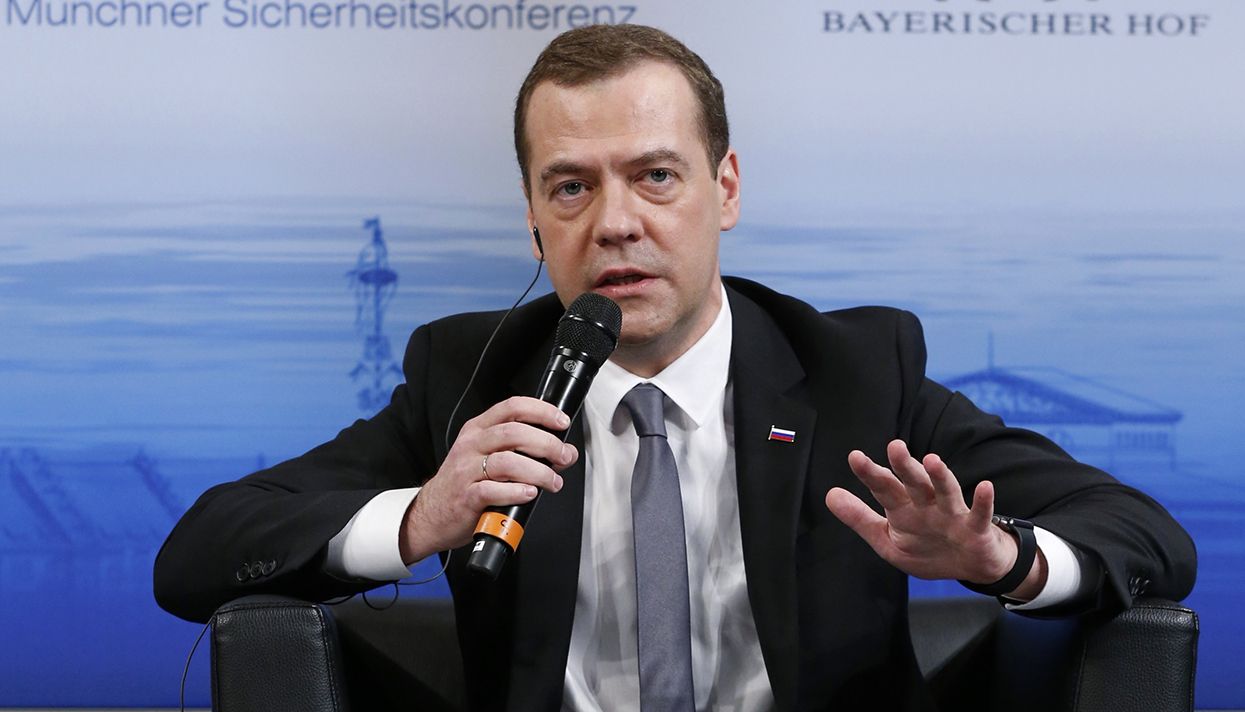
Medusa continues a joint project with the Moscow Center of Carnegie . In the next publication , the director of the Moscow Center of Carnegie Dmitry Train tells why and under what circumstances Dmitry Medvedev made a speech at the Munich conference. The Russian prime minister, according to training, became the conductor of the ideas of Vladimir Putin and developed the ideas of the famous presidential speech in Munich in 2007 - but was met with Skepsis.
On Saturday, February 13, Prime Minister Dmitry Medvedev made a speech at the Munich Security Conference, which can be called the update of the famous speech of President Putin in 2007. Before the trip, Medvedev not only received instructions from Putin. Speaking to the members of the Western foreign policy community, he voiced what Putin would say if he considered it necessary to come to Munich this time.
The main thesis of the Medvedev’s speech was that Russia and the West, which appeared before calling from terrorist forces, must be united, despite any disagreement. Otherwise, two options are possible. Either the world will be controlled by the World Caliphate, or the world will generally disappear as a result of the Third World War.
Medvedev’s speech did not cause the ridicule that fell to the share of Sergei Lavrov during last year's Munich conference. There was an emotional question of a Ukrainian female deputy about the creation of a tribunal to condemn the guilty of the MN17 flight disaster. Medvedev reacted to the question dryly and calmly, without emotion. He did not hear the Philippician President Poroshenko, who came out to participate in a panel discussion after Medvedev left the hall.
At the same time, the reaction of the audience to Putin’s call - Medvedev was generally skeptical. Almost all the speakers condemned not only Russian politics in Ukraine, but also the bombing of the Russian aviation Aleppo. NATO Secretary General Jens Stoltenberg, who spoke before Medvedev’s statement, announced the current general approach of the alliance to Russia: to restrain the Russian Federation with political, economic and military means - and at the same time maintain a dialogue with it in order to avoid a direct clash.
In the context of the obvious refusal of Moscow, to surrender its positions in the Donbass and in Damascus, this portends a continuation of confrontation. Foreign Minister Sergei Lavrov, who spoke after Medvedev, was much more restrained in expectations. Referring to the lack of progress in cooperation between the Russian and American military in Syria, he expressed doubts about the realism of the newly achieved agreement on the termination of hostilities if there was no such progress.
This remark was immediately interpreted in the audience as the readiness of the Russian Federation to continue to maintain the offensive of the Syrian government forces from the air. US Secretary of State John Kerry, on the contrary, took an optimistic note, calling the current moment decisive for the future of Syria and saying that the United States will consider the issue of coordinating the goals of air strikes. For a positive decision, however, the Pentagon consent to closer cooperation with the Russian Federation, which is not presented today, is required.
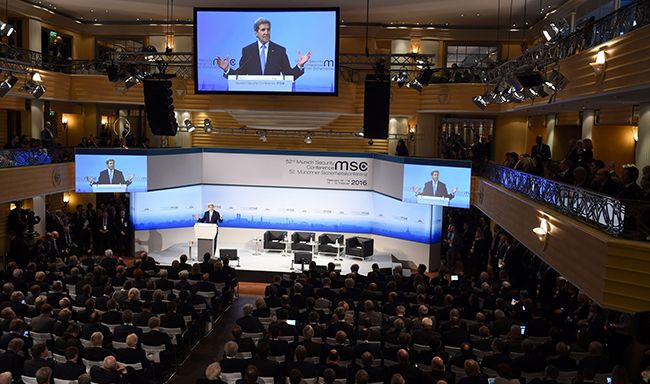
It is significant that Prime Minister Medvedev and Secretary of State Kerry made references to the events of the early 1960s-the period to which the history of the Munich conference dates back (then it was called the conference of the Verkunde magazine (Verkunde) and collected military, diplomats and politicians of NATO countries). But if Kerry turned to 1963, when President John Kennedy, speaking in West Berlin, assured the Western Germans and Western Europeans in solidarity and the support of the United States of America, Medvedev spoke about the Caribbean crisis of 1962, when the world came close to a nuclear war.
German Foreign Minister Frank-Walter Steinmeyer corrected the German media, regarding Medvedev’s words as a statement that the “second cold” has already begun. Medvedev really almost reached such a statement, talking about the “first Cold War”, and then drawing the prospects of the “third world fight”. But nevertheless, the main message of his speech - and the very meaning of his business trip to Munich - was probably the definition of opportunities for cooperation and interaction with the West without the surrender of the fundamental foreign policy positions of Moscow.
If so, then a constructive dialogue, at least in public space, is not yet possible. Western public opinion refuses to consider events in the east of Ukraine as a civil war. Instead, it speaks of aggression and annexation from Russia. In the same way, it rejects Medvedev’s thesis that Syria under the Assad was a happy and prosperous country. The Russian operation in Syria is considered not so much as a war with ISIS banned in the Russian Federation, but as a military interference in the Syrian war on the side of Assad.
There are no hopes that the need for cooperation in Syria, the growing fatigue of the West from Ukraine and the migration crisis will force Europeans this year to soften anti -Russian sanctions, and Americans - to recognize the role of Russia as an equal partner in the Middle East and in the rest of the world. Confrontation with the United States and alienation from the European Union will apparently continue to continue and delve into the foreseeable perspective. The main theme on the agenda between Russia and the West in the field of security will be the prevention of a military clash between them. It is unlikely that President Putin will appreciate the results of the Medvedev probe in Munich as especially encouraging. But, as Vladimir Putin likes to say, a negative result is also a result.
Dmitry Train
Moscow Center of Carnegie