
Translated material
Colta.ru
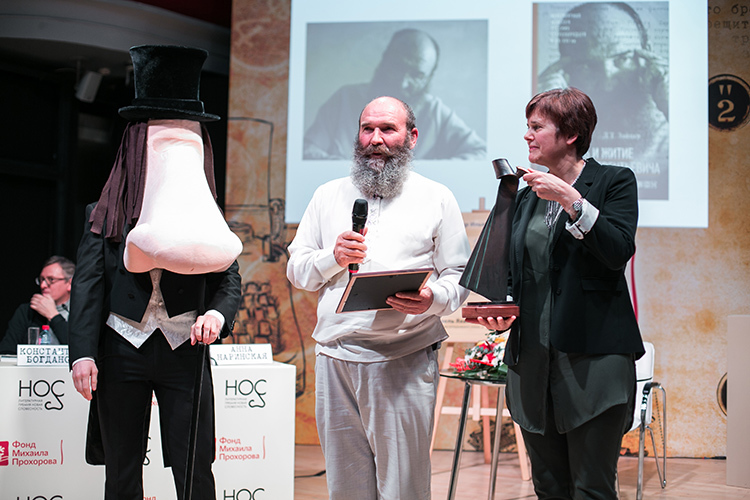
Strictly speaking, I have nothing to add to what Elena Rybakova wrote in her brilliant article “New Russian Life”. I was not present on the debates of the “nose”, so I can judge the progress of the discussion only by video. But in the article, an assessment of the decision of the jury, which awarded the prize by the book “The Tale and Life of Danila Terentyevich Zaitsev,” seems to me completely accurate in detail and in general.
However, the chairman of the jury Konstantin Bogomolov answered Rybakova with an article “On the right to judge”, in which I do not agree with almost nothing. I have a fans of the theater of Bogomolov and actually considered himself his ally-as, in fact, all the members of the jury and experts of the “nose”. Therefore, his performance sincerely upset me: something is wrong with us, if we are all united by the “nose”, we cease to understand each other. I worked in the jury of the Nose during the first three years of the prize and I perfectly understand the position of the chairman who has to justify the final choice that arose as a result of the complex interweaving of compromises and provocations.
As everyone who monitors literary prizes knows, the short list is truly significant for the results of the year-if it is compiled conscientiously, it really allows you to see the cut of the current state of literature. The short list “Nosa” -2015 included three groups of texts: a solid intellectual prose (“Pangea” by Marina Golovanivskaya, “Mariana Obsinin” by Tatyana Bogatyreva and “Diary for Friends” by A. Nune), “complex” literature (“Living Pictures” by Polina Barskova and “Pension” by Alexander Ilyanen) and populist texts (“Story and Living” ... ” Zaitseva and “Zuleikha opens his eyes” Guzeli Yakhina). The discussion on the debate was mainly concentrated around the last two texts, which could not but puzzle.
Explaining this strange shift of preferences, Konstantin Bogomolov, on the one hand, blames the Soviet school, who accustomed to pray on a “little man”, and on the other hand, accuses professional literary critics - fundamentally absent in the jury of this year - of banality, pretentiousness, salon wit and desire to subordinate a live course of literature abstract trends. Bogomolov writes: “Both literature and the theater are experiencing some powerful and radical screening today, and a critical thought there and there obviously does not have time for what is happening. The previous optics does not work. There is no new one. ” In principle, I agree with this statement, although, of course, a number of examples in which such a new optics is created. Honestly, I am afraid, because Bogomolov, who is intelligible, they will probably seem samples of professional banality.
Therefore, I better show meekness (whether the winner of the “nose” is led by her) and will focus on the master class on analysis of the text from the jury chairman himself. Thus, the author of the article “On the right to judge” calls on “making the difference between archaization as an artistic technique and archaism as a secondaryness”, offering Zaitsev as an example of the first Life, and as the second - the novel “Zuleikha opens the eyes”. However, is it so? If Zaitsev’s archaization is an artistic technique, then this author could write somehow differently, but from deep aesthetic reasons he decided to state his biography with the syllable of Akim from the “power of darkness”. But this is not so. Since-once again, Elena Rybakova’s rights, the winner of the “nose” was “an essay, not that the archaic, poorly individualized consciousness, but directly generated, is generated for the sake of some goals”. Therefore, this is not a technique - this is a property of author’s thinking.
(In brackets, I note that Yakhina’s one has a technique. It can be assumed that the graduate of the Faculty of Foreign Languages and the Faculty of Faculty of the Moscow School of Cinema quite deliberately decided to cross the socialist romance with the Brazilian soap opera. Having chosen such a technique and using the collectivization and gulags as “material”, Yakhin created a good script for television greater, But I am a wretched, predictable and sentimental book - here I completely agree with the Bogomolov.)
However, back to the literary approaches of the author "On the right to judge." Contrasting Zaitsev’s book, this time, Ilyanen’s pensions, Konstantin Bogomolov agrees that “Life” is a publishing project (as far as one can judge, Pyotr Aleshkovsky and linguist Olga Rovnova played the main role in this prose). But, it turns out, “the book of Ilyanen, who is in a very specific technique, is the same“ project ”located in a very specific technique. Only the project of oneself. Judge for yourself. In the first case, the producer and the source of the text are separated from each other. In the second, this is the same person trying to “objective” himself. <...> In the end, in front of us in one case is the author’s hologram. In another - a living author. "
Leo Oborin already noticed in a commentary on the article by Bogomolov that “the“ project of oneself ”is the product of individual creativity, unlike <...> Books of Zaitsev. Such projects, it seems, is designed to reward. ” Indeed, let's try to project the said by Bogomolov to the literary history. In search of analogies, we will find, on the one hand, the novel “How Steel was tempered” - undoubtedly, “Publishing Project”, and on the other, for example, an autobiographical (also literary) prose of Shklovsky “ Zoo . Letters are not about love, or the third Eloise ”and“ Third Factory ”. In the terminology of Konstantin Bogomolov, this is undoubtedly “the project of himself.” Moreover, from the point of view of the critics of the 1930s, of course, Ostrovsky is a living author, and Shklovsky is a “flirty” or “salon” dummy of a “living person”. However, for some reason, Bogomolov himself refers to Shklovsky and forgets about Ostrovsky, although it is clear that the Ostrovsky hares are closest-only the Komsomol drum battle is replaced in the “life” with an old-bore relief, and instead of “life is given to man once, we read this, for example, a teaching in the spirit of an Avvakuma Protopop:“ To figure it out, it’s a reason: for the people of a beard, a shame is a shame, but a shame for the people. They smear the haru, show their ass and go to the Besovan hooves - isn't it a shame? They turned the human image into Besovsky, and Isho competing before each other. They will say a lot: I am crazy, but I have to think more good, go crazy, and I am proud of my beard - at least a God's image. ”
By the way, highly amazing how the jury members ignored obscurantism, overwhelming Zaitsev’s “life”. And even after the remark of Rybakova about the “protocols of the Zion sages” mentioned in the book, but who did not delay the attention of the jury members, the manticly circumvents this issue with virtuoso grace - transferring arrows to critic, allegedly using blows below the waist. Completely confirming the anti -lititerantic Philippics of the chairman, I am in solidarity not with him, but with Elena Rybakova. In my opinion, if the jury members really missed this sweet detail (did not read to this place, according to the polite assumption of Rybakova), then they were elementarily checked, because for the first time this source of the hero’s wisdom is mentioned in the chapter 19 of the first, and then again-at the head of the 3rd notebook of the second. And if they read, took note and did not react in any way ... I am lost in conjecture.
I will not resist and give both these quotes, so that the reader himself is convinced how they are not neutral.
In the first “Protocols” are equalized with the Holy Scriptures: “I often sat down on the spiritual books, the Holy Scriptures were fascinated by the more Holy Scripture, the elderly talked about the last time and remembered about some book-“ The Protocols of the Sivonian sages ”, which was written there about the last time. I was asking:
- And where can I get it?
They answered me:
“You are young to read the books.”
In the second fragment, the hero takes on the treasured book and immediately puts it next to the Apocalypse: “I come home, read the book, I re -read it twice, and my goosebumps ran down my back. What is written in the Trochitov Apocalypse of the last time is written in ancient times by John the Theologian, and here the Zion sages write how they should act with the world in order to capture. But no one will believe, everyone will say a fool, but I will remember one thing: we really are “goy”. Since then, everyone began to be interested in everyone, to consider and analyze all the information, and in twenty -five years, yes, for sure, we were not mistaken, we will describe further. ”
And although there is no special anti -Semitism in the confession/preaching of Zaitsev, an understanding of the classical conspiracy composition as a guide to action is surprisingly rhyming the non -minute old man with the ecstasy of conspiracyology, which is raging in the modern political culture of Russia.
If the jury members did not miss these places in the “Life”, then why didn’t they hurt them? Why, before the article by Rybakova, no one mentioned this “trifles” in a word? What is the matter - in the "fatigue of the critical apparatus", about which Bogomolov writes so well, or in the irresponsibility that Rybakova speaks of?
Bogomolov, as far as I can understand the logic of his articles, offers to consider the “life” “genuine unconscious” (while the “pension” only “imitates the unconscious”). I will not go here to debate about how completely unconscious can be completely unconscious. However, I am convinced that if we are talking about an individual unconscious, then the text of Zaitsev has nothing to do with him - this is a completely rationalized report of the author about his life and his beliefs. Perhaps Bogomolov has in mind such a shaky category as a cultural unconscious? Accepting it as a metaphor, we can say that the Old Believer obscurantism is hidden somewhere in the depths of the Russian cultural unconscious. But why then bring it to the conscious sphere of culture, why give this gloomy unconscious the status of the phenomenon of new literature? After all, this is precisely the essence of the decision of the jury. Perhaps Bogomolov reads the text of Zaitsev as timeless and incomprehensible with modernity? Meanwhile, including it in the short list and handing the character of this text a prize in 2015, the jury placed the “life” in a modern context, and this gesture is far from as harmless as it might seem.
Unlike Konstantin Bogomolov, I am far from the opposition of “trends” of the judgments of taste: we all deal with such an object where one is inseparable from the other. All our attempts to rationalize the logic of literature are based on emotional reactions. Say, my judgment of taste is highly convincingly deployed by Kirill Kobrin, who explained why the “living paintings” of the barskovaya seem to us a more important phenomenon of the cultural process than the rest of the books of Short List. But in the solitaire, which has developed in the short list of this year, Barskov and Ilyanen were brighter than others, the support of which I and some other Nosa colleagues consider critical in a modern cultural context. Precisely because in this context, as Konstantin Bogomolov is known to me, the whole complex is coarsed and produced by everything that is opposed by the populism, implicated on xenophobia, patriotic fanaberia and religious fanaticism.
Bogomolov, the rationale proposed by Kobrin, for some reason seemed “salon”-perhaps due to the mention of Ovsyaniko-Kulikovsky, famous at the beginning of the last century, the author of the “History of the Russian Intelligentsia” and the editor of the multi-volume “History of Russian Literature”. Too long ago? Too esoteric? However, where did this “salon” word come from? Is it not from the articles of the Rappovites and the speeches of Zhdanov, here are far contexts? Or was it the Suleikhi socialist music? However, I think even the matter is not in Ovsyaniko-Kulikovsky. Bogomolov - how, I fear, and his colleagues in the jury - in principle, is incomprehensible and even emotionally unpleasant attempt to see in literary texts the constituent history, capable of affecting its move. For such a perception, one must be inside the course of literature, passing it through yourself for many years, and not only over the past two to three months. I want to emphasize that we are not talking about the competencies of the jury: Bogomolov himself is known as a bright and witty interpreter of classical literature, and Nikolai Uskov, with his judgments about the “simple man”, not directly from the eighth grade of the Soviet school, and then Forbes, and then Forbes . We are talking about historical attitude to modern texts, and not about the presence or absence of Philfak diplomas. They will tell me: a booker, the national budget and the “big book” are perfectly done without any “historicism”. That's the trouble!
In the absence of such an attitude, Bogomolov’s own arguments in favor of Zaitsev’s book (of course, completely not salon and not banal) are held, as I tried to show, on dubious abstract premises, neither with the history of literature, nor with the history of our time in no way connected. Which is confirmed by the diagnosis of Rybakova, made by the "nose" of this season: "Lesson of historical irresponsibility." Rather, political, because the choice in favor of the finding system of values, moreover, the dominant writing and the general way of thinking in the current cultural and political situation-of course, is a political choice. As Anna Narinskaya reminded during the debate, the taste is always an ideology. The deceased Boris Dubin loved to repeat the phrase of the American avant -garde film director and feminist Sue Friedrich "Personal is political." Today, apparently, this is not enough, and the political most in the most other way is related to the literary form. It is the difficulty or, conversely, the primitiveness of the form becomes the strongest political irritant and the most acute thing embodies political conflicts - from Pussy Riot to the Tangayzer, from Leviathan to the Council. A form that does not cause removal, but comfortably reproduces cultural stereotypes, today inevitably works for a political mainstream - because it is growing not only from the TV, but also from the general set of cultural cliches, primarily late Soviet, partly classical. It is hardly necessary to explain these banality to Konstantin Bogomolov, who, in his performances, in fact, is engaged in the fact that this set of cultural generators of a political reaction.
Why, then, the jury, all as one in their professional activity, opposing the onset of neoconservative obscurantism, finding themselves in the field of literature, so easily and with such a sense of dignity give up their positions? This question can be formulated differently: why did they all rest on the choice between Zuleikha and Life?
I think, because why the line was lined up for the Serov exhibition. The desire for “clarity” and “simplicity” (let imaginary), a clear division into good and evil, the desire of melodrama is not just reactions to a too complex cultural environment, but also the symptoms of imperial and authoritarian culture-2, according to Vladimir Papernum. The fact that the jury of the “nose” (of course, involuntarily, due to different circumstances), became the conductor of this trend instead of opposing it, causes despair, which Elena Rybakova wrote so well.
There is another problem.
I must say, there is a lot of in common between these books. The point is not only in archaic (what suffixes) their styles, not only that the authors are consciously (Yakhina) or involuntarily (Zaitsev, what Rybakova wrote about) use the techniques of Latin American soap operas. And not even that both books with amazing constancy ignore everything that contradicts the patriarchal system of values. Perhaps it is even more important that both of these books can serve as examples of orientalism - exactly according to Edward Said. Supposedly multicultural “Zuleikha” is actually reproduced by Soviet orientalism, in which the “old” national culture appears as a repressive, and the “spiritual growth” of the former colonial subject is performed exclusively under the leadership of the “older brother”; Only in Yakhina this process was transferred to the Gulag and is somewhat complicated by the reverse effect of Zuleikh on the commissioner Ignatov. As for Life, which rises from its pages, Russkij Muzhik (according to the witty remark of Rybakova) fully restores the complex of internal colonization described by Alexander Etkind in the book of the same name. In other words, both Zuleikha and Life fit into the channel of imperial expectations - granting readers (emphasize: intelligent readers) a comfortable sense of superiority over a colonial subject, backward, provincial, but tenderly spiritual. And the fact that this feeling is mixed with compassion, or rather, wrapped in a wrapper of compassion, only exacerbates the problem.
It seems that the time has come again and, as possible as clearly as possible, articulate the goals of the “nose” bonus in the current cultural situation. When this project was just beginning, public moods were not as polarized as now. Hence the long disputes about what is more important - a new literature or new sociality. В отличие от 2010-го сегодня определенность пришла не только в том, что касается социальности (она превратилась в неизбежную политизацию искусства), но и в том, что стоит за литературностью — см. выше о литературной форме как концентрате политического (отдаю себе отчет, что с этим тезисом согласятся далеко не все). Ведь если «НОС» не станет центром сопротивления агрессивной «простоте» в литературе, неотделимой от неоконсервативных и неоимперских дискурсов, если не предложит спектр ценностей и дискурсов, альтернативных националистическому культурно-политическому мейнстриму, тогда зачем он нужен?
Хочется верить, что для всех, кто спорит о «НОСе», этот вопрос носит риторический характер.