
Translated material
Katerina Izmailov was justified
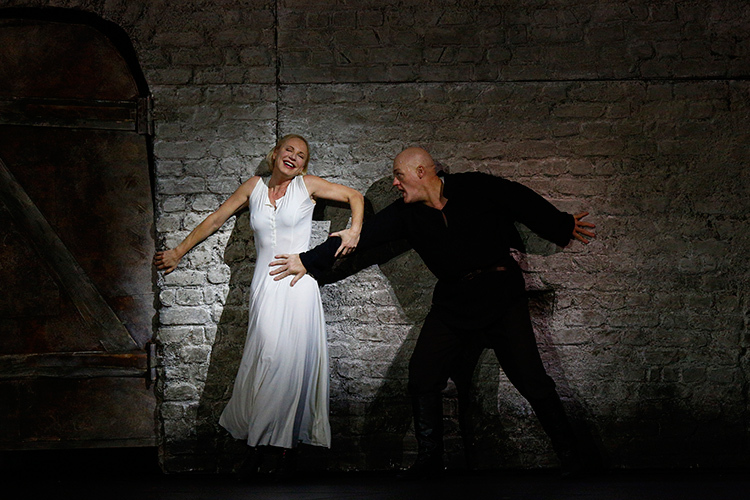
The Bolshoi Theater, as you know, has a long and difficult relationship with the main opera Shostakovich. It is here that she, by that time, is the famous and pueping, with great success, walking several times a week (!) In the Leningrad Malegot and the Moscow Theater named after Nemirovich-Danchenko, who scattered around the world (Cleveland, Philadelphia, Zurich, Buenos Aires, New York, London, Prague, Stockholm), on January 26, 1936) year Stalin. And on January 28, the article “Polbur instead of music” was published in Pravda, which set the bar of new, very stringent relations of power, society and art. Then the opera was called "Lady Macbeth of Mtsensk district." In the USSR, they forgot about her for 27 years.
The mitigated version of the opera called Katerina Izmailov, which arose after Stalin’s death, is the main loss of the symphonic image of the rapid intercourse of Katerina and Sergey, began to be performed since 1963. Not without difficulties, but nevertheless she settled on the scene of the big one: this happened only in 1980 through the efforts of the director Pokrovsky and the conductor of Rozhdestvensky, but without singers of the first row - by that time, rejection of modern music was already firmly formed, which should not be picked up by a voice. It is from the Pravdin article of 1936 that the so far problems are growing in this matter.
The rehabilitated Lady Macbeth was set by Temur Chkheidze in 2004, in the era of the decisive entry of the Bolshoi Theater into the civilized opera world, but the performance did not become an event. And now - a new, only fourth in the history of the theater, the production of this opera, which is one of the most popular of those written in the 20th century. It so coincided that the current premiere celebrates not only the 110th anniversary of the composer, but also the 80th anniversary of the article. Slight calculations, by the way, recall that at the time of the appearance of Sumbur, Shostakovich was only 30 years old.
Without all this painful background, it is impossible to start a conversation about the current production of a large one, the premiere series of which ends tomorrow. It is important that it is placed on a historical scene with an existing new, unofficially called experimental one, that is, progress is evident, Shostakovich is no longer modern music, but a classic.
 © Damir Yusupov / Bolshoi Theater
This time the second edition was taken, that is, the Katerina Izmailova, which was not adopted in the world. For all the visible compromise of such a decision, one should not forget that at this edition Shostakovich insisted at the end of his life that here the choice is not only between free art and art after fear, but also between youth and maturity. Lady Macbeth is beautiful with radicalism of coarse vocabulary and outsidating testosterone, Katerina is more solid in form, which is more courteous to Soviet Puritan mores and, in addition to sexual dissatisfaction, offers to consider other life problems - for example, the childless heroine's childlessness. The ethical conclusion washing the entire previous one, including Katerinin, dirt, is the final choir of convicts, unconditional righteous, sufferers, who cannot be sympathized with, with the last phrase, who stands out from the general choir of the old man, “Is a person born for such a life?”
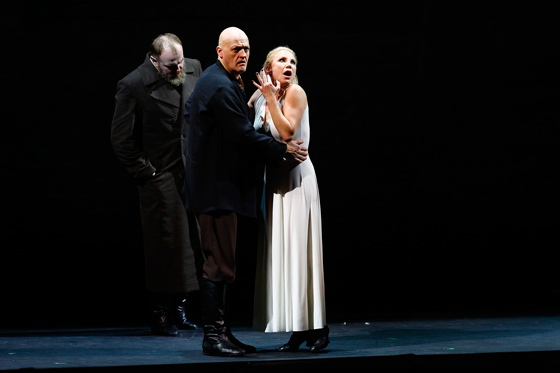
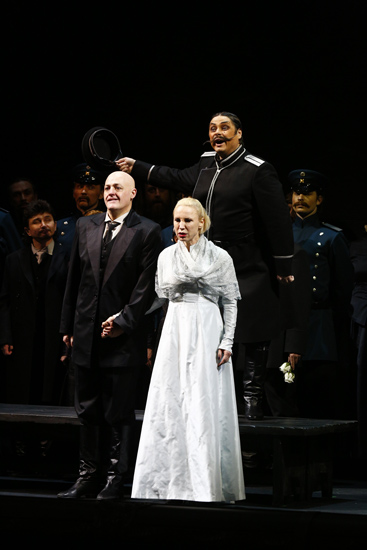
In general, it was this editorship that was proposed for the opera debut to the respected art of the Vakhtangov Theater Rimas Tuminas, and he agreed. The persistence of the Bolshoi Theater experimenting with dramatic directors is rewarded this time. The performance of Tuminas, his assistant in the plastic of Angelica Holina and the scenographer Adomas Yatsovskis turned out to be not about sex, violence and social grimaces, but nevertheless it is very expressive. Group rape, orgasm, flogging - all these awkward in the opera theater are marked without any naturalism, extremely conditionally. Instead of everyday details, smart close -ups, spectacular flow of human matter in mass scenes, especially impressive in the second action. Bright absurd spots appear on the stage either a military brass band, then from where the troupe of conditionally Italian comedians who wandered into this conditionally Russian horror.
The scene is not intelligently cluttered with excess objects-only good taste and verified curvature, white-white brickwork, alarming eye sockets, stylishly destroyed wooden gates. No merchant bed with a mountain of pillows, no fungi with rat poison. But in this space there are fear and existential hopelessness, which the orchestra subtly and tenaciously is the control of Tugan Sokhiev.
 © Damir Yusupov / Bolshoi Theater
And, of course, Katerina herself is a narrow cold core of this space. More precisely - a special substance named Nadia Michael. The Bolshoi Theater made a non -standard move and invited a German singer, known for his magnificent dramatic abilities to his magnificent dramatic abilities, willingly playing bloodthirsty heroines. You can’t make out Russian words, the voice is powerful, but sharp, with a beautiful horror in the orchestra is poorly knitted, but snake flexibility, courage and freedom do their job. We are shown by a new Katerina, rather, the heroine of German expressionism, a relative to Lulu, a woman carrying death, tormented by death, talking all the time with this death. Her main scenes are not with a lover, but with the ghost of the poisoned Boris Timofeevich, with the corpse of the strangled Zinoviy Borisovich and, finally, the almost afterlife final aria about the Black Forest Lake.
She was invited to the role of Sergey in a pair of another luxurious stranger - the Englishman John Dashak, who was Chernyakov’s charismatic Grishka in the Amsterdam “Kitezh” and in about the same image, who moved on the scene of the big one. The remaining participants in the play - their own, they, let's say, make up a good side dish for the main dish.