
Translated material
Echo of Moscow
Following the capital, the game in the "Long Boils" picked up the regions. How to physically destroy the small business with the help of an anti -constitutional amendment to the Civil Code - The New Times was versed
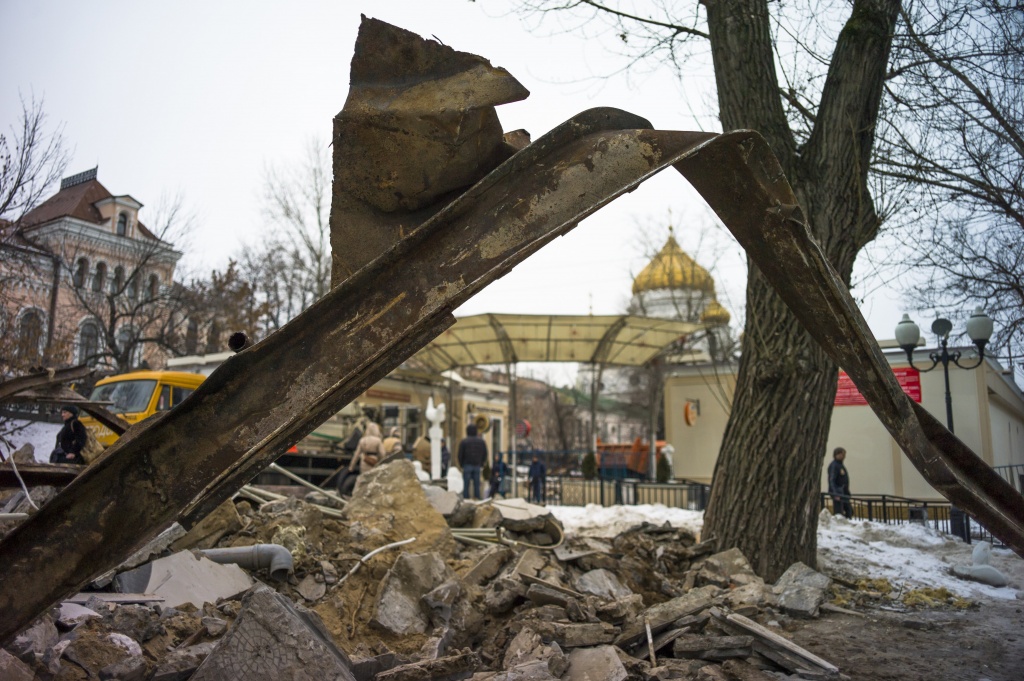
Is there a document on the right of ownership? This means nothing more, Moscow, February 10, 2016
After the demolition of trading pavilions in Moscow was supported by the head of the presidential administration Sergey Ivanov * , the regions picked up the baton. St. Petersburg, Yaroslavl and Kaliningrad promised to demolish 400 “dwells” and “crime seedlings and unsanitary conditions” in the near future, Voronezh-550 pavilions. In Crimea, they promised to “clean” 1 thousand stalls, in Novosibirsk - 3 thousand objects. In Omsk, Yekaterinburg, Kazan and Samara, they also began to fulfill the will from above.
Constitution? Have not heard
“We have one goal. Safe, beautiful, comfortable, modern Moscow. This work requires sequence and determination. Sometimes it raises your questions. I will continue to answer them, ”said Moscow Mayor Sergei Sobyanin, after 97 out of 104 pavilions recognized by the executive authority of self -building were demolished in Moscow (see NT No. 5 of February 15, 2016).
In its actions, the Moscow City Hall relies on paragraph 4 of Article 222 of the Civil Code of the Russian Federation - “unauthorized construction”, introduced on July 13, 2015. According to this innovation, state bodies of local self -government may decide on the demolition of the facility in an administrative manner - that is, without a court decision, notifying the owner and providing him for 12 months to resolve the conflict. The local directive is the decree of the Moscow Government, adopted on December 8, 2015 “On measures to ensure the demolition of unauthorized buildings in certain territories of the city of Moscow”.
The position of the Moscow authorities is as follows: buildings were erected on utilities and over the technical zone of the metro. Not only is it dangerous, but also ugly. Ownership? “Objects were erected mainly in the 1990s with obvious connivance or the assistance of officials,” said Sergey Sobyanin.
“I can imagine this in Somalia, in Bangladesh, in Myanmar, in Nigeria. But in the countries developed from the point of view of the law, this is impossible to imagine, ”says Vitaly Mozharovsky, a partner in the Goltsblat BLP law firm. - The right of ownership is inviolable from the Middle Ages. If we assume that the mayor of the Western city allowed himself what Sobyanin arranged for himself, he would not have sat in the mayoral chair until the morning. ”
A source that is well familiar with the device of the Moscow City Hall is sure that everything rests against the personal attitude of Sergei Sobyanin to small businesses. “He has a fad,” he said NT , “he does not like small business. He has a squeamish-indivisible attitude towards him: Sobyanin considers all these tents and kiosks-a source of dirt and unsanitary conditions, while taxes from them are shish: migrants from which there is nothing to take. ”
“Among the so -called owners there are people related to crime,” Sergei Sobyanin writes on his page on the VKontakte social network. Now that the pavilions are demolished and the income of entrepreneurs is actually destroyed, the mayor of the city invites them to sue.
However, at least half of the objects destroyed in the “Night of Long Buckets” (by the way, this is what the article on the capital’s demolition in “Evening Moscow” was called - the journalists did not feel the trick in the historical allusion), and had registered property rights, 27 objects had court decisions on the absence of universal construction. However, the Moscow authorities did not stop this.
“I can imagine this in Somalia, in Bangladesh, in Myanmar, in Nigeria. But in developed countries from the point of view of law, this is impossible to imagine "
“In fact, the mayor of Moscow took over the function of the judiciary, although the real judicial power was on the side of the owners, not the mayor,” comments the lawyer Mozharovsky, “if you had doubts that the documents were received by fraudulently, go to court, find out, prove that it was created for this! But they lost all the courts. "
“It was necessary to initiate production on the illegal behavior of former officials, to prove the illegality of their actions, to punish them,” comments Elena Lukyanova, a professor at the Faculty of Law of the Higher School of Economics, comments on the position of the Moscow government. - If there were doubts about the court decisions - let's say that they were made maliciously, then we had to go and punish the judges. Nothing would have happened from the fact that this process would last a year, two or three, as in other countries. But society would understand that everything was done by law. ”
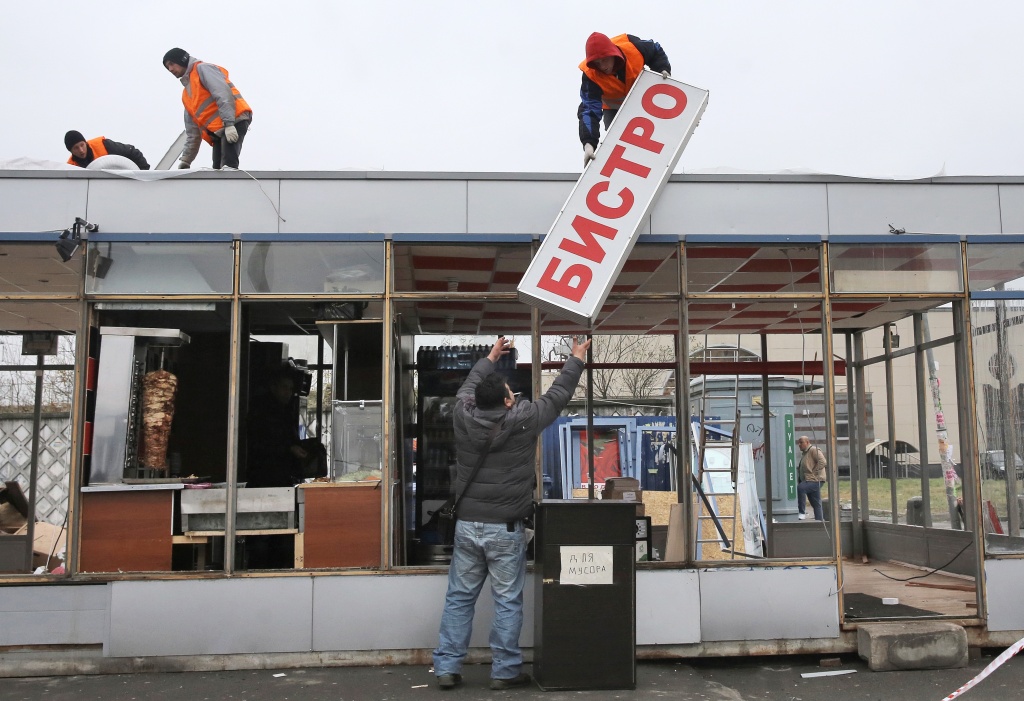
In St. Petersburg, the national course began to execute last year, November 16, 2015
Professor Lukyanova - by the way, is one of the most famous constitutionalists of the country - I am sure that amendments to Article 222 to the Civil Code contradict Article 35 of the Constitution of the Russian Federation .* Therefore, everything that was made under the cover of the Civil Code is illegal. “Our officials do not know how to read the constitution and do not want to do this. They have an obedient parliament, which they actually forced to transform the law for the sake of their momentary “Wishlists,” says Lukyanova. She believes that protection can and should be sought in the conditions of the constituency, where it will be proved that amendments to the Civil Code contradict the basic law of the country and encroach on norms that cannot be crossed out by any amendments to the Civil Code - unless, of course, "the CS does not bent under pressure from power."
“You can give any arguments as much as you like: someone may like the demolition of stalls, someone does not. But the fact that the extrajudicial action is legalized once again confirms the doubtfulness of the Russian Federation as a legal state, ”says Lukyanova. - Assignment will go throughout the country. And tomorrow it will spread to everything else. ”
Catch up and overtake the capital
The same scheme is used by officials from other cities. And it is still unknown, Moscow set the trend, or vice versa, adopted regional experience. For example, in Omsk a local document providing for the pre -trial liquidation of “self -building” was adopted on January 30, 2014.
“As a rule, in such cases we are talking about partial or the complete absence of permits. Typically, stalls and kiosks are exported using auto crackers and trailers to penalties, ”Oleg Vetrenko, deputy head of the Office of the Property of Omsk, told NT . Capital construction projects, the official assures, are eliminated only by court decision. Of the 25 objects declared last year, half was dismantled.
“We connect the prosecutor’s office, conduct checks of the legality of registration on such objects of property rights, which were often purchased according to“ crooked ”schemes in the late nineties and early zero years,” says Vetrenko, “there is a lot of fake documentation.”
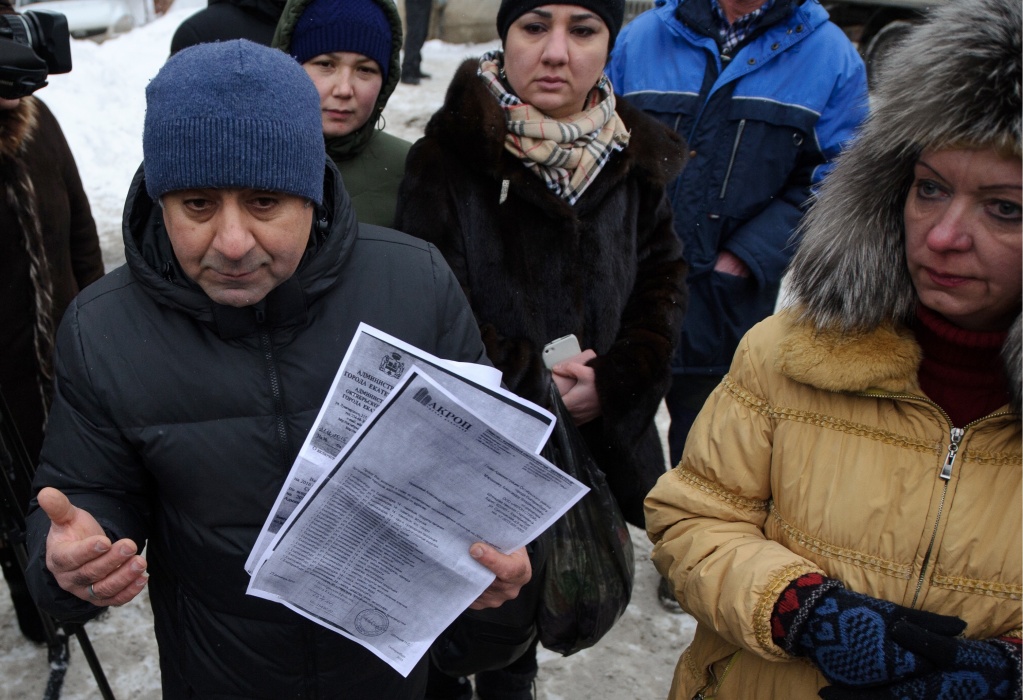
Ural entrepreneurs are trying to prove during the Raid of the authorities: their business is legal, Yekaterinburg, February 3, 2016
According to him, in 2013, about 300 “Templar” were discovered, in 2014 - 310, and until May 2015, another 111. Vetrenko looks positively to the future: “The developed practice gives hope that this year it will still be possible to increase the indicators.”
St. Petersburg is also ready to become a leader in the field of strangulation of everything that is trying to survive outside state institutions: if 150 self-buildings were liquidated in 2011, then in 2016 the authorities plan to dismantle 1.5 thousand objects. True, for some reason they refer to Articles 12 and 14 of the Civil Code of the Russian Federation.
“The process will occur systematically, 3-4 objects daily. Since the beginning of the year, almost 100 such points have already been dismantled, ”says Maxim Vorontsov, an official representative of the Center for increasing the efficiency of the use of state property (CPEIGI). -Imagine, for example, that in your home some persons will open a store without your permission and begin to trade in alcohol. In such a situation, you have the right to self -defense. St. Petersburg enjoys the same right. ”
According to the official, at first, the lawsuit from entrepreneurs poured one after another. The court “in the course of open and honest processes made decisions in our favor,” says Vorontsov. When the court did not help, entrepreneurs tried to defend differently. Or, as the representative of the CPEIGI says, "other cases of counteraction happened: for example, our employees received threats to physical reprisals." During the liquidation of small businesses in St. Petersburg, not a single employee of the Central Department Store was injured: as Mikhail Vorontsov said, there were attempts to violence, but the employees were well prepared, many of them used to serve in power structures ...
“Officials will have the opportunity to take the bribe, choosing which kiosks to demolish,” said Sevastopol entrepreneur Oleg Nikolaev
In Sevastopol - the capital of Crimea, they also want to be in trend: out of 3.5 thousand tents and stalls this year, they are going to remove 1 thousand “self -building”. In the south, they decided to combine the metropolitan legislation and Siberian methods: “Non -capital self -buildings, unauthorizedly placed on the lands of the city, are very many in Sevastopol today. They are dismantled or transferred to a specially designated site in a pre -trial manner by decision of the interdepartmental commission, ”said NT Roman Shaposhnikov, head of the land control department of Sevastopol. Officials who have recently met Russian law are eager to fulfill the plan. Entrepreneurs who created their business according to Ukrainian laws, and now learn about Russian law enforcement practice, experience a slight jolly: it is legally impossible to get land in Crimea - all competitions are suspended. “The authorities did not collect entrepreneurs and did not offer them any alternative - options to rebuild their property or move it to another place. Moreover, officials will have the opportunity to take the bribe, choosing which kiosks to demolish, ”says Sevastopol entrepreneur Oleg Nikolaev. A month ago, he decided to launch a network of food tracks-mobile points of food in Sevastopol. It was not possible to agree with the authorities. (By the way: three years ago, exactly the same network tried to open the same network in Moscow: they say that the mayor of Sobyanin said his firm no.)
“You come to the department, and the boss says: there is no land,” says Sevastopol Nikolaev NT correspondent, “and that which appears is illegal. I agreed with the shopping center, but in the last week we passed after eight checks. While holding on. ”
The restaurateur called his street food network “wolves and sheep”.
* On February 11, 2016, Sergei Ivanov said: “These vipers have nothing to do with the so -called small business, since, as a rule, they are crime seedlings and unsanitary conditions,” Interfax.ru said.
* Article 35 of the Constitution of the Russian Federation reads: “The right of private property is protected by law. No one can be deprived of their property other than by court decision. Forced alienation of property for state needs can be made only if preliminary and equivalent compensation can be made. ”
Photo : Svetlana Kholyavchuk/Interpress/TASS, Donat Sorokin/TASS, Alexander Zemlianichenko/Ap Photo