
Translated material
White on black
Theater.doc celebrated his birthday and showed several sketches of future premieres in honor of this at once
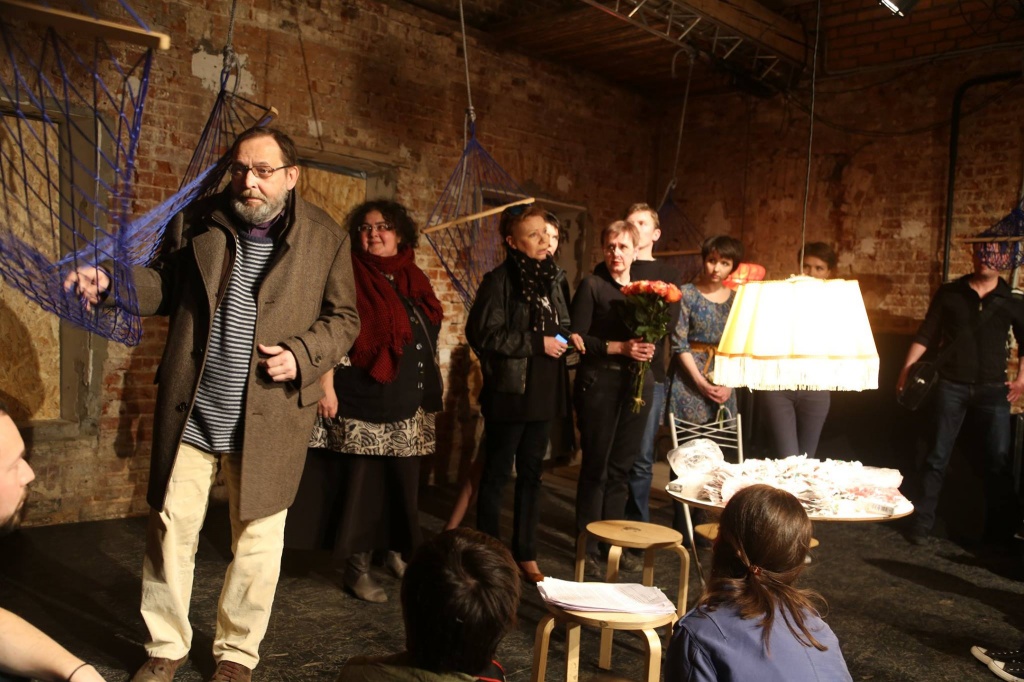
Theater leaders.doc Mikhail Ugarov and Elena Gremina at the premiere of the main performance of the fourteenth season - “Swamp business”, May 2015
The fourteenth season in the biography of the theater.doc turned out to be the most dramatic, but could be the last one: during the year the theater was twice expelled from the rented premises, its leadership was called to the prosecutor's office, where they invariably threatened with fines, sanctions, and closing. The theater was desperately fought for life, the artists and spectators dragged garbage together, painted the walls, stood in the patrol. Over the year, 12 prime minister was released and a children's studio was opened, classes for students of correctional schools and charitable performances in boarding schools, hospitals, orphanages continued. The theater has not a penny of budget financing, there is no wealthy patron and no administrative roof: they pay for the rent, communal apartment and production of the performance themselves. During this year, theater.doc practically acquired the status of a social movement, the principles and goals of which were formed by themselves: freedom from a compromise, freedom from the conjuncture, freedom from an official, freedom from hypocrisy.
Unsheated
Entering the anniversary 15th season, the theater confirmed its imperfection with the authorities. Of the six premieres declared at the Ealman “Hunt for Reality”, five are on taboo topics, to which state cultural institutions are afraid to touch. “To get out of the cabinet”-the stories of camming outs based on an interview with Russian gays of different ages and professions, each of them came out “from the closet” in his own way: someone alone, someone publicly, someone on tiptoe, afraid to cause the anger of relatives. However, not a single camming out was relief for heroes, all of them are still doomed to life outside the law or underground.
“Are you scared? You have already said to the article! " - The audience is worried after watching. "Will there be about lesbians?" - Female scream from the gallery is heard
This inner dumbness, a constant habit of living with an eye, eternal fear of being caught by neighbors, cops or just colleagues at work gradually deprive a person of the meaning of life, turning his existence into an endless chain of humiliation. Deadly tired, devastated people are deprived of the right to be themselves. “Are you scared? You have already said to the article! " - The audience is worried after watching. "Will there be about lesbians?" - A female scream from the gallery is heard. The hall laughs. The artists and director Nastya Patlai laugh from the closet. And it’s not so scary.
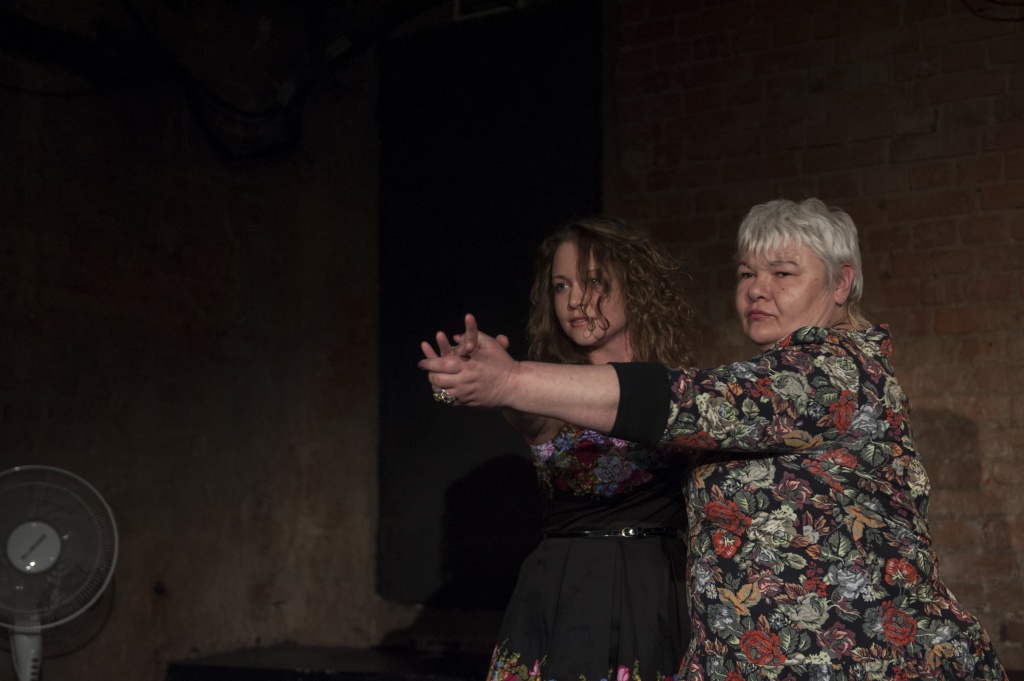
“Who wanted to about lesbians? Please!" - Marina Kleshcheva and Alina Ponomareva in the project "Two are not needed for tango"
Do not clap
“Diary from Lugansk” - the revived pages of the real diary, which was sent to the theater by its author, an ordinary peaceful entrepreneur who ended up at the epicenter of war. The manuscript came by Samotek, by mail right into the hands of the theater director Elena Gremina. Dmitry Bel, a resident of Lugansk, kept his diary since November 2013. These are a person’s notes whose psyche resisted the meaninglessness and chaos of war, a man who did not lose the ability to compassion and did not allow himself to draw himself into the logic of war. The internal resistance to mass madness retained the author of the human appearance and kept it from the noble rage, which distorted the image of a whole nation. Exploded streets, a crunch of broken glass, the horror of ringing silence, a burning puppy tied to the pillar and the inscription with a chalk on the door of the entrance “Do not clap! Scary!"…
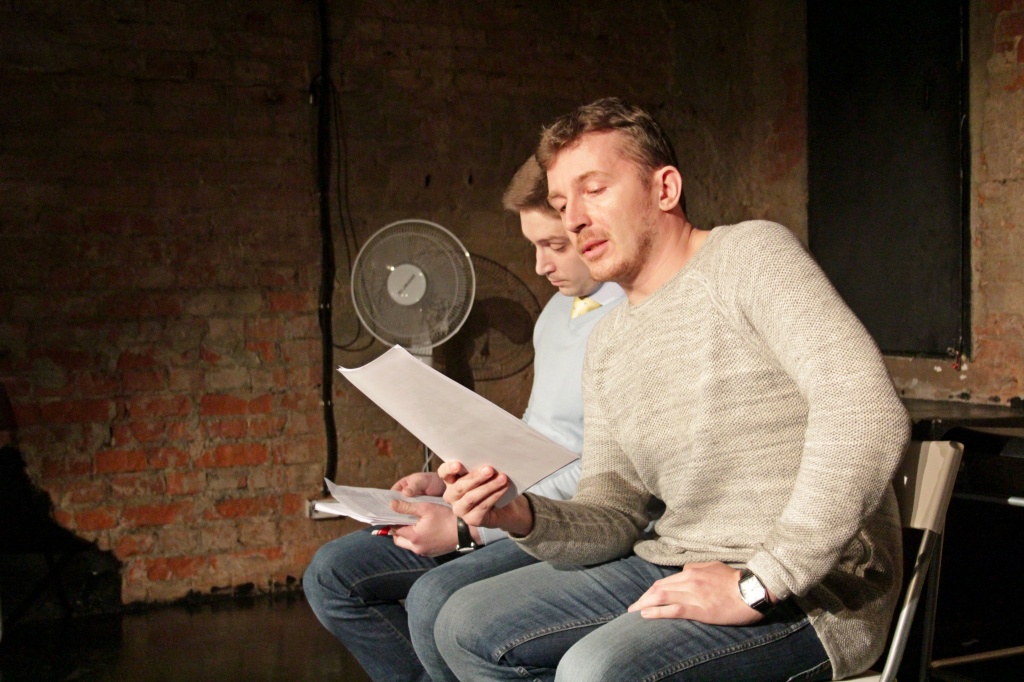
"Diary from Lugansk" came to the theater by mail, this is the real diary of a resident of Lugansk, who survived the war (actors Konstantin Kozhevnikov and Alexey Ovsyannikov)
In the hall was a woman from Lugansk, who fled from the war. Barely restraining her tears, she said that this scene literally returned her to the streets of her hometown, where she would never fall again, that her father’s grave remained in the Lugansk cemetery. And the next day she sent a letter to Gremina, in which she proposed her help in creating a play: “If you need to practice the actors to the Donbass accent, I will be glad to help. I will approach, remember how it was, we’ll “get a batch” a little.
The Ukrainian theme for theater.doc is one of the central ones. Texts, readings, evenings with the participation of Ukrainian playwrights, the semi -underground tour of the leader of the Ukrainian documentary Andrey May with the play “ATO” is not so much a conversation about the topical as a consistent denial of the front -implanted front line. Therefore, another coming premiere of the new season is Gremina’s documentation about the process over Oleg Sentsov and Alexander Kolchenko under the code name “Lifefield”. The engagement returns us during the "apartment" - they will play it at private squares rented for a party. She was invented as a game with a spectator, starting with a direct appeal to the hall: “Tell me, who has eggs? Raise your hands. Who considers himself a man? "
Total adoption
The star of Doca Marina Kleshcheva, the former prisoner and heroine of the camp of amateur performances, debuts as a full -fledged author: in the play “Two is not needed for tango”, she is a playwright, a director, and a leading role. “Who wanted to about lesbians here? Please!" - The peppy bass spreads through the hall. She goes to the platform, hugging a fragile girl in a colorful dress behind the waist: neither give the heroine of the famous "Soviet Lesbian" Yuza Aleshkovsky. The story of female love in a colony, defiantly frank, performed by a rude and deprived of all sorts of complexes, Marina collapses on the audience with a piercing confession of loneliness - absolute, deaf, unbearable. A person tears himself out of him, as from a viscous disastrous mud, panicky clutching any support - a female ankle, a male fist or a stone grown into the ground. In real life, Marina keeps a theater afloat. She writes plays, poems, composes songs, in her native Serpukhov organized a branch of the Doc and convinced the local administration that such a theater was necessary for the city. On the Moscow scene, she is already releasing the third performance, and each of them was born her past, which she turned from a nightmare into a source of inspiration by the power of her imagination.
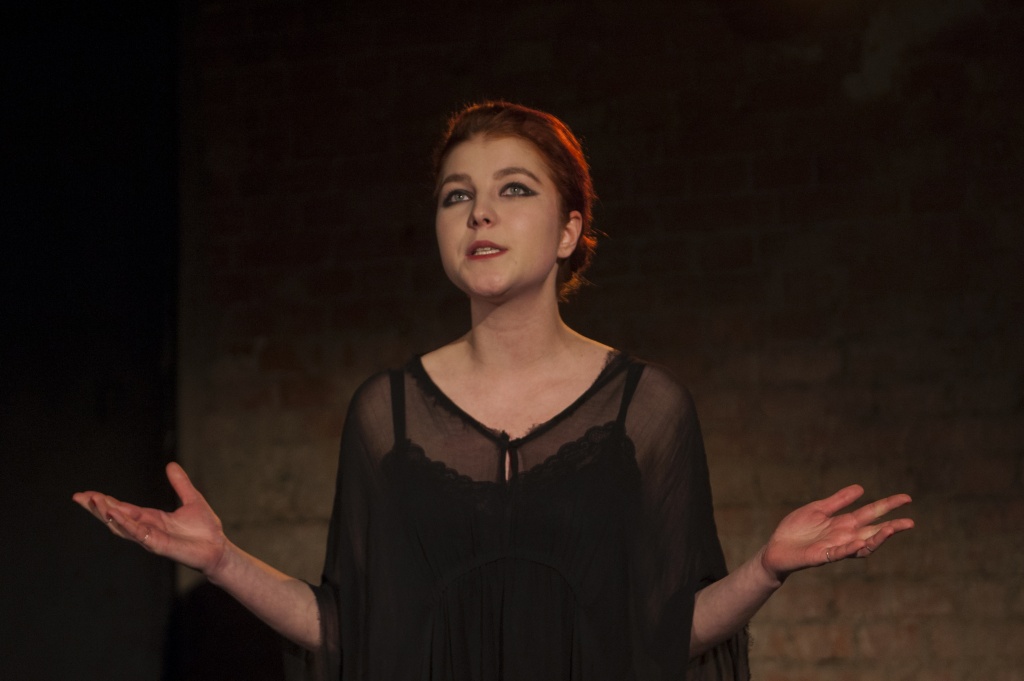
“Odinoi in Izmailovo” - the heroine of the play by Emilia Kazumova (actress Anastasia Slonina) fled here from Dagestan
Spectators have always been an integral part of the dock projects, and the discussion of the performance was the necessary last act, the same gun that is obliged to shoot. After fragments from the future play “Orphan”, the hall was shaken by a real cannonade, this story was so excited for the audience. The text for "orphans" writes, based on his own observations, the social psychologist Artem maternity. The play contains the history of the return of adopted children back to orphanages hidden from public eyes. The statistics of "returners" are not a very popular topic for discussion. Having adopted the inhuman anti -Sirot law of Dima Yakovlev, deputies and officials announced a course for "total adoption".
The heroine appears in the features of Russian deputies and officials broadcasting from TV screens about how mercifully Russian society, who does not give up their orphans and centuries -old family values
“Orphan” is a drama about the clash of two worlds, family and orphan: about how love is expounded by hatred, about misunderstanding, about monstrous egoism. The performance has been waiting for its incarnation for several years, but it seems that now in the episode presented by the public the necessary intonation has finally found - thanks to actress Olga Lysak. The adoptive mother, refusing the child twelve years after adoption, initially gives the impression of a woman desperate, bewildered, deeply suffering from awareness of her own guilt. We will not find a monster sitting inside this ancient beauty, as we do not immediately notice changes in her vocabulary: from “pray for her” to “everyone has died, her parents”, from “I am guilty, I can’t cope” to “she is inferior, it must be hidden from people”. The entire gallery of today's official triumphs for orphaned well -being is reflected in the Porcelain Face of the heroine Lysak. The features of Russian deputies and officials broadcasting from the screens of TVs about how mercifully Russian society, not giving out their orphans and its centuries -old family values from the screens, appear in it.
The world is against the war
The final application of the Dokovsky almanac was the sparkling monologue of Dagestan, who had come to Moscow, who escaped from the unloved husband and his relatives. The performance “Odinka in Izmailovo” based on the play by Emilia Kazumova is put by Zarem Zawdinov, a student of Marina Razbuzhkina and Mikhail Ugarova. Zarem - originally from Barnaul, half a Chechen, she walks in a black dress, in black tights, on which the ankle is slightly rudely and largely embroidered with white threads: “*** War”. Zarem and her actress Nastya Slonina are participants in the anti -corruption clip Pussy Riot "Seagull". This Pankovsky enthusiasm is the key to unlimited freedom, turning the actress almost into a witch, into a red pan, which descended from the Caucasian mountains, an angel of revenge, sweeping out in her path everything that can cause her mental pain.

The project “Leave the cabinet” is the daily life of Russian gays who decided to caming out (author of the play and actor Valery Voronetsky)
The artistic director of the theater Mikhail Ugarov did not say speeches that evening. Last year, as if drove a rink along it. Ugarov has just turned sixty. All his conscious life, he stubbornly went to his theater, and by the beginning of the new century he achieved his own. Michael built the theater that he dreamed about - they do not play, do not lie, do not hypocritize, do not please. This theater is able to change the very nature of man, as a sensitive psychoanalyst changes the course of the disease, an hour after an hour, pronouncing all his pains, reflection and fears with the patient. Ugarov does not like when the dock is called the “political” theater, emphasizing its acuteness and social problems. It seemed that it was precisely for this that the Theater was disliked in the bureaucratic offices, for this they mobilized the entire royal cavalry, led by the prosecutor’s office and the Ministry of Culture. But the point is not in politics, but in dialogue with society. Theater.doc exists so that it does not lose the ability to distinguish black from white.
Photo: Andrey Vermishev, Maria Botheva, Facebook.com/lena.gremina