
Translated material
Iranian dilemma
After the breakthrough agreements on its nuclear program, Iran seems to prepare another surprise to the world: reformers can win the first time in the parliamentary elections on February 26. The pre -election alignment and post -grade prospects analyzed The New Times
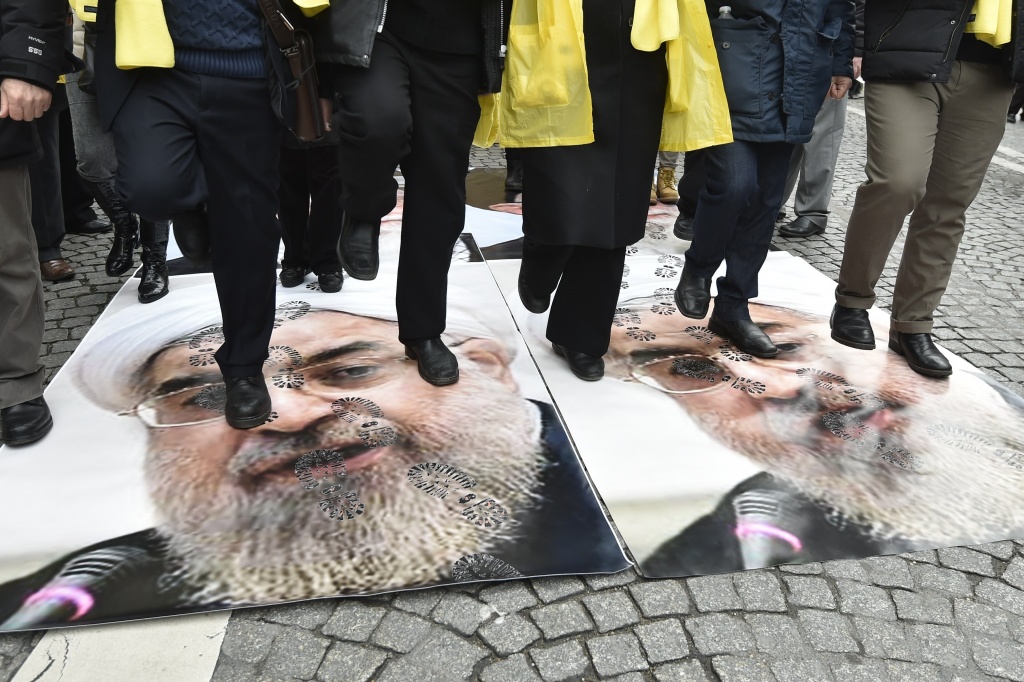
Iranian emigrants in Paris dance on the portrait of Iranian President Hassan Rukhani, protesting against torture and death sentences in Iran. The picture was taken during the official visit of the Iranian President to France January 27, 2016
Initially, more than 12 thousand candidates were registered in the elections in the 290-seater parliament (Medzhlis), of which 11% were women. On February 16, the final lists of those who were admitted (this is a keyword!) Were made public - 6230 lucky ones, that is, 21.5 people to a deputy place. All candidates went through a sieve of the Supervisory Board (NS) - one of the key bodies in the Iranian theocratic hierarchy (see scheme), which has the right to withdraw anyone. True, judging by reports from Tehran, the sieve was first filmed by representatives of the reformal camp and in general everyone who, according to the NS members, was associated with the events of 2009 ** and may turn out to be the “American fifth column”.
Spare option
Today, the reformists and moderate in Iran are united around the President Hassan Rukhani, who, after 2.5 years after his election, succeeded that no one could do before 12 years: to conclude an agreement with the world community under the nuclear program of Iran, releasing the country out of the burden of the most severe financial and economic sanctions. Rukhani and his team applauded almost all Iran. By the way, in the conservative camp, whose mood is considered to be Ahmad Giannati, the head of another most important theocratic body - the Council of Guardians, no one doubts that the relief of sanctions is a benefit for the country. Steaming in another: what to do next.
Reformers act rather as defenders of business interests of groups close to the government and the president and aimed at diversifying the economy. The fundamentalists are based on the support of the Islamic Revolutionary Corps (Xir), which, in addition to the regime, is trying to control the key sectors of the Iranian economy and is concerned about the preservation of their dominant position. It is clear that the xirir will simply not give in to control over parliament.
Initially, the Supervisory Board removed 99% of the candidates from the coalition of moderate and reformers (out of 3 thousand registered only 30 people), rejecting the candidates and many famous Iranian politicians, including those included in the country's political and religious elite. This caused a storm of indignation, many “rejected” candidates appealed their screening. As a result, the NS had to make concessions: 25% of those who filed an appeal were returned to the lists. By the way, the leaders of the reform camp foresaw the possibility of removing their most significant candidates. And therefore, a spare option was prepared in advance: they used little -known candidates during the election campaign, which were recorded either as independent or as representatives of professional, female and social structures.
Interference or help
For President Rukhani, the current Majlis, in which most places have fundamentalists, was a serious obstacle to many of his initiatives, including, by the way, an agreement with the international community under the nuclear program. Therefore, Rukhani is directly interested in the success of the reform camp in the elections on February 26.
But the Supreme Leader of Ayatollah Khamenei, apparently, counts on another outcome of the vote. Not only does he need a certain balance of the opposing forces, which allows effectively manipulating both, Khammeni clearly sympathizes with the current, conservative Majlis. Hence his recent statement: “The parliament that resists enemies in nuclear and other issues, boldly, independently and freely voices the position and words of the people, is fundamentally different from the parliament, which, according to various problems, repeats the words of the enemy.”
Fundamentalists have their own problems. Most of their candidates for Mejlis belong to the most radical wing. This caused the discontent of the moderate conservatives and, in fact, split the fundamentalist camp. However, the election results largely depend on the turnout: if its threshold approaches 70%, supporters of the government and reformers will receive a predominant number of votes. But the low turnout - about 50% - is fraught with their defeat.
According to the latest sociological surveys, reformers together with the forces supporting the Rukhani government will be able to get at least 30-40% of the places in the new Majlis, fundamentalists-20-30% (moreover, no more than 5% of this number) will take the remaining 30% of the places for independent candidates. In this situation, the key role will be played by what camp will end up with independent.
Who will choose the successor
This year, for the first time in the history of Iran, the elections to Majlis will be combined with elections to the Council of Experts (SE) - another most important theocratic institution, which, according to the Constitution, is vested with the right to control the activities of the Supreme Leader of Iran, and in the event of his death to choose a new one. According to many observers, the Elections in the SE, which consists of 86 people with a 8-year term of office, today acquire no less, but rather even a large role than the elections to the Mezhlis. The advanced age of Ayatollah Khamenei (76 years) and far from the perfect state of his health (oncology) make it possible to build the most diverse versions regarding the future of the Iranian leader. It is possible that choosing his successor is just a new composition of the Council of Experts. So for the forces opposing in Iran, it is simply necessary to have an advantage in this body.
Candidates for experts Council registered many famous religious figures representing the moderate wing of the Iranian establishment, including the very popular grandson of the founder of the Islamic Republic of Iran (Iri) Imam Khomeini Khojat-Ol-Eslam Hasan Khomeini. In his speeches, he repeatedly spoke of the need for greater democracy and openness of Iranian society. However, after a massive political attack by Orthodox, Hassan Khomeini, to the surprise of many analysts, was removed from the elections.
Two paths
In case of success of the fundamentalists on February 26, the restoration of the full -scale relations of Iran with the West (including with the United States) will be challenged. It is possible that the emphasis in Iranian politics will be made to strengthen ties with Russia, China, India and the countries of Southeast Asia. There will be difficulties in fulfilling Iran with the requirements and conditions of the “nuclear agreement” that it will exacerbate his relationship with the UN. The propaganda rhetoric against the West and Israel will intensify. As a result, Iran, albeit in a significantly softer form (nevertheless the head of the executive branch remains the president-reformer), will return to the time of the radical Akhmadinejad (2005–2013).
And on the contrary, the victory of the reformers will give the mandate to the President of Rukhani and his team to more active modernization of the society, further steps to withdraw the country from isolation. Of course, in this case, the main political and trade and economic track will be laid to the West.
Judging by the surveys, most voters, especially in cities, approve of the activities of the reform office and are ready to vote for his policy. However, to predict the results of the elections in Iran is an ungrateful occupation. Too many incoming factors can affect their results. The East is the East.
*Alexei Talyzin took part in the preparation of the material* * Dunaeva Elena Viktorovna, candidate of historical sciences, S.N.S. Institute of Oriental Studies of the Russian Academy of Sciences.
Sazhin Vladimir Igorevich, candidate of historical sciences, S.N.S. Institute of Oriental Studies of the Russian Academy of Sciences, professor.
** In June 2009, the opposition forces, disagreing with the official results of the presidential election, whose winner was announced Mahmoud Akhmadinejad, organized mass protests in the largest cities of Iran, which were brutally suppressed by the authorities.
The victory of the reformers will give the mandate to President Rukhani and his team to more active modernization of society, further steps to withdraw the country from isolation
Dossier
All the full power - spiritual, state, political and military - in the Islamic Republic of Iran (Iri) is the Supreme Head (he is also the head of the Shiite community, he is also the Rachbar - the political leader and the supreme commander in chief). At the same time, the Iri Constitution proclaims the division of powers into three branches: the legislative (single -palative parliament - Majlis), the executive (the president elected for four years, heads the government - voters in the presidential election elect, in fact, the head of the Cabinet of Ministers) and the judicial board, the head of which is appointed by Rachbar and is only responsible before it). IRI’s election law provides for universal suffrage (including women), direct and secret voting on a proportional basis, the lack of property qualification. All citizens who have reached the age of 18 have the right to elect.
Quote
“When the lists of candidates are brought to me, I often do not know most of them, but I trust people who conduct the selection. If I see that the candidate is a religious person, a person’s religious revolution, I believe him, but if I see a person who does not care about the country's revolution, religion and independence, or if he is going on to the United States or their allies, I do not trust him. I think it's right! " ( Ayatollah Ali Khamenei , Supreme Leader of Iran )
The relationship of various authorities in Iran
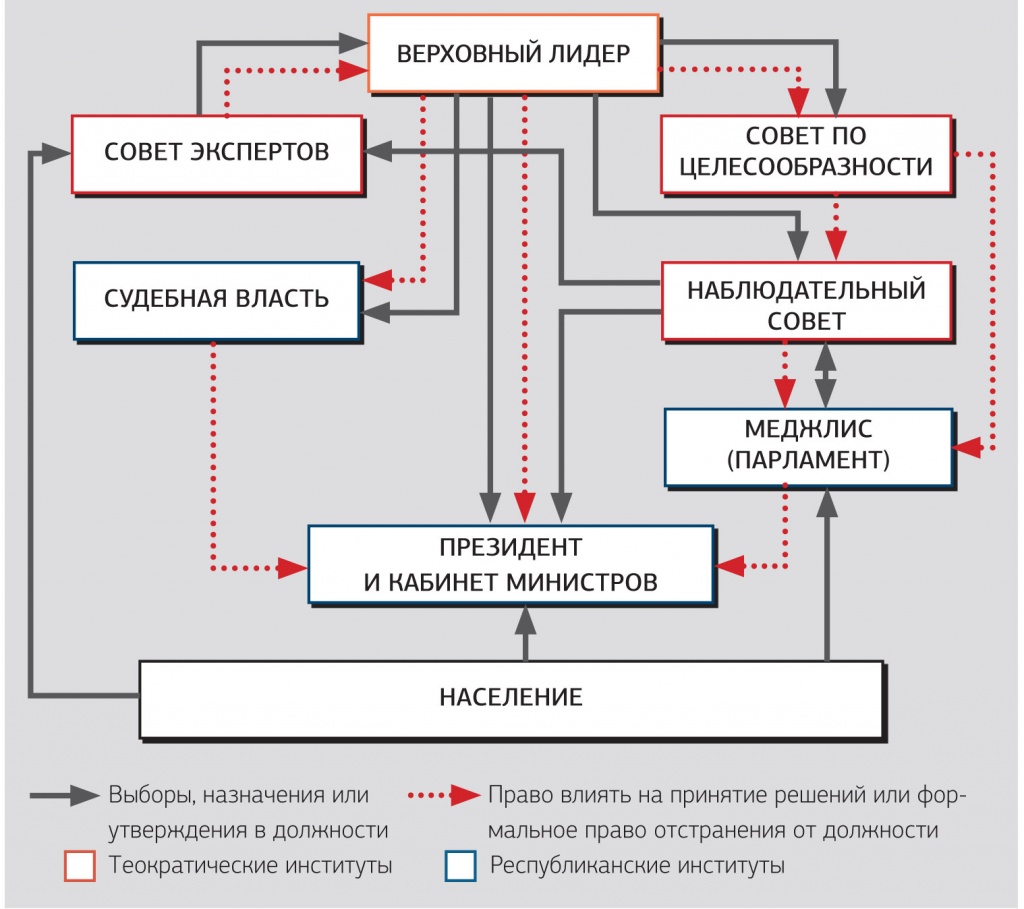
Source: Institute of Oriental Studies of the Russian Academy of Sciences, February 2016
Comment
Nadi Naimati, *graduate student of Tehran University, Civil activist *** :
“These elections to Medzhlis are another imitation of a democratic will. All candidates were pre -selected by the Council of Guardians. Personally, I am not going to participate in this performance. I well remember the protests of June 2009. Then the presidential candidate from the opposition, the world Hossein Musavi embodied people's hopes for changes, and many students followed him, the ultra -conservator Akhmadinejad was on the other side. The election day was the worst in my life. Almost from every city there were reports that Musavi was winning, but television, and 7 hours after the closing of the plots, announced that Akhmadinejad won. Two days later, the authorities blocked social networks and began repressions: the disagreements with the victory of Akhmadinejad were caught, put in prisons, tortured and killed.
In the next elections in 2013, many young Iranians voted for the “candidate for reformists” by Hassan Rukhani. And I did not go to vote. When Rukhani won, many rejoiced, although it was clear that the result was predetermined in advance - the victory of Rukhani then wanted Ayatollah Hameni ... If the supporters of Rukhani win the elections to Majlis, then this was again allowed Hamenia.
I had a very close friend, she was shot at the beginning of 2010 at a demonstration in Shiraz. The family was not even informed about the burial place. After that, I hated myself for drawing her into politics. Today I have no desire to do something for Iran. ”
* Khojat-Ol-Eslam-one of the highest Shiite religious titles, a rank below Ayatollah. Approximately corresponds to the bishop in Christianity.
** The surname of the Iranian activist at her request has been changed.
Photo: AFP/East News