
Translated material
Scientific as a zone of internal emigration
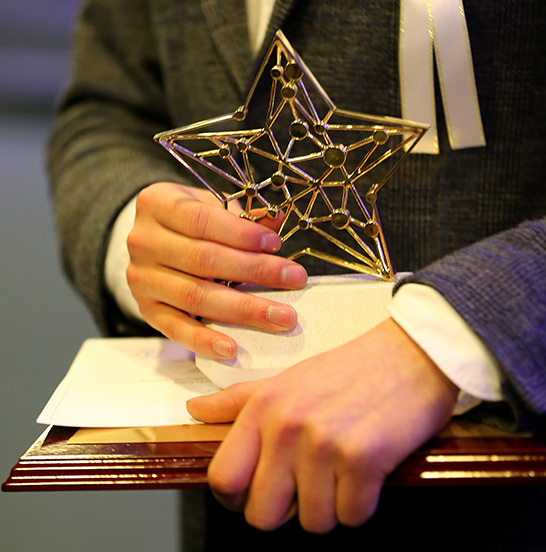
On February 8, the Moscow International International House of Music was awarded the winners of the II All -Russian Prize "For Fidelity of Science", established by the Ministry of Education and Science of Russia. According to the leading ceremony, the main goal of the new award is “encouraging the best journalists, scientists and public figures who have made the most noticeable contribution to the popularization of Russian science and building a dialogue between the state, the general public and the scientific environment”.
The Prize of the Ministry of Education and Science “For Fidelity of Science” is awarded to the best popularizers for the second year. But even during this short time, so many mutually exclusive things have occurred in the field of scientific, which in itself leads this area beyond the framework of traditional specialized journalism.
Scientific journalism and popular science projects and actions have become such a noticeable phenomenon in our intellectual environment that even those who are far from the sphere of science turned to them.
During one year, first to Dmitry Zimin, the founder of the Dynasty Foundation, the Minister of Education and Science gives a special prize for philanthropy and support for science, and after nine months the fund that has worked with incredible efficiency of ten years is closed in connection with the assignment of a foreign agent’s status to him. And a month later, an opposition bomond gathers at the ceremony of the Enlightener Award, founded by the same Dmitry Zimin.
Over the year, the video of the popular science blog of Evgenia Timonova “The Beastal Oscille of Patriotism” was watched by more than a million people. This and other videos of her blog “All like animals” become viral videos.
Russian publishers, largely thanks to the same “enlightener”, ceased to be afraid to release the scientific and book of Russian origin, and the books of Alexander Markov, Elena Naimark, Asi Kazantseva, Alexander Panchin, Alexander Sokolov, Elena Kokurina took honorary places in the best bookstores in Moscow.
In Moscow, several children's and adult lectures work at once, where famous scientists act.
Festivals of Koletes science around the country. Youth in the nightclubs of Peter, Samara, Tomsk, Novosibirsk gather for scientific battles.
In just a year, three original online projects “TASS” took off at once. The attic ”,“ Arzamas ”and“ N+1 ”, somewhat squeezing the leaders of the already familiar -“ Gazeta.ru ”,“ Elements ”, etc.
Several festivals of popular science cinema are now included in the program Russian films.
The market is developing so violently that when the acceptance for the Ministry of Education and Science of the Ministry of Education and Science was opened, about 200 potential nominees were received in the organizing committee. As a result, after the vote, it turned out that the composition of the short lists of last year and the current one was practically updated.
The bright and noisy life of a scientpop requires reflection and therefore becomes a separate topic of round tables, television programs and conferences.
The state corporations have separate budgets for the development of scientific communications, and now the boys in fitted jackets and girls in narrow corporate skirts, who did not know about two years ago how the magazines “Nature” and Nature are distinguished by these round tables and conferences of the presentation with the reviews of the popular science press and urge scientists to start “more better society. "
All this happens against the backdrop of difficult events in the Russian science itself. And even more so, politics. And here the question arises: why, in fact? Why do state money go to scientific? Why - private? Why do parents lead their children to natural science museums? Why do scientists go to popularization? Why did the unprofitated media and even federal channels be happy with this type of severe specialized content?
Apparently, because scientific popularization still remains a zone of unconditional general good. For example, the scientific policy in Russia is directly tied to the characteristics of domestic policy and is rooted again in the personnel of the country cooperative known throughout the country. And therefore, any attempts to do something reasonable in science is often drowning in the lake. In the literal and figurative sense. Conversely, any expenses on the actual scientific projects can be criticized with any of the parties opposing science.
Any action in the field of history, art, theater, and cinema is right away in ideological and aesthetic contradictions. Whatever movie you now shoot, you are either against Medinsky, or for. And the critic who writes a review of this, he is also either.
But to talk about the achievements of science in general, on behalf of mankind as a whole is quite safe. For everyone. For journalists, for the heads of these journalists, for corporation managers, for officials, for parents and children, for citizens who have no place in public or economic life. For those who are pushed out by the bored intellectual or corporate environment.
All parties agree about scientific and that this is important and necessary. The market is growing, different segments of the audience are growing. And a person who wants to earn money with an intellectual, but honest labor, has where to go.
Does this mean that the heyday of the scientific and in Russia is in the nature of a temporary misunderstanding? I think yes. Wherever the vector of the development of our society in the future turns, the scientific popularization awaits the decline. Either political isolation and the economic crisis will become tougher, the country will become less in the country with the state and individuals and everyone will not be together. Or the country will return to the early market and intellectual freedom of the beginning of the 90s, and then art can be developed, journalism in other areas. And the scientist will fade into the background.
A strong scientific scientist is a prerogative of developed countries where people live at the peak of the Maslow pyramid. Or is it a temporary phenomenon in a single country, which has not yet ended all oil money.
Here is a list of laureates of the Prize of the Ministry of Education and Science "For Fidelity of Science" of 2016
1. Best television program about science:
“Question of science” (program of TV channels “Science 2.0”, “Russia 24”)
2. The best children's project on science:
"Scientists - Children" (lecture of the Museum "Experimentaum")
3. The best online science project:
Scientific and popular portal n+1,
4. Special prize "For fidelity to science"
Sergey Popov, Astrophysicist, Doctor of Physical and Mathematical Sciences, leading researcher at the State Astronomical Institute named after P.K. Sternberg
5. The best periodic printed publication about science
Magazine "Cat Schrödinger"
6. Best Scientific and Popular Project of the Year
Project "Science Slam Russia"
7. Best photo work about science
Photo project of the expedition "Aquilis"
8. Anti -premium
LLC Scientific Corporation "Russian Academy of Psychology"
Olga Orlova is the author and presenter of the Hamburg account program, creative producer of programs on the science and technology of public television of Russia. Member of the Commission of Public Control over the Reform of Science.
Photo report by Maria Olendskaya/Hedgehog